


Welcome to the Thursday, April 23, 2026, Brew.
By: Briana Ryan
Here’s what’s in store for you as you start your day:
- Virginia voters approve a constitutional amendment to determine congressional maps for the midterm elections
- Sixteen candidates are running in the June 2 nonpartisan primary for mayor of Los Angeles
- Sixty-six members of the U.S. Congress have announced they will not seek re-election this year
Virginia voters approve a constitutional amendment to determine congressional maps for the midterm elections
On April 21, Virginia voters approved a constitutional amendment allowing the Virginia General Assembly to implement a new congressional map ahead of this year's midterm elections. In the special election, voters approved the amendment 51.5% to 48.5%.
The amendment allows the General Assembly to redraw congressional districts between Jan. 1, 2025, and Oct. 31, 2030, if another state redraws its districts for reasons other than completing decennial redistricting or complying with a court order.
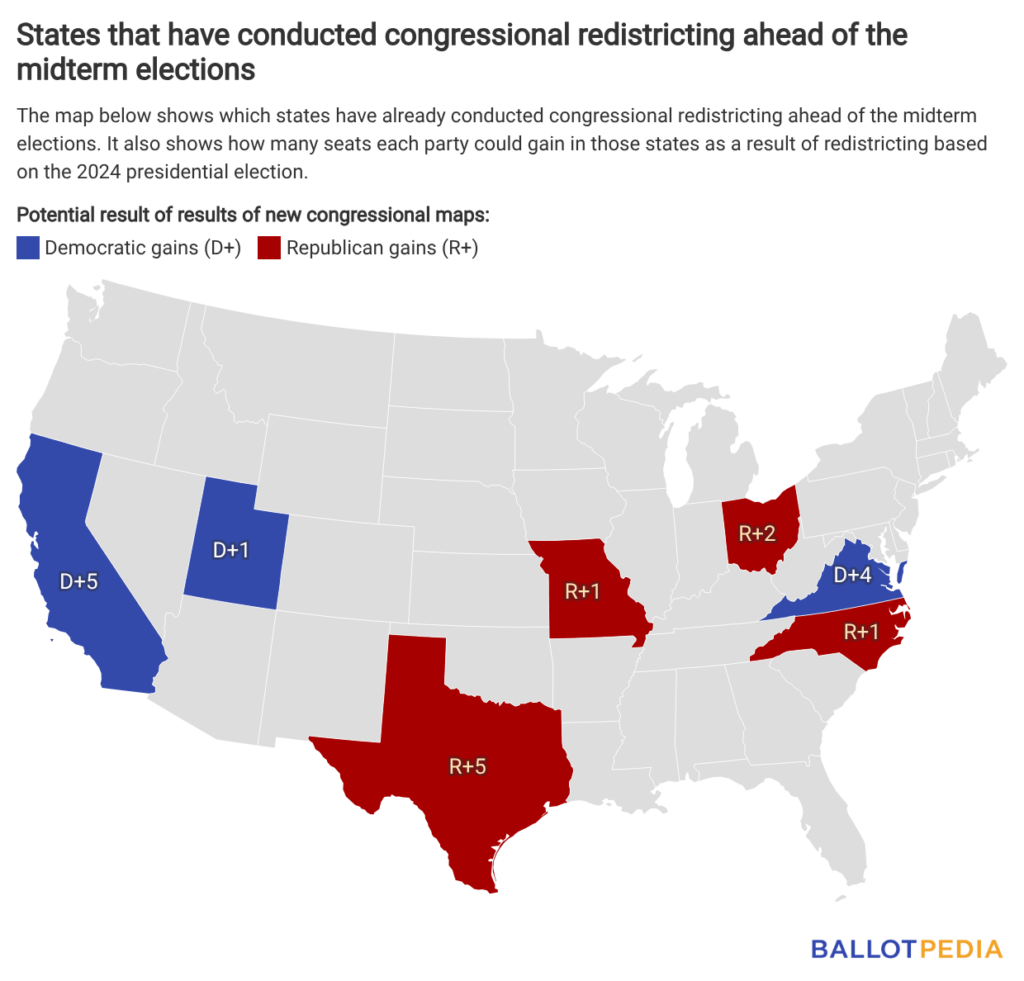
Since California, Missouri, North Carolina, and Texas voluntarily enacted new congressional maps in 2025, the General Assembly will be able to implement the new congressional map that was included as part of House Bill 29.
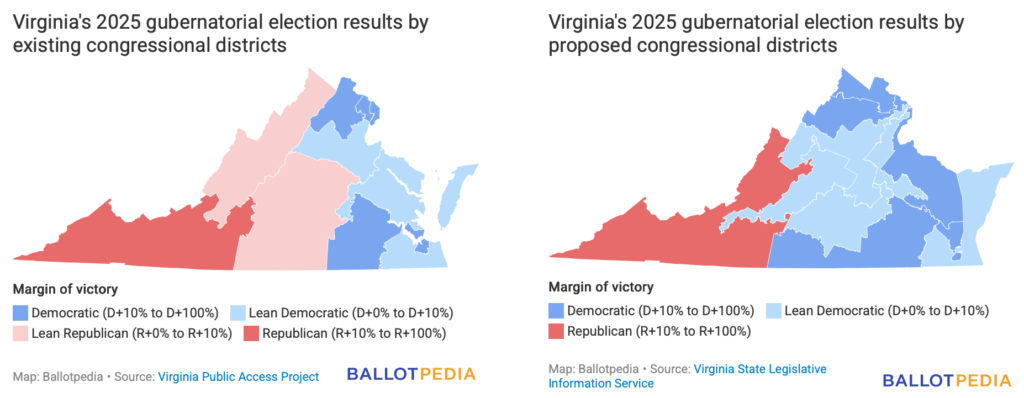
Based on the 2025 Virginia gubernatorial election results, the proposed map shifts four Republican-held congressional districts to be more Democratic. Virginia's current U.S. House delegation has six Democrats and five Republicans. Under the proposed map, and if results mirrored the governor’s race, the delegation could include 10 Democrats and one Republican.
Across Virginia, voter turnout declined by approximately 10.9% in this special election compared to the 2025 gubernatorial election. However, this decline was not uniform across localities. In general, counties and independent cities with higher Democratic vote shares experienced larger drops in turnout, while those that voted more Republican saw smaller declines.
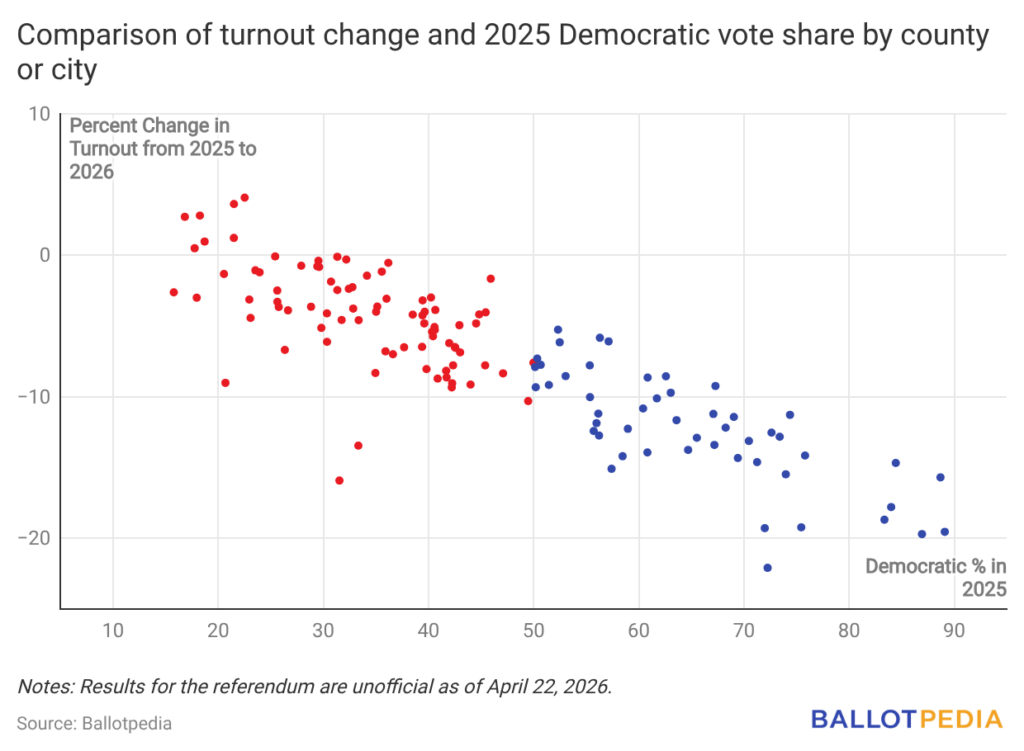
In seven counties in the southwestern part of the state, all of which supported Winsome Earle-Sears (R) in 2025, turnout was higher. The largest increase in turnout, 4.08%, occurred in Patrick County. In Patrick County, Earle-Sears won 77.48% of the vote in the 2025 gubernatorial election, and President Donald Trump (R) won 80.42% of the vote in the 2024 presidential election.
The largest decline occurred in Harrisonburg City, where turnout decreased by 22.1%. In Harrisonburg City, Gov. Abigail Spanberger (D) won 72.25% of the vote, and Kamala Harris (D) won 62.94% of the vote in the 2024 presidential election.
Among counties, excluding independent cities, the largest decline was in Arlington County, where turnout decreased by 17.8%. Arlington County had the highest Democratic vote share in both the 2025 gubernatorial and 2024 presidential elections.
Despite lower overall voter turnout across the state, votes against the amendment won 36,071 more votes than Earle-Sears did in the 2025 gubernatorial election.
Whether the new congressional map can be implemented may depend on the courts. There's currently litigation before the Virginia Supreme Court regarding the amendment. On Oct. 28, 2025, a group of Republican state senators filed a complaint with the Virginia Circuit Court seeking to block the amendment from appearing on the statewide ballot. The complaint stated that the Speaker of the House lacked the authority to convene or expand the scope of the special legislative session in 2025 when the amendment was introduced.
After a series of lower-court rulings and appeals, the Virginia Supreme Court denied a motion to pause the administration of the referendum, stating that it could be put on the ballot for the April 21 special election. The Court said it would hear arguments concerning the validity of the amendment after the election. Final briefs in the case are due on April 23.
Two other lawsuits challenge the ballot question that voters saw on their ballots as misleading and unfair. The ballot question asked voters: “Should the Constitution of Virginia be amended to allow the General Assembly to temporarily adopt new congressional districts to restore fairness in the upcoming elections, while ensuring Virginia’s standard redistricting process resumes for all future redistricting after the 2030 census?”
Ahead of the midterms, California, Missouri, North Carolina, Ohio, and Texas have passed new congressional maps. Litigation also led to a new congressional map in Utah.
Based on the 2024 presidential election results, Virginia's new map and the six other states' new maps could result in Democrats netting one seat.
Click here to read more information on the Virginia Use of Legislative Congressional Redistricting Map Amendment.
Sixteen candidates are running in the June 2 nonpartisan primary for mayor of Los Angeles
Sixteen candidates are running in the June 2 nonpartisan primary for mayor of Los Angeles, California. Incumbent Mayor Karen Bass, Spencer Pratt, and Nithya Raman lead in polling and media attention.
The Los Angeles Times' Julia Wick and David Zahniser write: "Bass appeared to be on the path to an easy reelection, with no serious challengers in sight after a relatively drama-free first two years in office. But that was before a wildfire annihilated swaths of Pacific Palisades, putting Bass’ leadership under a national microscope, and before the city slid into a major financial crisis, with Bass searching for cuts to close a nearly $1-billion budget gap."
Bass was elected mayor on Nov. 8, 2022, defeating real estate developer Rick Caruso 54.8% to 45.2%. Though the city's mayor is nonpartisan, Bass is a Democrat who ran as a progressive, focusing on homelessness and affordable housing.
Pratt starred in the reality television show The Hills and lost his home during the 2025 Palisades wildfire. A registered Republican, he announced his campaign at a rally marking the one-year anniversary of the wildfire.
Raman represents Los Angeles City Council District 4 and is an urban planner. She is a Democrat and has received support from the Democratic Socialists of America in past elections.
The Los Angeles Times' Steve Lopez writes, "Raman is to the left of Bass and the traditional left in Los Angeles. ... Raman’s candidacy — along with DSA candidates for other city offices — makes the election something of a referendum on the evolving center of political clout in L.A.” Pratt is running to the right of Bass, focusing on public safety and crime reduction.
Los Angeles' chapter of the Democratic Socialists of America did not endorse a candidate for the primary election. Endorsements for Bass include both business and labor organizations and the Los Angeles County Democratic Party. Senator Rick Scott (R-Fla.) and Donald Trump's (R) presidential envoy for special missions Richard Grenell endorsed Pratt. Abundant Housing LA and the Future Urbanist Club endorsed Raman.
Bryant Acosta, Rae Chen Huang, Nelson Cheng, Suzy Kim, John Logsdon, Juanita Lopez, Adam Miller, Griselda Diaz, and Misael Ortega are also running in the election.
In Los Angeles, a candidate who wins 50% or more of the vote in a primary wins the election outright. If no candidate does so, the top two vote-getters will advance to the general election on Nov. 3.
There are 22 elections in the top-100 cities in 2026. At the start of 2026, the mayors of 67 of the country's 100 largest cities were affiliated with the Democratic Party. Republicans held 22 mayoral offices, Libertarians held one office, independents held three, and six mayors were nonpartisan. One mayor's partisan affiliation is unknown.
Click here to read more about the nonpartisan primary for mayor of Los Angeles, California. Also, if you're a California voter, check out our Sample Ballot Lookup here to prepare for Election Day.
Sixty-six members of the U.S. Congress have announced they will not seek re-election this year
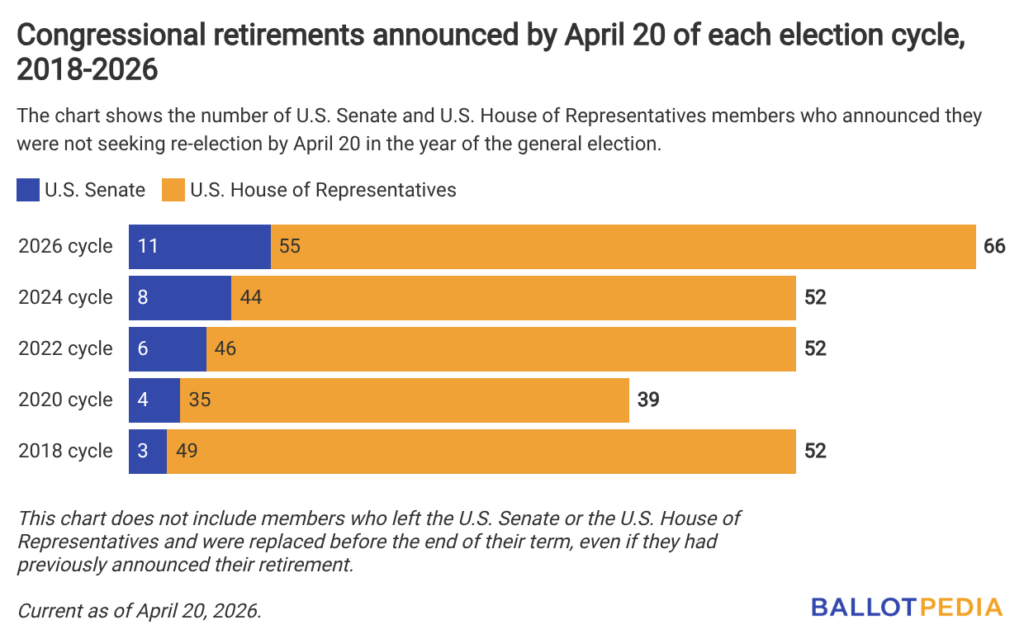
Sixty-six members of the U.S. Congress — 55 U.S. representatives and 11 U.S. senators — have announced they will not seek re-election this year.
Since our March 16 update, one U.S. representative and one U.S. senator announced they will not seek re-election. Here’s a list of how independent election forecasters have rated the 2026 general election for each district and state these incumbents currently represent.
- Sen. Alan Armstrong (R-Okla.) signed an affidavit on March 24 stating that he will not run to represent Oklahoma in the U.S. Senate this year. Election forecasters have rated the election for the seat as either Solid or Safe Republican.
- Rep. Sam Graves (R-Mo.) announced on March 27 that he is retiring from public office. Election forecasters have rated the election for the district as either Solid or Safe Republican.
Armstrong was appointed to succeed Sen. Markwayne Mullin (R-Okla.) in the U.S. Senate. Mullin resigned to serve as Secretary of Homeland Security. Reps. Eric Swalwell (D-Calif.), Tony Gonzales (R-Texas), and Sheila Cherfilus-McCormick (D-Fla.) also resigned from the U.S. House of Representatives. Additionally, Rep. David Scott (D-Ga.) died on April 22. We do not include members who leave office before the end of their term in our analysis of retirements because, in most cases, we expect successors to be sworn in before the next general elections.
U.S. House of Representatives
Fifty-five U.S. representatives — 20 Democrats and 35 Republicans — will not seek re-election in 2026. Of those:
- Twenty-eight — 13 Democrats and 15 Republicans — are retiring from public office
- Sixteen — seven Democrats and nine Republicans — are running for the U.S. Senate
- Ten — all Republicans — are running for governor
- One Republican is running for state attorney general
At this point in the last four election cycles, there were 44 retirement announcements in 2024, 46 in 2022, 35 in 2020, and 49 in 2018.
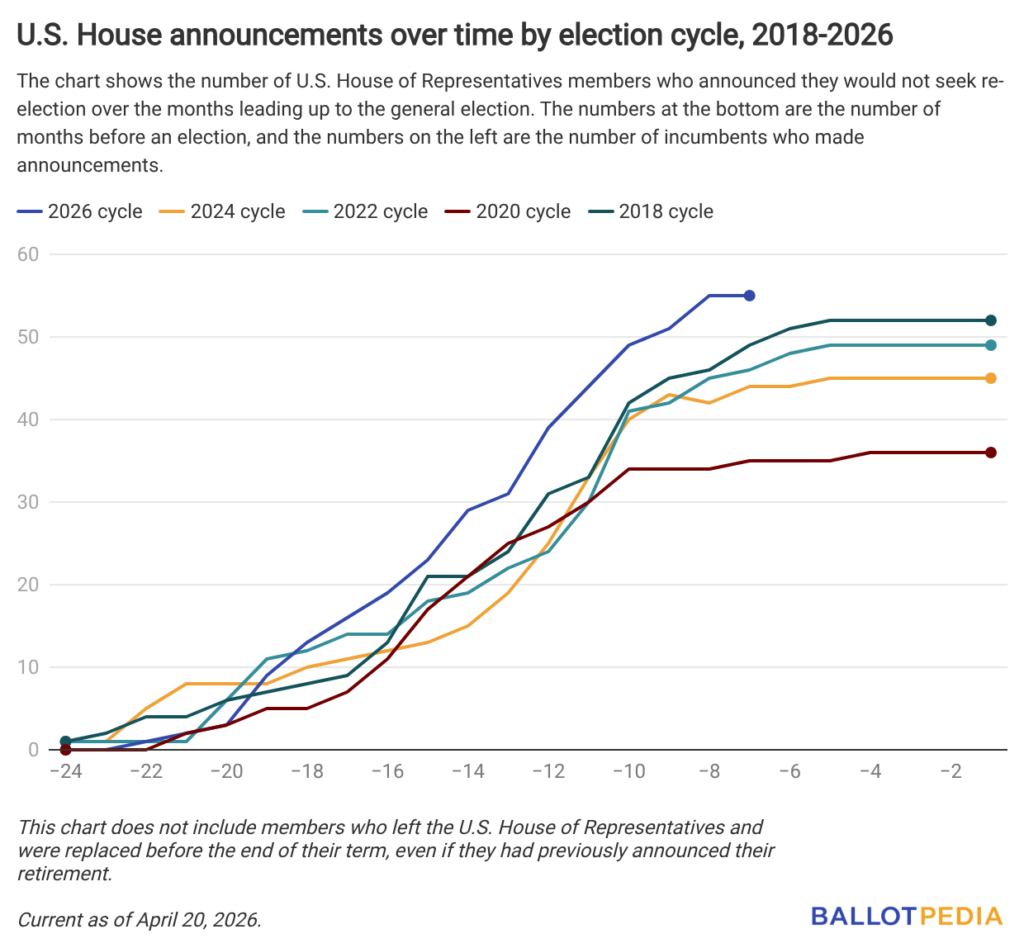
Seven of the 55 retiring U.S. representatives — two Democrats and five Republicans — won by 10 percentage points or fewer in 2024. Three U.S. representatives — Jared Golden (D-Maine), Don Bacon (R-Neb.), and David Schweikert (R-Ariz.) — won by fewer than five percentage points.
U.S. Senate
Eleven U.S. senators — four Democrats and seven Republicans — announced they will not seek re-election in 2026. Ten U.S. senators are retiring from public office, while Sen. Tommy Tuberville (R-Ala.) is running for governor of Alabama.
At this point in the last four election cycles, there were eight retirement announcements in 2024, six in 2022, four in 2020, and three in 2018.
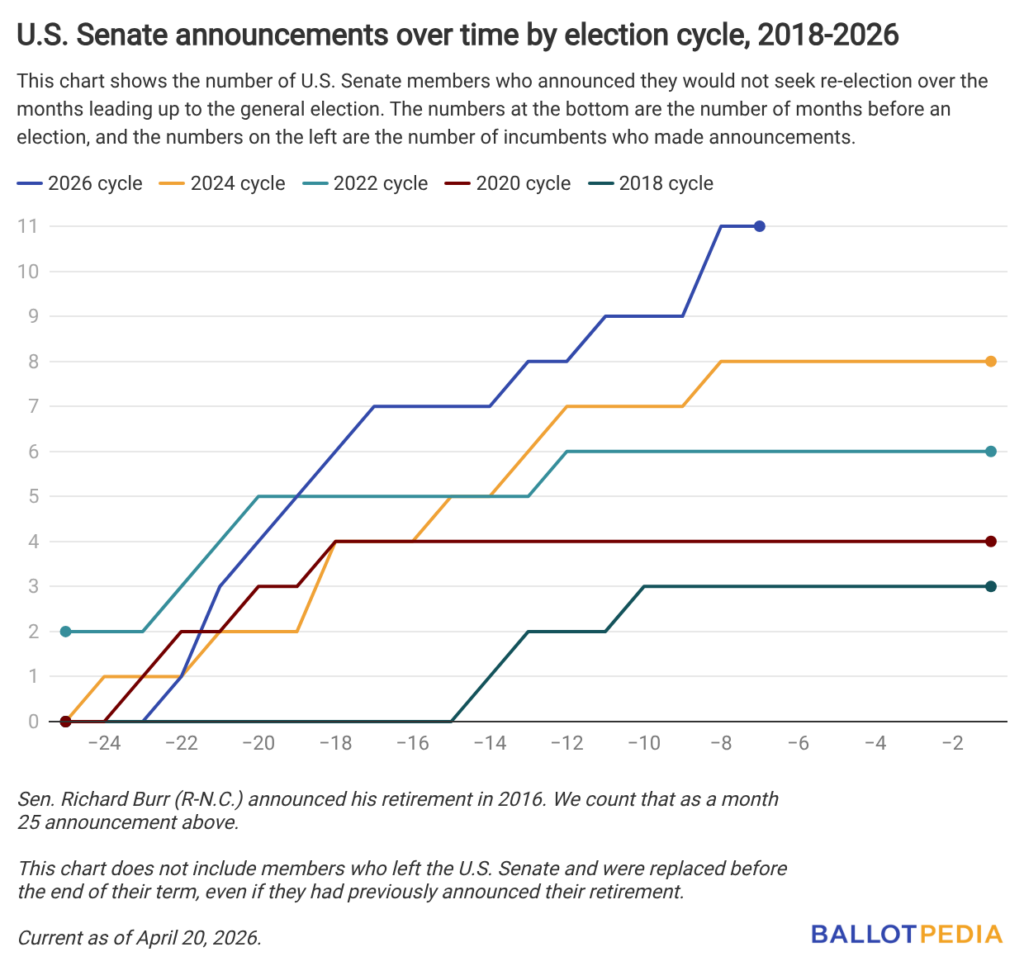
Looking at the last time those 11 U.S. senators ran in 2020, five of them — two Democrats and three Republicans — won by 10 percentage points or less. Sens. Thom Tillis (R-N.C.) and Gary Peters (D-Mich.) won by less than five percentage points.
Click here for a list of all the members of the U.S. Congress who are not seeking re-election this year.