


Welcome to the Monday, April 27, 2026, Brew.
By: Briana Ryan
Here’s what’s in store for you as you start your day:
- DLCC and RSLC targeting 30 of the same chambers in the 2026 state legislative elections
- Missouri voters to decide on a constitutional amendment to phase out and eliminate the state income tax
- Senate Democrats introduce a bill to repeal the federal education tax credit scholarship
DLCC and RSLC targeting 30 of the same chambers in the 2026 state legislative elections
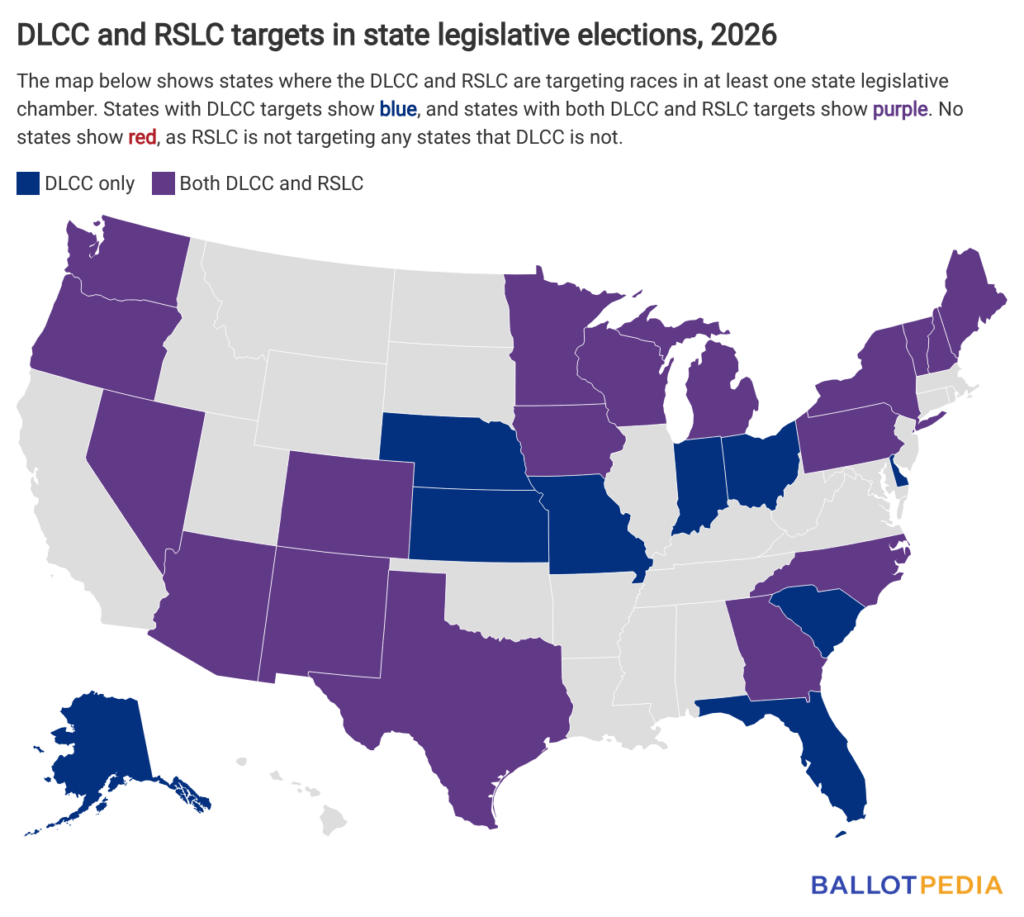
This year, the Democratic Legislative Campaign Committee (DLCC) and the Republican State Leadership Committee (RSLC) — the parties’ national campaign arms for state legislatures — are focusing on the same 30 chambers. In total, the DLCC will target 43 chambers, and the RSLC will target 35 chambers.
Ahead of this year’s state legislative elections, Republicans control a total of 57 chambers, and Democrats control a total of 39 chambers. The Alaska Senate and Alaska House are organized under multipartisan, power-sharing coalitions. The Minnesota House is evenly split between both parties.
Of the 88 chambers that are up for election this year, Democrats control 34 chambers and Republicans control 51. Of the 42 states where both chambers are up for election this year, Republicans control both chambers in 23 states, and Democrats control both chambers in 15 states.
The DLCC’s official website called this year’s elections “a historic opportunity to fundamentally shift the state legislative balance of power.” RSLC President Edith Jorge-Tuñón wrote, “Success this cycle will not be defined by sweeping gains, but by whether state Republicans can withstand sustained pressure in the most competitive districts.”
Democratic Legislative Campaign Committee (DLCC)
This year, the DLCC is seeking to gain control of both legislative chambers in Arizona, New Hampshire, and Wisconsin. They are also looking to gain control of the Michigan House and Minnesota House.
On the other hand, the DLCC is defending the Michigan Senate, the Minnesota Senate, and the Pennsylvania House.
The DLCC is also seeking to strengthen their coalitions in both chambers in Alaska. Currently, there are 11 Republicans and nine Democrats in the state Senate and 21 Republicans and 14 Democrats in the state House.
In terms of supermajorities, the DLCC sees the following chambers as possible gains: the Delaware House, Nevada House, New Mexico House, New York Senate, Oregon Senate, and Washington House. Both legislative chambers in Colorado and Vermont are also seen as opportunities to create Democratic supermajorities.
On the other hand, the DLCC is seeking to break Republican supermajorities in the Kansas House, North Carolina Senate, Ohio House, and South Carolina House. They are also seeking to break Republican supermajorities in both legislative chambers in Florida, Indiana, Iowa, and Missouri. The DLCC is also seeking to prevent the North Carolina House from becoming a Republican supermajority.
Finally, the DLCC is seeking to gain seats in the Nebraska Senate, Pennsylvania Senate, and Texas House. They are also aiming to pick up seats in both legislative chambers in Georgia and Maine.
Republican State Leadership Committee (RSLC)
This year, the RSLC is defending Republican majorities in both legislative chambers in Arizona, Georgia, Iowa, New Hampshire, North Carolina, Texas, and Wisconsin.
The RSLC is also seeking to compete for control of split legislatures in three states: Michigan, Minnesota, and Pennsylvania. Currently, Republicans have majorities in the Michigan House and Pennsylvania Senate. Democrats have majorities in the Michigan Senate, Minnesota Senate, and Pennsylvania House. As we mentioned above, the Minnesota House is evenly split between both parties.
Finally, the RSLC sees opportunities to pick up seats in both legislative chambers in Colorado, Maine, Nevada, New York, Oregon, Vermont, and Washington. They are also seeking to pick up seats in the New Mexico House. Currently, Democrats have majorities in all of those legislative chambers.
Historical context
The same 88 state legislative chambers up for election this year were up for election in 2022. In those midterm elections, which occurred following the 2020 presidential election, Democrats gained control of four chambers from Republicans — the Michigan House and Senate, Minnesota Senate, and Pennsylvania House.
Republicans had a net gain of 27 seats nationwide as a result of the 2022 state legislative elections. That included three seats created in Wyoming during the 2020 redistricting process. Democrats had a net loss of four seats in 2022, and independents and minor party officeholders lost 20 seats.
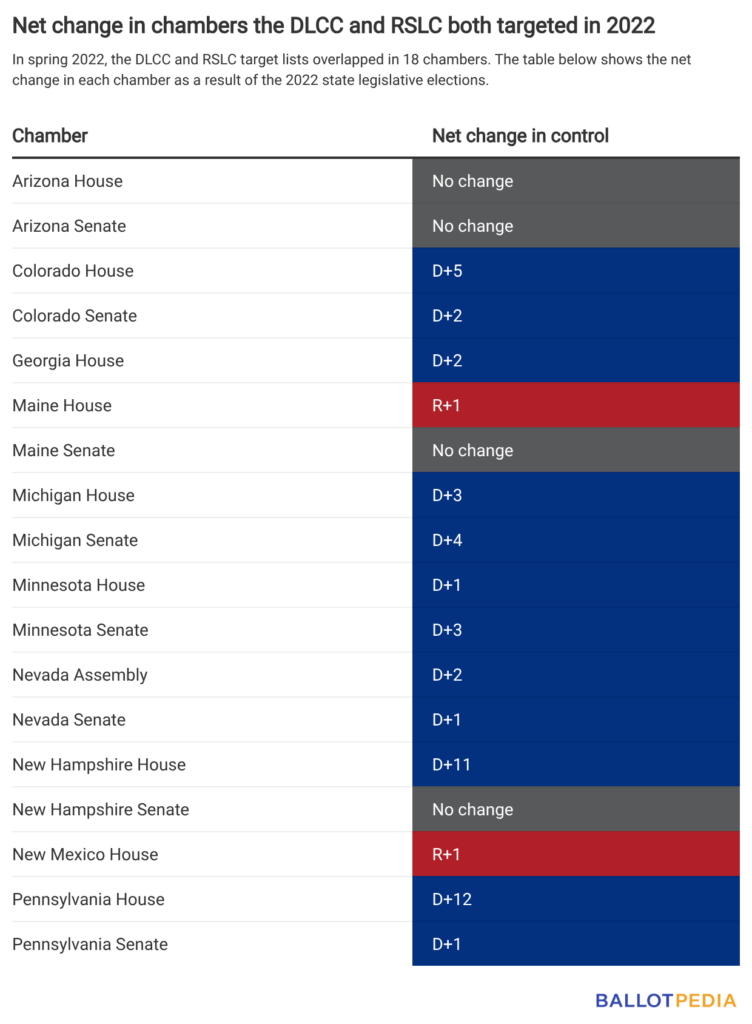
However, among the 18 state legislative chambers that both the DLCC and RSLC targeted in 2022, Democrats net 45 seats. Both groups are targeting state legislative races in the states listed below again in 2026.
Click here to learn more about this year’s state legislative elections.
Missouri voters to decide on a constitutional amendment to phase out and eliminate the state income tax
On April 21, the Missouri General Assembly voted to put a constitutional amendment on the ballot that would require lawmakers to phase out and eliminate the state income tax. Missouri Gov. Mike Kehoe (R) has until May 22 to decide whether the amendment will appear on the Aug. 4 ballot or the Nov. 3 ballot.
On Jan. 21, Rep. Bishop Davidson (R) introduced the constitutional amendment as House Joint Resolutions 173 & 174 in the Missouri House of Representatives. Among legislators, 0% of Democrats and 90.4% of Republicans voted in favor of the measure. Using the Partisan Direction Index (PDI) formula, which measures the partisan support behind the measure, this results in a score of 90.4%, which is classified as Republican. This classification means that the measure received mostly or entirely Republican support and little or no Democratic support.
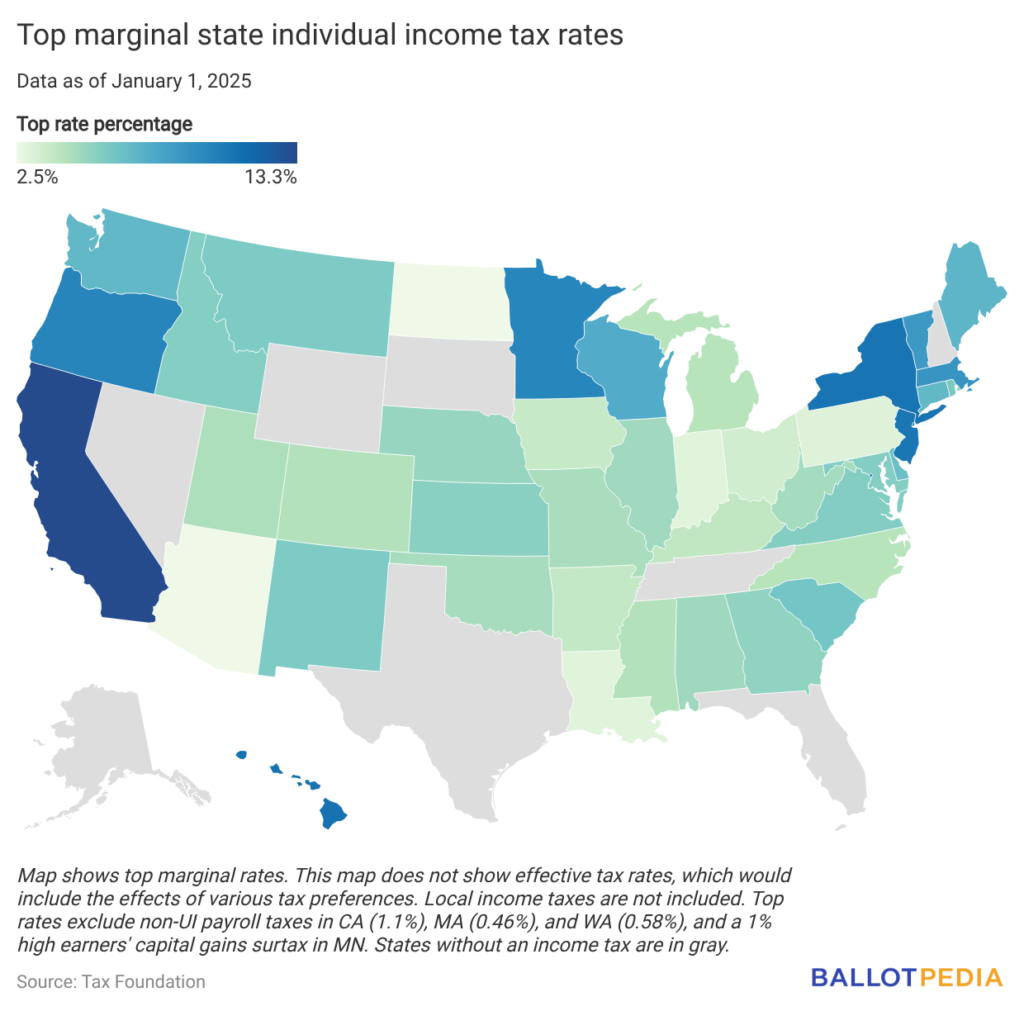
Missouri has a graduated income tax with a top rate of 4.7%. The state sales tax is 4.225%. However, local sales taxes, including county and city taxes, mean that combined sales taxes are higher. According to the Tax Foundation, Missouri has an average combined state and local sales tax rate of 8.41%.
The amendment would require the General Assembly to reduce the state individual income tax based on revenue growth until the tax is eliminated, and would prohibit future state income taxes once it is eliminated. It would also require reductions in personal property and other local taxes to offset revenue from any expansion of sales and use taxes, while prohibiting reductions in funding for public schools.
The amendment would allow the General Assembly to expand sales and use taxes if the changes are used to reduce and eliminate the income tax. However, it would prohibit applying those taxes to services or transactions that were not taxed as of Jan. 1, 2015. In 2016, Missouri voters approved Amendment 4 57% to 43%, which prohibited certain new state sales or use taxes.
The original measure included a framework for eliminating the state income tax, including a 0.01% reduction in the state income tax per $20 million increase in revenue and an automatic elimination of the state income tax if the rate fell below 1.4%. The state Senate-amended version removed those provisions and replaced them with a requirement that lawmakers must enact laws to phase out and eliminate the income tax based on revenue growth.
Forty-two states — including Washington, which taxes personal income over $1 million — and Washington, D.C., have a state income tax, while eight states do not have one. Florida, Tennessee, and Texas have constitutional bans on personal income tax. South Dakota law also bans a state income tax, but it is not part of the state constitution.
Click here for more information on the Missouri Income Tax Elimination and Sales Tax Changes Amendment.
Senate Democrats introduce a bill to repeal the federal education tax credit scholarship
On April 15, U.S. Sen. Mark Kelly (D-Ariz.) introduced S. 4297 to repeal the provisions in the One Big Beautiful Bill Act (OBBBA) that established the federal education tax credit scholarship program, also known as the Education Freedom Tax Credit. The bill, titled the Keep Public Funds in Public Schools Act, has 29 Democratic and two Independent cosponsors. The measure was referred to the Senate Committee on Finance.
The federal education tax credit scholarship program requires states to opt in. Five Democratic governors have vetoed bills to opt into the program, with two legislatures — in Kansas and Kentucky — overriding the vetoes to require the state to participate. The Kansas Legislature and the Kentucky General Assembly have Republican majorities. One Democratic governor, Colorado's Jared Polis, opted into the program.
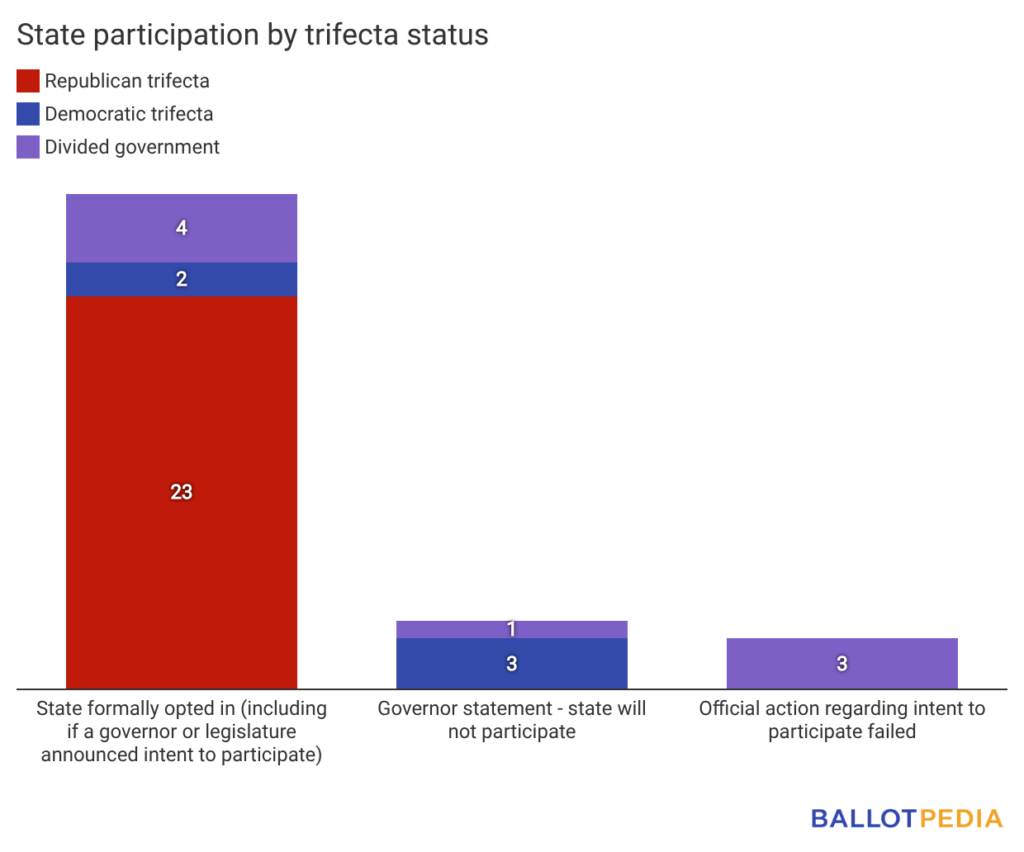
At least 29 states have officially opted into the program, 23 of which have a Republican trifecta. Four states with divided governments — Alaska, Kansas, Kentucky, and Nevada — have opted in. Two states with Democratic trifectas — Colorado and Virginia — opted in. Former Virginia Gov. Glenn Youngkin (R) opted into the program in January 2026, shortly before Gov. Abigail Spanberger (D) took office.
About the program
The federal school choice tax credit scholarship is a nonrefundable tax credit, allowing individuals to receive federal tax credits for donations up to $1,700 to authorized scholarship-granting organizations (SGOs). It is a dollar-for-dollar nonrefundable tax credit, meaning individuals can lower their federal tax liability by $1 for every $1 donated to accredited SGOs. If a taxpayer donates more than $1,700, they will not receive a tax refund for the amount over $1,700. The total amount of credits the program can offer is not capped.
SGOs distribute the donated scholarship funds to eligible families, which can be used on a variety of private or public educational expenses, including private school tuition, tutoring services, textbooks, and more. To qualify for scholarships, students had to live in households earning no more than 300% of the area's median gross income and be eligible to enroll in K-12 schools. The program will take effect on Jan. 1, 2027.
States that elect to participate must submit a list of SGOs that taxpayers can donate to in order to receive the federal tax credit. Students in states that do not opt in cannot receive scholarships funded under the program, but donors in those states can still receive a federal tax credit by donating to SGOs in participating states. As enacted, the program will not affect state budgets.
Responses to the program
U.S. Sen. Bill Cassidy (R-La.), who authored portions of the legislative text establishing the program, said when it passed, "Parents should decide where their kids go to school. This bill helps them do that. I am grateful to see President Trump sign the first federal school choice bill into law as a part of the One, Big, Beautiful Bill.”
U.S. Sen. Mazie Hirono (D-Hawaii) said, "As the Trump administration continues its all-out, coordinated attack on public education, its newly-created national school voucher program will harm our public schools by diverting critical resources that could otherwise be used to support students."
Click here to read more about the program, and here for more about state participation in the program.