


Welcome to Ballot Bulletin: Ballotpedia's Weekly Election Policy Digest. Every Tuesday, we deliver the latest updates on election policy around the country, including nationwide trends and recent legislative activity.
In this week’s edition, we cover 248 bills state legislatures acted on last week and look at noteworthy election-related legislation enacted in Virginia.
The state of election legislation in the U.S.
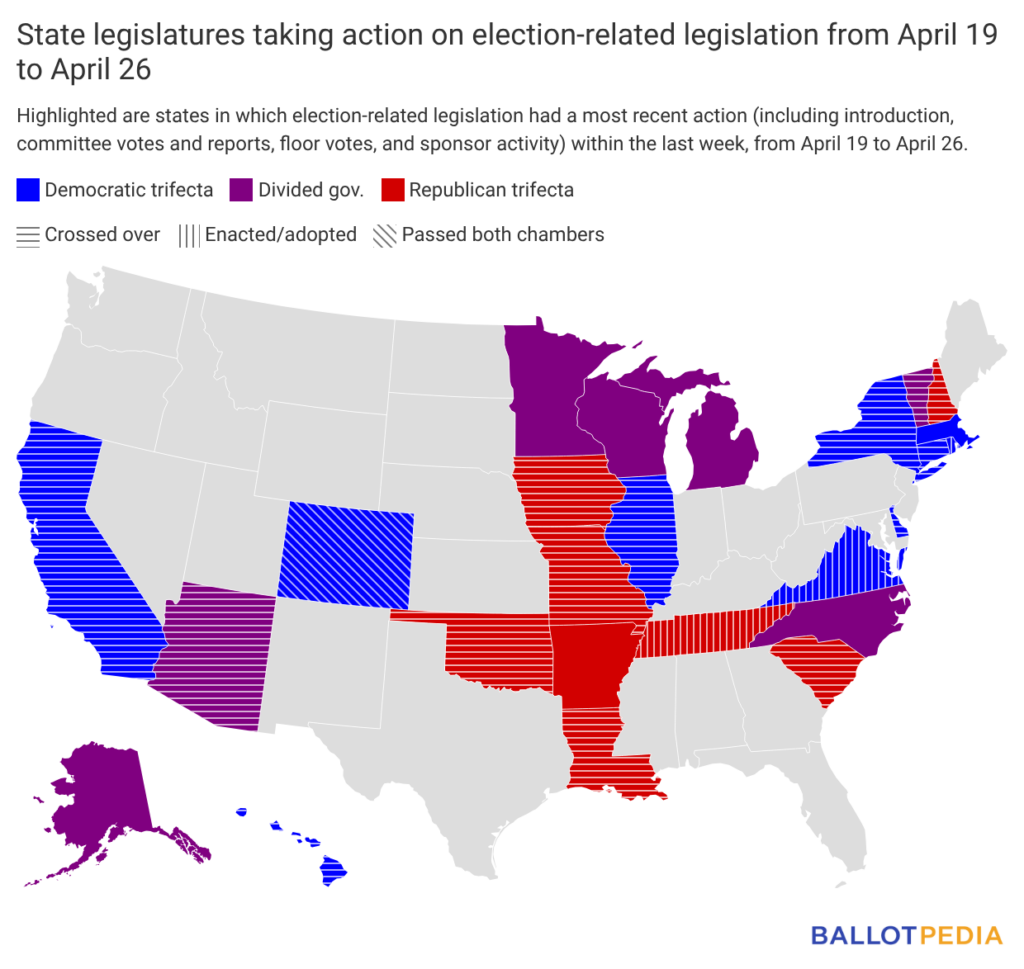
Lawmakers in 25 states acted on 248 election-related bills last week. Twenty-eight state legislatures are in regular or special sessions. Last week, 20 bills were enacted, one bill passed both chambers of a state legislature, and no bills were vetoed.
Of the bills acted on last week, 147 (59.3%) are in states with Democratic trifectas, 70 (28.2%) are in states with Republican trifectas, and 31 (12.5%) are in states with divided government. The most active bill categories last week were ballot measures (69), campaign finance (69), election types and stages (65), and Election Day voting (53).
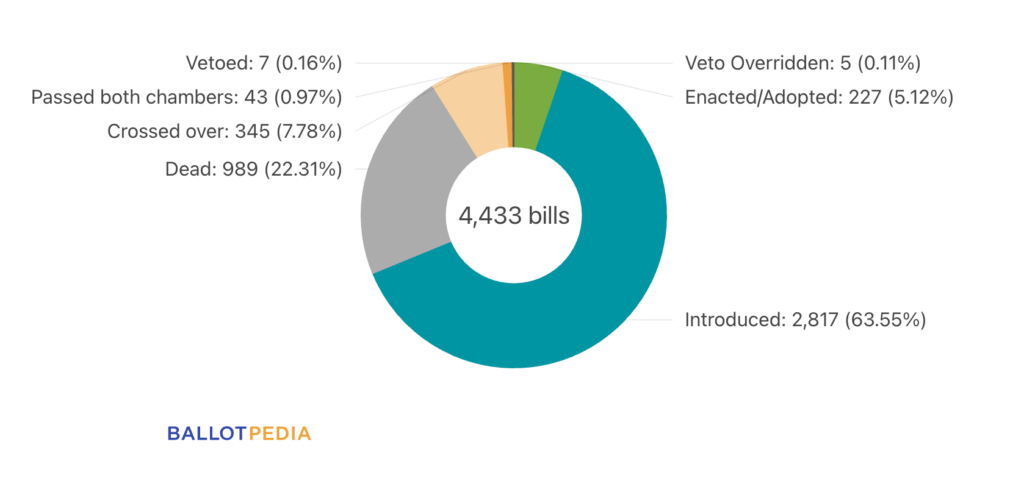
We are currently tracking 4,433 election-related bills across the country. The chart below breaks down the status of those bills by where they stand in the legislative process:
Enacted bills
On April 20, Rhode Island Gov. Daniel McKee (D) signed S 2417 into law. It requires a primary election to be held on the Wednesday following Labor Day if the eighth Tuesday before the general election is the day after Labor Day. Under previous law, primary elections had to be held on the eighth Tuesday preceding biennial state elections. Following the bill’s enactment, Rhode Island party primaries will take place on Wednesday, Sept. 9, 2026.
On April 22, Virginia Gov. Abigail Spanberger (D) approved HB 215 and SB 176, after the General Assembly adopted her recommendations the same day. HB 215 requires the commissioner of elections, before entering into, terminating, or modifying a memorandum of understanding with a third party for the exchange of voter registration data, to submit the proposal to the State Board of Elections for review and approval by a two-thirds vote. The bill does not apply to data sharing agreements between the Department of Elections and entities required by law to exchange data to operate and maintain the Virginia voter registration system. HB 215 also requires the commissioner to submit an application to join the Electronic Registration Information Center (ERIC).
SB 176 permits the use of ranked-choice voting (RCV) to elect members of any local governing body in Virginia, not just county board of supervisors or city council elections. It also requires a locality that decides to use RCV to notify the State Board of Elections, which must assess the technical feasibility of RCV in that locality within 10 days of receiving the decision.
Seventeen other bills were enacted or adopted last week:
- Rhode Island (Democratic trifecta)
- Tennessee (Republican trifecta)
- Virginia (Democratic trifecta)
Bills passing both chambers
One bill passed both chambers last week:
- Colorado (Democratic trifecta)
To see a full list of bills awaiting gubernatorial action, click here.
Vetoed bills
No election-related bills were vetoed last week. To see a list of all bills vetoed this session, click here.
All bills
The chart below shows all bills Ballotpedia is currently tracking, broken down by partisan sponsorship:
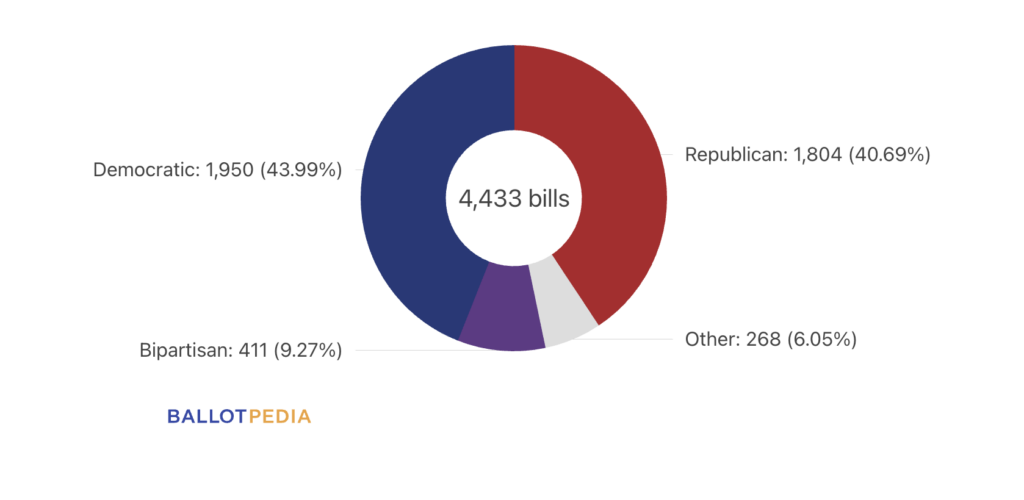
We are currently following 4,433 election-related bills, including bills carried over from the previous year.
- Trifecta status
- Democratic: 1,901 (42.9%)
- Republican: 1,621 (36.6%)
- Divided: 911 (20.6%)
- Partisan sponsorship
- Democratic: 1,950 (44%)
- Republican: 1,804 (40.7%)
- Bipartisan: 411 (9.3%)
- Other: 268 (6%)
In the news
There are at least five pending lawsuits related to mid-decade redistricting in Virginia. Here are three developments from last week:
- On April 27, the Supreme Court of Virginia heard oral arguments in a lawsuit regarding Virginia voters’ approval of a constitutional amendment to permit mid-decade redistricting. The arguments centered on whether the General Assembly followed procedural rules for submitting a constitutional amendment to voters. Legally, the General Assembly must approve a resolution for a constitutional amendment in two successive legislative sessions with a general election in between. The plaintiffs in the case said that because the first vote on the resolution took place in October 2025 during early voting, this requirement was not met. The state said that the General Assembly complied with procedural requirements because the resolution had to be passed before election day itself, not before the entire voting period began.
- On April 26, the Circuit Court of the City of Richmond denied the Republican National Committee’s motion for a preliminary injunction in Republican National Committee v. Virginia State Board of Elections. In its lawsuit, the RNC said that the redistricting resolution the Virginia General Assembly passed and the constitutional amendment the voters approved in the April 21 referendum violated the district compactness requirement in the state constitution. In its opinion, the court found that the General Assembly’s power to pass legislation is plenary and that “the issue of compactness is fairly debatable.”
- After the constitutional amendment was approved by voters in the April 21 special election, Tazewell Circuit Court Judge Jack Hurley issued a final judgment finding all votes cast in the election invalid. In the court’s judgment issued April 22, Hurley wrote that HJR 6007 referring the constitutional amendment to voters is void because it violates Art. XII of the state constitution governing the amendment process. He also wrote that the legislation scheduling the special election is void because it “submits to the voters a flagrantly misleading question.” State officials appealed the ruling on April 23.
Here are other news stories from across the country:
- On April 21, voting rights groups filed a complaint in the U.S. District Court for the District of Columbia to block the U.S. Department of Justice’s (DOJ) requests for unredacted statewide voter lists. In the complaint, the plaintiffs said that the DOJ’s attempt to create “a sprawling new voter surveillance and purging apparatus” is unconstitutional, as it lacks statutory authorization and “seeks to federalize voter list maintenance, a responsibility that our Constitution and federal statutes entrust to the States.”
- On April 23, Oregon Attorney General Dan Rayfield (D) joined AGs from 23 other states in challenging President Donald Trump’s (R) March 31 executive order requiring the United States Postal Service to mail absentee/mail-in ballots only to voters on an approved list, among other provisions. In the motion for summary judgment in the U.S. District Court for the District of Massachusetts, Rayfield and other state attorneys general said that the executive order “violates the constitutional separation of powers, and effects an unconstitutional commandeering of States’ resources.”
- On April 24, California Secretary of State Shirley Weber (D) announced that an initiative to require government-issued identification at the polls collected a sufficient number of signatures to make the Nov. 3 general election ballot. Supporters of the initiative said that it would restore integrity to California elections, while opponents said that it would suppress the voter turnout of individuals lacking ID, who are disproportionately poor or racial and ethnic minorities.
Policy spotlight: Virginia’s new Democratic trifecta enacted more election-related bills than other states so far this year
The story below is adapted from a recent Ballotpedia News story by Andrew Bahl.
Virginia has enacted more election-related bills than any other state so far this year, including several notable pieces of legislation.
The 2026 session was the first time in five years that Virginia had a Democratic trifecta — with Democrats controlling both chambers of the General Assembly and the governor’s office — following Gov. Abigail Spanberger's (D) election in November 2025.
Spanberger signed 31 election-related bills in March and April and returned an additional 22 bills to legislators with suggested amendments. The General Assembly approved her amendments to 17 of those bills on April 22. As of April 27, lawmakers had not considered five bills.
The 48 election-related bills enacted in Virginia so far this session exceed the total number of bills enacted in all other Democratic trifecta states combined.
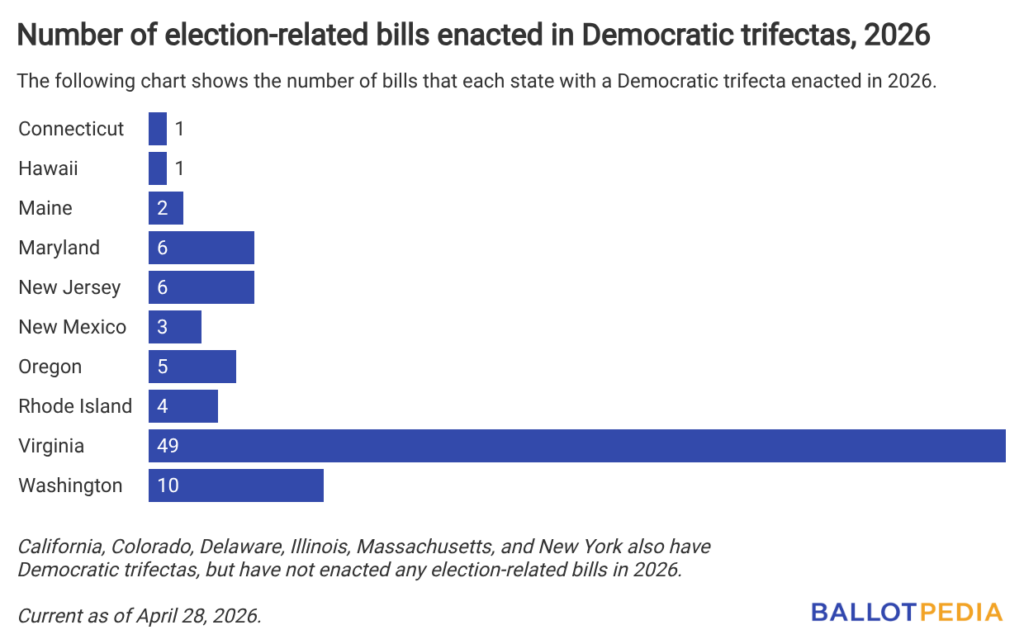
Some of the bills enacted in Virginia are similar to those advanced in other Democratic trifecta states this year. Virginia was one of two Democratic trifecta states, along with Maryland, to advance mid-decade redistricting legislation.
Virginia is also one of four Democratic trifecta states, along with California, Colorado, and Maryland, to advance legislation related to voting rights for individuals convicted of a felony.
Currently, Virginia has no mechanism for automatically restoring voting rights for individuals convicted of a felony. Instead, people must apply for restoration to the governor's office upon completion of their sentence, including any prison time, parole, or probation. Some governors have historically used their authority to automatically restore voting rights to thousands of people with felony convictions upon completion of their sentences.
Legislators referred HJR 2, a constitutional amendment that would automatically restore voting rights for individuals convicted of a felony upon completion of their sentence. Two other bills, HB 964 and SB 164, would implement the policy if the constitutional amendment is approved.
Virginia lawmakers also enacted legislation that was unique among Democratic trifecta states this year.
On April 13, Spanberger signed HB 965 and SB 322, which require Virginia to join the National Popular Vote Interstate Compact, an initiative in which member states agree to award their Electoral College votes to the presidential ticket that receives the most votes nationwide. Virginia was the only Democratic trifecta state that had not previously joined the NPVIC.
Virginia was also one of three Democratic trifecta states that were not members of the Electronic Registration Information Center (ERIC). ERIC is a nonprofit organization of member states that shares information to assist in voter list maintenance. Virginia was formerly a member of ERIC but withdrew in 2023, under former Gov. Glenn Youngkin (R).
Under SB 57 and HB 215, Virginia will be required to rejoin ERIC and ensure its membership remains in good standing. HB 215 also sets out future requirements for joining or terminating a data-sharing agreement with a third-party organization. Spanberger signed SB 57 on April 13 and approved HB 215 on April 22.
In 2025, the Democratic-controlled General Assembly sent 16 election-related bills to Youngkin, which he vetoed. Spanberger vetoed one election-related bill in 2026, SB 661, which would have legalized skill games in Virginia and allowed municipalities to hold referendums on prohibiting skill games locally.
In 2025, when the state had a divided government, lawmakers enacted 11 election-related bills.
Click here for more information on election policy in Virginia.