


Welcome to Hall Pass, a newsletter written to keep you plugged into the conversations driving school board governance, the politics surrounding it, and education policy.
In today’s edition, you’ll find:
- On the issues: The debate over standards-based grading
- School board filing deadlines, election results, and recall certifications
- Alabama moves to allow for the consolidation of school districts
- Extracurricular: education news from around the web
- Candidate Connection survey
Reply to this email to share reactions or story ideas!
On the issues: The debate over standards-based grading
In this section, we curate reporting, analysis, and commentary on the issues school board members deliberate when they set out to offer the best education possible in their district. Missed an issue? Click here to see the previous education debates we’ve covered.
Last week, we covered debates over no-zero grading policies. This week, we're diving into debates over another grading policy: standards-based grading. Instead of assigning letter grades for assignments or tests, teachers who use standards-based grading evaluate students on their mastery of learning standards. Students receive a 1-4 score based on whether they mastered a specific concept. For example, a student might receive a level three for the standard "I can find the difference between two two-digit numbers," but a level two for "I can find the quotient of two two-digit numbers."
Each K-12 course can have multiple standards. Under standards-based grading, students receive more than one grade for each course, each grade corresponding to a standard.
Lisa Westman, a former teacher and instructional coach, says that standards-based grading can provide a more detailed account of student learning when naming student mastery for each learning standard, rather than reporting that a student earned an "A" or "B" in a math or English course. She says that standards-based grading is less subjective than traditional grading.
Anthony Reibel, Director of Research and Evaluation at Adlai Stevenson High School in Lincolnshire, Illinois, says that standards-based grading prioritizes mastery of content standards over developing enduring skills and abilities. He says that many pitfalls of traditional grading on an A-F, 100-point scale — including lack of uniformity across instructors and the possibility that grades only reflect short-term knowledge rather than deep understanding or competence — still apply with standards-based grading.
Standards-Based Grading Made My Kid Average | Lisa Westman, Education Week
"Traditional grades give the facade of understanding because they use familiar words and measures. Consider a report card that lists: Math: A, Reading: B+. Parents understand the words math and reading. They understand that an A is the highest grade and a B is close to an A. But, the reality is, this communication does not actually tell parents anything about what was learned. Math and reading are too broad of categories to offer any insight and the letter grades could mean a variety of things, many of which have nothing to do with reading or math.
…
"[A]n A-F system creates a facade of objectivity. Using a percentage attached to a letter (93% = A) feels objective. But, what isn’t necessarily objective are the tools used to garner those scores. When I taught English, I often struggled to determine the critical difference between an 89% and a 90% on a student’s narrative writing assignment. When I taught social studies, I assumed the multiple choice tests I created were completely objective due to the right/wrong nature of the questions. I didn’t consider, however, the inherent bias of the questions since I had written them."
Is Standards-Based Grading The Best Solution? | Anthony Reibel, Solution Tree
"Students can earn high grades with last-minute studying and over-scaffolded instruction, but this is often an illusion of mastery (Brookhart, 1993; Brown et al., 2014). Thus, grades may reflect only short-term knowledge rather than deep understanding or competence. [Standards-based grading (SBG)] perpetuates this illusion by prioritizing content standards over developing enduring skills and abilities. Grades should represent rooted understanding and abilities, not temporary remembering.
…
"While SBG aligns grading with standards, it often prioritizes content standards over skill standards (Colby, 2019). For example, standards like 'use evidence to support a claim about the main characters in To Kill a Mockingbird' or 'complete the square to rewrite quadratic equations in vertex form' isolate the learning of content knowledge rather than learning content knowledge through skill mastery performances (Bandura 1997, 2023; Brown et al., 2014)."
School board update: filing deadlines, election results, and recall certifications
In 2026, Ballotpedia will cover elections for more than 30,000 school board seats. We’re expanding our coverage each year with our eye on covering the country’s more than 80,000 school board seats.
Upcoming school board elections
Ballotpedia’s staff is covering school board elections for 160 seats in 104 districts in the next 30 days.
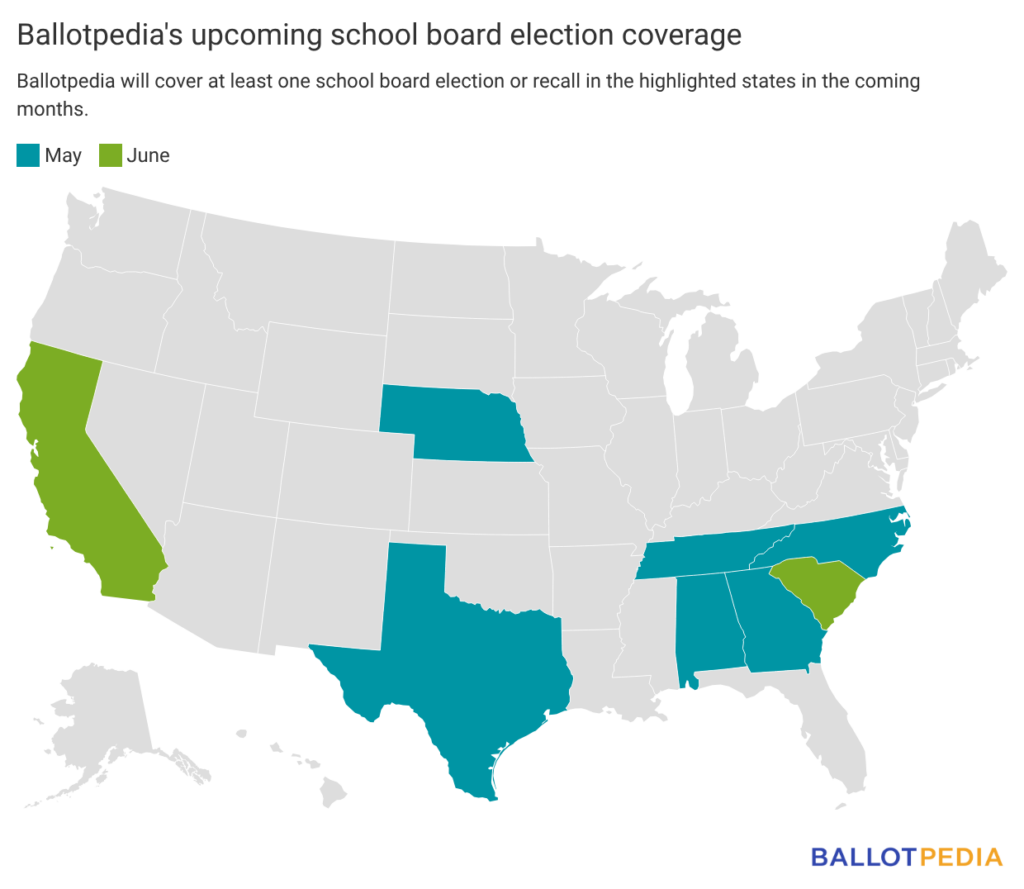
Watch future editions of Hall Pass for the following May primary and general election results:
- Texas - Primaries in 37 districts on May 2.
- Tennessee - Primaries in seven districts on May 5.
- Nebraska - Primaries in six districts and a general election in one district on May 12.
- North Carolina - Primary run-offs in four districts on May 12.
- Alabama - Primaries in two districts on May 19.
- Georgia - Primaries in four districts and general elections in six districts on May 19.
Alabama moves to allow for the consolidation of school districts
In April, the Alabama Legislature approved one bill and put one measure on the Nov. 3, 2026, ballot to authorize, but not require, two types of school districts to consolidate.
Alabama has county school districts, independent city school districts, and specialized school districts. The bill authorizes the consolidation of city school districts. The ballot measure, if approved by voters in Nov., would authorize the consolidation of county school districts.
On April 17, Alabama Gov. Kay Ivey (R) signed House Bill (HB) 178, which authorizes city school districts to consolidate if they share a border or corner point. To consolidate, all districts involved must adopt a formal resolution. After they adopt the resolutions, HB 178 allows residents within any school system proposed for consolidation to submit an initiative within 30 days after the adoption of the consolidation resolution. At least 25% of the qualified electors residing within the boundaries of the school systems that the proposal would affect must sign the initiative. If residents submit enough signatures to their district's school board, voters in each county the proposal would affect must approve the consolidation in a majority vote at the next general election.
Earlier in the month, the Alabama Legislature passed HB 380, which referred a constitutional amendment to the Nov. 3, 2026, statewide general election ballot. Through the measure, voters will decide whether to establish a process for consolidating county school districts that share a border or corner point in the state constitution. The amendment would require the Alabama State Board of Education to study the effect of the consolidation proposals. It includes the same process established by HB 178, allowing residents to vote on county district consolidation.
Current law authorizes two county school districts to consolidate individual schools across county school districts. It also authorizes a city and a county school district to consolidate. HB 178 and HB 380 aim to extend the authorization to different types of school districts as enrollment declines and smaller districts face funding shortfalls.
Both bills, HB 178 and HB 380, passed with bipartisan support. The Alabama House passed HB 178 104-0, and the Senate passed it 32-0. The Alabama Senate passed HB 380 30-0, with 5 not voting, and in the House, two Democrats opposed HB 380, while 24 Democrats joined 72 Republicans to support it. Seven representatives did not vote on HB 380.
Alabama House Education Budget Committee Chairman Danny Garrett (R) said HB 178 will give smaller districts more financial flexibility. "They need to stretch the dollars they get further ... So it’s possible that there may be two cities that realize together they might have more money to put into the classroom and more money for what they need.”
Rep. Curtis Travis (D) said he is concerned about how consolidation would affect the balance of schools in neighboring districts, though he did not vote against the measure.
About Alabama school districts
Alabama has county school districts, independent city school districts, and specialized school districts, including charter districts and state-run schools. According to the National Center for Education Statistics (NCES), Alabama had 161 school districts in the 2024-2025 school year, 67 of which were county school districts. Seventy-three were city school districts, and the remaining districts were either state-run schools or charter districts.
Debates about school district consolidation
National debates about school district consolidation generally center around using public school funding efficiently and the effect of consolidation on rural districts.
Some, including Wisconsin State Rep. Cindi Duchow (R), say school district consolidation is a way to address declining public school enrollment. She said, "We have some schools that are currently at 40 percent capacity in their buildings; by consolidating or closing schools, we can bring them all up to capacity."
Writing for the Illinois Policy Institute, Executive Director of the Illinois Center for Employee Ownership Adam Schuster said district consolidation "offers cost savings that could be reinvested in higher spending on students’ instruction, returned to overburdened homeowners who send nearly three-fifths of their property tax payments to school districts, or used for some of both."
Vermont Secretary of Education Zoie Saunders said that school consolidation was necessary for her state to address several educational challenges, including student mental health issues, decreasing test scores, and student achievement gaps across racial lines. A Vermont Education Agency report in 2024 said that district consolidation offered more education opportunities and extracurricular programming.
However, education policy researchers Craig Howley, Jerry Johnson, and Jennifer Petrie said in a National Education Policy Center (NPEC) brief that arguments supporting district consolidation can be oversimplified. They said there's little evidence supporting cost savings after districts are consolidated.
Noah Secondo, a doctoral candidate in the Harvard Department of History, said, "Failing to recognize the role of rural schools, many states have consistently approached these districts with expedient treatments rather than a careful cure. Too often, this means consolidation. … While consolidation can bring the hope of a higher-quality education, communities lose a critical social center."
Educator and founder of the South Carolina Organization of Rural Schools, Arnold Hillman, said that research on school consolidation found no instances of financial savings, that it negatively impacted student achievement, and that smaller communities had higher potential for adverse economic impact.
Big picture
According to an NCES report, the number of school districts in the U.S. decreased from 119,001 in the 1930s to 15,358 in the early 1990s, even as the number of public school students increased. As many states now face declining student enrollment, more states have considered or enacted statewide policies on school or district consolidation, including Vermont, Michigan, and Iowa.
Some proposals require consolidation, some incentivize it, while others, like Alabama, authorize but do not require it.
Extracurricular: education news from around the web
This section contains links to recent education-related articles from around the internet. If you know of a story we should be reading, reply to this email to share it with us!
- Arkansas education officials seek waivers to reduce federal oversight of state’s school system | Arkansas Democrat Gazette
- Welcome to the ‘Funky’ Politics of the Tech in Schools Debate | Education Week
- Tennessee Republicans vote to take over Memphis-Shelby County schools | Chalkbeat
- Could Arlington ISD launch a virtual school to battle declining enrollment? | Arlington Report
- Why emotional disturbance, a special ed category, is a double-edged sword for students | NPR
- School safety is shared area of Minnesota lawmaker focus, but parties split on solutions | MPR News
Take our Candidate Connection survey to reach voters in your district

Today, we’re looking at responses from the two candidates — Tiffany Auzenne and David Greene — running in the May 2 general election for Position 4 on the Katy Independent School District board in Texas.
The Katy Independent School District serves parts of Harris County, Fort Bend County, and Waller County, and operates 81 schools. The district served 94,785 students during the 2023-2024 school year.
Tiffany Auzenne's career experience includes working as a banking professional. Here's how she answered the question, “What are the main points you want voters to remember about your goals for your time in office?”

- "Every Student. Every Campus. Every Family. Student success on every campus, parent advocacy program, community connection, business workforce pipeline and meeting families where they are. Destination status cannot be selective.
- "Expert Oversight for a $1.2 Billion District. Fiscal discipline, teacher and paraprofessional support, benefits advocacy and governance expertise. I've been working in Governance, Risk, and Compliance (GRC) for the last twenty years. GRC is not industry-specific.
- "Protecting Katy ISD from External Threats. ESA vouchers draining public funding, enrollment decline and state underfunding at $6,215 per student threaten the long term stability of this district. I will align with fellow trustees and neighboring districts to fight for every dollar Katy ISD deserves."
David Greene's career experience includes working as a political consultant. Here's how he answered the question, “What are the main points you want voters to remember about your goals for your time in office?”
- "Empowering Teachers: Cookie-cutter solutions do not work in real classrooms. Students come from different schools, socioeconomic backgrounds, and levels of family and community support. Teachers face different needs as a result. By listening regularly and acting on what we hear, we can develop solutions that work for our educators while tailoring support to meet individual classroom realities.
- "Championing Parents: Based on my plain language understanding of the constitutional amendment passed in November 2025, parents are the first and primary decision makers for their children. Trustees serve families best by respecting those rights and avoiding policies that overstep that role. Katy ISD already has the right tools. Canvas gives parents direct, granular control over their child’s book access while allowing our Superintendent and campus leaders to do the jobs they are trained and paid to do. We should support them, not micromanage them.
- "Supporting Administration: Our Superintendent is the educational leader and chief executive officer of the District. We pay Dr. Gregorski a lot of money because he is highly qualified. It's our job as a board to pass the budget and hold him accountable. It's his job to hold the rest of the schools accountable. Let's support him instead of getting in the way with more policies that create confusion or put our students and teachers at risk."
As a reminder, if you're a school board candidate or incumbent planning to run this year, click here to take the survey. If you complete the survey, your answers will appear in your Ballotpedia profile. Your responses will also appear in our sample ballot. If there is an election in your community, share the link with your candidates and urge them to take the survey!