


Welcome to the Monday, May 4, 2026, Brew.
By: Lara Bonatesta
Here’s what’s in store for you as you start your day:
- Three notable California initiative campaigns submit signatures ahead of June 25 verification deadline
- Josh Turek and Zach Wahls are running in Iowa’s Democratic U.S. Senate primary on June 2
- Elections we're covering in May
Three notable California initiative campaigns submit signatures ahead of June 25 verification deadline
Campaigns for three notable California citizen initiatives recently submitted signatures to the secretary of state for verification, potentially joining six other measures that will appear on the Nov. 3 ballot. California’s signature verification deadline for citizen initiatives trying to get on the Nov. 3 ballot is June 25.
The notable citizen initiatives awaiting signature verification are the:
- One-Time Wealth Tax for State-Funded Healthcare, Education, and Food Assistance Programs Initiative
- Expedited Environmental Review Process for Certain Projects Initiative
- Require Healthcare Union Member Approval for Ballot Measure Campaign Spending Initiative
Here’s an update on some of the notable measures we’re watching.
Wealth tax
The California One-Time Wealth Tax for State-Funded Healthcare, Education, and Food Assistance Programs Initiative would impose a one-time, 5% tax on individuals whose net worth exceeds $1 billion to fund state health care programs, such as Medi-Cal, state food assistance, and public education.
SEIU-UHW West, a labor union for health care workers in California, announced that the campaign had gathered more than 1.5 million signatures. The measure is a combined initiated constitutional amendment and state statute. This means it needs at least 874,641 valid signatures to qualify for the ballot, which is 8% of votes cast for governor in the last general election.
The initiative would apply retroactively to individuals residing in the state as of Jan. 1, 2026. It would impose a one-time tax, with a reduced rate for individuals whose net worth is between $1 billion and $1.1 billion, decreasing incrementally as net worth approaches $1 billion. Taxpayers would be allowed to pay the amount owed in five equal installments beginning in 2027, with each payment installment subject to an annual deferral charge of 7.5%.
The initiative would create the 2026 Billionaire Tax Reserve Fund, where all taxes, interest, and penalties resulting from the initiative would be deposited. The fund would consist of two sub-accounts: the Billionaire Tax Health account, where 90% of the revenue would be deposited, and the Billionaire Tax Education and Food Assistance Account, with the remaining 10% of revenue.
According to the initiative, the health account would be used to:
- “Restore or address any reductions in federal funding or state appropriations”
- “Enhance or protect Medi-Cal and other health coverage programs for low- and moderate-income individuals”
- Support safety net providers
- To prevent or mitigate facility closures or service reductions
The education account would be used to:
- “Restore or address any reductions in federal funding or state appropriations”
- “Make investments to protect or enhance the kindergarten through grade fourteen public education”
- Fund food assistance programs such as CalFresh, CalFAP, CalFood, or California's Universal Meals Program for school meals.
Save California Health Care and Public Education, a campaign that is sponsored by SEIU-UHW West, is supporting the measure. Save California Health Care and Public Education reported raising more than $3.5 million through February 2026.
Two committees opposing the initiative — Stop the Squeeze and Golden State Promise — have reported raising a combined $10.3 million. Stop the Squeeze has raised $300,000, and Golden State Promise has raised $10 million.
U.S. Sen. Bernie Sanders (I-Vt.), U.S. Rep. Ro Khanna (D-Calif.), and California Superintendent of Public Instruction and gubernatorial candidate Tony Thurmond (D) have said they support the measure. U.S. Rep. Kevin Kiley (I-Calif.), Gov. Gavin Newsom (D), and San Francisco Mayor Daniel Lurie have all said they oppose the measure.
The wealth tax initiative would be the first tax of its kind in the country. In 2023, Texas voters approved Proposition 3 68% to 32%, amending the state constitution to prohibit the Legislature from passing a wealth or net worth tax in the future. That measure was also the first, and it is still the only of its kind.
To read the full text including all of the measure’s provisions, click here.
Environmental review process
The California Expedited Environmental Review Process for Certain Projects Initiative would modify California‘s environmental review process for specified project categories, such as housing, improvements to water supply, transportation, energy, and facilities for health and public safety.
The Committee to Build an Affordable California, the campaign supporting the initiative, reported submitting 945,000 signatures. The measure is an initiated state statute. This means it will need 546,651 valid signatures to qualify for the ballot, which is equal to 5% of the votes cast in the last gubernatorial election.
The initiative would set deadlines for agencies to complete environmental review, limit public agencies’ current obligation to consider a range of feasible project alternatives to reduce environmental impacts, and limit court review of project approvals. This would amend the California Environmental Quality Act (CEQA) and the Permit Streamlining Act (PSA).
CEQA, which the state adopted in 1970, requires state and local government agencies to identify, disclose to the public, and mitigate the potential environmental impacts of proposed projects. CEQA applies to projects that need government approval or use public funds and could cause a physical change to the environment. PSA, enacted in 1977, established time limits for state and local agencies making permitting decisions. State and local governments cannot issue permits cannot until the CEQA process is complete.
The Committee to Build an Affordable California had raised $2.48 million as of March 31. Top donors include Edison International & Affiliated Entities ($2 million), the California Building Industry Association Issues Committee ($300,000), and the CA Business PAC ($150,000). So far, no campaign has been registered to oppose the initiative.
To read the full text including all of the measure’s provisions, click here.
Health care union
The California Hospital Association is sponsoring an initiative that would require healthcare labor unions to inform members annually how their dues are being spent on political activities, including money spent to support or oppose candidates, political parties, and state and local ballot measures. It would also require a majority of members to approve such expenditures.
The campaign submitted more than 900,000 signatures for verification on April 29. Like the environmental review process amendment mentioned above, this measure is also an initiated state statute and would need 546,651 valid signatures (equal to 5% of the votes cast in the prior gubernatorial election).
The initiative would apply to all healthcare unions in the state with more than 50,000 members. This would include unions such as SEIU Local 2015, California Nurses Association, and SEIU-UHW.
The initiative’s sponsor, Californians for Health Care Workers' Right to Vote, reported raising $11 million through April 9, all of which came from the California Hospitals Committee on Issues.
To read the full text including all of the measure’s provisions, click here.
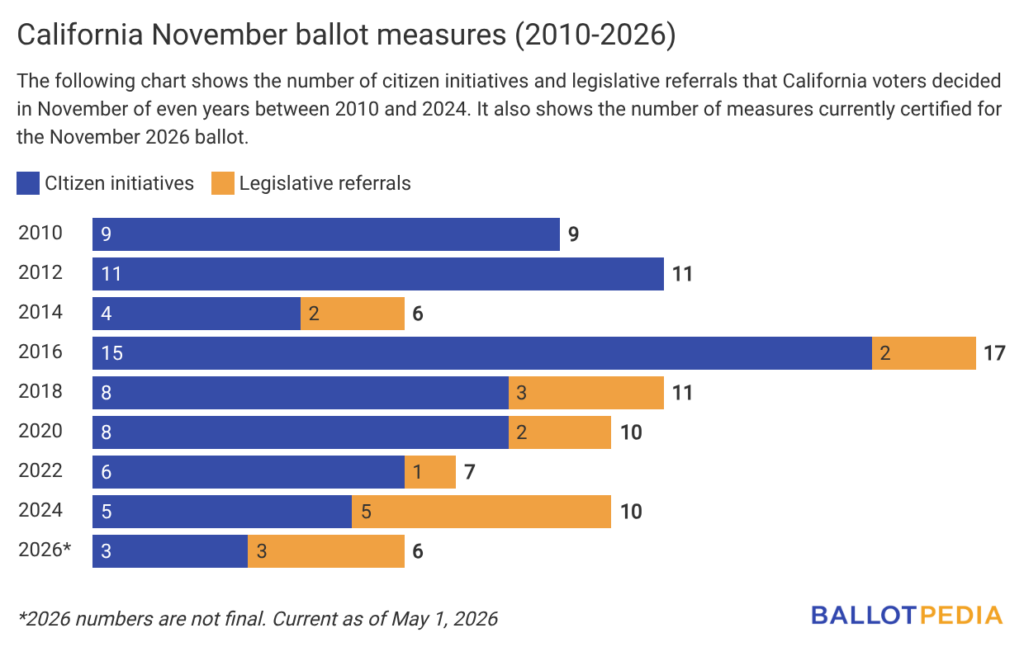
As of May 1, 26 initiatives have been cleared for signature gathering, and nine are pending verification with the secretary of state’s office. The chart below shows the number of citizen initiatives and legislative referrals California has decided in November of each even year between 2010 and 2024.
Click here to learn more about California’s 2026 ballot propositions.
Josh Turek and Zach Wahls are running in Iowa’s Democratic U.S. Senate primary on June 2
Josh Turek (D) and Zach Wahls (D) are running in Iowa’s Democratic U.S. Senate primary on June 2. Incumbent Sen. Joni Ernst (R) is not running for re-election.
The Cook Political Report's Jessica Taylor says this is one of the 2026 primaries in which Democrats are debating what type of candidate is more electable in a general election: "Do you need to energize your base more to get them to turn out, or do you need to win over the middle?”
According to the Des Moines Register's Stephen Gruber-Miller and Brianne Pfannenstiel, "[Wahls] is seen as the liberal candidate. He argues that a union-supported progressive with a working-class message can cut through the noise and energize the Democratic base. [...] Turek casts a more moderate image that his supporters believe will appeal to independents and disaffected Republicans.”
According to Taylor, endorsements in this race also show an ideological divide: "Moderate senators Catherine Cortez Masto of Nevada and Maggie Hassan of New Hampshire both endorsed Turek, while progressive Massachusetts Sen. Elizabeth Warren backed Wahls.”
Turek was first elected to represent District 20 in the Iowa House of Representatives in 2022. His professional experience includes working at a wheelchair and mobility assistance company. Turek was also a four-time Paralympian representing the United States in wheelchair basketball, winning two gold medals and one bronze medal.
Wahls was first elected to represent District 43 in the Iowa Senate in 2022 after representing District 37 from 2019 to 2023. From November 2020 to June 2023, Wahls served as Senate Minority Leader. His professional experience includes co-owning his family's tree farm in northeast Iowa.
The Cook Political Report with Amy Walter, Inside Elections with Nathan L. Gonzales, and Larry J. Sabato's Crystal Ball rated the general election as Likely Republican.
Click here to learn more about Iowa’s Democratic U.S. Senate primary.
Elections we're covering in May
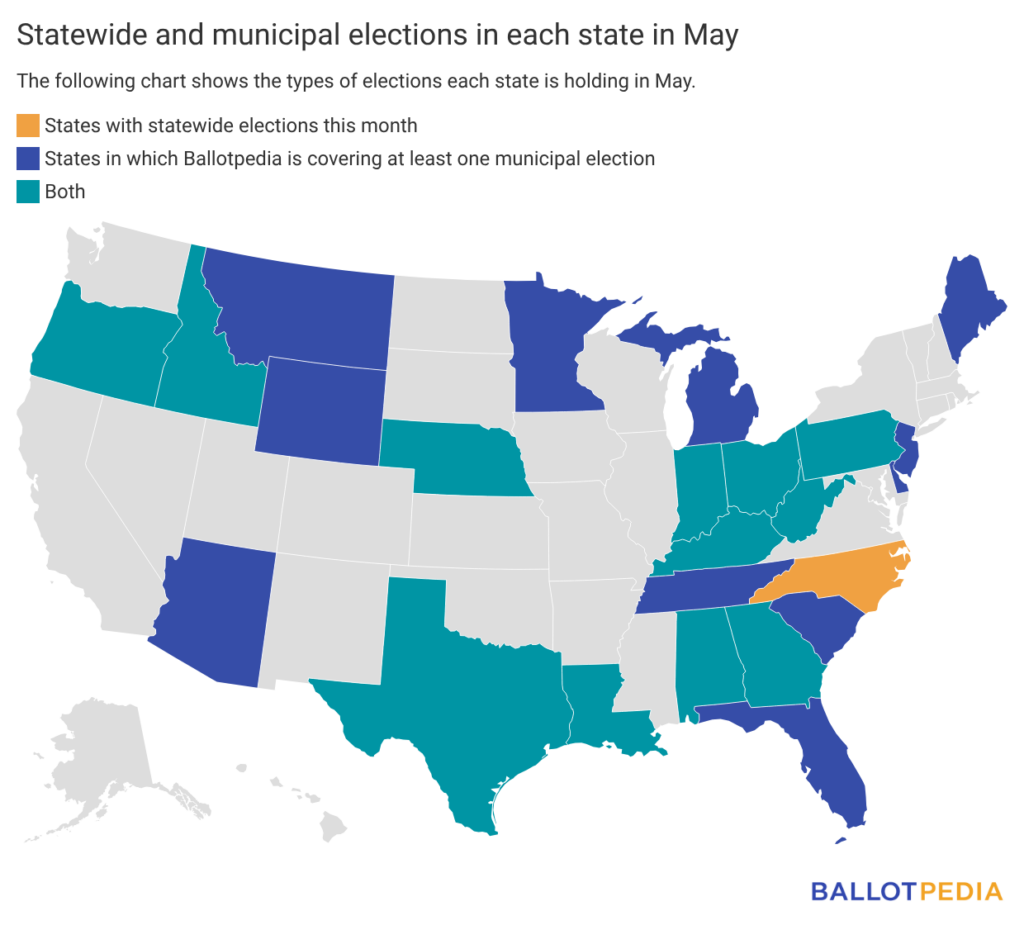
Ballotpedia is covering 8,249 elections in 27 states in May. These include 13 statewide elections, 127 special elections in 16 states, and nine recall elections in five states.
Last month, we covered elections in 24 states, including two statewide elections, 85 special elections, and five recall elections. In May 2024, we covered 4,502 elections in 25 states.
Here is a list of statewide elections happening this month:
- May 5: Indiana statewide primary, Ohio statewide primary
- May 12: North Carolina statewide primary runoff, Nebraska statewide primary, West Virginia statewide primary
- May 16: Louisiana statewide party primary
- May 19: Alabama statewide primary, Georgia statewide primary, Idaho statewide primary and judicial generals, Kentucky statewide primary, Oregon statewide primary, Pennsylvania statewide primary
- May 26: Texas statewide primary runoff
The following congressional and state-level special elections are occurring in May:
- May 2: Texas Senate District 4 special general
- May 5: Michigan Senate District 35 special general, Ohio Eighth District Court of Appeals special primary, Ohio U.S. Senate special primary
- May 12: Georgia House of Representatives District 177 special general, Nebraska Senate District 41 special primary, West Virginia Supreme Court of Appeals special general, University of Nebraska Board of Regents District 1 special primary, West Virginia Senate Districts 3 and 17 special primary
- May 16: Louisiana Supreme Court special primary, Louisiana Board of Elementary and Secondary Education District 1 special primary
- May 19: Georgia Senate District 7 special general, Kentucky Court of Appeals 5th Division 1 special general, Pennsylvania House of Representatives District 196 special general
Ballotpedia is also covering 6,705 municipal elections in 23 states. Below is a list of local elections in state capitals, the 100 most populous cities, or the 200 largest school districts by enrollment:
- May 2: Crowley Independent School District (Texas) Place 3, Fort Worth City Council (Texas) District 10, Irving City Council (Texas) Place 6, Mesquite Independent School District (Texas) Place 6
- May 5: Hamilton County Court of Common Pleas General Division (Ohio) special primaries
- May 16: Caddo Parish Public Schools (Louisiana) District 8 special general, East Baton Rouge Parish Family Court (Louisiana) Section 3 Division A special primary, Houston City Council (Texas) District C special general runoff, Orleans Parish Civil District Court (Louisiana) Divisions M and N special primary, Orleans Parish Criminal District Court (Louisiana) Section J special primary
- May 19: Cherokee County School District (Georgia) District 3 special primary
The following recall elections will take place:
- May 2: City Councilor Codi Chinn in Fate, Texas
- May 5: Clerk Pam Brinkman and Trustees Rochelle Brown and Evan Laurie in Elmwood Township, Michigan, and Treasurer Kimberly Ketzel in Columbus Township, Michigan
- May 12: Trustee Chris Juilfs in Alvo, Nebraska, City Councilor Theresa Westfall in Peru, Nebraska, and City Councilor Zhon Gering in Harvard, Nebraska
- May 19: City Councilors Levi Johnson, Patrick Boyle, Darren Hayes, and Anicleto Maldonado in Benson, Arizona, and Town Councilor Annie Martinez in Mammoth, Arizona
- May 28: Mayor Michael Bivens and City Councilors Amy Harcar and Lori Elmore in Whitehall, Ohio
Click here to see our full list of upcoming election dates.