


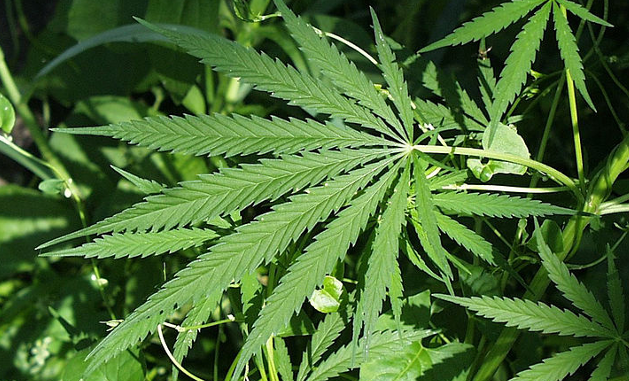
Supporters of an Idaho initiative that would legalize the use of marijuana for individuals diagnosed with a substantial health condition submitted signature petition sheets to county clerk offices on May 1.
County officials have until June 30 to certify the number of valid signatures submitted and report their findings to the secretary of state. If the secretary of state determines that the initiative has a sufficient number of signatures, the initiative will be placed on the November 2026 ballot.
In Idaho, the number of signatures required for an initiated state statute is equal to 6% of the number of registered voters as of the state's last general election. In 2026, that number is 70,725. Additionally, Idaho has a distribution requirement, requiring signatures to equal at least 6% of registered voters in 18 of the state's 35 legislative districts.
As of April 14, 2026, the Natural Medicine Alliance of Idaho reported that they had gathered more than 100,000 signatures in support of the measure.
Measure design
The initiative would legalize the use of marijuana for medical purposes.
The initiative specifically states that marijuana could be used for the treatment of a substantial health condition. The initiative lists 16 specific conditions that would qualify as a substantial health condition, as well as a terminal illness, a condition for which the patient is granted hospice or palliative care, or a rare condition that is not adequately managed with other treatment attempts. The initiative also allows the state Board of Pharmacy to add conditions to the list of substantial health conditions.
The measure would also provide for a program for businesses to apply for a medical cannabis production license, and require patients that use marijuana for medical purposes to obtain a medical cannabis card.
Arguments for and against the initiative
The Natural Medicine Alliance of Idaho, the sponsors of the initiative, said the measure would ease the suffering of Idahoans. A statement on their website says, “In Idaho nearly 836,000 opioid prescriptions are written every year in a state with fewer than 2 million people. That’s 44 prescriptions for opiates for every 100 residents. Yet patients facing cancer, PTSD, epilepsy, chronic pain, and other serious illnesses are still denied access to safe, natural, and non-addictive medical treatments to ease their pain.”
It continues, “The Idaho Medical Cannabis Act is our first step forward. It creates a safe, tightly regulated medical program that allows qualified Idahoans to seek medical cannabis treatment with a valid diagnosis from a healthcare provider. It supports Idaho agriculture, generates tax revenue to reinvest locally, and ensures that patients can find natural relief.”
On April 1, 2026, the state legislature approved Senate Concurrent Resolution 127 (SCR 127), which urges, “the citizens of Idaho to reject any effort to bring the Idaho Medical Cannabis Act to the ballot.” SCR 127 states that the “legalization of marijuana would have devastating impacts on Idaho children and their families,” and that the substantial health conditions “that qualify one to obtain a medical cannabis card, including insomnia, anxiety, and acute pain, are so broad that almost anyone could qualify.”
SCR 127 was approved in the Senate by a voice vote. It was approved by the state House in a vote of 58-9. The vote was along party lines with 58 Republicans voting yes, and nine Democrats voting no. Three Republicans did not vote.
Other 2026 marijuana policy ballot measures
A constitutional amendment concerning marijuana is already on the ballot in Idaho. HJR 4, which was placed on the ballot by the state legislature, would provide that only the Idaho State Legislature shall have the authority to legalize marijuana, narcotics, or other psychoactive substances. If the measure is approved by voters in November, it would remove the ability for citizens to initiate state statutes that would legalize these substances.
The wording of HJR 4 states that it would be "effective immediately upon adoption by the voters of Idaho." Therefore, it would not affect any initiatives on the ballot in the 2026 election, including the medical marijuana legalization initiative.
As of May 1, no ballot measures concerning marijuana have been certified for the 2026 ballot in other states. However, four initiatives have been proposed and have begun the process to be placed on the ballot in Arizona, Massachusetts, Missouri, and Nebraska.
History of marijuana policy ballot measures in Idaho
Between 2010 and 2025, there have been eight initiatives proposed for the ballot in Idaho concerning marijuana use. None of the initiatives met the signature requirement to be placed on the ballot.
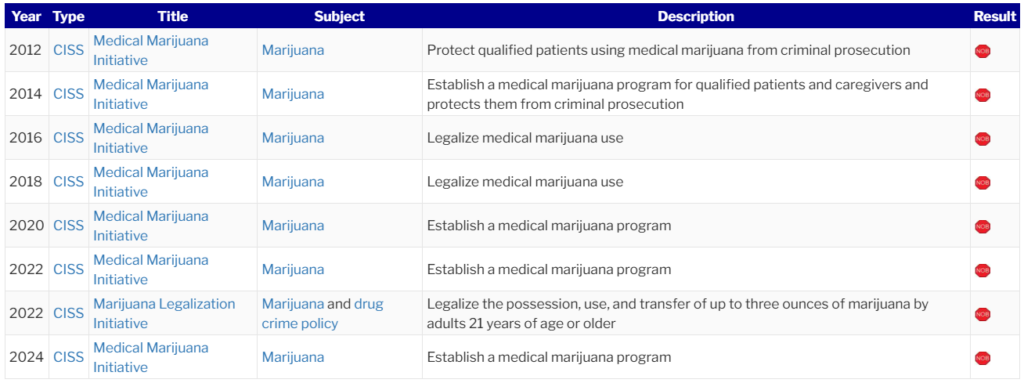
Another marijuana policy initiative was filed for the 2026 ballot. The initiative would have legalized the use of marijuana for recreational purposes. However, Kind Idaho, the organization sponsoring the measure, did not submit signatures by the May 1 deadline. As such, it will not appear on the 2026 ballot.
Other initiatives that submitted signatures
Supporters of another ballot initiative submitted signature petition sheets on May 1. The initiative would add a right to reproductive freedom and privacy to state law. The initiative defines that right as the ability to "make personal decisions about reproductive healthcare that directly impacts the person's own body."
The initiative would permit the state to regulate abortion after the point of fetal viability, except in cases of a medical emergency. The initiative defines fetal viability as “the point in a pregnancy when, on the basis of a physician's good faith medical judgment, based on the facts known at the time, and determined on a case-by-case basis, the fetus has a significant likelihood of sustained survival outside of the uterus without extraordinary medical measures.”
Additional reading: