


In this week’s edition of Economy and Society:
- Proxy advisors sue Indiana and Kansas over disclosure laws
- New York City rejects BlackRock, Fidelity climate plan
- ESG legislation update
- RBC and Scotiabank revise climate commitments
- Survey shows companies maintaining climate goals
In the states
Proxy advisors sue Indiana and Kansas over disclosure laws
What’s the story?
Institutional Shareholder Services (ISS) and Glass Lewis filed lawsuits in April 2026 challenging state laws in Indiana and Kansas that require the proxy advisory firms to disclose when their voting recommendations differ from management’s recommendations on shareholder votes.
ISS sued Kansas on April 29 in the U.S. District Court for the District of Kansas. Glass Lewis sued Indiana on April 30 in the U.S. District Court for the Southern District of Indiana, and ISS filed a separate lawsuit against Indiana on April 13. Both states' laws take effect July 1, 2026.
The lawsuits allege the laws violate the First Amendment because they compel speech in certain situations, illegally regulate interstate commerce, and impose unconstitutionally vague provisions. The firms said the laws require them to provide disclosures to shareholders and on websites when their advice differs from management recommendations and is not supported by written financial analysis.
Why does it matter?
Glass Lewis and ISS account for a combined market share of more than 90% of the proxy advisory industry, according to a September 2025 Congressional Research Service report. At least a dozen states had legislation regulating proxy advisory firms as of February 2026, according to Bloomberg Law.
Glass Lewis stated Indiana's law represents "a fundamental misunderstanding of the nature of corporate governance issues and how proxy guidance informs investor decision-making." The firm also wrote that the law "creates friction for investors that rely on our insights to fulfill their fiduciary duties."
ISS wrote in its Kansas suit that "it is hard to imagine a more plainly viewpoint-discriminatory law" and that "the law's goal is to force ISS to walk the line that corporate executives want — even if ISS and its clients believe that course of action is wrong."
Indiana lawmakers said the law would “ensure proxy advisors prioritize their fiduciary duty by providing clear justifications for their recommendations.”
What’s the background?
The lawsuits expand a legal strategy the firms launched in July 2025 over a similar Texas law, SB833. That lawsuit is pending. That law required disclosure when proxy advice is based on non-financial factors like diversity, equity, and inclusion (DEI) and environmental, social, and governance (ESG).
President Donald Trump (R) issued an executive order on Dec. 11, 2025, directing the Securities and Exchange Commission to expand oversight of Glass Lewis and ISS. The order instructs the SEC to revisit and potentially rescind rules for proxy advisors that implicate DEI and ESG policies.
New York City rejects BlackRock, Fidelity climate plans
What’s the story?
New York City's pension funds reported that asset managers BlackRock and Fidelity remain insufficiently aligned with the funds' net zero expectations.
The NYC pension funds published the assessment in their Fiscal Year 2025 Annual Climate Reports. The city's pension system — which includes the New York City Employees' Retirement System, Teachers' Retirement System, and Board of Education Retirement System — holds nearly $300 billion in assets and set a goal in 2022 to achieve net zero emissions in its portfolio by 2040. The funds required asset managers to submit net zero plans in 2025.
In 2025, the pension funds initially assessed three managers as insufficiently aligned — BlackRock, Fidelity, and PanAgora. PanAgora has since strengthened its approach, according to the funds, but BlackRock and Fidelity remain classified as insufficiently aligned as of the report's publication.
City Comptroller Mark Levine, who oversees the pension funds as investment advisor, said, "The climate crisis has a direct impact on our global economy, and our pension systems are doing the hard work of protecting retirees while advancing a transition to a low-carbon economy."
Why does it matter?
Former Comptroller Brad Lander recommended in 2025 that the funds drop $42 billion in mandates with BlackRock, Fidelity, and PanAgora over what he described as inadequate decarbonization plans. The pension funds' assessment follows Lander's recommendation and uses the same alignment framework.
BlackRock responded to Lander's earlier statements, saying the comptroller's actions represented "another instance of the politicization of public pension funds, which undermines the retirement security of hardworking New Yorkers."
The pension funds reported a 48.1% weighted average reduction in financed greenhouse gas emissions by the end of fiscal year 2025, exceeding interim targets toward their 2040 net zero goals. The funds recorded a 10.3% net return in 2025.
What’s the background?
In 2022, NYC pension boards launched a Net Zero Implementation Plan with a 2040 net zero target. In 2025, Lander increased demands on asset managers, requiring them to submit net zero action plans and set expectations for portfolio companies to establish full value chain net zero goals.
Lander's 2025 recommendation said BlackRock and Fidelity responded to the Trump administration by adopting more restrictive approaches to engagement and proxy voting.
ESG legislation update
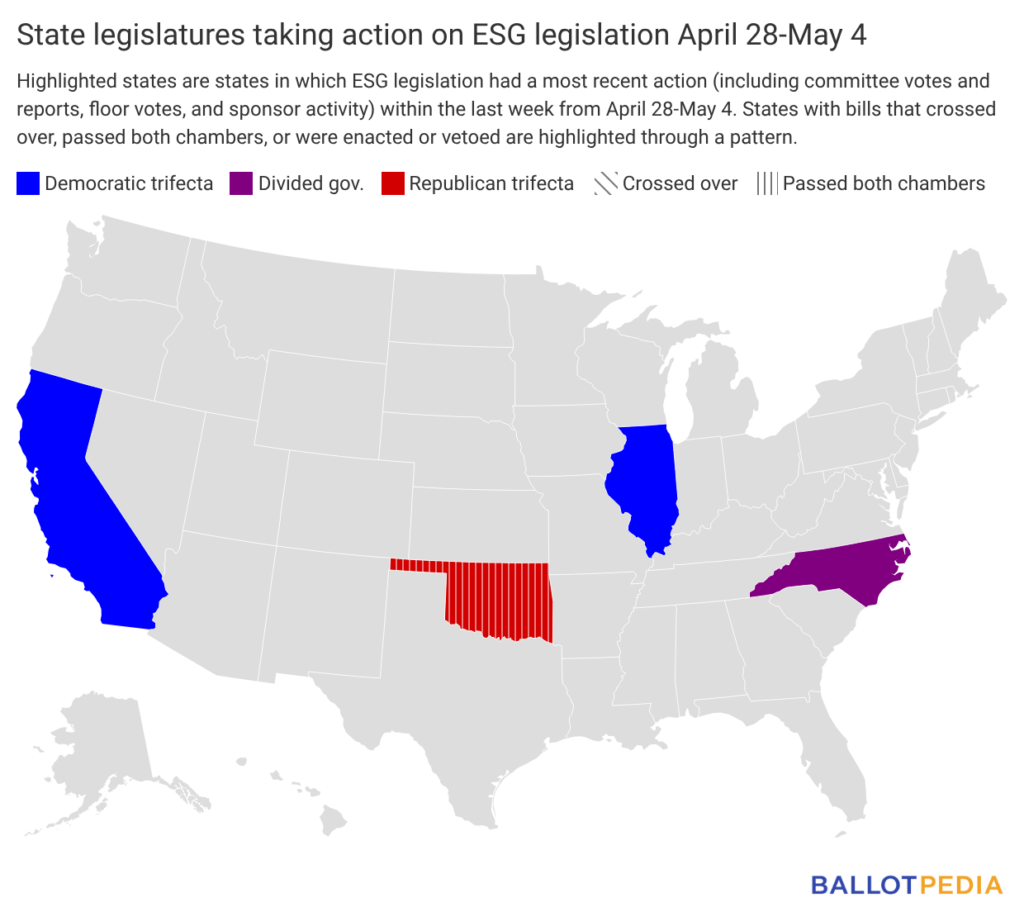
Four states took action on seven ESG-related bills last week (since April 28, 2026).
States with legislative activity on ESG last week are highlighted in the map below. Click here to see the details of each bill in the legislation tracker.
On Wall Street and in the private sector
RBC and Scotiabank revise climate commitments
What’s the story?
Two Canadian banks — Royal Bank of Canada (RBC) and Scotiabank — announced in their latest sustainability reports that they are dropping their 2030 targets to reduce financed emissions in high-carbon sectors. Scotiabank also said it will no longer pursue its 2050 net-zero financed emissions goal, while RBC maintained its 2050 target.
The banks said internal reviews of public policy, energy demand, and technology development led them to drop the targets. They concluded that decarbonization is progressing more slowly than expected and that some interim targets are no longer achievable.
What’s the background?
RBC and Scotiabank joined the Net-Zero Banking Alliance in 2021, committing to align their portfolios with net-zero emissions by 2050. They later set interim 2030 targets for sectors including oil and gas, power, and automotive.
Four of Canada's largest banks exited the alliance in January 2025, and the group ceased operations later that year. RBC also retired a $500 billion sustainable finance goal in 2025, while Scotiabank continues to pursue its separate target to mobilize $350 billion in climate-related finance by 2030.
Survey shows companies maintaining climate goals
What’s the story?
A new study from PwC found that 82% of companies are maintaining or accelerating their climate goals, based on an analysis of 3,547 firms across industries. The report, State of Decarbonization, released April 29, 2026, also found that 23% of companies increased their commitments and 18% scaled them back, indicating that firms expanding or maintaining targets continue to outnumber those reducing ambitions.
The study said companies are focusing more on reducing supply chain emissions — known as Scope 3 emissions — with 56% now on track to meet those targets, up from 54% the previous year. It also found that 75% of large companies have visibility beyond their direct suppliers, and 64% have established structured programs to engage suppliers on decarbonization.
Why does it matter?
The findings suggest that corporate climate commitments have remained steady even as ESG investing faces political and regulatory pressure. Pension funds, particularly in Democratic-led states and in Europe, have continued to press asset managers and companies to address climate risks, including through shareholder engagement and disclosure efforts.