


Welcome to Hall Pass, a newsletter written to keep you plugged into the conversations driving school board governance, the politics surrounding it, and education policy.
In today’s edition, you’ll find:
- On the issues: The debate over race-based teacher hiring
- School board filing deadlines, election results, and recall certifications
- Iowa Legislature passes a bill to limit the use of digital instruction for K-5 students
- Extracurricular: education news from around the web
- Candidate Connection survey
Reply to this email to share reactions or story ideas!
On the issues: The debate over race-based teacher hiring
In this section, we curate reporting, analysis, and commentary on the issues school board members deliberate when they set out to offer the best education possible in their district. Missed an issue? Click here to see the previous education debates we’ve covered.
According to the National Center for Education Statistics (NCES) from the 2020-2021 school year, 79.9% of K-12 public school teachers were white, 9.4% were Hispanic, and 6.1% were Black or African American. Data from 2022 found that 44% of public school students were white, 29% were Hispanic, and 15% were Black or African American.
A 2023 National Council on Teacher Quality survey of education leaders, advocacy groups, and researchers across the country found that diversifying the teacher workforce was a top-five priority for 32% of respondents.
In today's edition, we'll look at two perspectives on race-based teacher hiring.
Desiree Carver-Thomas, a Senior Researcher and Policy Analyst at the Learning Policy Institute, says studies show that all students, but especially Black students, do better in school when they have Black or otherwise non-white teachers. She says that students with racially diverse teachers are less likely to be chronically absent and that they report feeling cared for and academically challenged. Carver-Thomas says schools should incentivize the hiring of teachers of color.
Mike Petrilli, president of the Thomas B. Fordham Institute, an education policy think tank, says that a teacher's background matters for student achievement, but race-based teacher hiring focuses on a superficial form of diversity. He says schools should focus more on the similarities of life experiences between teachers and students when hiring than on racial similarities. Petrilli says that schools should hire teachers with backgrounds similar to those of the students, but should not overlook prospective teachers' academic qualifications in doing so.
Diversifying the Teaching Profession: How to Recruit and Retain Teachers of Color | Desiree Carver-Thomas, The Learning Policy Institute
"Increasing teacher diversity is a very important strategy for improving learning for students of color and for closing achievement gaps, the study finds. And, while White students also benefit by learning from teachers of color, the impact is especially significant for students of color, who have higher test scores, are more likely to graduate high school, and more likely to succeed in college when they have had teachers of color who serve as role models and support their attachment to school and learning. Students with racially diverse teachers also have fewer unexcused absences and are less likely to be chronically absent.
…
"[States should create] data systems that monitor and reward the racial diversity of enrollees in teacher preparation programs, as well as those who complete the programs. This creates an incentive for those programs to take innovative approaches to recruiting and supporting teacher candidates of color."
The Right Way to Boost Teacher Diversity | Michael Petrilli, The American Enterprise Institute
"All schools should hire at least a few teachers with life experiences similar to their student populations. Critically, though, we shouldn’t equate life experience simply with race. Instead, let’s encourage schools and districts to affirmatively recruit and hire teachers whose own lived experiences match those of the students they will teach. For Appalachian schools, that means teachers who grew up in Appalachia. For urban Title I schools, that means teachers who themselves attended urban Title I schools. For schools in the Rio Grande Valley, that means teachers who grew up in the Rio Grande Valley.
…
"First, we shouldn’t waive other important qualifications. All candidates should demonstrate strong academic achievement and the likely ability to boost student learning. Second, schools should not use life experience as a proxy for race. That would violate conservatives’ principles concerning race neutrality in public policy—and would likely violate the Constitution as well."
School board update: filing deadlines, election results, and recall certifications
In 2026, Ballotpedia will cover elections for more than 30,000 school board seats. We’re expanding our coverage each year with our eye on covering the country’s more than 80,000 school board seats.
Election results from the past week
May 2
Ballotpedia covered general elections in 37 Texas districts. School board elections in Texas are nonpartisan. Click this link to view the results.
May 5
Ballotpedia covered primaries in seven Tennessee districts: Clarksville-Montgomery County School System, Hamilton County Schools, Knox County Schools, Memphis-Shelby County Schools, Metropolitan Nashville Public Schools, Rutherford County Schools, and Williamson County Schools.
School board elections in Tennessee can be nonpartisan or conducted with party labels. Click this link to view the results.
Upcoming school board elections
Ballotpedia’s staff is covering school board elections for 160 seats in 104 districts in the next 30 days.
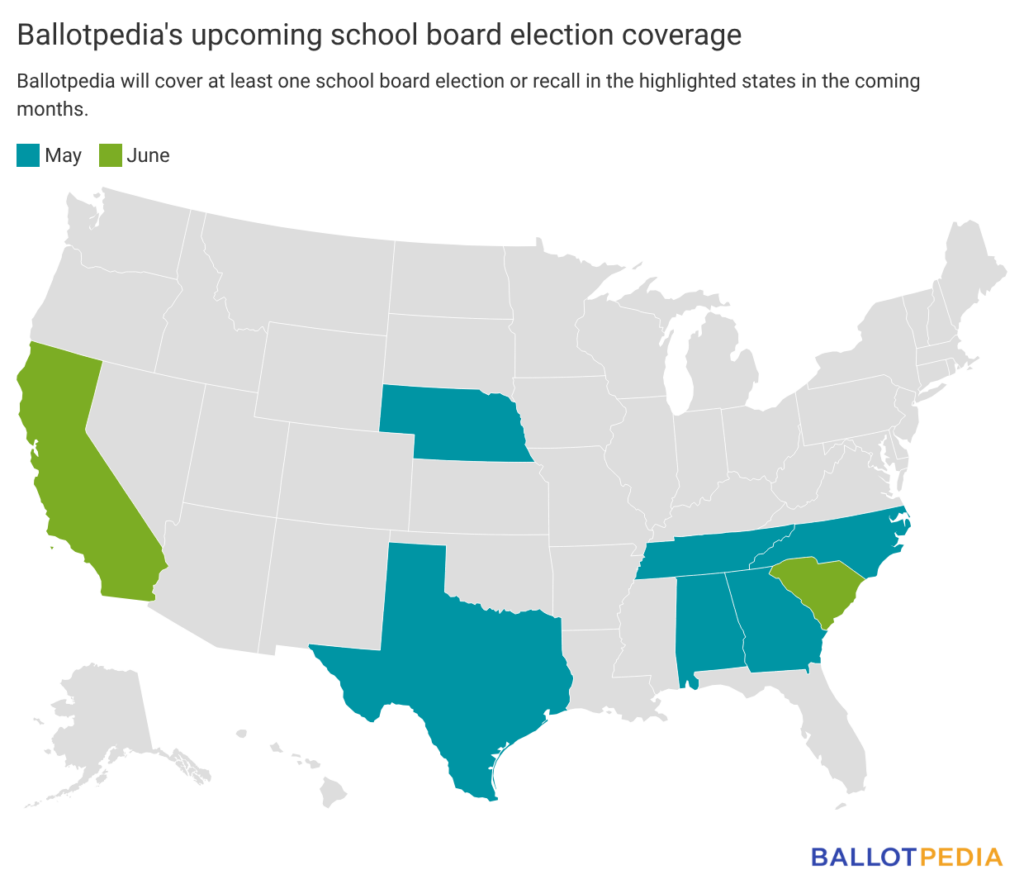
Watch future editions of Hall Pass for the following May primary and general election results:
- Nebraska - Primaries in six districts and a general election in one district on May 12.
- North Carolina - Primary run-offs in four districts on May 12.
- Alabama - Primaries in two districts on May 19.
- Georgia - Primaries in four districts and general elections in six districts on May 19.
Iowa Legislature passes a bill to limit the use of digital instruction for K-5 students
The Iowa Legislature approved legislation to limit student screen time in the classroom, joining at least 3 other states in adopting such restrictions. The bill awaits action from Iowa Gov. Kim Reynolds (R), who introduced it. House File (HF) 2676, titled the Iowa Make America Healthy Again Act, includes several measures (education-related and not) that Reynolds said will support the health and well-being of the state's residents.
On April 27, the Iowa Senate approved HF 2676 31-16 to limit digital instruction in K-5 public school classrooms to 60 minutes per day, among other measures. Only Republicans supported the bill, and only Democrats opposed it, with three Republicans and one Democrat not voting. The Iowa House of Representatives approved HF 2676 on 61-31 April 20. 61 Republicans supported the bill, and one Republican joined 30 Democrats to oppose it. Reporting on the measure indicated that the partisan split related less to the K-5 screen time limits than it did to other provisions of the bill.
The bill defined digital instruction as "lessons, assignments, assessments, or instructional activities delivered through instructional technology." It exempted device use related to student disabilities or individualized education plans from the limit. It also excluded state assessments, teacher-directed demonstrations using a smartboard or projector, and curricular instruction on computer science from the limit.
The bill would also require school districts to allow parents or caretakers to request a reduction in their students' screen time, and to prohibit the use of digital devices during recess. Before a district adopts or renews a program that gives each student a digital device, the bill would require the district to consider several factors. The district must document the purpose of each device, whether the device and its associated software are age-appropriate, how the district might maximize content filtering, and the data storage and sharing practices of the device and software.
HF 2676 contained more education-related measures for K-12 students, including:
- Establishing more physical activity and education requirements.
- Requiring schools to administer a presidential fitness exam.
- Mandating nutrition instruction.
- Prohibiting public and nonpublic schools receiving state funds from serving, selling, or otherwise distributing food containing certain ingredients, including several red, blue, and yellow dyes. The prohibition would exclude USDA Foods in Schools deliveries.
State representatives had introduced the HF 2676 screen time limit in another bill — HF 2451 — which passed the House Education Committee 19-4 in February. Fourteen Republicans and five Democrats voted to advance the bill, and two Republicans and two Democrats opposed it.
Differing views on screen time limits
Screen time limits in schools are part of a larger movement in several states to limit educational technology in K-12 classrooms. Parental organizations, such as Schools Beyond Screens and Moms for Liberty, have joined some teachers' unions and lawmakers, among others, to push for limits to K-12 screen time and digital device use in schools.
Richard Culatta, CEO of an educational organization called ISTE+ASCD, said that while he believes unrestrained internet use and access have negatively affected youth, legislation to limit screens in the classroom should focus more on the quality of digital instructional software than the quantity.
Culatta said, "Many of these bills set a daily time limit (e.g., one hour of digital instruction), though any amount of time would be too much for a student who is not using the technology effectively. On the flip side, technology used thoughtfully to increase student engagement and creativity should not be constrained by an arbitrary time limit, especially when supporting evidence-based pedagogical practices."
However, neuroscientist and co-founder of Learning Made Easy, Jared Cooney Horvath, said lawmakers need to limit the use of all digital devices in schools, because they slow learning, reduce depth of understanding, and weaken retention.
He said, "It doesn’t matter who bought it. Is it school-sanctioned? Does it have the word education stamped on it? It doesn’t matter. All these things are going to hurt learning, which, in turn, are going to hurt our kids’ cognitive development at the time when we need our kids to be sharper than we are.”
What are other states doing?
At least 14 states have considered legislation to limit student screen time in schools in 2026, and Alabama, Tennessee, and Utah have enacted such laws. In limiting classroom screen time — even if it's for instruction or on a school-issued device — these laws go beyond the statewide cellphone limits that are active or encouraged in 43 states.
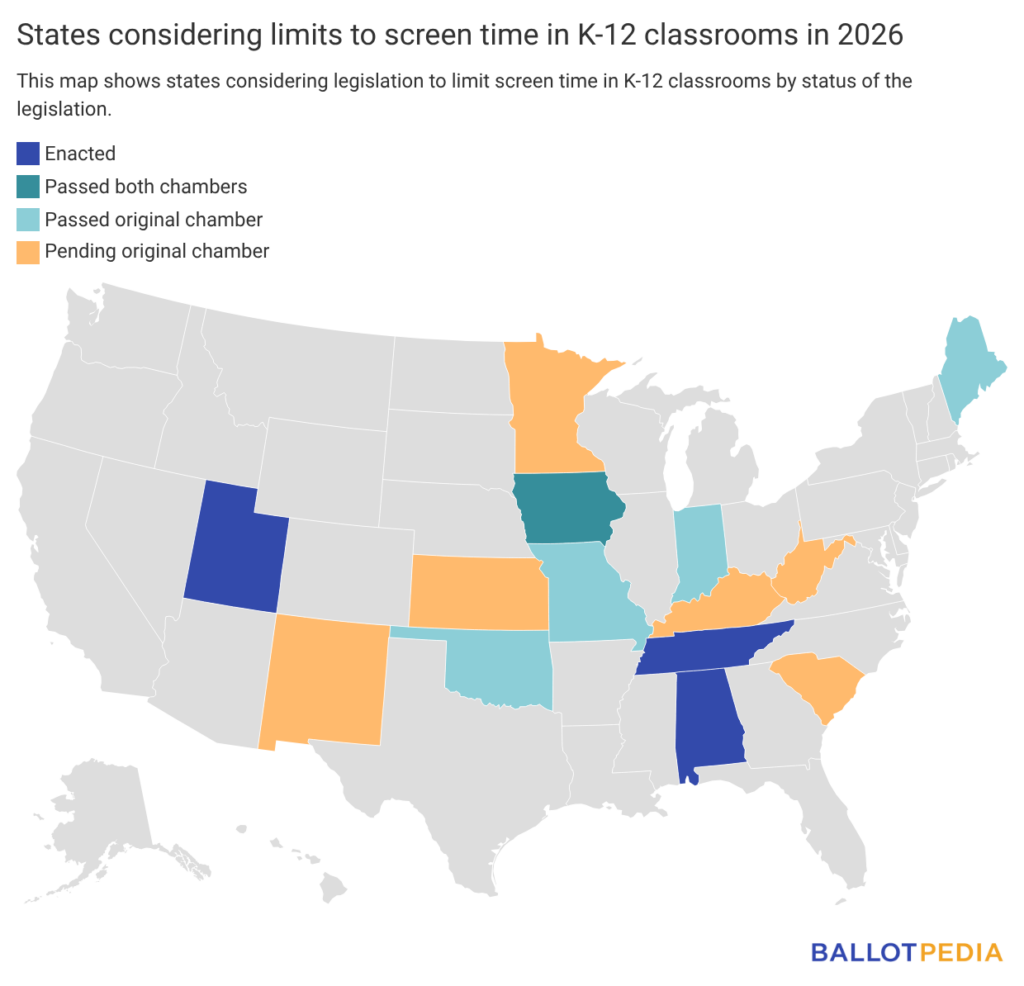
Bills limiting screen time in schools are not all alike. For example, while South Carolina H 5442 prohibits the use of digital devices in grades K-5, Tennessee SB 2310 requires districts to prioritize in-person, teacher-led instruction and the use of non-electronic instructional materials without specifying a screen time limit. Utah's legislation, in addition to requiring districts to minimize digital device use, requires instructional technology to meet quality standards.
Despite the difference, the bills from Alabama, Utah, Tennessee, and South Carolina all emphasize stricter device limits for K-5 students. Alabama's legislation said that "[b]irth through five years of age is a child's most critical period of rapid brain development, language acquisition, and social-emotional growth." It pointed to studies showing delayed communication skills, impaired problem-solving, and reduced social interaction in children with excessive screen time before age 3.
While not limiting screen time, some states, including Rhode Island and Vermont, are considering legislation that would allow parents to opt their students out of digital instruction or receiving a school-issued device.
Even without statewide limits, some districts, including the Los Angeles Unified School District, are establishing limits to student use of digital devices in schools.
Extracurricular: education news from around the web
This section contains links to recent education-related articles from around the internet. If you know of a story we should be reading, reply to this email to share it with us!
- DeSantis signs education bills in Fort Myers; one decertifies unions without 50% participation, another incentivizes some teacher pay | WGCU News
- Texas can force schools to post Ten Commandments, federal appeals court rules | Houston Public Media
- 5 things to know about Illinois’ new school rating system | The Illinois Policy Institute
- Colorado lawmakers won’t pursue bill to place state limits on Trump-backed education tax credit program | OUTLET
- Do career ‘pathways’ work? Delaware offers early clues | The Hechinger Report
- NC teachers march for higher pay and increased funding for public schools | EdNC
Take our Candidate Connection survey to reach voters in your district
Today, we’re looking at responses from the two candidates — Dawn L. Green and Rasheeda J. Campbell — running in the May 12 general election to represent District F on the Colonial School District board in Delaware.
The Colonial School District operates 15 schools. The district served 8,778 students during the 2023-2024 school year.

Dawn Green's career experience includes owning a business. Here's how she answered the question, “What are the main points you want voters to remember about your goals for your time in office?”
- "Strengthening Community Connection and Participation
- "Improving Student Achievement in Math and Reading
- "Building Stronger Community Engagement"

Rasheeda Campbell's career experience includes being a director of operations. Here's how she answered the question, “What are the main points you want voters to remember about your goals for your time in office?”
- "I am not an outsider, I'm one of you. I grew up in this community, raised my family here, and today my grandson walks the same Colonial Hallways as I once did. I have deep roots here, that makes my motives personal not political.
- "I bring 30+ years of executive leadership, a proven record of building results-driven teams, and a heart of children and families in our communities. I know how to assess what is broken, build what's needed, and delivery results.
- "Our children deserve a board member who shows up, digs in, and gets it done. My commitments are to 1) Improve Student Literacy, 2) Trust through Transparency, 3) Results-Driven Leadership, and 4) Budgets that Match Priorities. We have many challenges ahead, you need someone with grit, who holds themselves and other accountable and who cares how decisions impact your life. That is who I've always been, I am Colonial Built and Colonial Strong!"
As a reminder, if you're a school board candidate or incumbent planning to run this year, click here to take the survey. If you complete the survey, your answers will appear in your Ballotpedia profile. Your responses will also appear in our sample ballot. If there is an election in your community, share the link with your candidates and urge them to take the survey!