


The Virginia Supreme Court voided and nullified the election results for the April 21 Virginia redistricting amendment on May 8, 2026. The court issued a ruling that stated that the Virginia General Assembly violated procedural requirements when placing the Virginia redistricting amendment on the April 2026 ballot.
Voter approved the amendment at the April 21 election; 51.7% voted 'yes' on the measure. If certified, the constitutional amendment would have allowed the general assembly to implement a new congressional district map. The proposed map would have shifted four Republican-held districts to be more Democratic, based on the 2025 gubernatorial election results.
Background of Ryan T. McDougle, et al. v. Don Scott, et al.
The case, Ryan T. McDougle, et al. v. Don Scott, et al., was originally filed in the Tazewell County Circuit Court on October 28, 2025. A group of Virginia Republicans filed a complaint that claimed that the Virginia General Assembly had incorrectly expanded the scope of the special legislative session in order to approve the constitutional amendment.
On Jan. 27, Judge Jack Hurley issued a ruling stating that the constitutional amendment could not be placed on the 2026 ballot because it was introduced to the Virginia General Assembly in a way contrary to state law. Virginia Speaker of the House Don Scott (D-88) appealed the case. On Feb. 13, 2026, the Virginia Supreme Court ruled that the amendment could be placed on the April 21 ballot, and that they would decide the case on an expedited basis.
On May 8, 2026, the Virginia Supreme Court declared, in a 4-3 opinion, that the results of the measure were void because the general assembly violated procedural requirements when placing the measure on the April 21 ballot.
Focus of the case
The case addressed the intervening-election requirement in Article XII, Section 1, of the Virginia Constitution, which provides that a general election for the House of Delegates must occur between the two legislative sessions in which the legislature approves a constitutional amendment for referral to voters.
- Plaintiffs argued that general election encompasses the entire voting period, meaning the requirement was violated when the legislature cast the first vote on October 31, 2025, six weeks after voting began on September 19, 2025.
- Defendants argued that general election means Election Day, which was November 4, 2025, and that because the legislative vote occurred four days before that date, the intervening-election requirement was satisfied.
Majority opinion
Justice D. Arthur Kelsey authored the majority's opinion. Justices Teresa M. Chafin, Stephen R. McCullough, and Wesley G. Russell Jr. joined the opinion.
The opinion held that the general election encompasses the period from the first day of early voting through Election Day. Therefore, the court found that the intervening-election requirement was violated because the General Assembly cast its first vote on Oct. 31, 2025, after more than 1.3 million Virginians had voted, thereby denying those voters their constitutionally protected “opportunity to elect the House of Delegates that will participate in the second legislative vote on the proposed amendment.” Justice Kelsey wrote:
“The metes and bounds of an election begin with the point of casting votes and end with the point of receiving votes and closing the polls on the last day of the election. Election Day is the boundary marker for the last act constituting an election. ...
In legal argot as well as common speech, a wedding can last for hours, but the bride and groom are not lawfully wed until the officiant declares them so at the end of it. Equally so here. A general election can take place over many days, but it culminates and ends on Election Day. ...
And that inflexibility, deployed by the Commonwealth in this case, ended up denying over 1.3 million Virginians their constitutional right to have a voice in the debate over whether their Constitution should be amended — thereby eroding one of the core rights that Article XII, Section 1 was intended to safeguard.”
The opinion cited the U.S. Supreme Court's ruling in Foster v. Love (1997), which defined an election as "the combined actions of voters and officials meant to make a final selection of an officeholder." The opinion stated, "The 'combined actions' that define the term 'election' include citizens casting votes, from the beginning of the early-voting period until Election Day, and the officers of election receiving these votes and closing the polls on 'Election Day.'"
Dissenting opinion
Chief Justice Cleo Powell wrote the dissenting opinion. Justices Thomas P. Mann and Junius P. Fulton, III joined the dissent.
The dissent would have held that general election means only Election Day, a single day, consistent with the General Assembly’s statutory definition of a general election as the Tuesday after the first Monday in November, and with Virginia’s early voting statute, which describes early voting as occurring prior to an election rather than during one. Under that definition, the dissent concluded that the intervening-election requirement was satisfied because the legislature cast its first vote four days before Election Day. Chief Justice Powell wrote:
“By focusing on the legislative history, dictionary definitions, and how legal scholars might interpret the term 'election,' the majority fails to apply the most basic tenet of interpretation of constitutional provisions: looking to the language of the constitution itself. ...
The General Assembly did not define a general election as an election ending on a specific day, it said that a general election is an election held on a specific day. ...
By limiting the term 'election' to refer to a single day, as the framers of our Constitution and the General Assembly clearly intended, the infinite voting loop is avoided entirely, the two-day gap is of no consequence, and there is both a definitive beginning and end of an election: Election Day.”
The dissent also addressed Foster v. Love, stating, "Every federal circuit court that has applied the combined action approach has concluded that early voting is not considered part of the election. This is due to the fact that, during early voting, there is no combined action to make the final selection of an office holder. Indeed, only the voters are taking any action; it is only on election day that election officials are able to act. Thus, there can be no combined action until election day. ... By including early voting into its definition of election, the majority goes beyond the combined action theory of Foster."
Reactions
After the Virginia Supreme Court published the order on May 8, supporters and opponents of the measure issued statements and published remarks on social media reacting to the ruling.
Virginia Attorney General Jay Jones (D) issued a statement responding to the ruling. It said, “This Court’s ruling follows a dangerous trend of tilting power away from the people. My team is carefully reviewing this unprecedented order and we are evaluating every legal pathway forward to defend the will of the people and protect the integrity of Virginia’s elections.”
Virginians for Fair Elections, the campaign in support of a ‘yes’ vote on the measure, said, “Today is a deeply troubling moment for Virginia, the nation, and our entire democracy. It comes at a moment when voting rights are already imperiled nationwide — when the U.S. Supreme Court is weakening voter protections, and MAGA politicians in other states are drawing maps without any public input at all.”
President Donald Trump (R) said on Truth Social, “Huge win for the Republican Party, and America, in Virginia. The Virginia Supreme Court has just struck down the Democrats’ horrible gerrymander. MAKE AMERICA GREAT AGAIN!”
State Sen. Ryan McDougle (R-26) said, “The Supreme Court ruling today affirms what we all know: you cannot violate the Constitution to change the Constitution. The Justices of the Supreme Court of Virginia, after careful and thorough review of this matter, affirmed that even the General Assembly must follow the law. This ruling is not a partisan one - it is a constitutional one. The rule of law is the foundation of our Commonwealth, and today it has been upheld. Every Virginian wins.”
Redistricting in other states
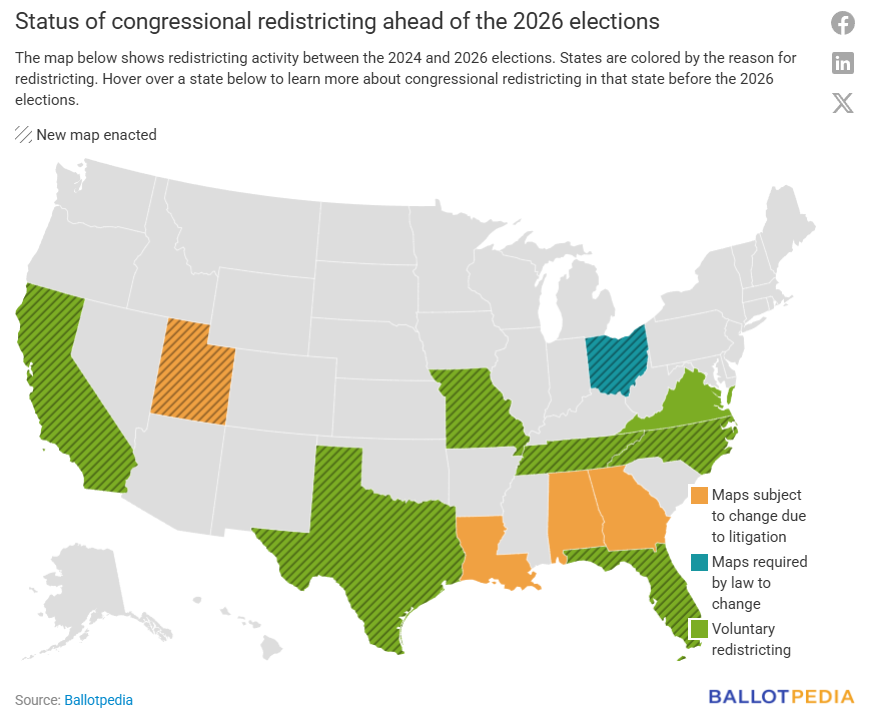
As of May 2026, four states had congressional district maps that were subject to change before the 2026 elections, and eight states — California, Florida, Missouri, North Carolina, Ohio, Tennessee, Texas, and Utah — had new congressional maps.
Virginia's new map was blocked from certification by court-order; three other states — Louisiana, Alabama, and Georgia, — also had congressional maps that were subject to change due to litigation. Before 2025, only two states had conducted voluntary mid-decade redistricting since 1970.
Additional reading: