


Welcome to the Monday, May 11, 2026, Brew.
By: Briana Ryan
Here’s what’s in store for you as you start your day:
- Nine states are holding public utility commission elections this year
- Iowa voters will decide a constitutional amendment that would require two-thirds approval from the general assembly to increase income taxes
- Five Republican trifecta states and one with divided government enact bills reducing agency power in 2026
Nine states are holding public utility commission elections this year
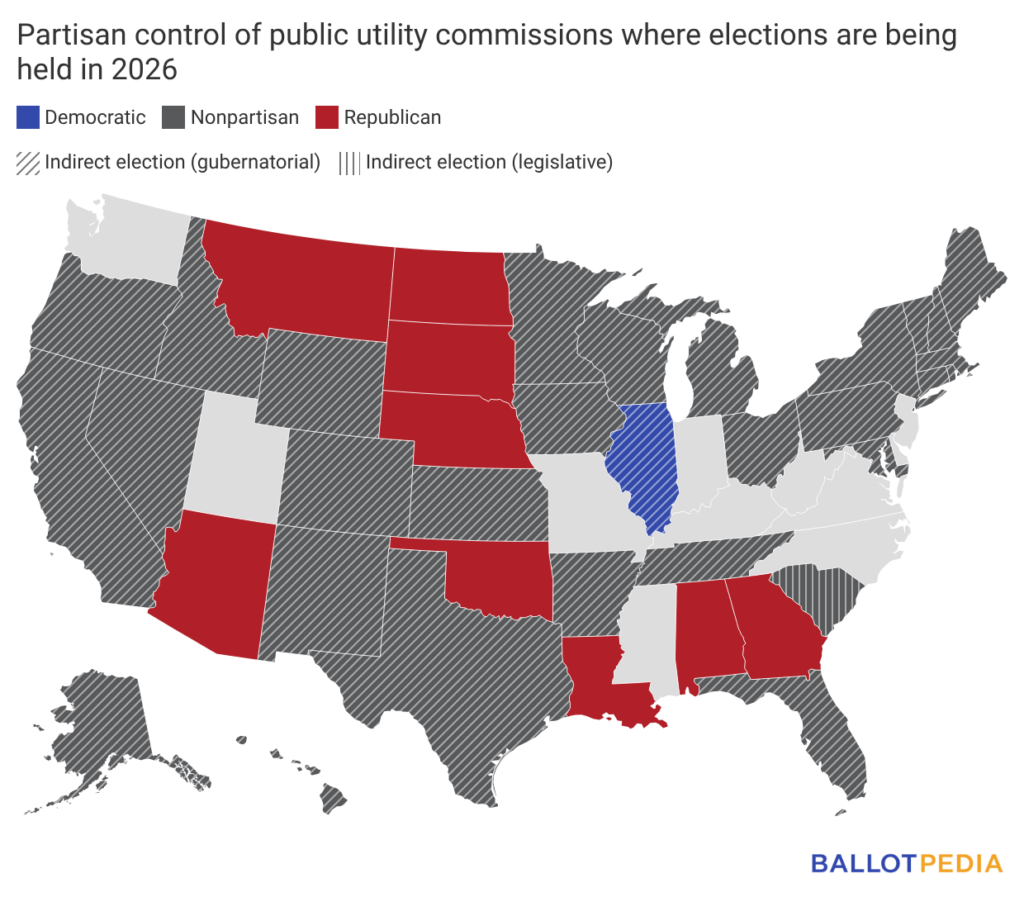
Republicans have majorities on all nine of the public utility commissions directly on the ballot this year. These states are Alabama, Arizona, Georgia, Louisiana, Montana, Nebraska, North Dakota, Oklahoma, and South Dakota. The other state in which public utility commissioners are directly on the ballot is Mississippi, which also has a Republican majority. However, Mississippi is not on the ballot this year.
Of the nine states holding direct elections this year, Georgia is the only one in which the commission’s partisan control could change. Republicans currently have a 3-2 majority on the Georgia Public Service Commission. Democrats need to retain control of the District 3 seat and gain control of the District 5 seat to win control of the commission. Republicans need to either gain control of the District 3 seat or retain control of the District 5 seat to retain a majority.
Louisiana is the only other of the nine states with a Democrat on its commission. Republicans currently have a 3-2 majority on the Louisiana Public Service Commission. Democrats need to retain control of the District 5 seat and gain control of the District 1 seat to win control of the commission. Republicans need to either gain control of the District 5 seat or retain control of the District 1 seat to retain a majority.
Of the nine commissions, we’re following the elections for three as battlegrounds.
- Arizona: In April, national groups invested in elections for the Salt River Project, a utility regulator in central Arizona. As a result of the election, candidates aligned with the SRP Clean Energy slate won majority control of the board. Two Democrats are campaigning to reduce the state commission’s 5-0 Republican majority to 3-2. Democrats last won a seat on the commission in 2020.
- Georgia: In November 2025, Democrats won two seats on the Georgia Public Service Commission, resulting in the commission’s current 3-2 Republican majority. One of the Democrats elected last year is running again, while another seat is up for election. This election will decide which party controls a majority of the commission.
- Montana: Two seats are up for election. One district is open, while in another, a Republican incumbent faces two primary challengers. A Democrat was last elected to the commission in 2012. The 2026 races also follow a 2025 court ruling that the commission's district boundaries were constitutional. According to Montana Public Radio's Ellis Juhlin the boundaries “divided major cities across the state into different districts, and was found by an expert during trial to have been drawn in a way that favored Republican candidates.”
Although commissioners are elected in 10 states, commissioners in the other 40 states are appointed to their seats. Heading into the 2026 elections, 10 commissions have a majority of members from the Republican Party, one has a majority of members from the Democratic Party, and 39 are officially nonpartisan.
In addition to the nine commissions on the ballot this year, 30 are also up for election because either the appointing person or all or part of the appointing body is up for election.
Twenty-nine states in which the governor appoints commissioners are holding gubernatorial elections this year. Democrats currently control 16 of those offices, and Republicans control 13.
In South Carolina, the Legislature selects the commission's members. Currently, Republicans have a 34-12 majority in the South Carolina Senate and an 88-36 majority in the South Carolina House of Representatives. All 124 seats in the state House are up for election this year.
A total of 23 commissions are in states with a Democratic governor or a Democratic majority in the legislature with appointment power. The other 17 commissions are in states with a Republican governor or a Republican majority in the legislature with appointment power.
As a result, Democrats currently control 16 of the 39 commissioner elections either directly or indirectly on the ballot this year, and Republicans control 23.
Click here to read more about public service commission elections being held this year.
Iowa voters will decide a constitutional amendment requiring a two-thirds vote in the General Assembly to increase income taxes
Iowa voters will decide on a constitutional amendment at the Nov. 3 election that would require a two-thirds vote from both chambers of the General Assembly to approve an increase in the individual or corporate income tax rate.
The amendment would also require a two-thirds vote in both chambers to create a new tax “on any type of income or legal and special reserves.” Currently, only a simple majority vote is required to pass bills that create or increase an income tax.
In Iowa, the General Assembly must approve a constitutional amendment in two successive legislative sessions with an election for state legislators in between. Amendments do not require the governor's signature to be put on the ballot.
The constitutional amendment was first introduced in the Iowa General Assembly as House Joint Resolution 2006 (HJR 2006) in the 2023-2024 legislative session. During the 2025-2026 legislative session, the amendment was introduced as Senate Joint Resolution 11 (SJR 11). HJR 2006 and SJR 11 each passed both legislative chambers along partisan lines, with Republicans voting for it and Democrats voting against it.
According to the National Conference of State Legislatures, 15 states currently require a supermajority to raise income taxes. In four states, the supermajority requirement is 3/5 (60%); in nine states, it is 2/3 (66.67%); and in two states, it is 3/4 (75%).
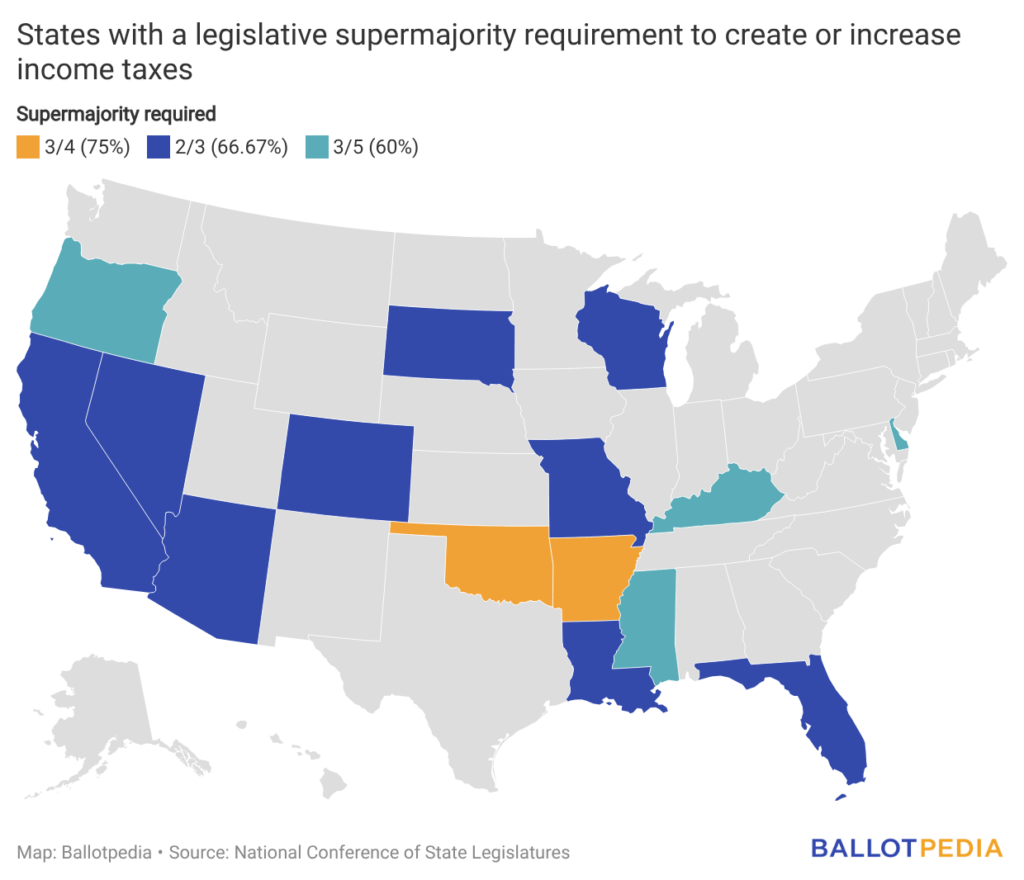
Currently, Iowa is the only state with a measure on the ballot concerning legislative vote requirements. Ballot measures on legislative vote requirements have been introduced in four states.
- Alaska: The constitutional amendment would require a two-thirds vote to overturn a governor's veto of a bill that raises revenue or appropriates funds. As of 2026, a three-fourths vote (75%) is required to overturn a veto of any bill.
- Arizona: The constitutional amendment would require that the Legislature approve a bill authorizing a fee or assessment with a two-thirds vote.
- Nebraska: The initiated constitutional amendment would require a four-fifths legislative vote to change, impair, or repeal an approved ballot initiative.
- South Dakota: The initiated constitutional amendment would require a three-fourths vote of the Legislature, as well as voter approval, to change initiated state laws within seven years of voter approval.
Click here to read more about the Iowa Two-Thirds Legislative Vote Requirements for Income Tax Increase Bills Amendment.
Five Republican trifecta states and one with divided government enact bills reducing agency power in 2026
The 2026 legislative session featured a number of state-level bills affecting the administrative state, with five Republican trifecta states and one state with a divided government enacting bills that reduce the power of state agencies. The term administrative state refers to executive branch agencies with unelected officials (in this case, at the state level) that have the authority to create, interpret, and enforce regulations.
In 2026, major bills affecting the administrative state included REINS-style bills (which require legislative approval for new agency rules exceeding a specified cost threshold) enacted in one state and passed in another, and bills restricting judicial deference by state courts enacted in two states and passed in another. The 2026 session also saw bills enacted that limit agency power to make temporary rules, require legislative review of new rules, and modify existing REINS-style provisions. Five REINS-style bills and five bills restricting state judicial deference were enacted in 2025.
Bills enacted
Kansas’s HB 2183: Gov. Laura Kelly (D) signed it on Feb. 6. This bill restricted judicial deference in state courts. HB 2183 requires courts to use a de novo standard of review when determining the meaning of language in a state statute, regulation, or other document, rather than deferring to the interpretation of a state agency. The Kansas Senate passed the bill 30-10 on March 27, 2025, and the Kansas House of Representatives passed it 83-39 on Jan. 22, 2026. Kansas has a divided government.
South Dakota’s SB133: Gov. Larry Rhoden (R) signed it on March 12. This bill established a REINS-style requirement for agency rulemaking, under which major proposed rules (defined as expected to cost "businesses, individuals, other nongovernmental entities, and units of local government" $3 million or more over two years) must receive legislative approval before going into effect. The bill also established a de novo review standard for state courts hearing disputes about whether a proposed rule counts as major. The South Dakota Senate passed the bill 33-0 on Feb. 24, and the South Dakota House of Representatives passed it 66-1 on March 3. South Dakota is a Republican trifecta state.
Idaho’s H0539: Gov. Brad Little (R) signed it on March 17. This bill modified requirements for temporary agency rules, which are exempted from existing statutory language that requires new rules to be approved by the Legislature. The bill specified requirements for agencies to promulgate temporary rules, including a requirement that specific emergency conditions must be met before an agency may re-adopt an expired temporary rule. The Idaho House of Representatives passed the bill 67-2 on Feb. 17, and the Idaho Senate passed it 33-1 on March 10. Idaho is a Republican trifecta state.
Alabama’s SB167: Gov. Kay Ivey (R) signed it on March 31. This bill restricted judicial deference in state courts, requiring courts to use a de novo standard of review when determining the meaning of statutory or regulatory language, rather than deferring to the interpretation of a state agency. The Alabama Senate passed it 34-0 on Feb. 5, and the Alabama House of Representatives passed it 105-0 on March 17. Alabama is a Republican trifecta state.
Mississippi’s HB925: Gov. Tate Reeves (R) signed it on April 8. This bill required the Joint Legislative Committee on Performance Evaluation and Expenditure Review (PEER Committee) to review newly adopted agency rules and to report its findings to the Legislature. The bill also created a State Board of Health Professions, with a mandate to advise the Governor and Legislature on health-related professional regulation. The Mississippi House of Representatives passed it 119-1 on Feb. 5, and the Mississippi Senate passed the amended version 50-2 on March 10. The state House passed a conference committee version of the bill 116-0 on March 31, and the state Senate passed it 52-0 on April 1. Mississippi is a Republican trifecta state.
Oklahoma’s HB4319: Gov. Kevin Stitt (R) signed it on April 17. This bill restricts agency rulemaking to instances in which “the agency has been specifically and explicitly granted rulemaking authority by state law,” and specifically denies that general statutory language like the phrase "as necessary and proper" confers this authority. The bill also requires that legislative review of proposed agency rules (required under the REINS-style law enacted in 2025) include a determination that the agency acted under specific statutory authority. The Oklahoma House of Representatives passed the bill 89-0 on March 11, and the Oklahoma Senate passed it 46-0 on April 15. Oklahoma is a Republican trifecta state.
Vetoed and veto overridden
Wisconsin’s SB289: Gov. Tony Evers (D) vetoed the bill on March 20. This bill would have required agencies to offset the expected costs of new rules to businesses, local governmental units, and individuals with a separate rule reducing expected costs. The Wisconsin Senate passed the bill 18-15 on Feb. 11, and the Wisconsin Assembly passed it 53-45 on Feb. 12. Wisconsin has a divided government.
Wisconsin’s SB277: Evers vetoed the bill on March 20. This bill would have introduced a seven-year sunset provision for agency rules, requiring that rules automatically expire seven years after being promulgated unless they are reissued through the agency rulemaking process. The Wisconsin Senate passed the bill 18-15 on Feb. 11, and the Wisconsin Assembly passed it 53-45 on Feb. 12.
Wisconsin’s SB276: Evers vetoed the bill on March 20. This bill would have required that a plaintiff successfully challenging the validity of an agency rule in court receive attorney fees and costs. The Wisconsin Senate passed the bill 18-15 on Feb. 11, and the Wisconsin Assembly passed it 53-45 on Feb. 12.
Wisconsin’s SB275: Evers vetoed the bill on March 20. This bill would have required that agency statements of scope (which are required by existing state law as a preliminary step in agency rulemaking) would expire after 30 months, and that agencies specify whether a statement of scope is beginning the permanent or emergency rulemaking process. The Wisconsin Senate passed the bill 18-15 on Feb. 11, and the Wisconsin Assembly passed it 53-45 on Feb. 12.
Kansas’ HB2719: Gov. Laura Kelly (D) vetoed this bill on April 6, and the Kansas Legislature overrode it on April 9. This bill created exemptions from existing statutory language that requires various formal procedures, including ratification by the Legislature, as part of agency rulemaking. The bill exempted technical amendments to agency rules and specific categories of rules issued by the Department of Corrections. The bill also added a requirement that agencies submit proposed rules to the legislative Joint Committee on Administrative Rules and Regulations. The Kansas Senate passed the bill 40-0 on March 19, and the Kansas House of Representatives passed it 122-0 on March 24. Kelly’s April 6 veto was overridden by the House 89-34 and by the Senate 38-1 on April 9. Kansas has a divided government.
Passed, not signed
Tennessee’s HB1913: If Gov. Bill Lee (R) signs this bill, it would require rulemaking agencies to publish the text of proposed rules, to “make a good faith effort to notify each trade association or organization” potentially affected by the rule, and for the agency to create a fiscal impact statement based on feedback received. The bill would also introduce a REINS-style requirement, with rules expected to cost $1 million or more over five years (or one year for emergency rules), requiring legislative approval to go into effect. The Tennessee House of Representatives passed the bill 76-16 on April 13, and the Tennessee Senate passed it 24-4 on April 16. Tennessee is a Republican trifecta state.
Georgia’s HB 1247: If Gov. Brian Kemp (R) signs this bill, it would restrict judicial deference in state courts, requiring courts to use a de novo standard of review when determining the meaning of constitutional, statutory, or regulatory language, rather than deferring to the interpretation of a state agency. The bill would also require rulemaking agencies to submit an economic impact statement to the Legislature when promulgating new rules, and to report the economic impact of existing rules to the Office of Planning and Budget every five years (with specified exceptions). The Georgia House of Representatives passed the bill 98-63 on March 4, and the Georgia Senate passed the amended version 48-2 on March 25. The state House passed the Senate-amended version with amendments of its own 98-70 on April 2, and the state Senate passed the amended bill 34-18 on April 3. Georgia is a Republican trifecta state.
As of May 7, 21 of the 47 state legislatures that convened a special or scheduled regular session in 2026 have adjourned.
Click here to learn more about the administrative state.