


Welcome to the Friday, May 15, 2026, Brew.
By: Briana Ryan
Here’s what’s in store for you as you start your day:
- Drawing lines: A look at the methods, precedents, and history of redistricting
- Alabama announces special primary elections for the U.S. House, while New Hampshire moves its 2028 primary date
- 105 statewide ballot measures have been certified this year — more than the average at this point in past even-numbered years
Drawing lines: A look at the methods, precedents, and history of redistricting
Today, we're sharing the fourth installment in our project marking America's 250th anniversary: The Blueprints of Democracy.
Redistricting looks like a straightforward government process. Every 10 years, following the Census, the states redraw district boundaries for their congressional, state legislative, and, in some cases, local elected officials.
But behind the procedural facade is a long and rich history of a government process that has helped shape, and itself been reshaped by, our political landscape.
How the states conduct redistricting
States use three general methods to conduct redistricting: legislature-dominant, commission, or hybrid.
For congressional redistricting, 33 states have legislature-dominant approaches. This means state legislatures are largely or entirely responsible for drafting and passing new district boundaries, sometimes with the help of an advisory commission.
Nine states have commissions that conduct congressional redistricting. Some commissions are politician commissions, composed of elected officials or party appointees, and others are non-politician commissions composed of private citizens.
New York and Virginia have hybrid systems, where redistricting starts with a commission that drafts maps that are sent to the legislature for further consideration.
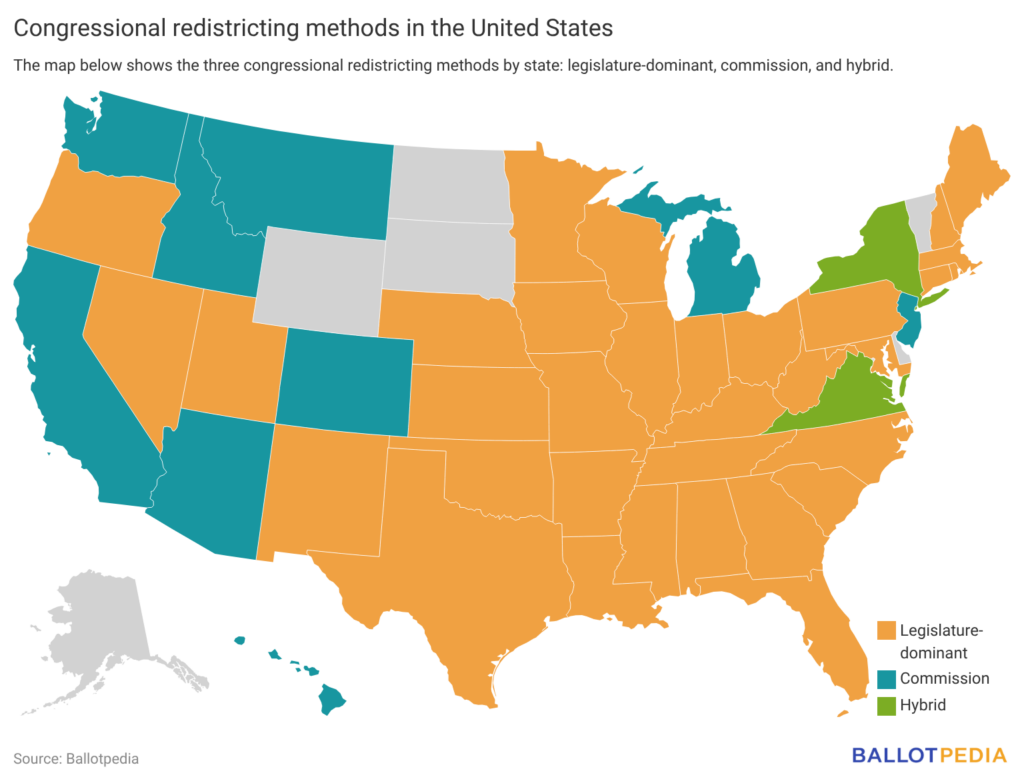
Six states have one at-large congressional district and don’t have to redistrict until their population increases. The Constitution guarantees every state at least one House member.
When it comes to redistricting state legislatures, 34 states have a legislature-dominant approach, 14 have commissions, and New York and Virginia use a hybrid approach.
What lawmakers take into consideration when drawing district boundaries
There are several general principles that guide map drawing in most states:
- Contiguity: the principle that all areas within a district are physically connected.
- Compactness: the principle that constituents within a district live as close to one another as possible.
- Communities of interest: drawing lines so that they create groups of constituents who have shared interests.
- Respect for political boundaries: when drawing maps, counties, cities, and towns are drawn into the same districts rather than split across multiple districts.
There are also federal requirements states must consider when drawing district boundaries. These include equal population and limits on the use of race, and a number of these requirements were established through Supreme Court decisions.
In the 1964 U.S. Supreme Court case Wesberry v. Sanders, the Court ruled that the number of people in each U.S. House district must be equal “as nearly as practicable.” In 1969, the Court ruled in Kirkpatrick v. Preisler that the “as nearly as practicable” principle “requires that the State make a good-faith effort to achieve precise mathematical equality.” In the 1983 case Karcher v. Daggett, the Court struck down a map with less than 1% population deviation. That case concerned New Jersey’s 1982 redistricting plan in which the largest district was just 0.7% larger than the smallest.
Another important federal pillar in redistricting is the 14th Amendment's Equal Protection Clause, which requires that race not be a predominant factor in redistricting. The Voting Rights Act, however, requires that race sometimes be considered because states cannot draw lines that dilute minority voting strength. States must consider race enough to comply with the VRA, but not so much that race predominates.
In the recent Supreme Court case Louisiana v. Callais, the Court ruled that vote-dilution claims under Section 2 of the Voting Rights Act require “evidence giving rise to a strong inference of intentional discrimination.”
How redistricting has changed over time
Article I, Section 4 of the U.S. Constitution gives states authority over the “times, places, and manner” in which congressional elections occur.
By the 1830s, two dominant systems of how voters were represented in the House had emerged in the states: the familiar single-member districts we have today and a “general ticket” approach where voters would cast as many votes as there were seats in their state’s House delegation, resulting in a slate of representatives all serving at-large.
The Apportionment Act of 1842 was a federal law that required U.S. House members to be elected from single-member districts. Some states ignored the law and continued to elect members at-large or in multi-member districts. Some later apportionment acts included the requirement, and others didn’t throughout the years. It wasn’t made permanently mandatory by Congress until 1967, with the passage of the Uniform Congressional District Act.
The same idea is true for election dates, which varied by state until 1872, when Congress aligned U.S. House elections with presidential elections on the Tuesday after the first Monday in November in even-numbered years. In 1875, Congress carved out exceptions for states whose constitutions required other election dates, and full compliance occurred through individual state constitutional amendments.
Redistricting controversies
Ballotpedia readers are probably familiar with the term gerrymander. It originated in 1812, after Massachusetts Gov. Elbridge Gerry signed a state senate map into law that packed Federalist Party voters into a few districts and favored Democratic-Republicans. Cartoonist Elkanah Tisdale drew a head, wings, and claws onto one of the districts, likening it to a salamander, and accordingly dubbed it the Gerry-mander in the Boston Gazette.

But one of the earliest instances of lawmakers trying to draw a district to elect (or prevent the election of) certain members comes from Virginia. In the elections for the First Congress in 1789, former Virginia Gov. Patrick Henry and his anti-federalist allies in the General Assembly drew the newly-created 5th Congressional District to favor an anti-federalist candidate — and not the man who was running for the seat, James Madison. Henry recruited James Monroe to run against Madison, making this the first and so far only time two future presidents were candidates for the same House seat. Madison defeated Monroe, winning 1,308 votes to 972.
Another controversy stems from the Apportionment Act of 1842 mentioned above. When some states refused to abide by the single-member district requirements and elected at-large members anyway, the U.S. House had to decide whether to seat those individuals. The majority concluded they should be seated, following a committee report written by Stephen Douglas, who said the federal government had no authority to dictate election rules to the states.
Redistricting controversies are not limited to congressional districts. They have happened at the local level, too. In 1957, the Alabama Legislature redrew the legal boundaries of the city of Tuskegee from a square into what a federal court called “an uncouth twenty-eight-sided figure,” excluding almost all of the city’s registered Black voters and leaving every White voter inside city limits. The result was that Black voters could no longer vote in city elections. In a unanimous 1960 ruling in Gomillion v. Lightfoot, the U.S. Supreme Court struck down the redraw as a violation of the Fifteenth Amendment, a ruling that set up many of the redistricting and reapportionment cases of the 1960s.
Click here to read past installments of this series.
Alabama announces special primary elections for the U.S. House, while New Hampshire moves its 2028 primary date
Two states recently revised their election calendars: Alabama scheduled special primary elections this year for four congressional districts, and New Hampshire moved its statewide and congressional primaries to June beginning in 2028.
On May 12, Alabama Gov. Kay Ivey (R) announced that special primaries will happen on Aug. 11 for four of the state's seven congressional districts. Primaries for the three other congressional districts, which are unchanged under the new maps, will remain on May 19.
The special primaries will take place for voters in Alabama's 1st, 2nd, 6th, and 7th congressional districts. The filing deadline for major party candidates is May 22, and for independent and minor party candidates it's Aug. 11.
The announcement comes on the heels of the U.S. Supreme Court vacating a lower court ruling, which had blocked Alabama from using a set of congressional maps enacted in 2023 during redistricting litigation. A court-appointed special master drew a different set of maps that were used in the 2024 elections. Ivey signed HB 1 on May 8, which authorized the special elections in the districts drawn by the Legislature in 2023.
In a statement, Alabama Attorney General Steve Marshall (R), said he supported the ruling and redistricting efforts, saying “the Supreme Court confirmed our long-held argument that States must not use race, either to help or to harm particular voters, when drawing voting districts.”
Critics of the Supreme Court’s ruling have asked a federal district court judge to keep the previous maps in place, stating in a court filing that using new districts “when this election is already underway, absentee ballots have been mailed, and every relevant deadline under state and federal law has long since passed, is contrary to the public interest."
In New Hampshire, Gov. Kelly Ayotte (R) signed House Bill 481 on May 8, moving up the primary date for statewide and congressional elections from the second Tuesday in September to the second Tuesday in June. The state's presidential primary date will not be affected by the move.
Supporters of the primary date change argue that there is currently a short time between the September statewide primary and the general election in November, which they say benefits current officeholders. Rep. Ross Berry (R) said in April that "the incumbent protection act, which is our current system, is coming to a close." New Hampshire Secretary of State David Scanlan (R) said changing the September date could be helpful for election officials, as the August date could reduce the time available for officials to prepare general election ballots for military and overseas voters.
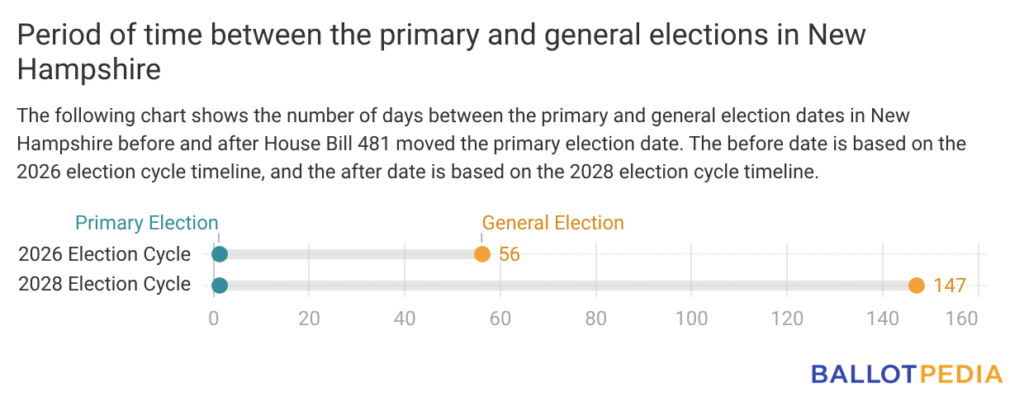
Others opposed changing the statewide primary to June and instead favored House Bill 408, which would have moved the primary to August. State Rep. Timothy Horrigan (D), a cosponsor of HB 408, said that a June election would necessitate a March candidate ballot access deadline and that candidates “haven’t even decided what they want to do over the next two years by March.” Scanlan said he preferred the August election date because municipal elections would overlap with a June primary.
New Hampshire is the third state to enact legislation related to primary election dates in 2026, after Arizona and Rhode Island. Legislators have introduced 57 bills to alter regular or special primary elections this year.
105 statewide ballot measures have been certified this year — more than the average at this point in past even-numbered years
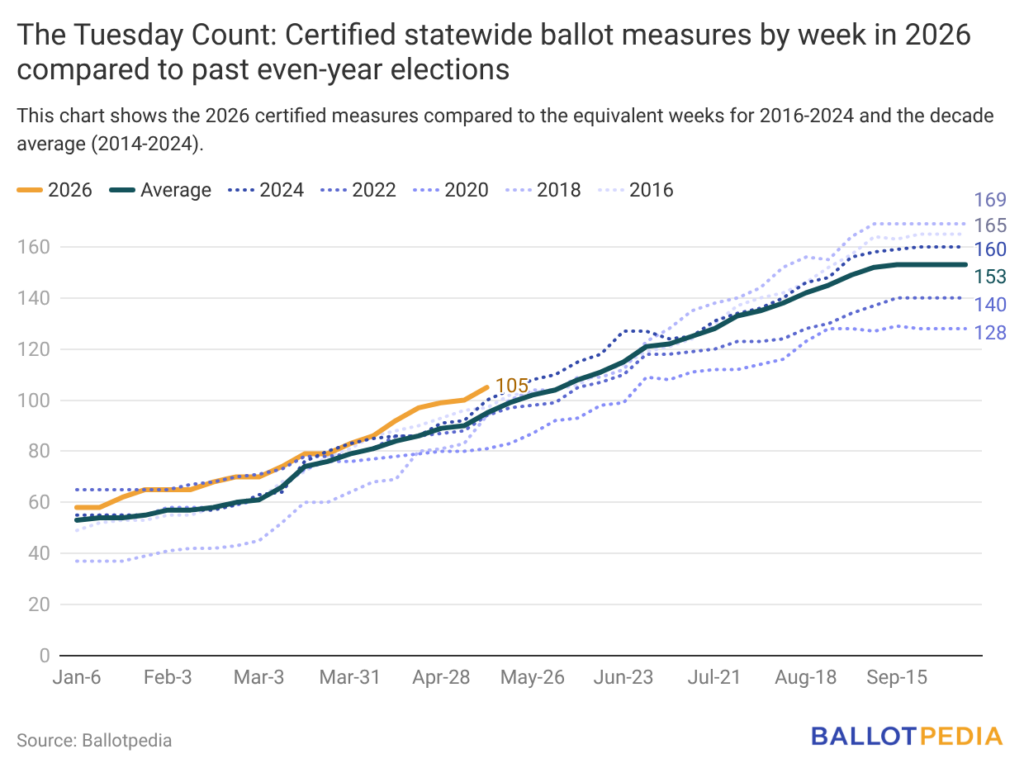
As of May 12, 105 statewide measures have been certified for statewide ballots this year — more than the historical average of 95 at this point in even-numbered years from 2014 through 2024. From 2014 through 2024, an average of 153 statewide measures were certified in even-numbered years.
Over the past two weeks, six new measures were certified:
- California Limit Compensation of Healthcare Executives Initiative
- Colorado TABOR Revenue Cap Increase for K-12 Education Measure
- Hawaii Authorize Resilient Infrastructure for Shelter and Equity (RISE) Bonds Amendment
- Iowa Two-Thirds Legislative Vote Requirement for Income Tax Increase Bills Amendment
- Louisiana One-Time Transfer of Disabled Veteran Homestead Tax Exemption for Surviving Spouses Amendment
- Louisiana Property Tax Rate Limits Based on Existing Voter-Approved Maximums Amendment
Signatures are pending verification for 17 citizen initiatives:
- California Establish Immunology and Immunotherapy Research Institute Initiative
- California Establish Personal Injury Lawyer Regulations Initiative
- California Expedited Environmental Review Process for Certain Projects Initiative
- California One-Time Wealth Tax for State-Funded Healthcare, Education, and Food Assistance Programs Initiative
- California Prohibit Taxes on Retirement Holdings and Personal Savings Amendment
- California Renew State Income Tax Increase for Education Funding Initiative
- California Require Background Checks and Sexual Assault Reporting by Rideshare Companies Initiative
- California Require Healthcare Union Member Approval for Ballot Measure Campaign Spending Initiative
- California Revenue Use Requirements for New Special Taxes Amendment
- California Spending Requirements for Federally Qualified Health Centers Initiative
- California State University Staff First-Time Homebuyer Down Payment Loan Program Initiative
- Idaho Medical Marijuana Legalization Initiative
- Idaho Reproductive Freedom and Privacy Act Initiative
- Michigan Citizenship Verification and Voter Identification Initiative
- Missouri Congressional Map Referendum
- Missouri Initiative and Referendum Powers and Legislative Change Requirements Amendment
- North Dakota Require Schools to Provide Free Meals to Students Initiative
There are currently no indirect initiatives certified to state legislatures. The Massachusetts General Court did not approve any of the 11 indirect initiatives before the May 5 deadline. As a result, campaigns must now collect a second round of 12,429 signatures by July 8 for the initiatives to make the ballot.
The most recent signature deadline for initiatives was May 5 in South Dakota. No signatures were submitted for initiatives, marking the first time since 1976 that no citizen initiatives will be on the statewide ballot in South Dakota. However, a veto referendum could still make the ballot. Click here to check out our coverage of the lack of initiatives on the state's ballot from the May 14 Daily Brew.
The next signature deadline is May 27 in Michigan for indirect initiated state statutes.
Click here for more information about the measures on statewide ballots this year.
Editor’s note: This story has been updated to correct the filing deadline for major party candidates running in Alabama's 1st, 2nd, 6th, and 7th congressional district special primaries from May 26 to May 22. May 26 is the date by which major parties must certify candidates for the primary.