



On May 8, Utah Supreme Court Justice Diana Hagen resigned, marking another structural change within the Court.
Hagan’s resignation comes after Gov. Spencer Cox (R) signed a bill on Jan. 31 to increase the number of justices on the Court from five to seven — making Utah the first state since 2016 to expand its state supreme court. Utah is now one of 29 states to have a state supreme court with seven justices. Among all states, seven is the most common number of justices for a state supreme court.
Deseret News’ Brigham Tomco wrote that the bill “coincides with an increase in workload for Utah’s highest courts, and intends to speed up decisions, according to legislative leadership. It also comes amid Republican frustration over recent rulings that have stalled legislation and scrapped legal precedent.”
The bill gives Cox the opportunity to appoint two justices to the Court. Utah uses an assisted appointment process to select justices. During this process, the governor selects a nominee from a list of recommended candidates from a judicial nominating commission. The Utah Senate then votes whether to confirm the nominee. New appointees serve for at least three years, after which they must run for retention. If a majority of voters decides to retain, justices serve subsequent ten-year terms. The judicial nominating commission has announced a list of recommended candidates to fill the vacancy that the bill created, but Cox has not announced nominees for either seat.
The judicial nominating commission has not announced a list of recommended candidates to fill the vacancy that Hagen created. Hagen's resignation means that Cox will have another opportunity to appoint a justice. It also means only one justice is running for retention on Nov. 3. Hagen was running for retention alongside Justice Jill Pohlman, who is still running for retention.
Utah is one of 14 states holding retention elections for state supreme court justices this year. A retention election happens when voters must decide whether an incumbent justice should remain in office for another term. The justice, who does not face an opponent, is removed from the position if a certain percentage of voters decide the justice should not be retained.
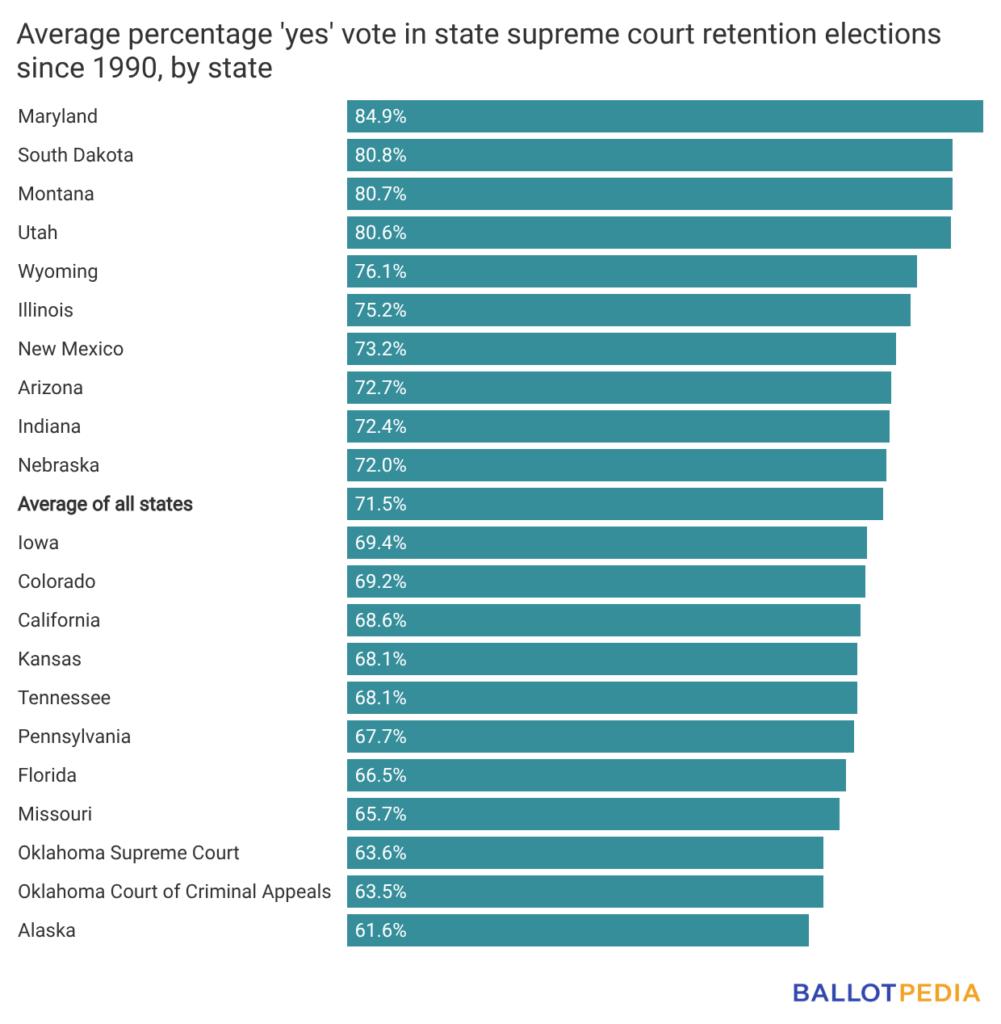
No Utah Supreme Court Justice has ever lost a retention, and in our data going back to 1990, Utah Supreme Court Justices have received an average of 80.6% of support across 17 elections. The most recent justice to stand for retention was Matthew Durrant in 2024. He received 77% of the vote favoring retaining him. Additionally, since 1990, only nine justices in seven states have lost a retention election.
At the Utah Republican Party convention in April, state party chair Robert Axon opposed retaining Hagen and Pohlman. According to Axon, his opposition stems from a July 2024 decision in which the Court ruled that the Utah Legislature violated the Utah Constitution when it repealed and replaced Proposition 4.
The citizen initiative that voters approved 50.3% to 49.7% sought to create a seven-member independent redistricting commission to draft and recommend to the Legislature maps for congressional and state legislative districts according to certain criteria. According to The Salt Lake Tribune's Emily Anderson Stern, the decision led to "a district judge subsequently order[ing] Utah to adopt a new congressional map that includes a left-leaning district."
At the time of the decision, Republican governors had appointed all five members of the Court. Specifically, Cox had appointed two — Hagen and Pohlman. Before Hagen’s resignation, Cox said he was undecided on how he would vote in the retention election.
Click here to read more about this year’s Utah Supreme Court election.