Highlights from this edition of Checks and Balances include Trump administration plans to re-combine two agencies that were split in 2011 and a discussion of notable state bills reducing agency power in 2026
In Washington
Trump admin to re-combine two agencies that were split in 2011
On April 3, the Department of the Interior announced that it would merge two agencies which the Obama administration split in 2011. The plan will create a new agency called the Marine Minerals Administration by merging the Bureau of Ocean Energy Management (BOEM) with the Bureau of Safety and Environmental Enforcement (BSEE). BOEM is an agency responsible for managing extraction of offshore energy, mineral, and other resources, while BSEE is responsible for ensuring safety and environmental protection in offshore extractive operations. The Interior Department split BOEM, BSEE, and the Office of Natural Resources Revenue from an agency called the Minerals Management Service (MMS) in 2011.
What was the Minerals Management Service?
The MMS was established within the Department of the Interior in 1982, with responsibilities for managing and overseeing the safety of offshore resource development. On May 19, 2010, in the wake of the 2010 Deepwater Horizon oil spill, then-Interior Secretary Ken Salazar issued a Secretarial Order restructuring the MMS.
Salazar’s order renamed the MMS was the Bureau of Ocean Energy Management, Regulation and Enforcement before disbanding the agency in 2011. When it was disbanded, its responsibilities were split between three new agencies: BOEM, BSEE, and the Office of Natural Resources Revenue, responsible for MMS’ revenue management functions.
According to the April 3, 2026 announcement, the BOEM and BSEE will be re-merged as the Marine Minerals Administration at an unspecified future date. The announcement did not mention the Office of Natural Resource Revenue, which is still in operation as its own agency within the Interior Department.
What were the reactions?
In the April 3 announcement, Interior Secretary Doug Burgum said that “the Department is applying what we’ve learned over the past decade to deliver clearer coordination, better service to the public and stronger, more integrated oversight of offshore energy development.”
Miyoko Sakashita, oceans director at the Center for Biological Diversity, said in a statement that “the agencies were intentionally split in the aftermath of the Deepwater Horizon oil spill because regulators were too cozy with industry, and we couldn’t trust the integrity of their work.” Harvard Law Professor Richard Lazarus, who chaired a presidential commission on the Deepwater Horizon accident, said that “the decision to merge them back again into one agency is exceedingly reckless and risks another disastrous oil spill to the detriment of both business and environmental interests.”
Sen. John Cornyn (R-Texas) supported the move, saying that “I don’t think [managing leasing and safety enforcement] need to be separated. I think lease sales should be taking into consideration safety anyway.”
Want to learn more?
In the states
Seven Republican trifecta states and one with divided government enact bills reducing agency power in 2026
The 2026 legislative session has featured a number of state-level bills affecting the administrative state, with seven Republican trifecta states enacting bills that reduce the power of state agencies. Democratic governors in Kansas and Wisconsin, which have divided governments, vetoed similar bills, with the Kansas legislature overriding this gubernatorial veto. The administrative state refers to executive branch agencies with unelected officials (in this case, at the state level) which have the authority to create, interpret, and enforce regulations.
In 2026, major bills affecting the administrative state included REINS-style bills (which require legislative approval for new agency rules exceeding a specified cost threshold) enacted in one state and passed in another and bills restricting judicial deference by state courts enacted in two states and passed in another. Five REINS-style bills and five bills restricting state judicial deference were enacted in 2025. Counting the 2026 bills, a total of 11 states have enacted REINS-style bills since 2010.
The 2026 session also saw bills enacted that limit agency power to make temporary rules, require legislative review of new rules, and that modify existing REINS-style provisions. In Oklahoma, a bill that strengthened legislative control over agency rulemaking was enacted.
Bills enacted
Kansas’s HB 2183: Gov. Laura Kelly (D) signed it on Feb. 6. This bill restricted the practice of judicial deference in state courts, requiring courts to use a de novo standard of review when determining the meaning of language in a state statute, regulation, or other document, rather than deferring to the interpretation of a state agency. The Kansas Senate passed the bill 30-10 on March 27, 2025, and the Kansas House of Representatives passed it 83-39 on January 22, 2026. Kansas has a divided government, with Republican majorities in both houses of the legislature.
South Dakota’s SB 133: Gov. Larry Rhoden (R) signed it on March 12. This bill established a REINS-style requirement for agency rulemaking, under which the legislature must approve ‘major’ proposed rules (expected to cost "businesses, individuals, other nongovernmental entities, and units of local government" $3 million or more over two years) before going into effect. The bill also established a de novo review standard for state courts hearing disputes about whether a proposed rule counts as ‘major.’ South Dakota has a Republican trifecta.
Idaho’s H 0539: Gov. Brad Little (R) signed it on March 17. This bill modified requirements for temporary agency rules, which are exempted from existing statutes requiring the legislature to approve new rules. The bill specified specific requirements for agencies to promulgate temporary rules, including a requirement that specific emergency conditions must be met before an agency may re-adopt an expired temporary rule. Idaho has a Republican trifecta.
Alabama’s SB 167: Gov. Kay Ivey (R) signed it on March 31. This bill restricted the practice of judicial deference in state courts, requiring courts to use a de novo standard of review when determining the meaning of statutory or regulatory language, rather than deferring to the interpretation of a state agency. Alabama has a Republican trifecta.
Mississippi’s HB 925: Gov. Tate Reeves (R) signed it on April 8. This bill required the Joint Legislative Committee on Performance Evaluation and Expenditure Review (PEER Committee) to review newly adopted agency rules and to report its findings to the Legislature. The bill also created a State Board of Health Professions, with a mandate to advise the Governor and Legislature on health-related professional regulation. Mississippi has a Republican trifecta.
Oklahoma’s HB 4319: Gov. Kevin Stitt (R) signed it on April 17. This bill strengthens legislative authority over agencies in Oklahoma. It restricts agency rulemaking to instances in which “the agency has been specifically and explicitly granted rulemaking authority by state law,” and specifically denies that general statutory language like the phrase "as necessary and proper" confers this authority. The bill also requires that legislative review of proposed agency rules (required under the REINS-style law promulgated in 2025) must include a determination that the agency was acting on specific statutory authority. Oklahoma has a Republican trifecta.
Georgia’s HB 1247: Gov. Brian Kemp (R) signed it on May 12. The bill restricts the practice of judicial deference in state courts, requiring courts to use a de novo standard of review when determining the meaning of constitutional, statutory, or regulatory language, rather than deferring to the interpretation of a state agency. The bill would also require rulemaking agencies to submit an economic impact statement to the Legislature when promulgating new rules, and to report the economic impact of existing rules to the Office of Planning and Budget every five years (with specified exceptions). Georgia is a Republican trifecta state.
Tennessee’s HB 1913: Gov. Bill Lee (R) signed it on May 19. The bill requires rulemaking agencies to publish the text of proposed rules, to “make a good faith effort to notify each trade association or organization” potentially affected by the rule, and for the agency to create a fiscal impact statement based on feedback received. The bill also introduces a REINS-style requirement, with rules expected to cost $1 million or more over five years (or in one year, in the case of emergency rules) needing legislative approval to go into effect. Tennessee is a Republican trifecta state, and the 11th state since 2010 to enact a REINS-style law.
Vetoed and veto overridden
Wisconsin’s SB 289: Gov. Tony Evers (D) vetoed the bill on March 20. This bill would have required agencies to offset the expected costs of new rules to businesses, local governmental units, and individuals with a separate rule reducing expected costs. The Wisconsin Senate passed the bill 18-15 on Feb. 11, and the Wisconsin Assembly passed it 53-45 on Feb. 12. Wisconsin has a divided government, with Republican majorities in both houses of the legislature.
Wisconsin’s SB 277: Evers vetoed the bill on March 20. This bill would have required that rules automatically expire seven years after being promulgated unless they are re-issued through the agency rulemaking process, a requirement called a sunset provision. The Wisconsin Senate passed the bill 18-15 on Feb. 11, and the Wisconsin Assembly passed it 53-45 on Feb. 12.
Wisconsin’s SB 276: Evers vetoed the bill on March 20. This bill would have required that a plaintiff successfully challenging the validity of an agency rule in court receive attorney fees and costs. The Wisconsin Senate passed the bill 18-15 on Feb. 11, and the Wisconsin Assembly passed it 53-45 on Feb. 12.
Wisconsin’s SB 275: Evers vetoed the bill on March 20. This bill would have required that agency statements of scope (which state law requires as a preliminary step in agency rulemaking) would expire after 30 months, and that agencies specify whether a statement of scope is beginning the permanent or emergency rulemaking process. The Wisconsin Senate passed the bill 18-15 on Feb. 11, and the Wisconsin Assembly passed it 53-45 on Feb. 12.
Kansas’ HB 2719: Gov. Laura Kelly (D) vetoed this bill on April 6, and the Kansas Legislature overrode her veto on April 9. The bill exempted technical amendments to agency rules and specific categories of rules issued by the Department of Corrections from the requirements of an existing statute. This existing statute requires various formal procedures as part of agency rulemaking, including ratification by the Legislature. The bill also added a requirement that agencies submit proposed rules to the legislative Joint Committee on Administrative Rules and Regulations. The Kansas Senate passed the bill 40-0 on March 19, and the Kansas House of Representatives passed it 122-0 on March 24. Kelly’s April 6 veto was overridden by the House 89-34 and by the Senate 38-1 on April 9. Kansas has a divided government.
As of May 19, 25 of the 47 state legislatures which convened a special or scheduled regular session in 2026 have adjourned.
Want to learn more?
Featured commentary
What does Loper Bright mean for the Democratic and Republican coalitions? Northern Illinois University Law Professor Gregory Elinson argues that the political coalitions of both the Democratic and Republic parties should reexamine their positions on the power of executive agencies in the wake of the Loper Bright decision’s transformation of administrative jurisprudence. Click here to read his discussion of the post-Loper Democratic coalition, which he argues faces a choice between continuing to support strong judicial deference standards and adopting a more skeptical approach to agency power. Click here to read his discussion of the post-Loper Republican coalition, which he argues has lost the unifying force of opposition to Chevron deference.
Regulatory highlight
In this section, we highlight one of several regulations reviewed by the Office of Information and Regulatory Affairs (OIRA) each month and discuss an aspect of the federal Congressional Review Act (CRA), which is an increasingly used mechanism for repealing executive agency regulations. In this edition, we provide an update on how federal legislators have used the Congressional Review Act in the 119th Congress.
Notable regulations
- The Office of Information and Regulatory Affairs (OIRA) completed its review of an Internal Revenue Service (IRS) final rule identifying occupations that customarily received tips on or before December 31, 2024. It provided a definition of qualified tips for purposes of the income tax deduction as enacted in the One Big Beautiful Bill Act.
Congressional Review Act
The Congressional Review Act (CRA) allows Congress to repeal executive agency rules with joint resolutions of disapproval. Under the CRA, Congress has 60 working days after a rule has been submitted to Congress to introduce a joint resolution of disapproval.
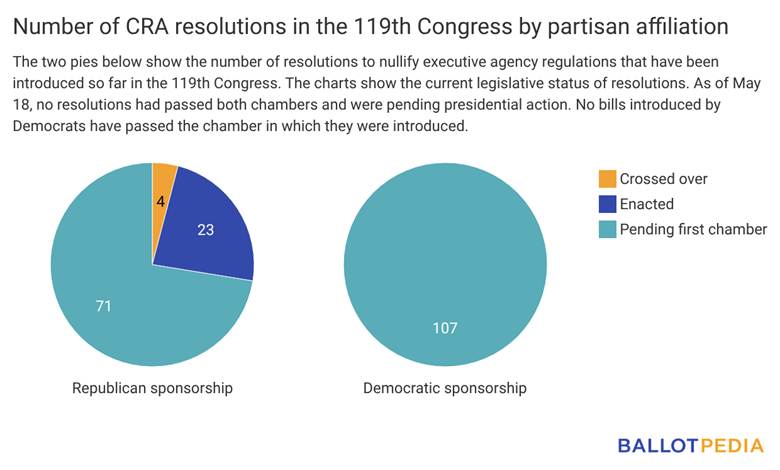
In the last edition of Checks and Balances, we reviewed the partisan breakdown of resolutions introduced under the CRA so far in the 119th Congress to nullify regulations. Since then, President Donald Trump (R) signed one resolution nullifying a Biden-era regulation, and ten Democrats and one Republican have introduced 46 resolutions to nullify Trump administration regulations as oof May 18.
- Want to learn more?
Pick of the news
Federal
Members of National Science Board dismissed. President Trump dismissed all 22 members of the National Science Board, an independent body responsible for helping to govern the National Science Foundation. Science
GAO: Improper agency payments up $24 billion in 2025. In a new report, the Government Accountability Office found that executive agencies made $186 billion in improper payments in 2025, $24 billion more than in 2024. While most of these improper payments were overpayments, at least $10 billion of the total is money that agencies improperly withheld from spending. Government Executive
House spending bill would cut GAO budget by 25%. The House Appropriations legislative branch subcommittee voted to approve a spending bill that would cut the Government Accountability Office budget by 25%. If the bill is enacted, the GAO would need to cut about 1,000 employees. The bill language would also reduce the GAO’s ability to sue to obtain agency records under the Impoundment Control Act. Federal News Network
2027 budget request would cut inspector general office budgets by 12%. President Trump’s 2027 budget request would cut funding to inspector general offices in the executive branch by an average of 12%. The proposed cuts vary by inspector general office, with the IG offices in the Interior and Justice Departments each being cut by 28%. Government Executive
OPM exempts political appointees from performance appraisal requirements. The Office of Personnel Management exempted Schedule C and Schedule G federal employees from newly revised performance appraisal standards. Schedule C and Schedule G employees are appointed by the President. Schedule G was created in 2025. FedWeek
GSA, OPM to move into same headquarters building. The General Services Administration (which is responsible for managing federal properties) and the Office of Personnel Management (which manages the federal workforce) have announced plans to move into the same headquarters building. The GSA will temporarily move into the OPM’s building until renovations of the GSA headquarters are completed. Both agencies then plan to move to the renovated building. Federal News Network
State
Massachusetts Attorney General says state Auditor can hire attorney in dispute over legislative audit. Massachusetts Attorney General Andrea Campbell said that State Auditor Diana DiZoglio can hire an attorney to represent her office in a lawsuit over a voter-approved legislative audit of the Legislature, after DiZoglio narrowed the scope of the proposed audit in oral arguments before the Massachusetts Supreme Court. Boston.com
Montana judge finds appointment of sitting legislator was unconstitutional. A state district court judge has found that Montana Gov. Greg Gianforte’s (R) appointment of Marta Bertoglio to head the state Commerce Department was unconstitutional because she was a sitting legislator when she was appointed. News From the States
Federal appellate court blocks California law requiring federal agents to wear ID. A three-judge panel of the Ninth Circuit Court of Appeals blocked a California law that required federal agents to display identification. PBS News
Legislative Tracking Update
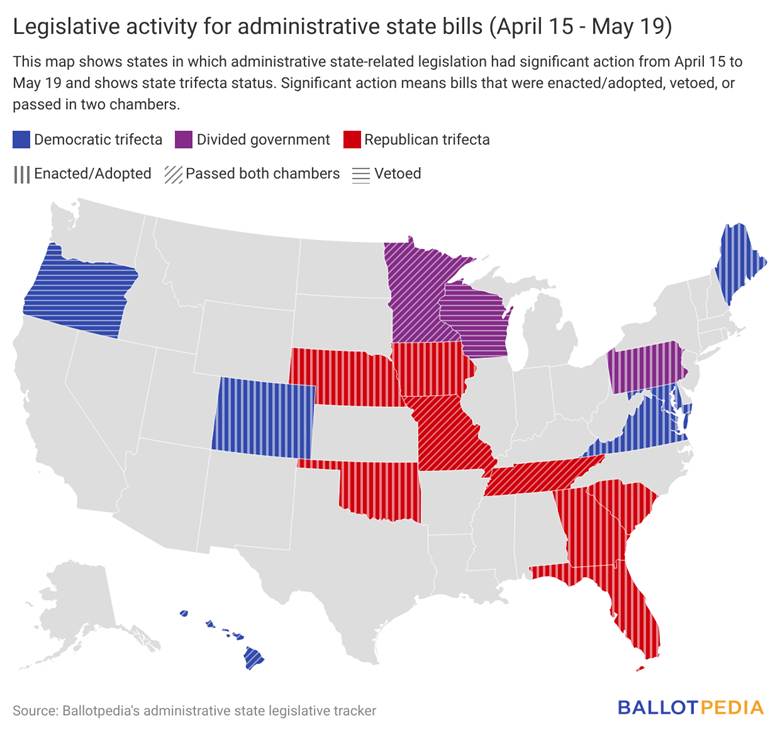
Since our last newsletter edition, Ballotpedia tracked significant legislative action (enactments, vetoes, and passage through both chambers) in 17 states on 60 bills related to the administrative state, as of May 19.
Colorado Gov. Jared Polis (D) signed three bills and the Colorado legislature passed 15 bills. Florida Gov. Ron DeSantis (R) signed four bills and Georgia Gov. Brian Kemp (R) signed five bills. The Hawaii legislature passed two bills. Iowa Gov. Kim Reynolds (R) signed one bill. Maryland Gov. Wes Moore (D) signed seven bills. Maine Gov. Janet T. Mills (D) signed one bill. The Minnesota and Missouri legislatures each passed one bill. Nebraska Gov. Jim Pillen (R) and Oklahoma Gov. Kevin Stitt (R) each signed two bills. Pennsylvania Gov. Josh Shapiro (D) signed one bill. South Carolina Gov. Henry McMaster (R) signed one bill, and the South Carolina legislature passed one bill. The Tennessee legislature passed two bills. Virginia Gov. Abigail Spanberger (D) signed four bills, and the Virginia legislature passed two bills. Oregon Gov. Tina Kotek (D) vetoed one bill, and Wisconsin Gov. Tony Evers (D) vetoed four bills.
Ballotpedia tracked a total of 1,880 bills related to the administrative state in 2026, as of May 19.