


In this week’s edition of Economy and Society:
- Texas, Nebraska, Iowa, West Virginia sue ISS over ESG disclosures
- ESG legislation update
- Proxy advisors recommend voting against Exxon's Texas move
- Exxon says ISS and Glass Lewis failed to disclose Texas legal dispute
- Consumer group warns 75 companies on plastics organization membership
- Science Based Targets initiative expands mission to implementation
In the states
Texas, Nebraska, Iowa, West Virginia sue ISS over ESG disclosures
What’s the story?
Four Republican state attorneys general filed lawsuits on May 20, 2026, against Institutional Shareholder Services (ISS), accusing the proxy advisory firm of violating state consumer protection laws by failing to disclose that its voting recommendations prioritize environmental, social, and governance (ESG) policies over clients' financial interests.
Texas Attorney General Ken Paxton (R), Nebraska Attorney General Mike Hilgers (R), Iowa Attorney General Brenna Bird (R), and West Virginia Attorney General Patrick Morrisey (R) filed separate complaints in their respective states. The lawsuits claim ISS advertised its proxy voting recommendations as independent and objective while coordinating with climate activist groups and incorporating ESG mandates into its benchmark voting guidelines without adequate disclosure to clients.
According to a September 2025 Congressional Research Service report, ISS is one of two firms that control more than 90% of the proxy advisory market. The company provides voting recommendations to institutional investors on shareholder proposals at publicly traded companies.
Why does it matter?
The lawsuits allege ISS violated state consumer protection laws by misrepresenting the nature of its services. The Texas complaint, filed under the Texas Deceptive Trade Practices Act, seeks civil penalties of up to $10,000 per violation and a court order requiring ISS to disclose its focus on ESG initiatives to clients.
The complaints cite ISS's Climate Accountability policy, which recommends voting against directors at companies the firm determines have not taken sufficient steps to address climate risks. The lawsuits also reference ISS's ownership structure, noting that its majority owner Deutsche Börse joined the Net Zero Financial Service Providers Alliance in 2022, committing to achieve net zero greenhouse gas emissions by 2050. The complaints allege ISS failed to disclose these affiliations and its membership in the Interfaith Center on Corporate Responsibility, an organization focused on ESG advocacy.
Paxton said, "ISS has enormous influence over how billions of dollars are invested and managed across this country, and they have abused that influence in order to push woke ideology."
An ISS representative said, “ISS’ job is to provide sophisticated institutional investor clients with independent, timely, and expert research and vote recommendations based on the proxy voting policies the clients have selected or customized based on their determination of the best interests of the beneficiaries they serve.”
What’s the background?
ISS and Glass Lewis have faced scrutiny from Republican officials over their proxy voting guidelines. Paxton announced an investigation into both firms in September 2025. Glass Lewis and ISS filed separate lawsuits in 2025 and 2026 challenging state laws in Texas, Indiana, and Kansas that require proxy advisors to disclose when their recommendations differ from management positions or are based on non-financial factors.
President Donald Trump (R) issued an executive order on Dec. 11, 2025, directing the Securities and Exchange Commission to expand oversight of proxy advisory firms regarding diversity, equity, and inclusion and ESG policies.
ESG legislation update
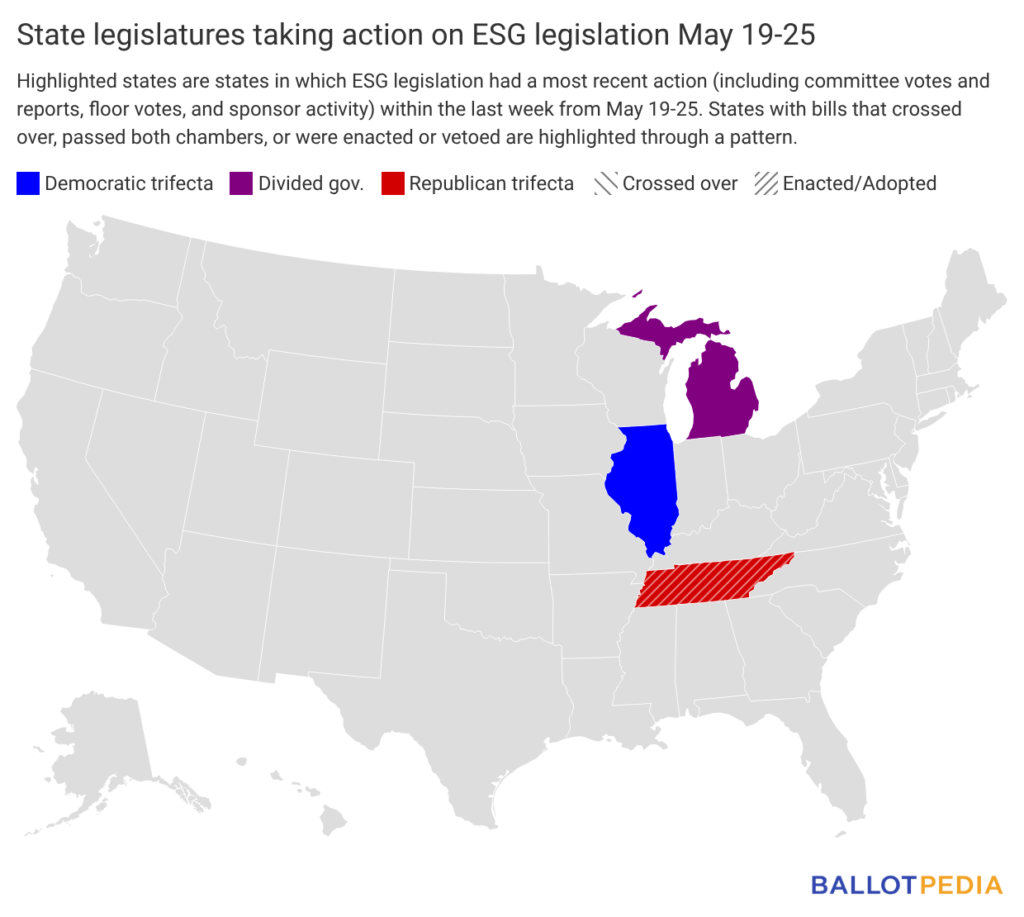
Three states took action on five ESG-related bills since May 19, 2026. Tennessee Governor Bill Lee (R) signed Senate Bill 2641 on May 19, 2026, requiring fiduciaries for certain local public pension plans to invest and vote proxies solely for financial reasons and prohibiting the subordination of beneficiaries’ financial interests to ESG considerations unless supported by documented financial analysis.
States with legislative activity on ESG last week are highlighted in the map below. Click here to see the details of each bill in the legislation tracker.
On Wall Street and in the private sector
Proxy advisors recommend voting against Exxon's Texas move
What’s the story?
Proxy advisory firms ISS and Glass Lewis recommended that Exxon Mobil shareholders vote against the company's proposal to change its legal domicile from New Jersey to Texas. Exxon shareholders will vote on the redomiciling proposal at the company's annual meeting on May 27.
The proxy advisors said the move could restrict shareholder rights and limit shareholders' ability to seek legal recourse. ISS wrote that "the company has demonstrated a degree of hostility to shareholders' exercise of certain of these key accountability mechanisms in recent years." Glass Lewis said in its benchmark advisory policy that "forum selection clauses are not in shareholders’ best interests.”
New York City Comptroller Mark Levine (D), who oversees the city's worker pension funds, also opposed the move, saying it "sets the stage for the potential erosion of shareholder rights under Texas state law."
Exxon responded in a Tuesday filing that Glass Lewis was ill-informed in its recommendation and that the New York City Comptroller's criticism was politically motivated. The company said exclusive forum provisions are standard practice among most S&P 500 companies.
Why does it matter?
Texas law makes it harder for shareholders to submit proposals and bring lawsuits compared with New Jersey. Under Texas law, companies incorporated in the state can require investors to hold at least $1 million in market value or 3% of voting shares for six months before submitting shareholder proposals. Texas also allows companies to require shareholders to own at least 3% of shares to bring lawsuits for breaches of fiduciary duty and self-dealing. New Jersey imposes lower thresholds for both actions.
Exxon said in announcing the move that Texas has established specialized business courts "designed to resolve complex disputes efficiently" that "apply clear, statute-based standards." Exxon has faced shareholder proposals in recent years urging the company to evaluate climate and human rights risks.
What’s the background?
ISS and Glass Lewis control approximately 90% of the proxy advisory market. Multiple companies, including Tesla, SpaceX, Coinbase, and Dillard's, have moved their state of incorporation to Texas in recent years.
ISS and Glass Lewis filed separate lawsuits in July 2025 challenging Texas Senate Bill 2337, a state law regulating proxy advice related to public companies incorporated or headquartered in Texas. On Aug. 29, 2025, a U.S. District Court judge issued preliminary injunctions blocking enforcement of the law against both firms while litigation proceeds. In February 2026, Texas abandoned efforts to appeal the injunctions after determining the Fifth Circuit was unlikely to lift the hold.
Exxon says ISS and Glass Lewis failed to disclose Texas legal dispute
What’s the story?
Exxon Mobil said on May 21, 2026, that proxy advisory firms ISS and Glass Lewis have a conflict of interest in recommending that investors vote against the company's plan to redomicile in Texas from New Jersey. Exxon said the firms should have disclosed their ongoing legal battle with Texas Attorney General Ken Paxton (R) under their conflict-of-interest policies.
Exxon said it intends to run full-page ads in major newspapers, including The Wall Street Journal, highlighting the conflict of interest it alleges. The ads state: "We're not surprised the two dominant proxy advisory firms ISS and Glass Lewis are against our redomiciliation to Texas. But we are surprised both firms didn't disclose their ongoing litigation with the Texas Attorney General under their conflict-of-interest policies."
A Glass Lewis representative said "there is no conflict of interest" and that the firm's proxy research "is entirely separate from our lawsuit challenging Texas Senate Bill 2337, which is a matter of public record and has been disclosed on our website."
What’s the background?
Exxon's accusation centers on the ongoing litigation between the proxy advisors and Paxton's office over Texas Senate Bill 2337. Exxon argues the firms have little incentive to support proposals tied to Texas given their legal dispute with the state.
On May 20, 2026, Paxton, a candidate for the Texas GOP Senate nomination, filed a separate lawsuit against ISS alleging the firm misled investors. In announcing the suit, Paxton said ISS is trying to obstruct Exxon's planned move to Texas and is prioritizing "its own environmental, social, and governance agenda over the fiscal well-being of its clients."
An ISS spokesman said the firm would defend itself in court and that Paxton's allegations lack merit.
Consumer group warns 75 companies on plastics organization membership
What’s the story?
Consumers' Research, a consumer advocacy group, sent letters on May 22, 2026, to 75 companies warning of legal consequences if they do not end memberships in plastic-focused organizations the group characterized as politically radical. The companies include Costco, Microsoft, Aldi, Amazon, General Mills, and S.C. Johnson.
In the letters, Consumers' Research told companies they face "serious potential antitrust and related legal exposure" from participation in the U.S. Plastics Pact, the Sustainable Packaging Coalition, and the Consumer Goods Forum. Executive director Will Hild said the group is "putting companies on notice that by colluding with [those] organizations… they are prioritizing a political agenda over their consumers."
Why does it matter?
The warning follows a multi-state coalition led by Florida Attorney General James Uthmeier (R) that put the same 75 companies on notice in February 2026 for involvement in practices potentially violating antitrust and consumer protection laws. The Consumers' Research letters increase pressure on companies to withdraw from plastics initiatives, potentially disrupting coordinated efforts across the industry.
Consumers' Research argued that plastics initiatives "are not about lowering costs for consumers, they are about using political ideology to eliminate products, reduce quality, and drive-up costs on goods."
What’s the background?
Florida Attorney General James Uthmeier (R) announced on Feb. 10, 2026, that he and nine other Republican attorneys general sent notices to nearly 80 companies involved with the U.S. Plastics Pact, the Consumer Goods Forum, or the Sustainable Packaging Coalition, warning that participation in the groups could expose companies to antitrust and consumer-protection liability.
On Oct. 29, 2025, the attorneys general sent letters to the organizations themselves raising concerns that their coordinated packaging standards and sustainability targets may violate the Sherman Antitrust Act and state antitrust laws.
Uthmeier said "multiple advocacy organizations have pressured companies into artificially changing the output and quality of their goods and services in [a] way that normal market forces would not otherwise bring about." The attorneys general stated that companies should anticipate formal investigative demands, subpoenas, or other compulsory legal processes, and directed the companies to preserve documents, communications, and data relevant to these matters.
In the spotlight
Science Based Targets initiative expands mission to implementation
What’s the story?
On May 22, the Science Based Targets initiative (SBTi) announced a new five-year strategy that expands its mission from climate target-setting and validation to supporting companies in implementing their climate goals. The organization said it will offer tailored target-setting approaches focused on what companies can influence and provide sector-specific guidance for different industries and geographies.
SBTi Chief Executive David Kennedy said the shift reflects demand from companies for "more actionable guidance to translate climate ambition into action, as well as clearer pathways and better data." The organization said it will consolidate data on corporate emissions and investments and provide benchmarking data to companies on peer progress.
SBTi was founded in 2015 and became an independent organization in 2023. More than 13,000 companies globally have set or committed to set science-based targets through the organization.
What’s the background?
The announcement follows investigations by Republican state attorneys general into SBTi's practices. Florida Attorney General James Uthmeier (R) launched an investigation in August 2025 into SBTi and the Climate Disclosure Project, alleging deceptive trade practices and antitrust violations.
In July 2025, 23 Republican state attorneys general sent a letter to SBTi warning that the organization and financial institutions that commit to its standards "risk violating federal and state antitrust laws as well as state consumer protection laws."