


While congressional and state legislative districts are supposed to be redrawn every 10 years, this is not always the case with state supreme court districts. In fact, Mississippi was set to redraw its districts for the first time since 1987, but the U.S. Supreme Court’s ruling in Louisiana v. Callais led to the cancellation of a court order for the state to do so.
On May 11, after the ruling in Louisiana v. Callais, the 5th U.S. Circuit Court of Appeals canceled a U.S. District Court judge’s 2025 order that the Mississippi Legislature redraw its districts to include a majority-Black district to be in accordance with the Voting Rights Act. Subsequently, Gov. Tate Reeves (R) canceled a special session to redraw the districts, though he said the Legislature will likely redraw the judicial, legislative, and congressional maps in the future.
Two states that have recently redrawn their districts are Illinois and Louisiana. The Illinois Legislature redrew the state’s districts in 2021, the first time since 1964. The Louisiana Legislature redrew the state’s districts in 2024 for the first time since 1997 to create a second Black-majority district.
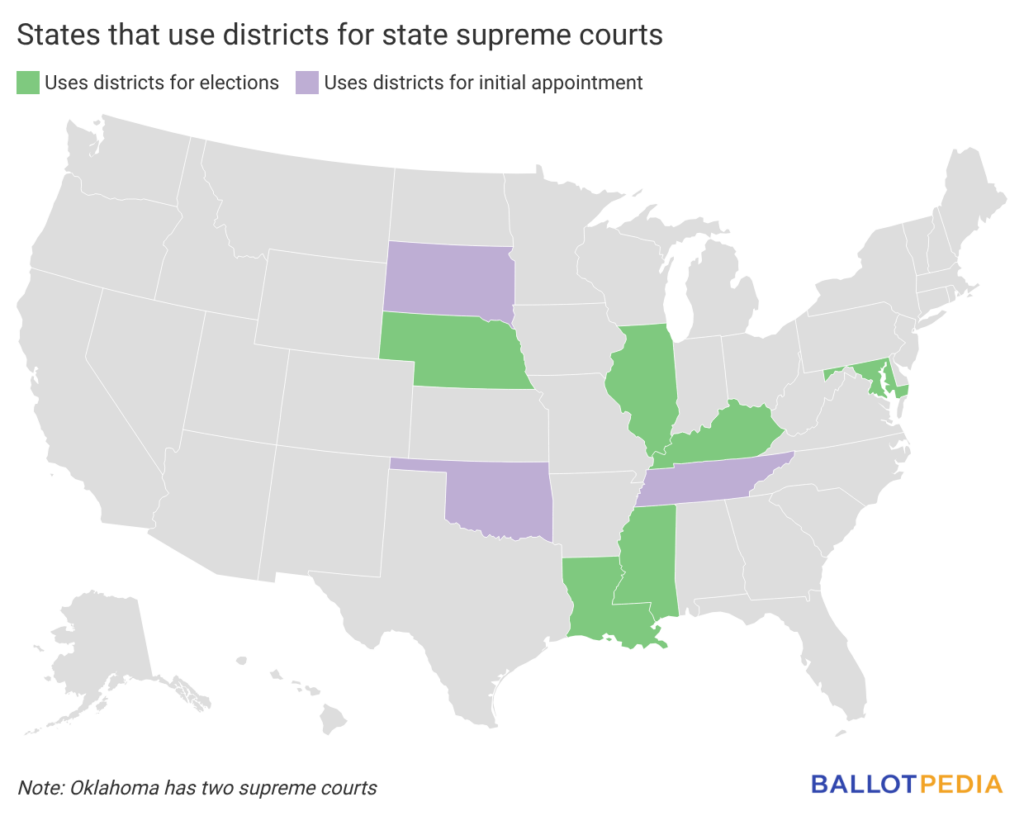
States use supreme court districts in one of two ways — for all elections to the court or for initial appointment after which all justices must run in statewide retention elections.
Mississippi is one of six states that use districts for supreme court elections, along with Illinois, Kentucky, Louisiana, Maryland, and Nebraska. Illinois and Louisiana use partisan elections, while Kentucky and Mississippi use nonpartisan elections, and Maryland and Nebraska use retention elections.
South Dakota, Tennessee, and Oklahoma use districts for initial appointment after which all justices must run in statewide retention elections. Oklahoma uses districts for both its Supreme Court and Court of Criminal Appeals. Oklahoma is one of two states nationwide that have two courts of last resort, one for civil appeals and one for criminal appeals.
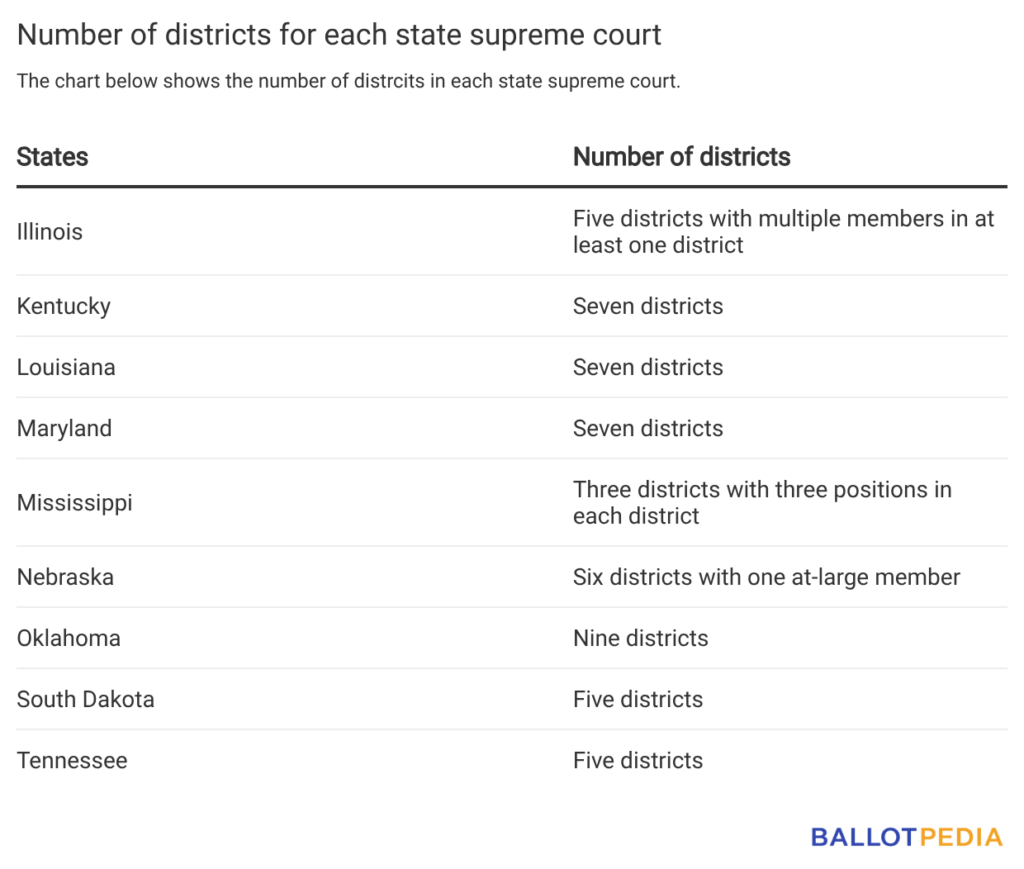
The number of districts varies by state, ranging from three to nine. Some courts have multiple members serving in a district, such as Illinois, where District 1, based in Cook County, has three justices, while the other districts have only one. In Mississippi, there are three districts, each with three positions. In Nebraska, six of the justices are elected from districts, while the chief justice is an at-large position.
Although the states named above use districts for elections or appointments, they hear cases as one court.
Thirty-two states are holding supreme court elections this year, including Kentucky, Louisiana, and Maryland. Click here to read more about state supreme court elections this year.