


Welcome to the Monday, June 1, 2026, Brew.
By: Lara Bonatesta
Here’s what’s in store for you as you start your day:
- North Carolina voters to decide on two measures on property and income tax limits in November
- The Arizona, California, and Rhode Island legislatures have deadlines to put measures on the November ballot this month
- The results from Ballotpedia’s March 2026 school board member survey
North Carolina voters to decide on two measures on property and income tax limits in November
The General Assembly of North Carolina approved two constitutional amendments on property and income tax limits for the Nov. 3 ballot. Legislators passed both amendments on May 20.
The first amendment, introduced as Senate Bill 1080 (SB 1080) on May 13, would prohibit raising the state income tax rate above 3.5%. As of 2026, North Carolina has a flat individual income tax rate of 3.99%. Currently, Section 2, Article 5 of the North Carolina Constitution sets the maximum allowable income tax rate at 7%.
According to the Tax Foundation, North Carolina is one of 15 states with a flat income tax. Compared to other states with flat rates, North Carolina’s rate falls roughly in the middle (the eighth lowest). If North Carolina’s rate is lowered to 3.5%, it would be the seventh-lowest among these states.
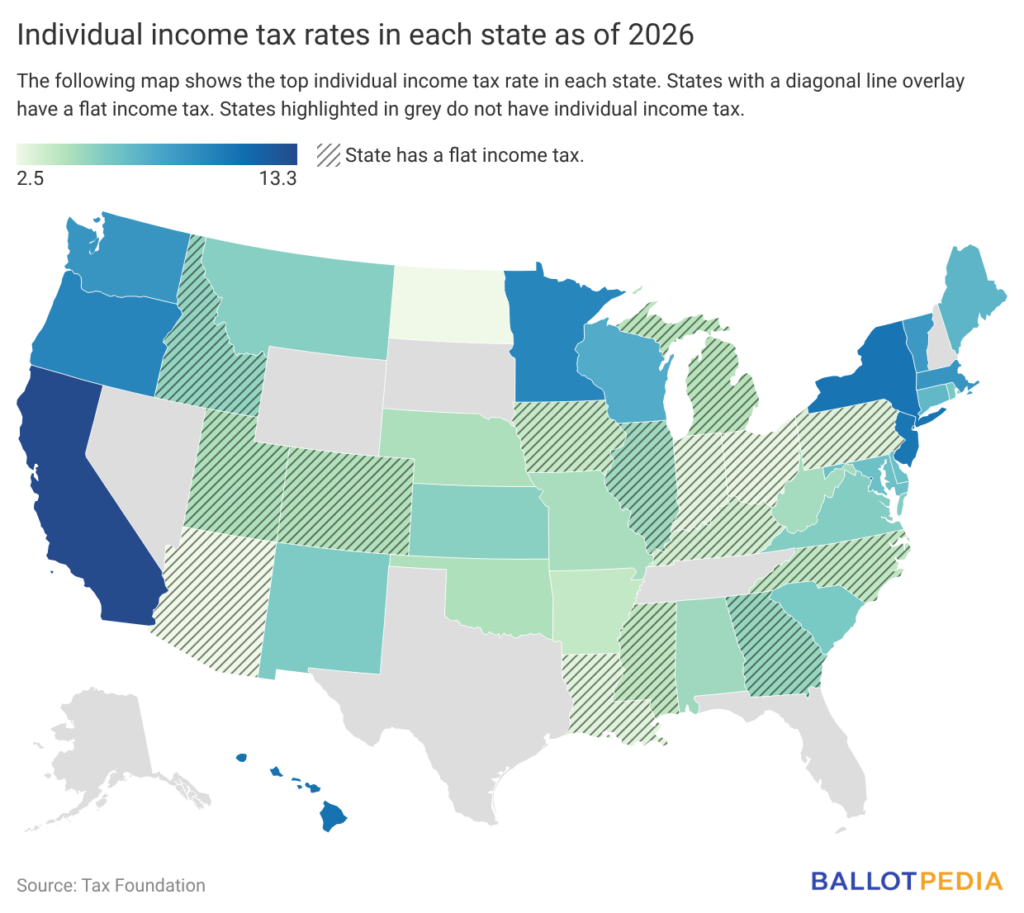
In 2018, voters approved a constitutional amendment lowering the maximum allowable state income tax rate from 10% to 7%. The vote was 57.4% to 42.6%.
The second proposed amendment, introduced as House Bill 1089 (HB 1089) on April 28, would require the General Assembly to pass laws limiting property taxes increases. Under the amendment, the General Assembly would not be permitted to authorize local governments to levy taxes on property, “except for purposes authorized by general law uniformly applicable throughout the State, unless the tax is approved by a majority of the qualified voters of the unit who vote thereon.” Currently, Section 2, Article 5 of the state constitution does not have such restrictions.
Both legislative chambers approved SB 1080 and HB 1089 in May.
The state Senate approved SB 1080 30-18, and, with one seat vacant, the state House approved it 73-46. The state Senate approved HB 1089 31-15, and the state House approved it 73-46. Votes in both chambers on each amendment were mostly split along party lines, with Republicans voting in support and most Democrats voting in opposition. The two independent members of the state House voted in support of both bills.
North Carolina is one of 11 states with a divided government. Republicans have a 30-20 majority in the state Senate and a 71-47-2 majority in the state House. Governor Josh Stein is a Democrat.
In North Carolina, a 60% vote is required during a single legislative session for the General Assembly to place a constitutional amendment on the ballot. That amounts to a minimum of 72 votes in the North Carolina House of Representatives and 30 votes in the North Carolina Senate, assuming no vacancies.
With the passage of these amendments, three measures are set to appear on the Nov. 3 ballot. Voters will also decide on a constitutional amendment that would require all voters to show photo identification. Currently, the photo ID requirement applies only to those voting in person.
In even years between 2010 and 2024, there were an average of 1.8 measures on the ballot in North Carolina.
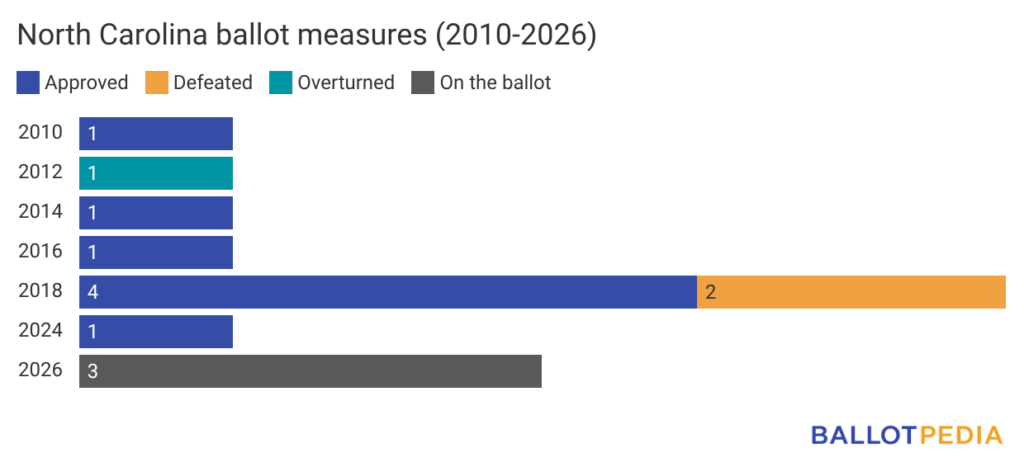
Click here and here to learn more about the tax measures and here to learn more about North Carolina’s 2026 ballot measures.
The Arizona, California, and Rhode Island legislatures have deadlines to put measures on the November ballot this month
The Legislatures in Arizona, California, and Rhode Island have June deadlines for placing measures on the ballot for voters to decide. As these deadlines approach, assuming there’s no change in the legislative calendar, here’s a look at what might be on the ballot in each state in November.
Arizona
The Arizona Legislature was set to adjourn on April 25, but extended the session until June 30. The Legislature can refer both constitutional amendments and statutes to the ballot with a simple majority vote in each chamber. Referred statutes do not require the governor's signature. Republicans control both chambers.
There are 31 measures currently before the Legislature — 21 constitutional amendments and 10 statutes. These have passed one chamber but have not yet received a vote in the other. Here are some of the most interesting topics and measures. Click here for a full list.
Constitutional Rights:
- One measure would prohibit government agencies, including public education systems, from requiring written or oral statements supporting "race-based diversity, equity and inclusion or intersectionality in contemporary American society" beyond the 14th Amendment. (House vote: 31-23, along party lines)
- Another would establish a state constitutional right to refuse any government-mandated medical product or treatment. (House vote: 31-23, along party lines)
Criminal Justice:
- One proposal would allow individuals sentenced to the death penalty to choose their execution method from a firing squad, lethal injection, or lethal gas. (Senate vote: 16-9, along party lines)
- The other would prohibit photo traffic enforcement systems. (Senate vote: 16-12, along party lines)
Education:
- prohibiting public school resources from supporting labor organizations (House vote: 31-25, along party lines)
- prohibiting school employees from using a pronoun inconsistent with a student's sex or a name other than their official school record name without written parental consent (Senate vote: 16-11, along party lines)
- prohibiting schools and athletic associations from allowing individuals to use restrooms, locker rooms, or other private facilities that do not correspond to their sex. (House vote: 32-25, along party lines)
Elections:
- requiring voter ID in the state constitution (House vote: 32-27, along party lines)
- prohibiting foreign nationals from contributing to ballot measure campaigns (Senate vote: 16-13, along party lines)
- moving the early ballot return deadline from 7 p.m. on Election Day to 7 p.m. the Friday before (Senate vote: 16-11, along party lines)
Government:
- increasing the mandatory retirement age for judges from 70 to 75 (Senate vote: 17-13, along party lines)
- increasing the size of the state House of Representatives from 60 to 90 members (Senate vote: 16-10, 15 Republicans voted yes, one Republican and nine Democrats voted no)
Taxes: One measure would exempt virtual currency from state property tax. The measure defines virtual currency as "a digital representation of value that functions as a medium of exchange, a unit of account and a store of value other than representation of the United States Dollar or a foreign currency." (Senate vote: 16-11, along party lines)
California
The California Legislature doesn't adjourn until Aug. 31, but measures must be certified by June 25 (131 days before the general election). The Legislature can waive this deadline because it's set by statute.
The Legislature can place both constitutional amendments and statutes on the ballot. A two-thirds vote is needed in each chamber to refer constitutional amendments and bond measures. A simple majority is needed to refer statutes. The governor's signature is needed on statutes and bond measures. Democrats have a two-thirds supermajority in both chambers.
The following amendments passed one chamber:
- The Changes to Public Utilities Commission Amendment would make several changes to the California Public Utilities Commission (CPUC), which regulates public utilities. It would expand the CPUC board from five to nine members, with legislative leaders filling the four new seats rather than the governor. It would also require the CPUC to consider affordability when setting utility rates and provide that the Legislature has the authority to assign broadband and telecommunications oversight to agencies other than the CPUC. (Assembly vote: 67-1, bipartisan)
- The Remove Public Education from Affirmative Action Ban Amendment would narrow the state's affirmative action ban in public education to higher education admissions and enrollment. (54-14, along party lines)
There are also three proposed bond measures – two that focus on housing and one that focuses on education.
Rhode Island
The Rhode Island General Assembly is scheduled to adjourn on June 30. Legislators have considered two constitutional amendments. The General Assembly could also consider several general obligation bond measures. A simple majority vote is needed in each legislative chamber to place constitutional amendments or bond measures on the ballot. Bond measures require the governor's signature. Rhode Island has a Democratic trifecta.
- The Environmental Rights Amendment would state that people "have an inherent, inalienable, indefeasible, and self-executing right to clean air, clean water, healthy and uncontaminated soil, a life-supporting climate, and the preservation of the environment's natural, scenic, and recreational values." The amendment also says that the state shall serve as trustee of the state's natural resources for "the benefit of all the people, including both present and future generations." (Senate vote: 32-4, along party lines)
- The Right to Public Education Amendment would "guarantee an equitable, adequate and meaningful education to each child." (Senate vote: 32-3, along party lines)
Deadlines for a Legislature to put a measure on the ballot often line up with the end of its legislative session. Click here to see a list of 2026 legislative session dates. Plus, check out our weekly Tuesday Count for updates on the number of statewide ballot measures certified for upcoming elections. The next citizen initiative signature deadline is June 21 in Montana for initiated state statutes and constitutional amendments.
Click here to see a list of measures before the legislature in each state, as well as ballot initiatives that have been filed or cleared for circulation, depending on state processes.
The results from Ballotpedia’s March 2026 school board member survey
School boards in rural, suburban, and urban districts serve different communities and face fundamentally different challenges. A Ballotpedia survey of 656 school board members — two-thirds of them from rural districts — found that the challenges rural boards face are distinct from those in urban and suburban areas.
Sixty-one percent of rural respondents said they faced challenges that peers in other district types didn’t, compared to 41% of suburban and 35% of urban respondents. Those specific challenges included funding constraints, geographic isolation and transportation, declining enrollment, unique social dynamics, and teacher recruitment and retention.
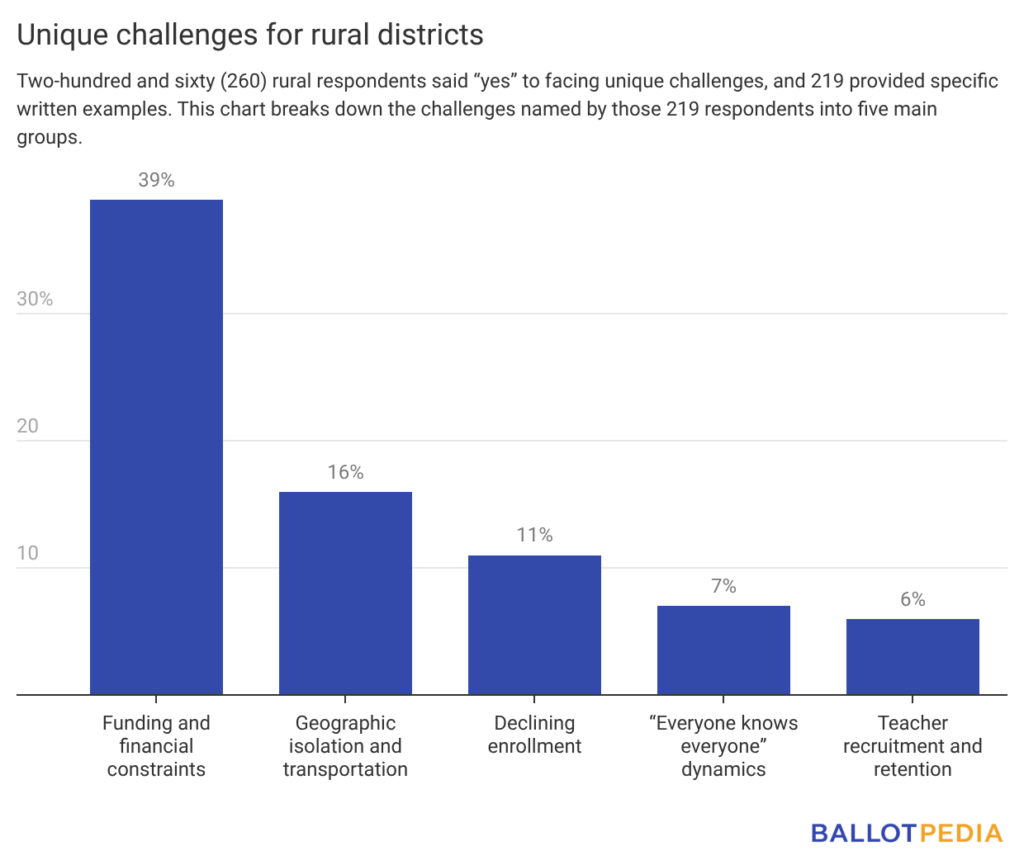
How school board members from rural, suburban, and urban districts engaged with their communities also differed in the following areas:
- Community member school board meeting attendance: Fifty-two percent of rural respondents said their most well-attended meeting drew fewer than 15 people. Thirty-two percent of suburban respondents and 22% of urban respondents said the same.
- How often school board members heard from community members: Suburban board members were more likely to hear from parents or community members a few times a month Thirty-five percent of rural respondents heard from parents or community members a few times a month, compared to 43% of suburban respondents and 18% of urban respondents. Thirteen percent of rural respondents heard from them weekly, compared to 22% of suburban respondents and 34% of urban respondents.
- How school board members communicated with the community: Respondents said they communicated with the community through multiple channels. Rural school board members were less likely to use a direct website or social media, but were more likely to post information in a public location.
- Media coverage of school board meetings. Twenty-four percent of rural respondents said local media either didn’t exist or never attended their meetings. Combined with the 21% who said media rarely attended, 45% of rural boards operated with minimal media presence. Forty-six percent of suburban and 43% of urban respondents said they operated with minimal media presence.
Thirty percent of rural respondents said their community was more divided than it was five years ago, 24% said it was less, and 46% said it was about the same. Thirty-six percent of suburban respondents said their community was more divided, 30% said it was less, and 38% said it was about the same as it was five years ago. Eighteen percent of urban respondents said their community was more divided, 34% said it was less, and 47% said it was about the same as it was five years ago.
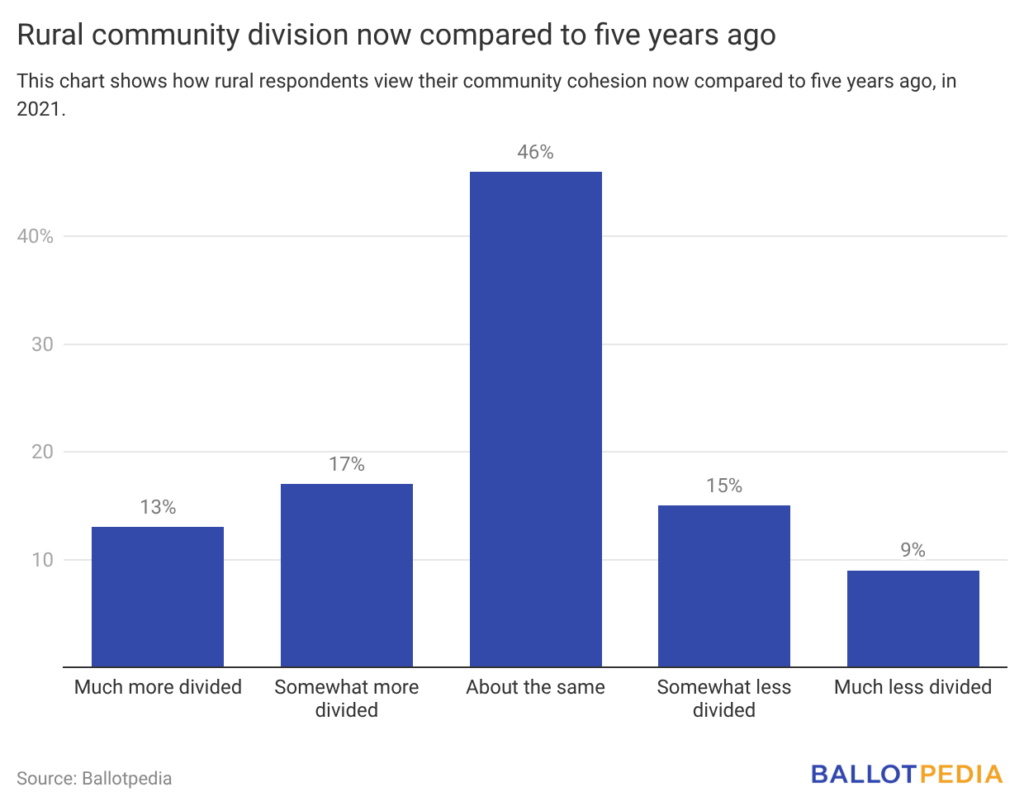
To view all the results and a detailed breakdown of the data, click here.