


Welcome to the Friday, June 5, 2026, Brew.
By: Lara Bonatesta
Here’s what’s in store for you as you start your day:
- Louisiana voters will decide on 10 legislatively referred ballot measures in Nov. 2026, the most since 2014
- Senate moves reconciliation 2.0 to the floor for debate after stalled negotiations
- Six statewide candidate filing deadlines in the next two weeks
Louisiana voters will decide on 10 legislatively referred ballot measures in Nov. 2026, the most since 2014
The Louisiana Legislature adjourned on June 1, with a total of 10 ballot measures certified for the Nov. 3 ballot. This is the most since 2014. In May, the Legislature voted to put nine measures on the Nov. 3 ballot, joining one that was certified in June 2025. A simple majority was required in each legislative chamber to put the amendments on the ballot. The governor’s signature was not required.
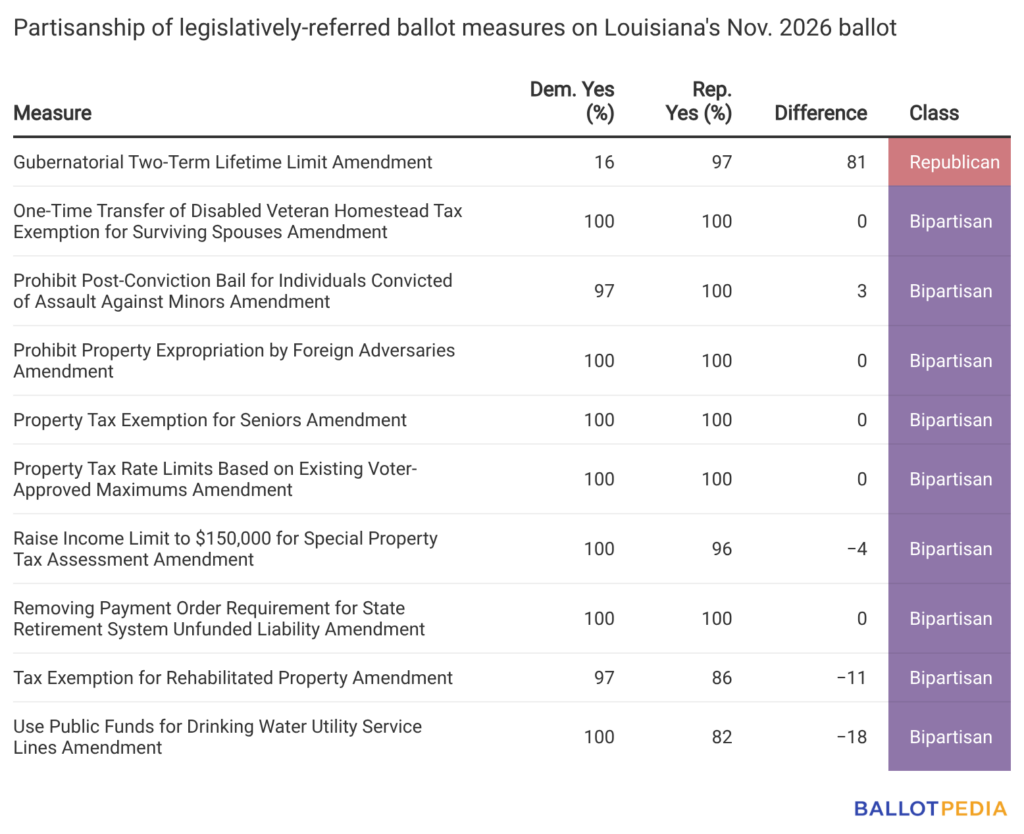
All but one of the measures received support from a majority of state legislators of both parties. The one exception to this was a measure to implement a lifetime gubernatorial term limit, which received support from 97% of Republicans and 16% of Democrats. See the table below to learn more about how lawmakers voted.
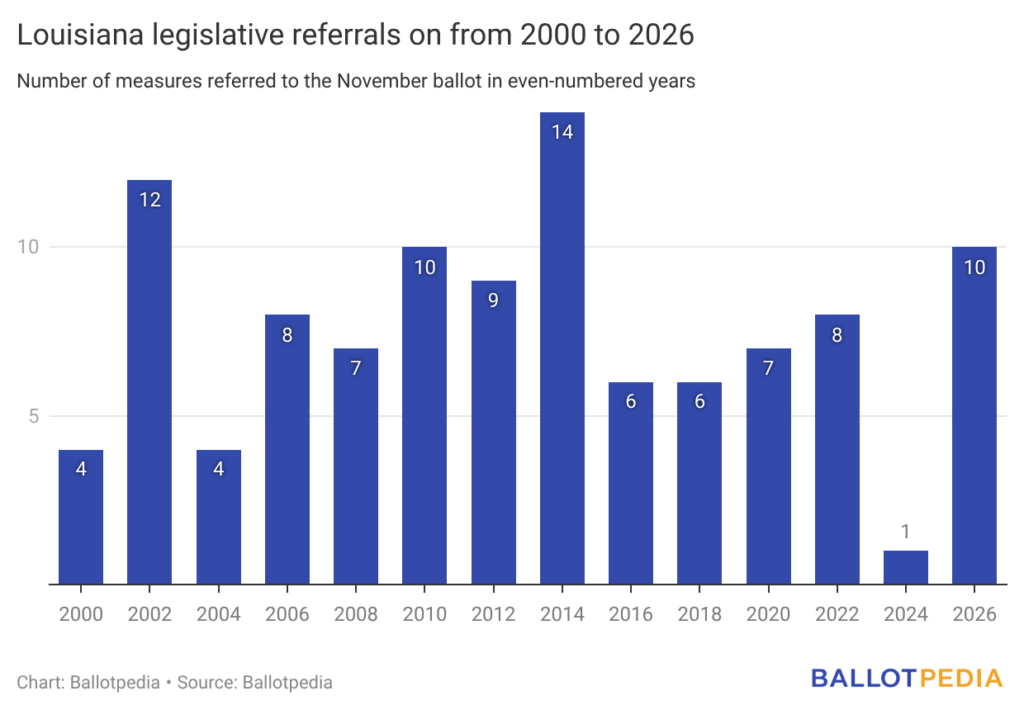
From 2000 to 2026, the Legislature has certified an average of eight measures for the November general election ballot in even-numbered years. The number of referrals on the 2026 ballot is the third highest, after 2002 (12 measures) and 2014 (14 measures).
All 10 measures on the November ballot are constitutional amendments. Below is a selection of these measures.
House Bill 225
House Bill 225 (HB 225) would establish a lifetime gubernatorial term limit of two terms.
Currently, Article IV, Section 3(B) of the Louisiana Constitution prohibits governors from serving more than two consecutive terms.
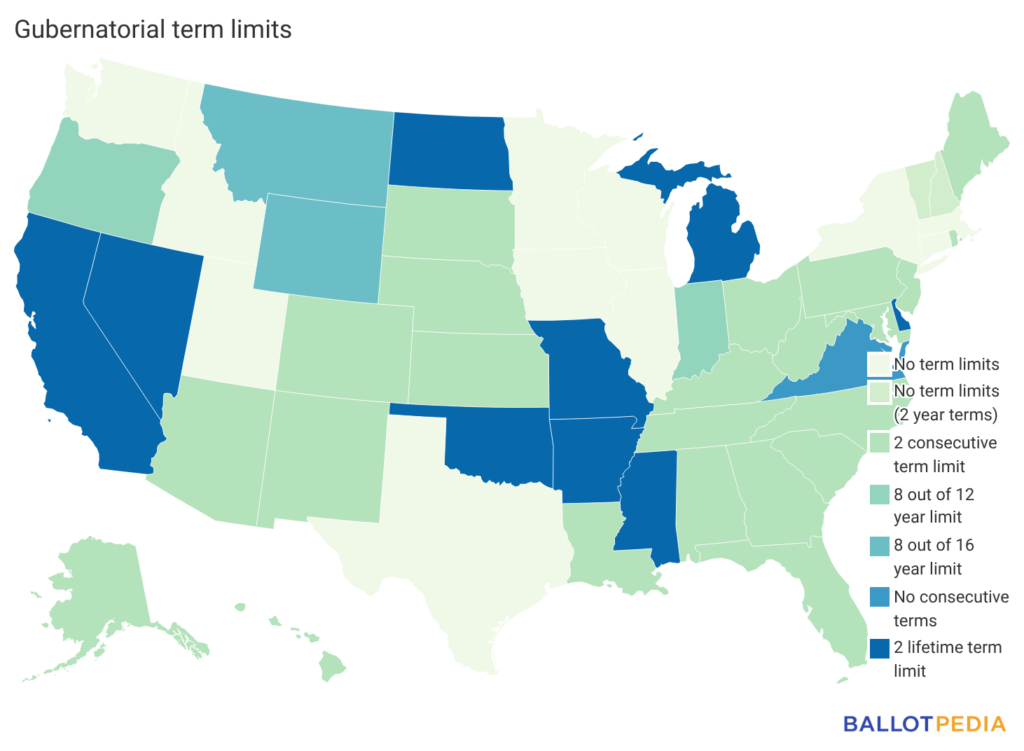
Thirty-seven states have gubernatorial term limits, and nine have lifetime limits of two terms.
The state House approved HB 225 73-25 on May 5. The state Senate approved it 28-10 on May 26.
House Bill 51
House Bill 51 (HB 51) would prohibit bail for individuals convicted of an aggravated offense, as defined by state law, against a minor.
Currently, Article I, Section 18 of the Louisiana Constitution provides the right to bail after conviction but before sentencing if the maximum sentence is five years or less. Judges may grant bail if the maximum sentence is more than five years.
The state House approved HB 51 92-0 on April 20. The state Senate approved it 31-1 on May 13.
House Bill 192
House Bill 192 (HB 192) would prohibit the expropriation of property by foreign adversaries or agents of a foreign adversary — both of which are defined in state law.
Currently, Article I, Section 4 of the Louisiana Constitution prohibits property from being taken or damaged by private entities, except for a public and necessary purpose, in addition to the property owner being compensated.
The state House approved HB 192 100-0 on April 21. The state Senate approved it 36-0 on May 21.
House Bill 514
House Bill 514 (HB 514) would authorize a property tax exemption of up to $30,000 in assessed value, increasing with age, for individuals at least 65 who already qualify for the income-based assessment freeze under the state constitution.
Currently, Article VII, Section 21 of the Louisiana Constitution does not provide property tax exemptions for seniors.
The state House approved HB 514 93-0 on April 20. The state Senate approved it 34-0 on May 20.
House Bill 300
House Bill 300 (HB 300) would raise the income limit to qualify for the property tax special assessment level — a provision that freezes the assessed value of a home for eligible homeowners so that their property taxes do not increase due to rising property values — from $100,000 to $150,000.
Currently, the special assessment level applies to:
- individuals 65 years or older;
- veterans with a service-connected disability rating of 50% or more as determined by the U.S. Department of Veterans Affairs;
- members of the military or Louisiana National Guard who last owned the property and were killed in action, missing in action, or taken as prisoners of war for at least 90 days; and
- individuals permanently totally disabled as determined by a non-appealable court judgment or government agency.
Individuals who do not qualify for a special assessment level are subject to property value reassessments that could increase the amount of property taxes owed.
The state House approved HB 300 91-2 on May 27, 2025. The state Senate approved it 35-2 on June 9, 2025.
House Bill 27
House Bill 27 (HB 27) would remove the requirement that a state retirement system receiving nonrecurring state funds must apply those funds to its oldest outstanding unfunded accrued liabilities (UALs) first.
The state House approved HB 27 87-0 on April 20. The state Senate approved it 34-0 on May 28.
Senate Bill 228
Senate Bill 228 (SB 228) would authorize the use of public funds to identify, inventory, remove, or replace drinking water utility service lines affected by hazardous materials, as specified by the U.S. Environmental Protection Agency's (EPA) Lead and Copper Rule Improvements.
Currently, Article VII, Section 14 of the Louisiana Constitution prohibits funds from being "loaned, pledged, or donated to or for any person, association, or corporation, public or private." The section includes a list of exceptions in which public funds may be used. SB 228 would add water utility lines affected by certain hazardous materials to that list.
The state Senate approved SB 228 29-9 on May 6. The state House approved an amended version of SB 228 — which included the EPA specifications — 80-12, sending it back to the state Senate. The Senate approved the amended version 32-4 on May 31.
Click here to learn more about Louisiana’s 2026 ballot measures.
Senate moves reconciliation 2.0 to the floor for debate after stalled negotiations
On June 3, the U.S. Senate voted 53-46 to bring the current version of the FY2027 budget reconciliation bill to the chamber’s floor for debate. This was two days after the original June 1 deadline that President Donald Trump (R) gave lawmakers to deliver the bill to his desk. Lawmakers have referred to the package as reconciliation 2.0, after Trump signed a previous reconciliation bill, the One Big Beautiful Bill Act, in 2025.
The bill’s progress stalled both due to the Senate Parliamentarian’s ruling that certain provisions related to funds for the White House ballroom did not comply with the Senate’s Byrd Rule, and because of disagreements about funding of the anti-weaponization fund, a proposed $1.8 billion fund to compensate people who said they were unfairly investigated or prosecuted by the Biden-era Justice Department — including Jan. 6 defendants. No draft of the budget reconciliation legislation has included funding for the anti-weaponization fund, but debate about the proposal became enmeshed in negotiations over the reconciliation package.
Two U.S. Senate committees released the first version of a proposed budget reconciliation spending package on May 4. It mostly included funding for the Department of Homeland Security (DHS) and increased the deficit by $72 billion over the following decade, according to the Congressional Budget Office.
The Senate committees that released draft legislation are the Committee on the Judiciary and the Committee on Homeland Security and Governmental Affairs. Their proposed reconciliation spending package included nearly $72 billion in funding, including $38.2 billion for Immigration and Customs Enforcement (ICE), between $22 and $26 billion for U.S. Customs and Border Protection (CBP), $5 billion for the Department of Homeland Security, $1.5 billion for the Justice Department, and $1 billion for the Secret Service.
Process going forward
The reconciliation bill will now head to the House and Senate floors for debate. During and after the debate, lawmakers can propose amendments and raise points of order seeking the removal of provisions under The Byrd Rule. Click on the links below for more information on this topic:
A simple majority is required in both chambers on an identical reconciliation package to complete the reconciliation process. Debate is limited in the Senate, preventing filibusters. After the budget reconciliation bill passes both chambers, it is sent to the president to be signed or vetoed.
Budget reconciliation bill 3.0?
The budget reconciliation process and resulting legislation packages originate with budget resolutions. Since there is generally only one budget resolution per fiscal year, this means that in most cases, there can only be one reconciliation process per fiscal year. The Senate Parliamentarian has advised, however, that reconciliation could be conducted more than once for the same fiscal year if Congress passed a revised budget resolution due to changed economic conditions or an emergency, and the revised budget resolution also called for reconciliation.
House Republicans have indicated that they are considering another reconciliation package for FY2027 focused on defense spending and changes to entitlement and social programs. On June 3, after meeting with the Centers for Medicare & Medicaid Services administrator Dr. Mehmet Oz, House Majority Leader Steve Scalise (R) said that he had been involved with a working group for close to two months.
Click here to learn more about uses of budget reconciliation in Congress.
Six statewide candidate filing deadlines in the next two weeks
While 44% of this year's statewide party primaries are in the rearview mirror, there are still plenty of filing deadlines yet to come this year.
Six states have statewide candidate filing deadlines in the next two weeks. The map and bulleted list below show which states have candidate filing deadlines scheduled between June 6 and June 19.
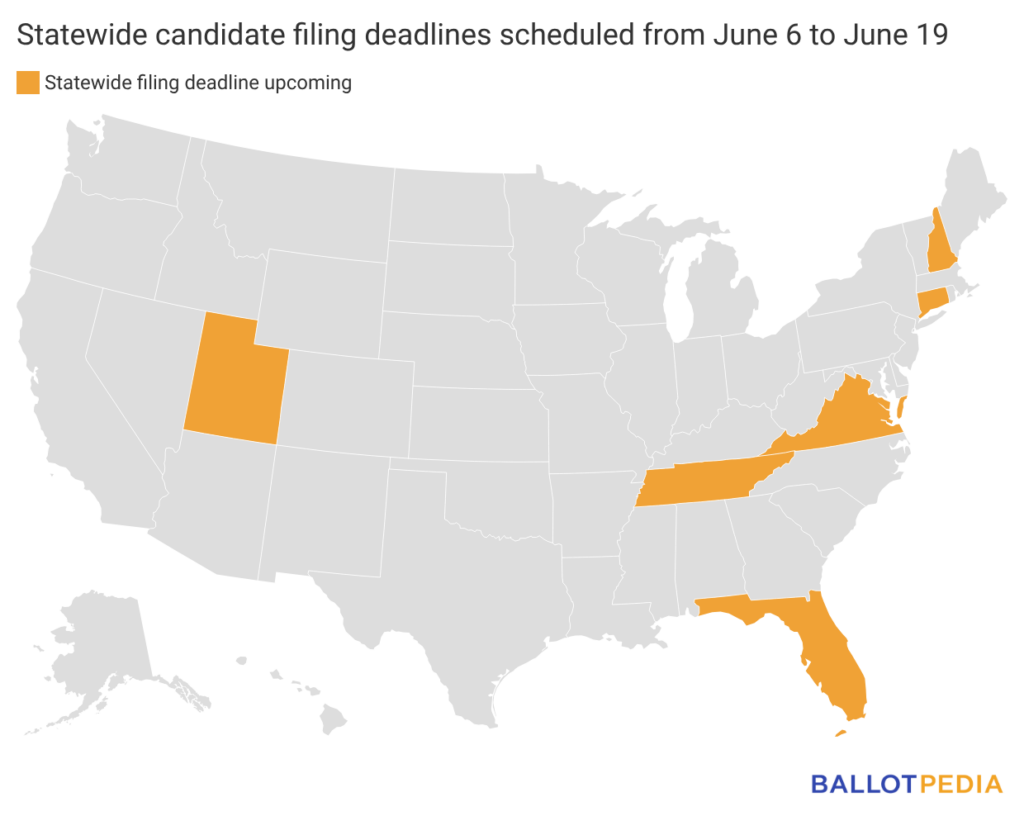
- Connecticut: June 9 (statewide primary candidate filing deadline)
- Florida: June 12 (statewide candidate filing deadline for U.S. House of Representatives, governor, attorney general, agriculture commissioner, chief financial officer, state senator, state representative)
- New Hampshire: June 12 (statewide primary candidate filing deadline)
- Tennessee: June 17 (statewide primary write-in candidate filing deadline)
- Utah: June 15 (statewide unaffiliated candidate filing deadline)
- Virginia: June 16 (statewide unaffiliated candidate filing deadline for U.S. Senate)
Looking back
16 states had candidate filing deadlines in the past two weeks:
- Alaska: June 1 (statewide candidate filing deadline)
- Hawaii: June 2 (statewide candidate filing deadline)
- Illinois: May 26 (statewide unaffiliated candidate filing deadline)
- Iowa: June 2 (statewide unaffiliated and minor party candidate filing deadline)
- Kansas: June 1 (statewide primary candidate filing deadline)
- Kentucky: June 2 (statewide unaffiliated candidate filing deadline)
- Maine: June 1 (statewide unaffiliated and minor party candidate filing deadline)
- Massachusetts: May 26 (statewide candidate filing deadline for Governor's Council, state Senate, and state House races) and June 2 (statewide primary candidate filing deadline for U.S. Senate, U.S. House, governor, lieutenant governor, attorney general, secretary of state, treasurer, and auditor's races)
- Minnesota: June 2 (statewide candidate filing deadline)
- Montana: June 1 (statewide unaffiliated and minor party candidate filing deadline)
- New Jersey: June 2 (statewide unaffiliated candidate filing deadline)
- New York: May 26 (unaffiliated candidate filing deadline)
- Vermont: May 28 (statewide primary candidate filing deadline)
- Virginia: May 26 (statewide primary candidate filing deadline for U.S. House races)
- Wisconsin: June 1 (statewide candidate filing deadline)
- Wyoming: May 29 (statewide primary candidate filing deadline)
Candidates must meet various state-specific filing requirements and deadlines to appear on primary and general election ballots. These regulations, known as ballot access laws, determine whether and how candidates can make it onto the ballot. These laws are set at the state level and apply to candidates running for state and federal offices.
Voting in upcoming elections
Seven states and D.C. have elections taking place in the next two weeks:
- Alabama: June 16 statewide primary runoff election
- District of Columbia: June 16 primary election
- Georgia: June 16 statewide primary runoff election
- Maine: June 9 statewide primary election
- Nevada: June 9 statewide primary election
- North Dakota: June 9 statewide primary election and special election primary
- Oklahoma: June 16 statewide primary election
- South Carolina: June 9 statewide primary election
Voter participation deadlines
Nine states and D.C. have early voting periods that start in the next two weeks:
- District of Columbia: Early voting begins June 8 for the June 16 primary.
- Georgia: Early voting begins June 8 for the June 16 primary runoff.
- Louisiana: Early voting begins June 13 for the June 27 party primary runoff.
- Maryland: Early voting begins June 11 for the June 23 primary.
- New York: Early voting begins June 13 for the June 23 primary.
- Oklahoma: Early voting begins June 11 for the June 16 primary.
- South Carolina: Early voting begins June 17 for the June 23 primary runoff.
- South Dakota: Early voting begins June 12 for the July 28 primary.
- Utah: Early voting begins June 9 for the June 23 primary.
- Virginia: Early voting begins June 18 for the August 4 primary.
Five states and D.C. have voter registration deadlines in the next two weeks:
- District of Columbia: June 16 is the last day to register to vote in person in the June 16 primary.
- Louisiana: June 6 is the last day to register to vote online in the June 27 party primary runoff.
- Maine: June 9 is the last day to register to vote in person in the June 9 primary.
- Nevada: June 9 is the last day to register to vote in person and online in the June 9 primary.
- New York: June 13 is the last day to register to vote in the June 23 primary.
- Utah: June 12 is the last day to register to vote by mail or online in the June 23 primary. In-person voter registration is available through June 23.
Four states have absentee/mail-in ballot request deadlines in the next two weeks:
- Alabama: June 9 is the last day to request a ballot online for the June 16 primary runoff. June 11 is the last day to request a ballot in person.
- Maryland: June 16 is the last day to request a ballot by mail for the June 23 primary. June 19 is the last day to request a ballot online, and June 23 is the last day to request a ballot in person.
- New York: June 13 is the last day to request a ballot by mail or online for the June 23 primary. June 22 is the last day to request a ballot in person.
- North Dakota: June 9 is the last day to request a ballot in person for the June 9 primary.
Click here to see our list of upcoming election dates and filing deadlines.