


Welcome to the Tuesday, June 9, 2026, Brew.
By: Lara Bonatesta
Here’s what’s in store for you as you start your day:
- U.S. Postal Service proposes absentee/mail-in voting rule
- Four states are holding statewide primaries today
- Montana voters have decided on 266 ballot measures since statehood in 1889
U.S. Postal Service proposes absentee/mail-in voting rule
The United States Postal Service filed a proposed rule on May 29 that would prohibit absentee/mail-in ballots for general elections from being delivered to anyone not on a list provided to USPS by state election officials. The proposed rule was published in the Federal Register on June 2.
Under the rule, states would submit to USPS the names of absentee/mail-in voters, as well as "the unique barcode applied to the outbound and return ballot mail envelope for such individuals." States would be allowed to modify this list up to the final day for sending out absentee/mail-in ballots. The rule would not apply to primary elections or to military or overseas voters.
President Donald Trump (R) issued Executive Order 14399, "Ensuring Citizenship Verification and Integrity in Federal Elections," on March 31, 2026. In supplementary background on the rule, USPS stated, "The Executive Order discusses the importance of additional measures concerning the use of the mails to vote in federal elections, in order to facilitate enforcement of federal law, reduce the risk of fraud, and help protect the integrity of federal elections. ... [T]he Postal Service issues this proposed rule regarding the preparation of ballot mail for federal elections to facilitate the enforcement of federal law."
Under the rule, USPS would be required to confirm before mailing an absentee/mail-in ballot that the recipient is on the list provided by their state. The agency said that it would not change the information provided by state officials and that "states would retain full control over who would (or would not) be able to vote by mail in federal elections within each state."
"This provision will help determine adherence to federal law and facilitate law enforcement efforts," the USPS document stated. "For example, the provided lists will evidence how many ballots have been mailed, and allow law enforcement officials to compare the total number of mailed ballots to the total number of received ballots to detect potential issues meriting further investigation."
The rule would also create a new design for ballot envelopes, including "placement of a uniquely serialized Intelligent Mail barcode (IMb) on each outbound and return ballot envelope."
Stakeholders have until July 2 to submit comments on the proposed rule to USPS.
After USPS's rule filing, White House spokesperson Abigail Jackson said, "The entire Trump Administration will continue lawfully enacting the agenda President Trump was elected to enact – which includes the safety and security of American elections. ... This campaign pledge from the President is why millions of Americans sent him back to the White House."
Washington Secretary of State Steve Hobbs (D) said, "This is an unnecessary rule and does nothing to provide security in our elections. We’ll continue to evaluate and provide feedback to the USPS. Once again, we’re seeing federal overreach that threatens to undermine the rights of eligible voters and override states’ authority over elections. This is clearly another attempt by the Trump administration to exercise authority they don’t have."
On June 3, the NAACP filed a motion in a lawsuit against USPS that was originally brought in 2020 related to ballot delivery in that year's election. The motion alleges that the proposed rule would violate the terms of a 2021 settlement requiring USPS to "prioritiz[e] ... the timely delivery of Election Mail." NAACP Legal Defense Fund associate director-counsel Samuel Spital said, "USPS has committed over and over to playing its part in democracy by prioritizing the timely delivery of mail-in ballots. ... And now for USPS to say we affirmatively will not deliver a ballot at all because it doesn’t meet criteria that we invented out of whole cloth, not only violates the settlement agreement, but also the historical role of the USPS in our democracy." USPS has until June 11 to file a response.
Trump's executive order also requires the U.S. Department of Homeland Security to transmit a list of citizens age 18 and older to state election officials at least 60 days before a federal election. The order grants enforcement powers to the U.S. Attorney General and federal agency heads, including withholding funding from noncompliant states.
In April, multiple groups of Democratic state and federal officials and nonprofit organizations filed four lawsuits, alleging that the requirements of the executive order are unconstitutional and seeking a court order blocking them from taking effect.
On May 28, Judge Carl Nichols of the U.S. District Court for the District of Columbia denied a request to block the order. In his ruling, Nichols held that because the order had not yet been implemented, the plaintiffs in the case could not show the harm required to block it from taking effect. A federal judge in Massachusetts heard oral arguments in a separate case on June 2.
Every state provides a method for voters to cast ballots without visiting a physical polling place.
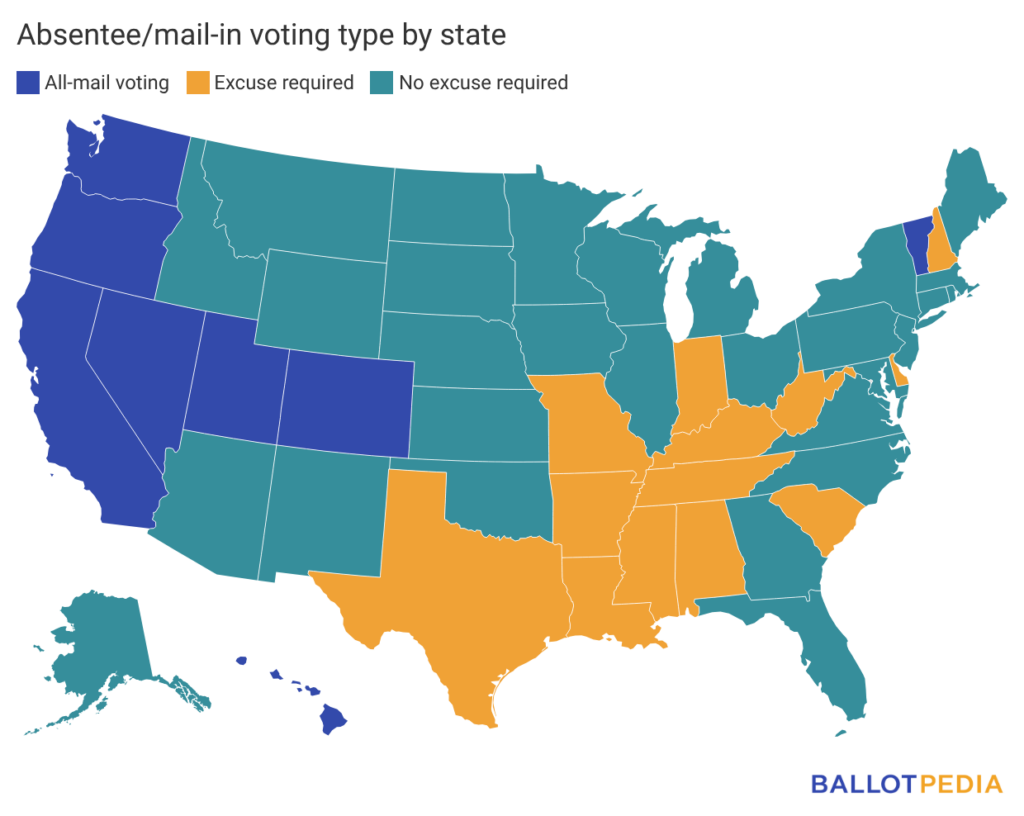
Thirteen states require voters to provide a valid excuse to vote by mail. Twenty-nine states allow any eligible voter to cast an absentee/mail-in ballot. Eight states have all-mail voting systems in which every eligible voter is automatically sent a mail ballot.
For more information on absentee/mail-in voting in the United States, click here.
Four states are holding statewide primaries today
Maine, North Dakota, Nevada, and South Carolina are holding statewide primaries today, June 9. Here’s a look at the notable races that we’re covering.
Maine’s 2nd Congressional District
Joe Baldacci (D), Matthew Dunlap (D), Paige Loud (D), and Jordan Wood (D) are running in the Democratic primary for Maine's 2nd Congressional District. Baldacci, Dunlap, and Wood have led in fundraising, media attention, and polling. Incumbent Jared Golden (D), who took office in 2019, is retiring. This is one of 58 open House races this year.
In 2024, Donald Trump (R) won the district over Kamala Harris (D) 53.5% to 44.5%. Golden was re-elected with 50.3% of the vote that year. According to analysis from The University of Virginia's Center for Politics, Golden represents the Democratic-held district with the highest level of support for Trump. This district is one of 20 that Trump won that Democrats represent in Congress.
Maine uses ranked-choice voting (RCV) in primary elections for certain statewide offices, and in primary and general elections for federal offices. Click here to learn more.
South Carolina’s 1st Congressional District
Jay Byars (R), Jenny Honeycutt (R), Sam McCown (R), Alex Pelbath (R), Mark Smith (R), and six others are running in the Republican primary for South Carolina's 1st Congressional District. Byars, Honeycutt, McCown, Pelbath, and Smith have led in fundraising and media attention.
Incumbent Nancy Mace (R), who was first elected in 2020, is running for governor rather than seeking re-election. This is the first election for an open seat in the 1st District since 2013. Major election forecasters rated the general election solid/safe Republican. If no candidate wins a majority of votes, the top two finishers will advance to a runoff on June 23.
U.S. Senate election in Maine
Another notable primary that we are covering is Maine’s Democratic U.S. Senate primary. David Costello (D) and Graham Platner (D) are running. The winner will face incumbent Susan Collins (R) in the general election.
Gov. Janet T. Mills (D) suspended her campaign on April 30. Before suspending her campaign, Mills received endorsements from U.S. Sens. Chuck Schumer (D-N.Y.) and Catherine Cortez Masto (D-Nev.) and polled second behind Platner.
Thirty-three of the 100 Senate seats are up for election this year, and another two seats are up for special election. Democrats hold 13 of the seats up for election, and Republicans hold 22. Republicans hold a 53-45 majority in the chamber and both independent U.S. senators — Bernie Sanders (I-Vt.) and Angus King (I-Maine) — caucus with the Democrats.
The Cook Political Report and Sabato's Crystal Ball have rated the general election a toss-up. Inside Elections has rated it tilt Republican.
Click here to see a full list of elections that we are covering on June 9. Plus, if you live in one of the states holding elections, check out our Sample Ballot Lookup Tool.
Montana voters have decided on 266 ballot measures since statehood in 1889
Ballotpedia's Historical Ballot Measures Factbooks will document nearly 200 years of direct democracy in the United States. This ongoing research effort will provide an unparalleled resource for researchers, reporters, and the public on how ballot measures have evolved, the issues they have covered, and their role in our civic life.
Today, let's look at historical ballot measures in Montana. Our comprehensive inventory spans from 1889 — when Montana became a state — to 2025. In that time, Montana voters decided on 266 measures, approving 165 and defeating 101 — a 62% approval rate. The average number of measures per decade ranged from 17 to 18.
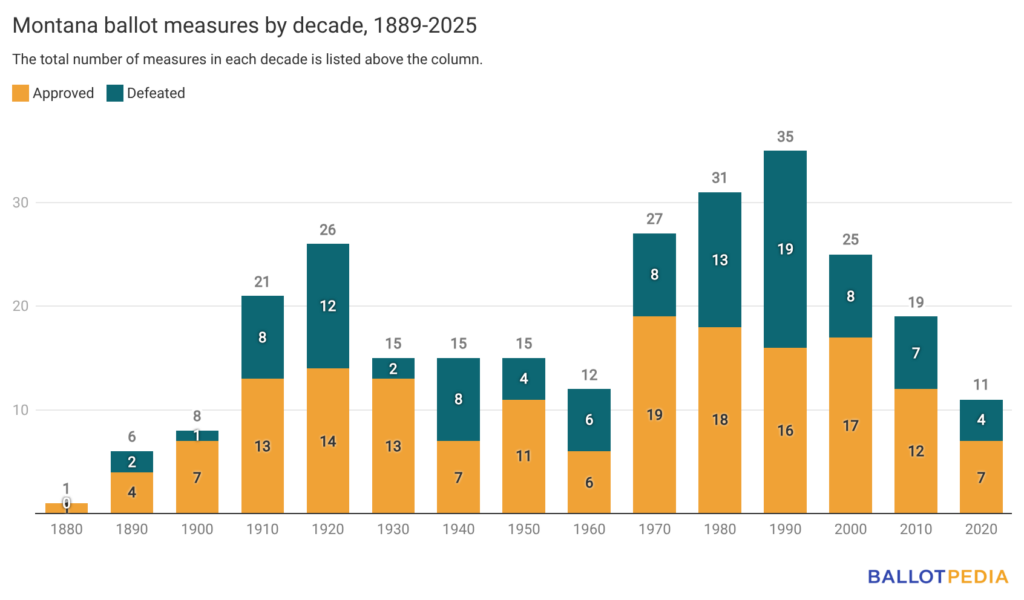
The Montana Legislature put 163 ballot measures on the ballot, and there were 99 citizen initiatives. Two measures were automatic constitutional convention questions, and two measures were referred to the ballot by the state's constitutional convention.
Voters established the initiative and referendum process when they approved the Montana Initiative and Referendum Amendment in 1906. Montana was the fifth state to adopt an initiative process. Referred measures had a higher success rate (66%) than citizen initiatives (56%).
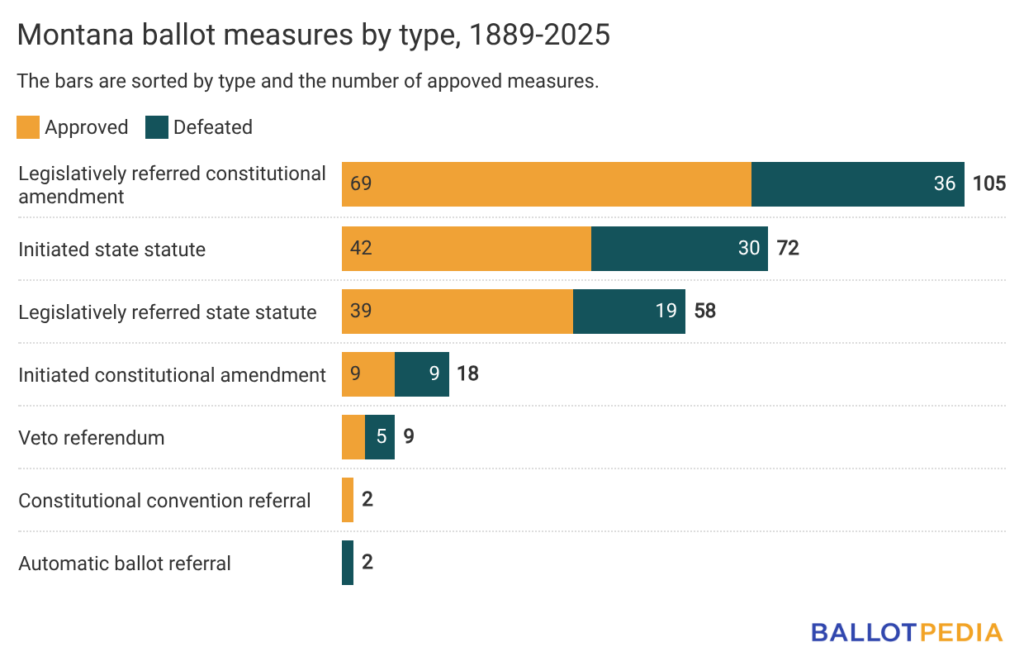
Montana ballot measures have addressed 118 unique topics, with some measures addressing multiple topics. Below is a selection of notable and interesting topics:
State constitution and capital
Montana voters have ratified two state constitutions. Voters approved the first constitution 92%-8% in 1889, shortly before Montana became a state. Voters approved the current constitution 50.6% to 49.5% in 1972. Voters called the convention that produced the 1972 constitution when they approved Referendum 67 in 1970. Montana is one of 14 states that have an automatic constitutional convention question every 20 years. Voters rejected automatic convention questions in 1990 and 2010.
Voters decided the location of the state capital across two elections. An 1892 question proposed seven cities — Anaconda, Boulder, Bozeman, Butte, Deer Lodge, Great Falls, and Helena. Helena and Anaconda received the most votes, 31% and 22%, respectively. Voters decided between the two cities in an 1894 runoff, and selected Helena.
Mining and business regulations
In 1904, voters approved an eight-hour workday in mills, smelters, and mines 88.4% to 11.6% and a measure to prohibit the employment of children under 16 in underground mines 92.4% to 7.6%. The measures were among the widest margins in state history. Voters approved another amendment extending the eight-hour day to all industries in 1936.
Taxes
In 1934, voters approved an amendment to levy graduated and progressive income taxes to replace property taxes. The revenue was distributed between public schools and the state government.
Montana has no general sales tax, and voters have repeatedly rejected statewide ballot measures to create one. They rejected a 2% sales and use tax in 1971 and a 4% sales tax in 1993, then approved an amendment in 1994 that limited any future statewide sales or use tax to 4%.
Elections and campaign finance
In 1996, voters approved a prohibition on corporate contributions to ballot measure campaigns. The Legislature expanded the prohibition to include contributions or expenditures in ballot issue campaigns by corporations, partnerships, associations, and tax-exempt organizations, except through separate political funds funded by voluntary contributions, with the passage of House Bill 575 in 1997. A veto referendum challenged the law in 1998, and voters upheld it. The law was later struck down in court. In 2012, Montana voters approved an initiative to ban corporate contributions and expenditures in elections. However, the measure was overturned in 2013.
In 1992, voters approved CI-64, setting term limits for statewide executives, legislators, and members of Congress. In 2004, voters rejected a legislatively referred amendment that would have increased term limits for state legislators from eight years in a 16-year period to 12 years in a 24-year period.
In 2024, voters rejected two election-related measures: CI-126, which would have established top-four primaries, and CI-127, which would have required a majority rather than a plurality to win certain offices, including governor, lieutenant governor, secretary of state, auditor, attorney general, superintendent of public instruction, state legislature, and Congress.
Social issues
In 2004, voters approved CI-96, defining marriage as between one man and one woman. Montana was one of 31 states to approve such an amendment. The amendments were later overturned by the U.S. Supreme Court’s 2015 ruling in Obergefell v. Hodges.
Montana voters have decided on three abortion-related measures. Voters approved parental notification for minors in 2012, with 71% of voters supporting it. In 2022, voters rejected LR-131 53% to 47%, which would have stated that infants born alive at any stage of development are legal persons and would have required medical care to be provided to infants born alive “regardless of whether the expulsion or extraction occurs as a result of natural or induced labor, cesarean section, induced abortion, or another method.” In 2024, voters approved CI-128 58% to 42%, establishing a state constitutional right to abortion before fetal viability.
Click here to see our full Montana Factbook.