


Welcome to Hall Pass, a newsletter written to keep you plugged into the conversations driving school board governance, the politics surrounding it, and education policy.
In today’s edition, you’ll find:
- On the issues: the debate over capping graduate degree loans for teachers
- School board filing deadlines, election results, and recall certifications
- A roundup of state K-12 education news
- Extracurricular: education news from around the web
- Candidate Connection survey
Reply to this email to share reactions or story ideas!
On the issues: the debate over capping graduate degree loans for teachers
In this section, we curate reporting, analysis, and commentary on the issues school board members deliberate when they set out to offer the best education possible in their district. Missed an issue? Click here to see the previous education debates we’ve covered.
The One Big Beautiful Bill Act (OBBBA), enacted into law on July 4, 2025, placed limits on the amount of higher education loans that a student can borrow from the federal government, including specific caps for graduate students that vary by degree pathway.. On April 30, 2026, the U.S. Department of Education issued a final rule for the higher-ed loan portion of the law. The rule distinguishes between graduate degree programs and professional degree programs. The rule establishes a $100,000 total borrowing limit on students in graduate degree programs, including those seeking teaching degrees and degrees in most other disciplines. Professional degree students are capped at $200,000 total. Professional degree programs comprise 11 fields, including law, dentistry, theology, and clinical psychology.
What are the arguments for and against these limits?
Heather Peske, the president of the National Council on Teacher Quality (NCTQ), says excluding teaching from the list of programs with a higher borrowing limit will exacerbate staffing shortages in schools, especially in rural districts. Peske says that the rule will disproportionately affect low-income students, making the teaching profession less diverse. Peske says the federal rule, by excluding teaching from its list of professional degree fields, demeans the profession.
Preston Cooper, a senior fellow at the American Enterprise Institute (AEI), says capping the total amount graduate students can borrow will put downward pressure on college tuition. Cooper says the cap is higher than the amount most education graduate programs charge to obtain a degree, so most students are unlikely to bump up against the limit. Cooper says the rule is likely to affect a small number of institutions which charge higher-than-average tuition and that states should find ways to develop the education workforce without asking students to take on large amounts of debt.
The federal government values your pet’s vet more than your child’s teacher | Heather Peske, National Council on Teacher Quality
“It doesn’t make sense to limit borrowing power in education graduate degrees if we want to increase the number of people who enter teaching, especially in persistent shortage areas. To build a strong teacher workforce for students with disabilities and English learners, we need to leverage every opportunity. In fact, the most recent federal data from 2023-2024 show that education remains one of the largest graduate fields – and more than 1 in 10 graduate education degrees are in special education–related fields. It would be fair to limit these loans to those teachers seeking initial teaching certifications or additional endorsements in high-need subjects that they intend to teach, but shutting them off altogether harms not only aspiring teachers but also the districts who hope to hire them.”
New Caps on Federal Student Lending Could Impact Schools of Education | Preston Cooper, Education Next
“Education schools have watched with trepidation as changes to the student loan system have developed. Most institutions, however, have little reason to worry. The student loan limits of OBBBA mostly affect very expensive institutions, and that’s by design. Why should a school charging $50,000 tuition have access to unlimited loans when other schools are offering a similar product at much lower cost? Similarly, the Do No Harm test will not impact the vast majority of education degrees. The exceptions are mostly sub-baccalaureate programs in early childhood education, and states should find ways to develop this workforce without forcing students to take on debt.
“OBBBA will require some adjustment from institutions in the short run, but that’s true of most consequential policy reforms. When OBBBA’s changes are fully implemented, fewer students will take on unaffordable loans, bending the student debt curve downward and making $1.7 trillion a number for the history books.”
School board update: filing deadlines, election results, and recall certifications
In 2026, Ballotpedia will cover elections for more than 30,000 school board seats. We’re expanding our coverage each year with our eye on covering the country’s more than 80,000 school board seats.
Election results from the past week
June 9
Maine: Click here to see results.
Nevada: Click here to see results.
South Carolina: Click here to see results.
Upcoming school board elections
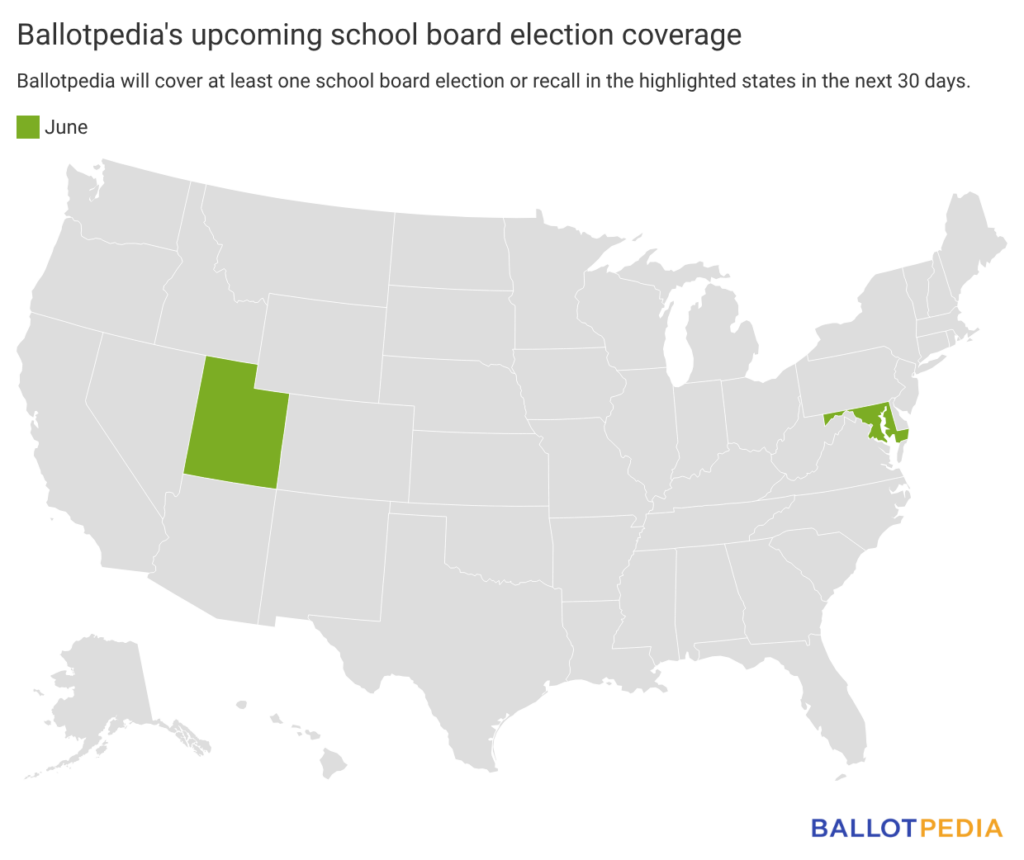
Watch future editions of Hall Pass for the following June primary and general election results:
A roundup of state K-12 education news
Today, we’re going to look at three recent stories you might have overlooked:
- The first concerns the most recent state to opt into the federal tax credit scholarship program.
- The second is about an Illinois bill that would prohibit student cellphone usage in public schools.
- The third is an update on the results of the recent California Superintendent of Public Instruction primary.
Let’s jump right in.
North Carolina General Assembly overrides Governor's veto of bill opting state into federal education tax credit scholarship program
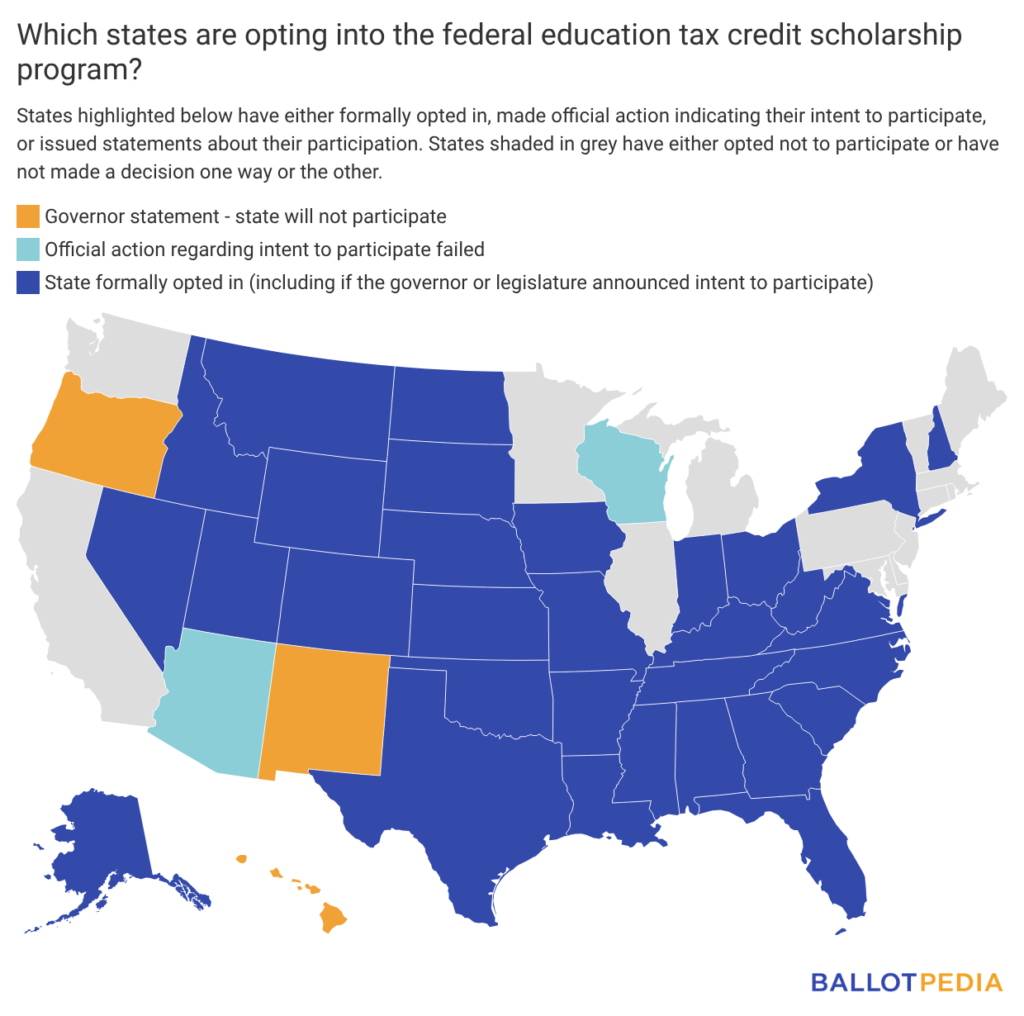
North Carolina’s participation in the new federal K-12 education tax credit scholarship program — the first at the federal level to allow public funds to be used for private educational expenses — has been up in the air since August 2025, when Gov. Josh Stein (D) vetoed a bill that would have made the state the first to officially opt in. But, 10 months later, on June 3, 2026, the North Carolina General Assembly voted to override Stein’s veto, making the state the 31st to either formally opt in or indicate an interest in doing so.
The One Big Beautiful Bill Act (OBBBA), which President Donald Trump (R) signed in July 2025, established the tax credit scholarship program, which goes into effect Jan. 1, 2027. The program will allow individuals to lower their federal tax liability up to $1,700 by making donations to accredited scholarship-granting organizations (SGOs). In turn, those organizations will distribute scholarship funds to K-12 students for private school tuition, tutoring services, textbooks, and more. Participating states must submit a list of SGOs that taxpayers can donate to in order to receive the federal tax credit.
Students in states that do not opt in cannot receive scholarships funded under the program, but donors in those states can still receive a federal tax credit by donating to SGOs in participating states.
The North Carolina House of Representatives voted 73-46 on May 20, 2026, to override the veto, with all Republicans and one unaffiliated representative supporting the bill and all Democrats opposing it. One Democratic representative was absent. The North Carolina Senate voted 30-19 on June 3, 2026, to override the veto, also along party lines, with one Democratic senator absent.
North Carolina has a divided government.
In his 2025 veto message, Stein said that while he opposed spending government funding on private school tuition, he saw “opportunities for the federal scholarship donation tax credit program to benefit North Carolina’s public school kids,” and said he intended to opt the state into the program whenever the U.S. Treasury releases guidance. As of this writing, that guidance is still pending.
While proponents of private school choice have expressed support for the program, saying the money will open up more educational opportunities for families, it has polarized the advocates for public schools who oppose the use of government money for private schools. That’s in part because it is not clear to what extent students enrolled in public schools will benefit from the scholarships. The U.S. Treasury is expected to issue regulations answering that question — and others — in the coming months.
Three quarters of the 31 states that have formally opted in or plan on doing so are Republican-led. All 23 states where Republicans control the governor’s office and both chambers of the state legislature are expected to participate in the program when it begins operating in 2027. So far, that is true for only three of the 16 Democratic-led states — Virginia, Colorado, and New York. Four governors, all in states with Democratic trifectas, released statements at one point saying they do not intend on opting into the program, though at least three have since said they are waiting on federal regulations before making a final decision. Seven of the 31 states that have opted in or intend to do so have divided governments.
Lawmakers in Illinois pass bill to restrict K-12 public student cellphone usage during the school day
On May 31, the Illinois General Assembly passed SB 2427, a bill that would restrict students in K-12 public schools and charter schools from using their cellphones during the school day. Gov. J.B. Pritzker (D) — who called for lawmakers to send him a cellphone ban bill in 2025 which ultimately did not materialize — said he would sign the legislation.
Illinois would be the 36th state to limit students' cellphone usage in K-12 public schools, and the seventh since the start of the year.
The House voted 102-3 (with one legislator voting “present”) to pass SB 2427 on April 16. The Senate voted 55-2, sending the bill to Pritzker’s desk. Illinois has a Democratic trifecta.
The bill would require districts to adopt policies in 2027 that prohibit elementary and middle school students from using their phones during the entire school day. The requirements for high schools are similar, though the legislation permits schools to allow students to using their phone during lunch and passing periods. The bill includes several exemptions, including for students on Individualized Education Plans (IEPs).
Pritzker said, “Every parent and educator knows the damage that unchecked screen time and social media can do to our children and how disruptive they can be in school. The bipartisan support for this effort reflects the urgency educators and families across Illinois feel.”
Pritzker has made combating screens in schools a legislative priority in recent years. He called for banning cellphones in schools in his 2025 State of the State address, saying, “More focus on learning will bring even greater success for kids across the state.” Pritzker’s office backed SB 2427 that year, and the Senate passed it unanimously. However, lawmakers in the House did not pass the bill before the legislative session came to an end, and it was carried over to 2026 with a few changes. For example, a provision in the 2025 version of the bill would have allowed districts to enforce the policy through suspensions or expulsions. The version that passed in 2026, however, prohibits districts from using those methods to enforce their policies.
In addition to the states that’ve enacted new bans in 2026, several states have expanded their existing laws. On May 5, Georgia Gov. Brian Kemp (R) signed HB 1009 to expand the state's elementary and middle school cellphone ban to include high schools.On April 6, Virginia Gov. Abigail Spanberger (D) signed SB 108 to expand the state's existing statewide cellphone ban to prohibit use on school grounds from bell-to-bell.
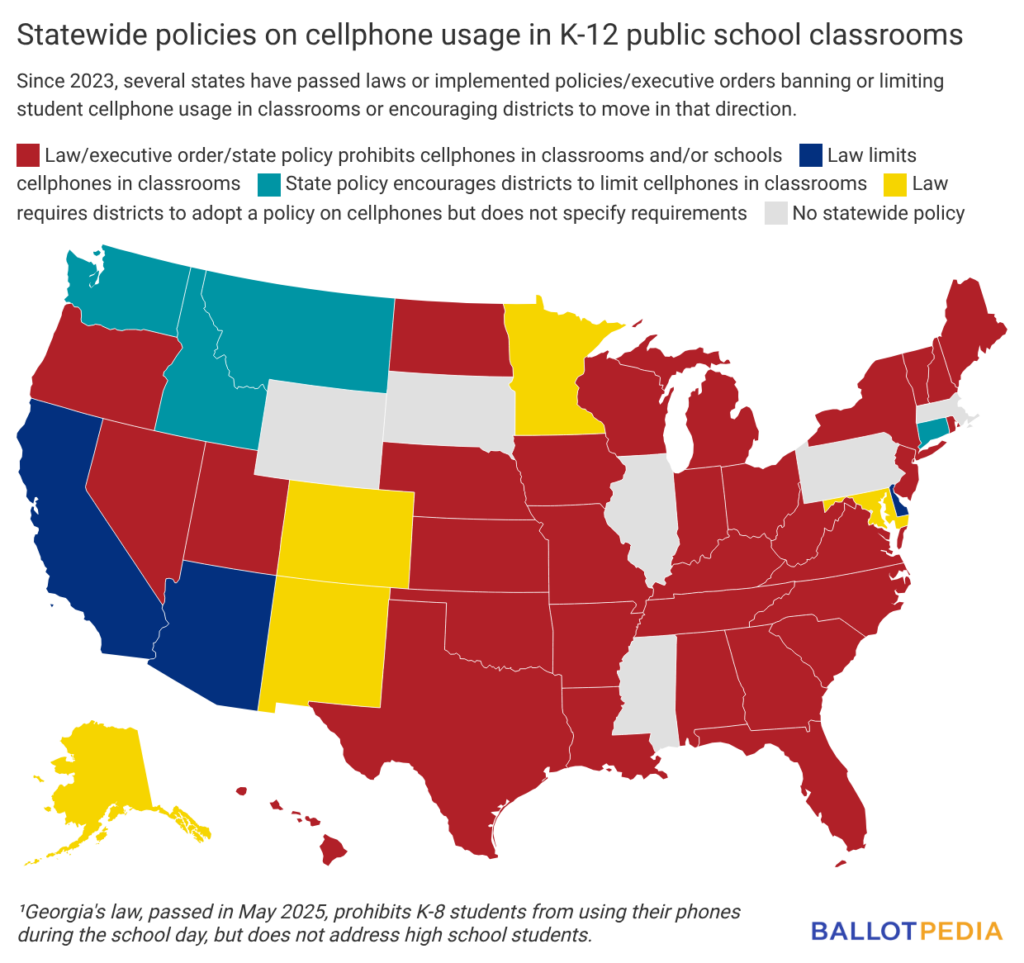
Florida became the first state to pass a statewide law regulating cellphones in schools when Gov. Ron DeSantis (R) signed HB 379 in 2023.
Click here to read more about state policies on cellphone use in K-12 public schools.
Barrera, Shaw advance to general election for California Superintendent of Public Instruction
The race to decide who succeeds Superintendent of Public Instruction Tony Thurmond, who is term-limited, will be between two sitting school board members in the November general election.
The Superintendent of Public Instruction is the state’s chief school officer and the head of the California Department of Education.
Chino Valley Unified School District school board president Sonja Shaw and San Diego Unified School District school board president Richard Barrera advanced to the Nov. 3 general election with 25% and 19% of the vote, respectively. Ten candidates ran in the primary. Click here to read our in-depth coverage of that race.
Shaw was first elected in 2022, while Barrera was first elected in 2008. According to EdSource, this will be the first time since 1982 that California voters haven’t selected a current or former state legislator for the job.
Shaw, a Republican, was endorsed by the California Republican Party and Moms for Liberty California. Barrera, a Democrat, was endorsed by the California Teachers Association (CTA), the state’s largest teachers union, and the California Charter Schools Association (CCSA). The two organizations have tended to back competing candidates in the past. Barrera has worked as a special policy advisor to Thurmond since 2024.
Shaw said she would focus on academics, saying “right now, nearly half of our students are not reading at grade level. That ends on Day One.” She also said she supports policies prohibiting transgender girls from participating in girls’ sports and accessing locker rooms. Shaw said, “Richard has made it very clear that he’s OK with our daughters having to change in their cars and feeling uncomfortable in their locker rooms, and having scholarships ripped away from them.”
Barrera has said his priorities include helping to recruit and retain teachers, expand early childhood education, and increase school funding. Barrera has said he disagrees with Shaw’s stances on policies affecting transgender students, saying “I do believe that what we’ve seen out of Sonya Shaw is an attempt to violate the basic civil rights of certain groups of students. And I will hold those districts accountable, absolutely.”
In 2023, the Chino Valley Unified School District board became the first in the state to put in place a policy that required school officials to notify parents if their child began using different pronouns or a name different from the one on their birth certificate or official records. Shaw voted for the policy.
When Shaw or Barrera take office in January 2027, it’s possible the office’s role could be different than it is now. A bill currently before the California State Assembly, AB 2117, would remove the Superintendent of Public Instruction as the head of the California Department of Education and make it “an independent evaluator and cross-sector coordinator for public education, covering preschool through higher education.” Gov. Gavin Newsom (D) has backed the plan. Both Shaw and Barrera have come out against it.
Voters in eight states — Arizona, California, Georgia, Idaho, North Dakota, South Carolina, Oklahoma, and Wyoming — will select a new chief state school officer in 2026.
Extracurricular: education news from around the web
This section contains links to recent education-related articles from around the internet. If you know of a story we should be reading, reply to this email to share it with us!
- The SAT Is Back. But Is There a Better Alternative? | The Free Press
- Texas Schools Say They Still Face Budget Difficulties Despite $8.5 Billion Boost | The 74
- Sex, drugs and … AI?: Students think everyone else is doing it more than they are | The Hechinger Report
- Kansas political battles await after 5 Republicans decline to seek reelection to Board of Education | Kansas Reflector
- Wave Goodbye to the Last Normal Year for American Schools | Slate
- A survey of America’s school board members | Brookings
- Will Public Schools Benefit From Federal Vouchers? | Curmudgucation
Take our Candidate Connection survey to reach voters in your district
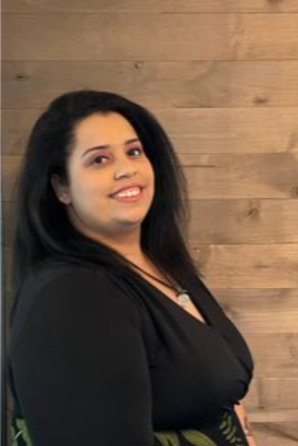
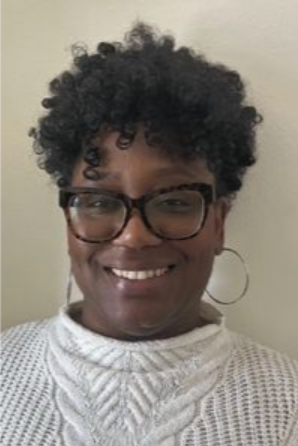
Today, we’re looking at survey responses from Dani Paez and Shernice Mundell, two of the three candidates running in the June 23 primary for Harford County Board of Education District A, in Maryland.
Donna Blasdell is also running, but had not completed the survey as of this writing.
Six of the nine seats on the board are up for election this year. Harford County Public Schools is the eighth largest district in Maryland, with roughly 38,000 students.
Here’s an excerpt from Paez’s answer to the question, “What are the main points you want voters to remember about your goals for your time in office?”
- “No Book Bans: Defending Intellectual Freedom
- I stand firm against censorship in our classrooms and libraries. Students deserve access to a wide range of voices and perspectives that reflect the fullness of human experience. I will:
-Protect educators and librarians from political interference in curriculum and book selection.
-Uphold professional standards for educational materials based on age-appropriateness and academic value.
-Foster open dialogue about complex topics so that students learn to think critically, not merely conform.”
Click here to read the rest of Paez’s responses.
Here’s an excerpt from Mundell’s answer to the question, “What are the main points you want voters to remember about your goals for your time in office?”
- “I wholeheartedly support diversity, equity, and inclusion because every student deserves to feel seen, valued, respected, and supported. Our schools should reflect the strength of our diverse community and ensure every child—regardless of background, ability, identity, or circumstance—has access to opportunities and the resources they need to succeed.
- I do not support book banning. Public education should encourage learning, critical thinking, and exposure to diverse ideas and perspectives through age-appropriate materials. I believe concerns about books or curriculum should be addressed through a fair, transparent review process led by educators, librarians, and established policies—not politics. Our schools should prepare students to think, question, learn, and engage with the world around them”
Click here to read the rest of Mundell’s responses.
As a reminder, if you're a school board candidate or incumbent planning to run this year, click here to take the survey. If you complete the survey, your answers will appear in your Ballotpedia profile. Your responses will also appear in our sample ballot. If there is an election in your community, share the link with your candidates and urge them to take the survey!