


Welcome to the Thursday, June 11, 2026, Brew.
By: Lara Bonatesta
Here’s what’s in store for you as you start your day:
- California’s election results timeline and what to know about how states count absentee/mail-in ballots
- Two U.S. House members lose primary for governor of South Carolina, and other election results from June 9
- Iowa becomes the 25th state to ban foreign contributions for ballot measures
California’s election results timeline and what to know about how states count absentee/mail-in ballots
Today, June 11, marks nine days after California’s primary election, and votes are still being counted. In the days after the primary, some public officials have criticized how long California has taken to count ballots, while others have defended it.
On June 9, U.S. Rep. Ro Khanna (D) wrote on X, “We need to figure out in California how we can get the vote counted faster and results tabulated so it does not drag on. … Right now the system is eroding trust and spawning conspiracy theories.”
California Secretary of State Shirley Weber (D) said, “Accuracy comes before speed.” Weber continued, “California is the nation’s largest voting state, with millions of ballots to process and count. Taking the time to do this work correctly protects voters’ rights and ensures the integrity of our elections.”
There are four key points in the vote counting process that can affect how quickly states complete their counts. Along with where California falls among the 50 states, they are:
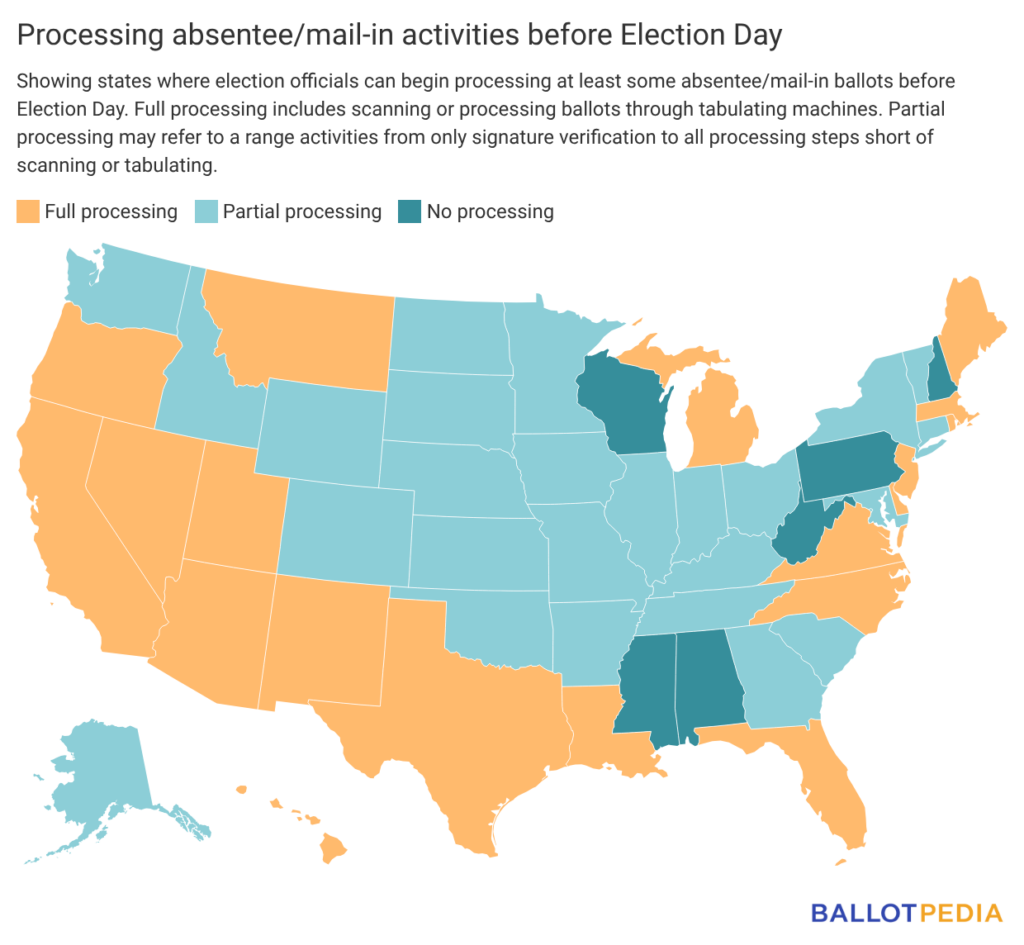
- When a state can begin processing absentee/mail-in ballots. California is one of 19 states that allow full absentee/mail-in vote processing before election day.
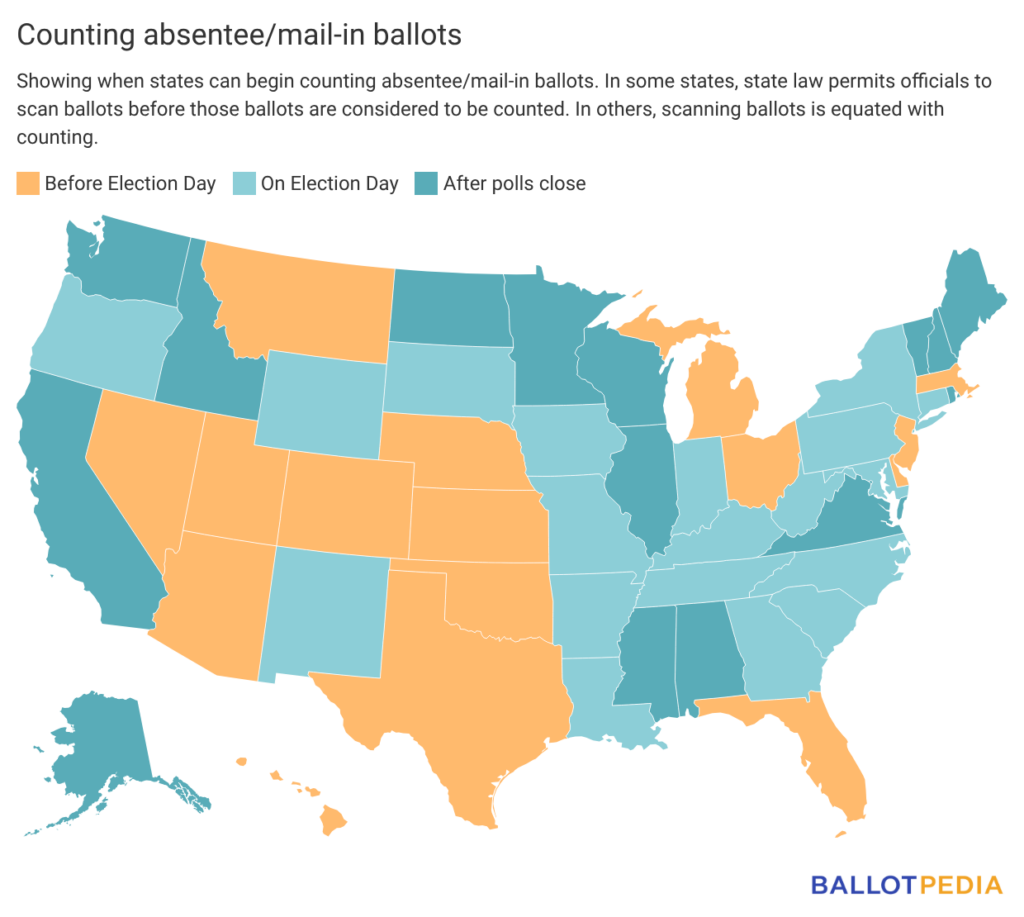
- When a state can begin counting absentee/mail-in ballots. California is one of 15 states where officials cannot begin counting ballots until polls close.
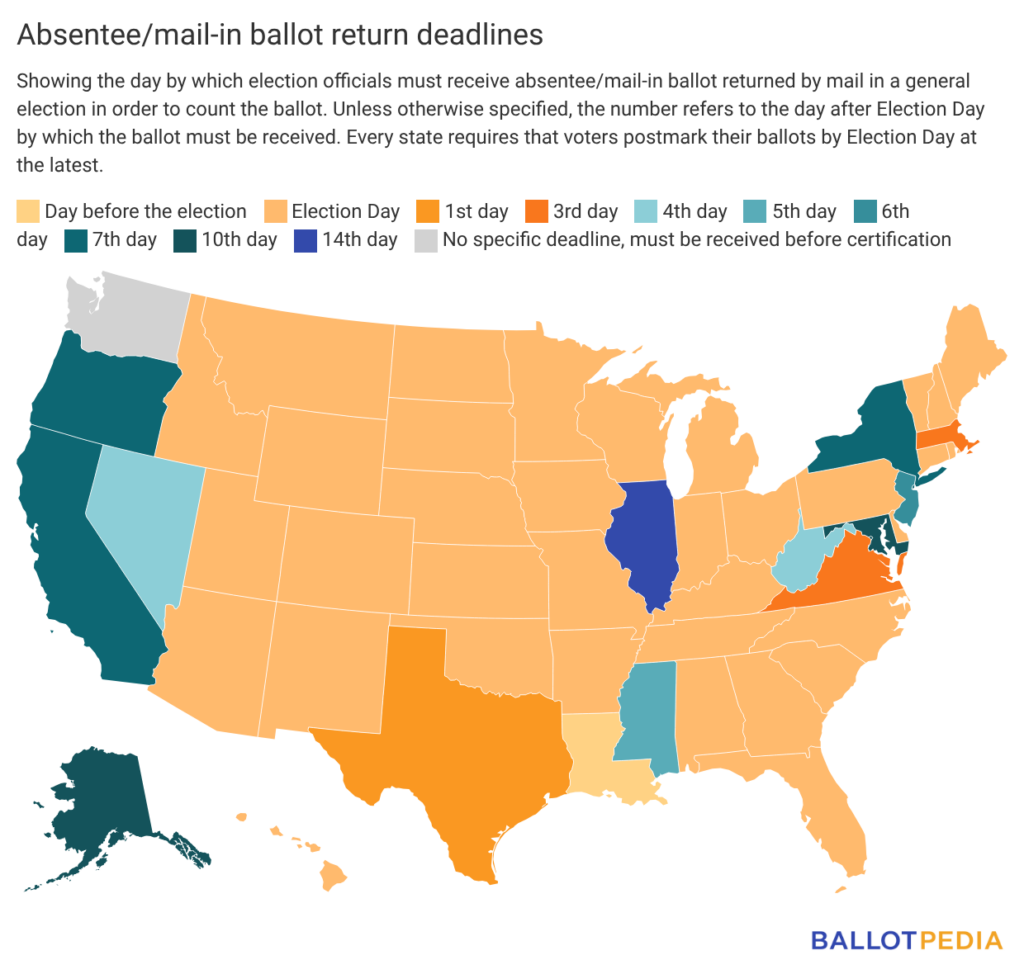
- The day by which officials must receive an absentee/mail-in ballot for it to count. California is one of 14 states that allow post-election ballot receipt, specifically through the seventh day after election day.
- When a state is legally required to finish counting absentee/mail-in ballots. California is one of eight states with a specific deadline, requiring election officials to count most ballots by the 13th day after an election (with an exception for ballots received more than four days after the election.)
Processing
Processing involves taking the administrative steps required to prepare ballots for tabulation. Which activities are allowed during processing also vary by state.
Vermont allows officials to begin processing 45 days before the election. Six states do not permit election officials to begin processing ballots until election day. Twenty-five states allow the partial processing of absentee/mail-in ballots before the election.
Counting
States vary in when they can begin counting ballots.
Sixteen states allow counting to begin before election day, and an additional 19 permit it before polls close on election day. Those states have laws prohibiting the disclosure of election results before the polls close. Fifteen states require counting to begin after polls close on election day.
Return deadlines
Regardless of when state laws permit election officials to process or count ballots, the work depends on when they receive completed ballots. Louisiana requires absentee/mail-in ballots to be received the day before election day. Thirty-five states require that election officials receive absentee/mail-in ballots on election day.
Fourteen states allow a post-election window for ballots postmarked by election day to be counted. Texas requires ballots to be received by the day after the election, while Washington counts ballots received up until the certification deadline.
The legality of a Mississippi law allowing absentee ballots postmarked by but received after election day is an issue in Watson v. Republican National Committee, a case argued before the U.S. Supreme Court on March 23, 2026.
Deadline to finish counting
Eight states also have a specific deadline by which election officials must finish counting absentee/mail-in ballots or otherwise certify the review of absentee/mail-in ballots.
Arkansas requires absentee/mail-in ballots to be counted before polls close on election day. Alaska requires absentee ballots to be counted no later than the 15th day following election day.
Eight states do not have a completion deadline, but require election officials to continue counting on a predetermined schedule until all ballots are counted. The remaining states do not specify a deadline or schedule for completing the counting of absentee/mail-in ballots.
So far this year, five states have passed bills on the return of absentee/mail-in ballots. That includes Mississippi HB 908, which would repeal the state’s five-day grace period if the Supreme Court rules it unlawful.
Fourteen states have passed 17 bills on the administration of absentee/mail-in voting so far this year. That includes South Dakota SB 171, which allows an absentee ballot counting board to begin meeting on the day before the election.
For more information on absentee and mail-in voting timelines, click here.
Two U.S. House members lose primary for governor of South Carolina, and other election results from June 9
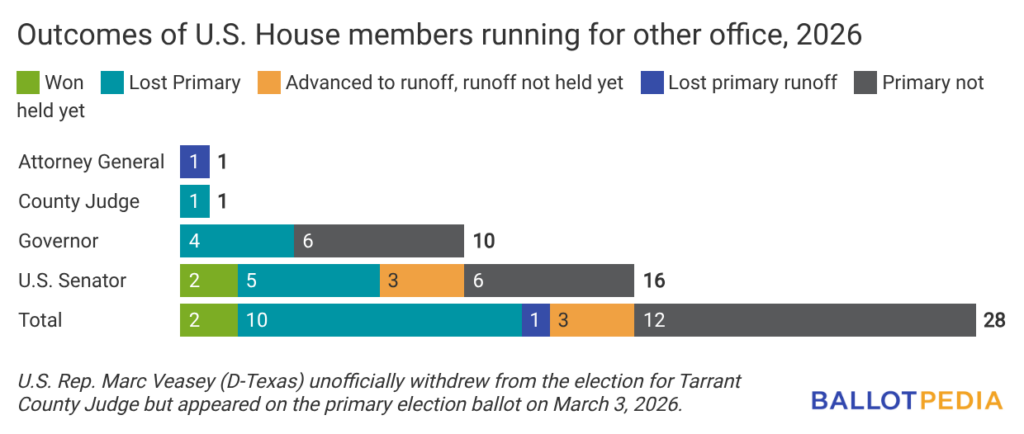
On June 9, U.S. House members Nancy Mace (R) and Ralph Norman (R) lost the Republican primary for governor of South Carolina. Of the 10 U.S. House members who retired this year to run for governor, four of them have lost their primaries. The other six have not had their primaries yet. The chart below shows how that compares to U.S. House members' performances in elections for other offices this year.
In addition to South Carolina, three other states—Maine, North Dakota, and Nevada—also held statewide primaries on June 9. Below is a look at some of the key races we covered in each state.
Maine
U.S. Senate: Graham Platner won the Democratic nomination for U.S. Senate in Maine with 72% of the vote, in the first round of ranked-choice voting. Governor Janet T. Mills (D), who suspended her campaign on April 30, received 19.5% of the vote, and David Costello received 8.1%.
Platner will face incumbent Susan Collins (R) in the general election. The Cook Political Report and Sabato's Crystal Ball have rated the general election a toss-up. Inside Elections has rated it tilt Republican.
Several other key races in Maine were still uncalled as of this writing, including both primaries for governor and the Democratic primary for Maine’s 2nd Congressional District. According to the New York Times, the state’s ranked-choice voting process typically takes a week or two.
Click here to see more results from Maine.
South Carolina
U.S. Senate: Incumbent Lindsey Graham won the Republican primary with 56.8% of the vote. As of this writing, second-place finisher Mark Lynch (R) had 28.9% of the vote. On the Democratic side, Annie Andrews (D) defeated two other candidates with 61.5% of the vote.
Governor: Pamela Evette (R) and Alan Wilson (R) advanced to a runoff after neither received a majority in the Republican gubernatorial primary. As we mentioned above, U.S. Reps. Ralph Norman (R) and Nancy Mace (R), as well as Rom Reddy (R), also ran in the primary. The runoff will be held on June 23. The winner will face Jermaine Johnson (D) in the general election.
South Carolina’s 1st Congressional District: Jenny Honeycutt (R) and Mark Smith (R) advanced to a runoff in South Carolina’s 1st District, after neither received a majority of the vote in the primary to replace incumbent Nancy Mace.
This is the first election for an open seat in the 1st District since 2013. Major election forecasters rated the general election solid/safe Republican.
State Legislature: Two incumbent South Carolina state legislators – one Democrat and one Republican – lost their primaries.
- In House District 121, Shannon DeLoach (D) defeated incumbent Michael Rivers (D)
- In House District 14, Rick Shealy (R) defeated incumbent Luke Rankin (R).
Click here to see more results from South Carolina.
Nevada
Governor: Incumbent Gov. Joe Lombardo (R) won his primary with 90.9% of the vote. Attorney General Aaron Ford (D) defeated five other candidates in the Democratic primary. Major election forecasters have rated the general election as a toss-up or tilt/lean Republican.
Other state executives: In primaries for Attorney General, Nicole Cannizzaro (D) and Adriana Fralick (R) each defeated one other candidate, advancing to the open general election. Meanwhile, Nevada’s incumbent Secretary of State Cisco Aguilar (D) and incumbent Controller Andy Matthews (R) won their respective primaries.
Click here to see more results from Nevada.
North Dakota
U.S. House: Incumbent Julie Fedorchak (R) won her primary in North Dakota's At-large U.S. House District with 72.9% of the vote. She will face Trygve Hammer (D) in the general election.
State Legislature: Three state legislators in North Dakota – two Republicans and one Democrat – lost their bids for re-election. As of this writing, 10 primaries featuring incumbents were still uncalled.
- In House District 33, incumbent Bill Tveit lost in the Republican primary. Incumbent Anna Novak (R) and Mike Heger (R) won the primary, advancing to the general election.
- In House District 43, Jill Chandler (R) and Mike Holmes (R) defeated incumbent Eric Murphy.
- In Senate District 9, Jayme Davis (D) defeated incumbent Richard Marcellais (D)
Click here to see more election results from North Dakota.
California local ballot measures
Voters across California decided on 113 local ballot measures on June 2. Of those, 54 were approved, 22 were defeated, and 37 remain uncalled. Here’s an update on some of the notable measures we’re following.
Los Angeles voters approved one of the two measures that would change the city's transient occupancy tax (TOT), while the other is still too close to call. Also in Los Angeles, Measure ER, which would increase the sales tax from 9.75% to 10.25% for five years to provide funding for local health departments and services, is still too close to call. As of this writing, the vote is 50.4% Yes to 49.7% No.
San Francisco voters defeated two measures that would have changed the city's top executive pay tax. They approved a measure establishing lifetime term limits of two four-year terms for the mayor and members of the board of supervisors.
Monterey Park voters approved a measure prohibiting data centers citywide. While this isn't the first ballot measure related to data centers, it is the first to explicitly prohibit them.
Shasta County approved a charter amendment to require in-person voting on a single election day, limit absentee voting to certain groups, and require voters to present a government-issued photo ID. The measure also requires ballots to be hand-counted at the precinct level. Before the election, the Los Angeles Times reported that both supporters and opponents of the measure expect it to be challenged in court.
Click here for more election results from June 9.
Iowa becomes the 25th state to ban foreign contributions for ballot measures
On June 2, Iowa Gov. Kim Reynolds (R) signed legislation, HF 2601, prohibiting foreign contributions in ballot measure elections. Iowa is now the 25th state to ban foreign nationals or governments from contributing to ballot measure campaigns. It is also one of 19 states to prohibit foreign contributions to both campaign and ballot measure committees.
Iowa’s new law prohibits anyone who is not a citizen or lawful permanent resident of the United States, as well as foreign governments, political parties, and groups, from making contributions to or soliciting contributions for ballot measure campaigns. The law also prohibits foreign nationals from making independent expenditures in candidate and ballot measure elections.
Iowa previously had a ban on foreign funding in candidate elections, but no such prohibition on foreign contributions to ballot measure committees.
The law requires donors to political committees involved in ballot measures to certify that they are not foreign nationals. Political committees must also affirm that they have not knowingly received contributions from a foreign national.
The bill passed the Iowa House 90-0 on March 23. The Iowa Senate then approved the bill 44-0 on April 21.
Two other states have enacted similar bans this year. Alabama enacted legislation in March banning foreign national contributions to both ballot measures and candidate campaigns, while Nebraska expanded its ban on foreign contributions to ballot measure committees in April.
Click here to see a map of states that prohibit foreign contributions in elections.
So far this year, legislators in 30 states have introduced or carried over 90 bills related to foreign funding of elections.
Under current federal law and court precedent, foreign nationals are prohibited from contributing to candidate campaigns but may contribute to ballot measure campaigns, which courts and the Federal Election Commission have treated as issue advocacy rather than electoral activity.
Click here to learn more about state laws on foreign funding in elections.