


Welcome to the Friday, June 12, 2026, Brew.
By: Briana Ryan
Here’s what’s in store for you as you start your day:
- D.C. to hold first election using ranked-choice voting on June 16
- A look at the role of endorsements in the June 2 primaries
- 121 statewide ballot measures have been certified this year — above the average in even-numbered years
D.C. to hold first election using ranked-choice voting on June 16
Washington, D.C., will hold its first election using ranked-choice voting (RCV) on June 16, joining three states and three of the 100 largest cities in the country that use or are scheduled to use the system.
D.C. voters will use the system in the Democratic primaries for mayor, delegate to the U.S. House, four D.C. Council seats, and an independent special election to fill an at-large council seat. D.C. only uses RCV when there are three or more candidates on the ballot, so the system will not be used in any Republican primaries.
RCV is a system where voters rank candidates by preference on their ballots. In the RCV system used in D.C., a candidate who wins a majority of first-preference votes is the winner. If no candidate wins a majority of first-preference votes, the candidate with the fewest first-preference votes is eliminated, and their votes are transferred to the voters’ second-choice candidate. This process continues until a candidate receives a majority of the vote.
In 2024, D.C. voters approved a ballot measure 73% to 27% that authorized the use of RCV starting in 2026. In December 2025, the D.C. Council rejected an effort to delay the implementation of RCV until 2027. Beyond Tuesday's primary, the D.C. will also use RCV for presidential elections, as well as other local offices, including board of education members, attorney general, and advisory neighborhood commissioners.
Washington, D.C., a federal district rather than a city or state, will be the fourth most populous local jurisdiction that currently uses RCV or is scheduled to do so, after New York City, San Francisco, and Seattle. Nationally, at least 39 cities or counties use or are scheduled to use RCV.
Ashtabula, Ohio, became the first locality in the United States to use RCV, starting in 1915. Other cities, including Cincinnati, Cleveland, New York City, and Sacramento, followed suit during the 1920s and 1930s. At least 15 cities were using RCV by 1947.
Beginning in the late 1940s, however, cities began to repeal their use of RCV. At least 53 localities across the country have stopped using RCV after previously adopting it, though some cities, like New York, later resumed its use. According to Georgetown University’s Jack Santucci, Cambridge, Massachusetts, was the only city in the U.S. using RCV by the early 1960s.
Interest in RCV rose again in the 2000s, with San Francisco adopting the system in 2002 and Minneapolis beginning to use RCV in 2006. Supporters of the change argued it would improve voter turnout and reduce the expense of runoff elections, while opponents argued it would delay election results and confuse voters. New York City, the largest locality in the United States to use RCV, adopted it in 2019.
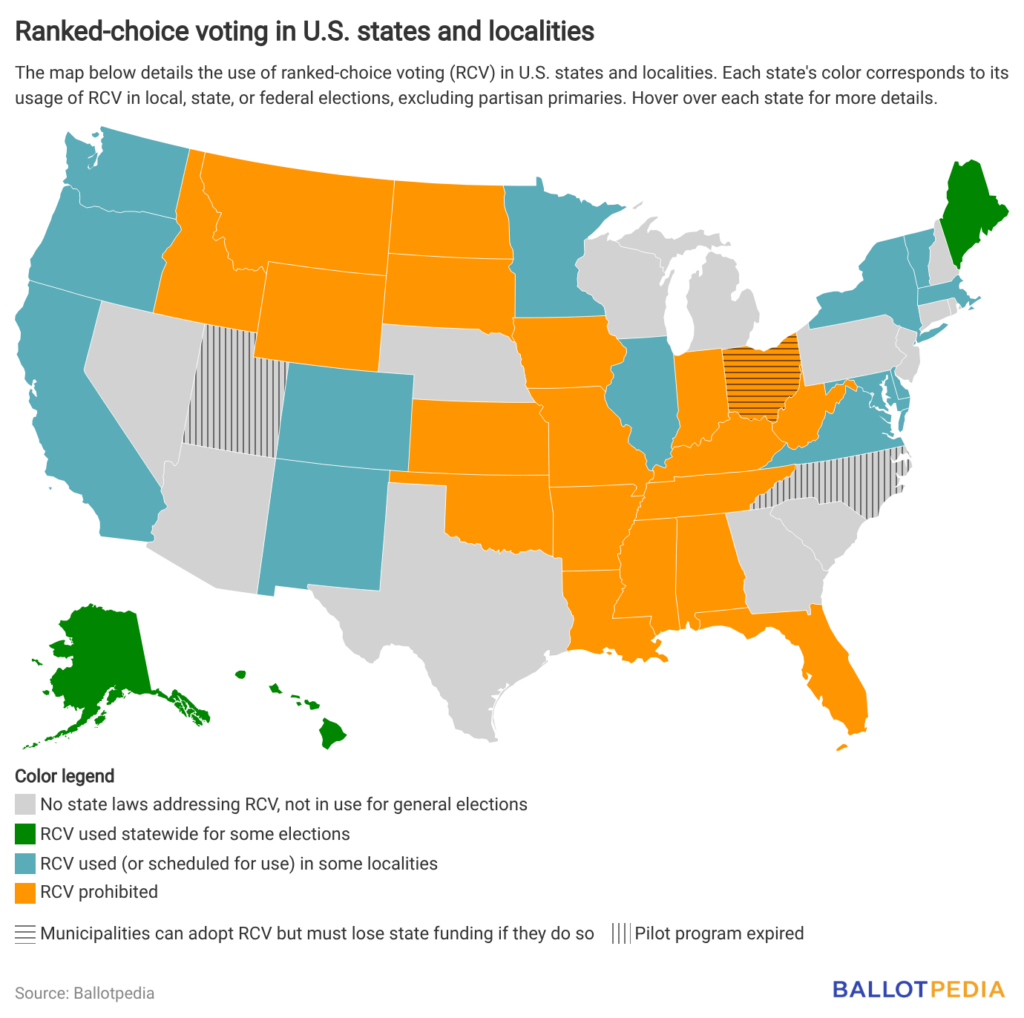
Beyond the local level, three states — Alaska, Hawaii, and Maine — use RCV for at least some statewide or federal elections. Nineteen states have laws prohibiting or restricting the use of RCV.
According to the D.C. Board of Elections, “Final results in ranked choice elections will not be known until all eligible ballots have been received and counted.” This includes mail-in ballots, which in D.C. can be received up to 10 days after the election, provided they were postmarked by election day.
The Washington Post reported that officials “expect their initial count of second-choice votes will be completed and released by June 21, but it might be earlier than that.”
Click here for more information on RCV in the United States, and here for more information on voting in D.C.’s June 16 primary election.
A look at the role of endorsements in the June 2 primaries
Endorsements are one of the ways voters learn who candidates are and what they stand for — especially in down-ballot races where little other information is available. Ballotpedia tracks endorsements from organizations we call Recognized Endorsement Contributors (RECs). These groups range from labor unions and advocacy organizations to newspaper editorial boards that published their endorsements. In the primaries on June 2, we identified 463 endorsements from 46 RECs across five states: Iowa, Montana, New Jersey, New Mexico, and South Dakota.
Eleven organizations issued more than 10 endorsements each in these primary elections. The table below displays the organizations and their endorsee success rates. Candidates these organizations endorsed won 89% of their races, lost 9%, and the remaining races are still too close to call.
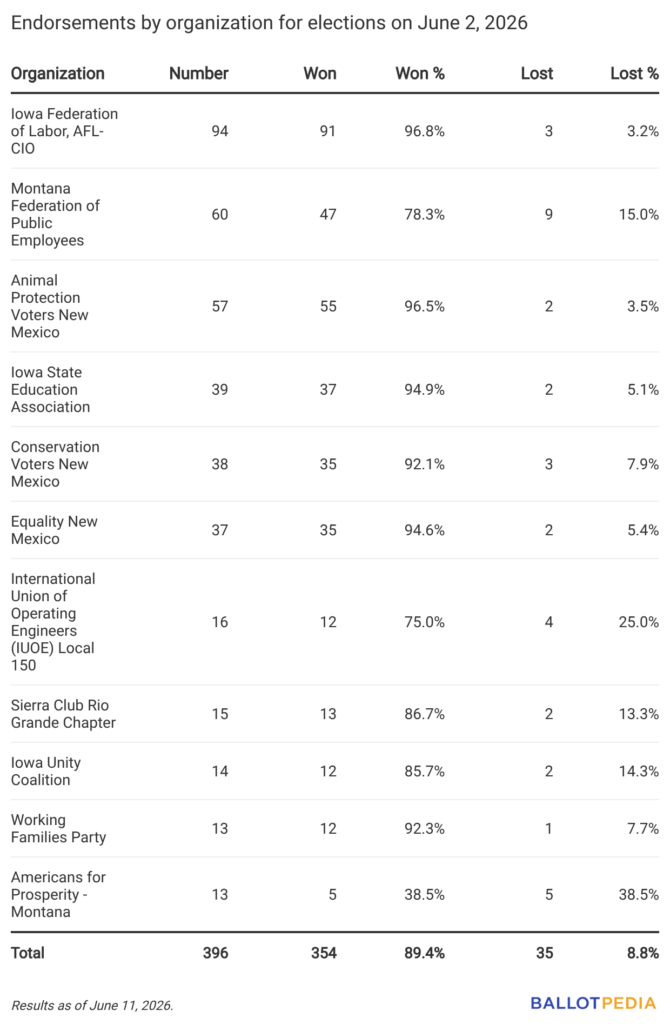
Among these organizations, three endorsed candidates from multiple political parties. Click the links below to explore their endorsements:
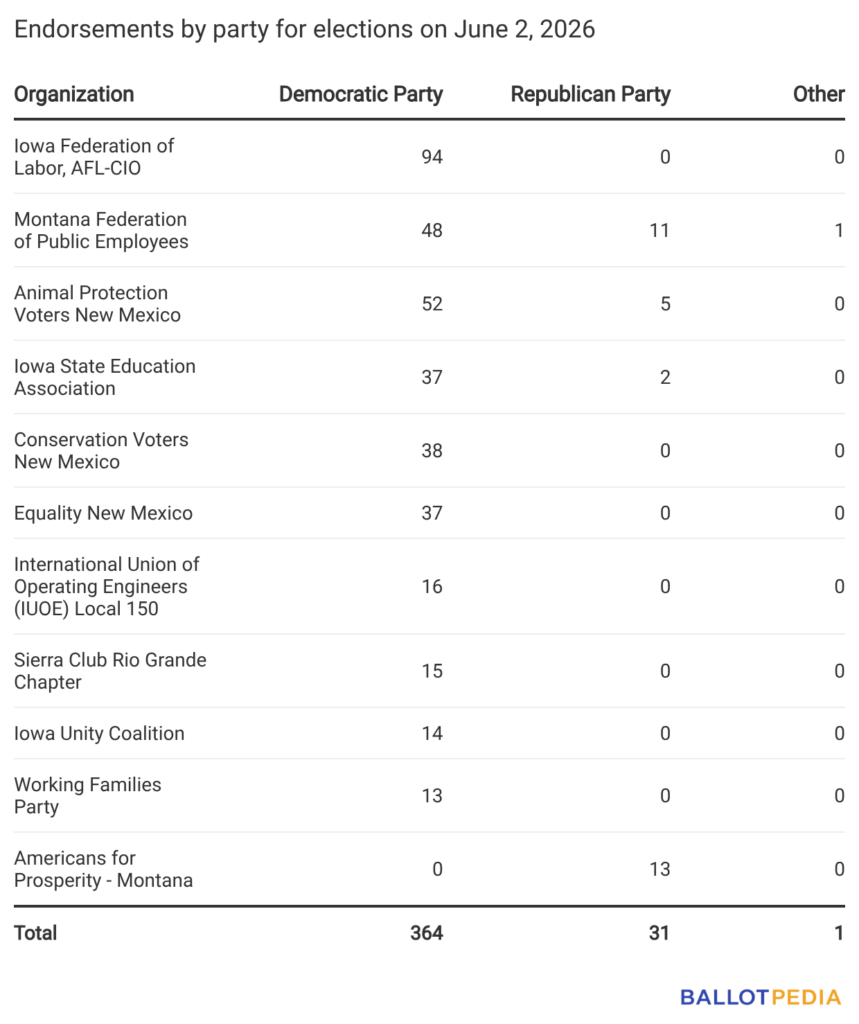
- Montana Federation of Public Employees: Endorsed 48 Democratic candidates, 11 Republican candidates, and one nonpartisan candidate.
- Animal Protection Voters New Mexico: Endorsed 52 Democratic candidates and five Republican candidates.
- Iowa State Education Association: Endorsed 37 Democratic candidates and two Republican candidates.
The remaining organizations endorsed candidates from one major political party. The chart below displays the candidate affiliations for endorsees by all 11 RECs.
These 11 RECs issued their endorsements primarily in state-level races (374). They made 22 endorsements in congressional races. None of the RECs issued endorsements in local-level races in Ballotpedia’s core coverage scope. The chart below displays these RECs’ endorsements by level of government.
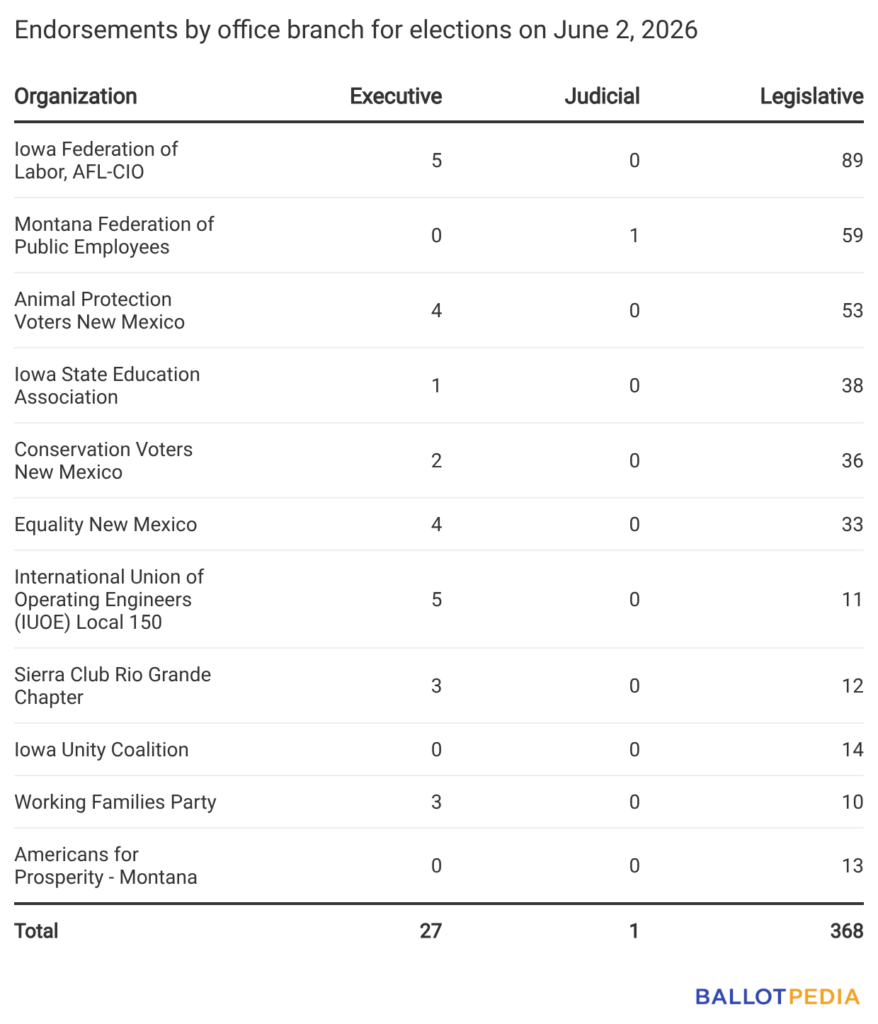
The majority of these endorsements came in legislative races (93%), with another 7% coming in executive races. Only one organization, the Montana Federation of Public Employees, issued an endorsement in a judicial race. The table below shows each organization’s endorsements by branch of government.
Endorsements are statements or actions that an individual or group provides in support of a candidate, but they are also much more than that. Endorsements reveal alliances, ideological leanings, and potential policy priorities in ways that campaign platforms and quotes from a candidate sometimes can’t. Endorsements also play a practical role in campaigns. Many endorsers — especially for statewide and national candidates — can provide candidates with volunteer support, access to possible campaign donors, and give candidates a degree of credibility and notoriety.
Ballotpedia is tracking endorsements in races at all levels of government, with a particular focus on groups that endorse candidates at the local level. Endorsements are one component of Ballotpedia's goal to provide robust information — data that helps voters understand who a candidate is and what their political philosophy is — for every office on the ballot.
Click here to read more about RECs.
121 statewide ballot measures have been certified this year — above the average in even-numbered years
As of June 9, 121 measures have been certified for statewide ballots this year — more than the historical average of 108 at this point in even-numbered years from 2014 through 2024. From 2014 through 2024, an average of 153 statewide measures were certified in even-numbered years.
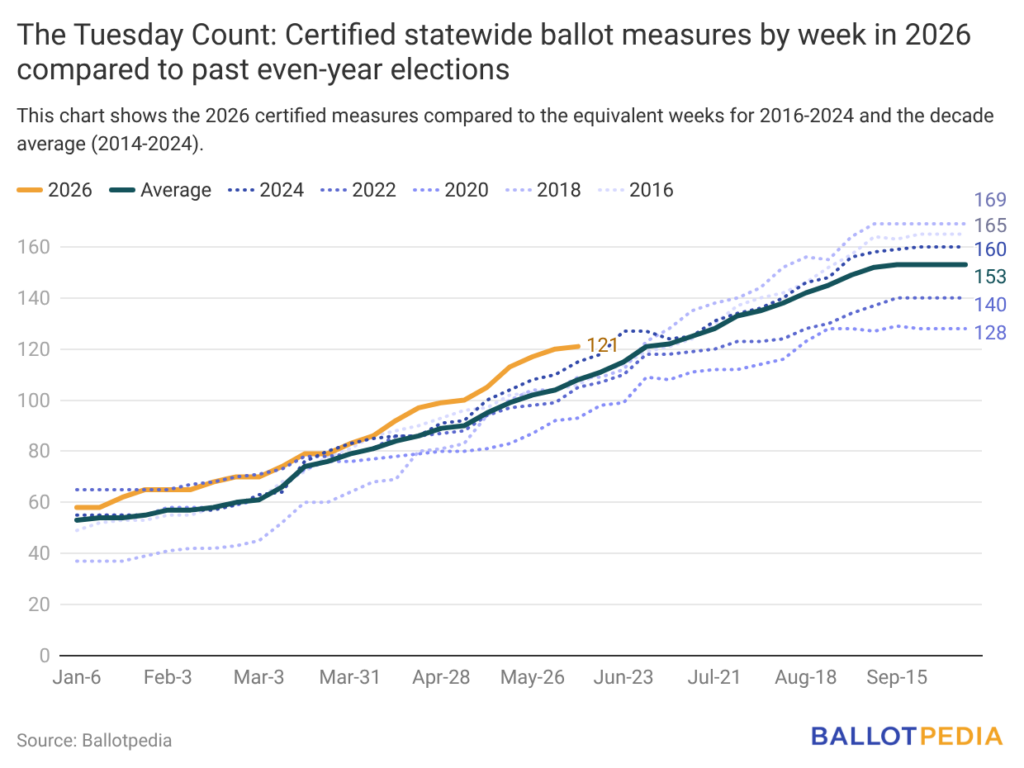
Over the past two weeks, four new measures were certified:
- California Require Healthcare Union Member Approval for Ballot Measure Campaign Spending Initiative
- Florida Homestead Tax Exemptions, Property Assessments, and Spending Restrictions Amendment
- Louisiana Remove Payment Order Requirement for State Retirement System Unfunded Liability Amendment
- Louisiana Use Public Funds for Drinking Water Utility Service Lines Amendment
Signatures are pending verification for 17 citizen initiatives:
- California Establish Immunology and Immunotherapy Research Institute Initiative
- California Establish Personal Injury Lawyer Regulations Initiative
- California Expedited Environmental Review Process for Certain Projects Initiative
- California One-Time Wealth Tax for State-Funded Healthcare, Education, and Food Assistance Programs Initiative
- California Prohibit Taxes on Retirement Holdings and Personal Savings Amendment
- California Renew State Income Tax Increase for Education Funding Initiative
- California Require Background Checks and Sexual Assault Reporting by Rideshare Companies Initiative
- California Revenue Use Requirements for New Special Taxes Amendment
- California State University Staff First-Time Homebuyer Down Payment Loan Program Initiative
- Colorado Increase Transportation Funds for Road Transportation and Decrease Funds for Other Forms of Transportation Amendment
- Idaho Medical Marijuana Legalization Initiative
- Idaho Reproductive Freedom and Privacy Act Initiative
- Michigan Citizenship Verification and Voter Identification Initiative
- Michigan Utility and Government Contractor Campaign Finance Regulations Initiative
- Missouri Congressional Map Referendum
- Missouri Initiative and Referendum Powers and Legislative Change Requirements Amendment
- Oregon Criminalize Hunting, Fishing, and Intentional Injury to Animals Initiative
The next signature deadline is June 21 in Montana.
Click here for more information about the measures on statewide ballots this year.