



On August 4, as Kansans vote in primaries for offices including governor and U.S. Senate, a constitutional amendment to change how the state’s supreme court justices are selected will be on the ballot.
Currently, the state uses an assisted-appointment method in which a nominating commission sends a list of applicants to the governor, who selects from that list. The measure on the ballot would introduce elections for justices. If the measure passes, it will be the first time since 2021, when Ohio changed its elections, that a state has changed its method of selection for the state supreme court.
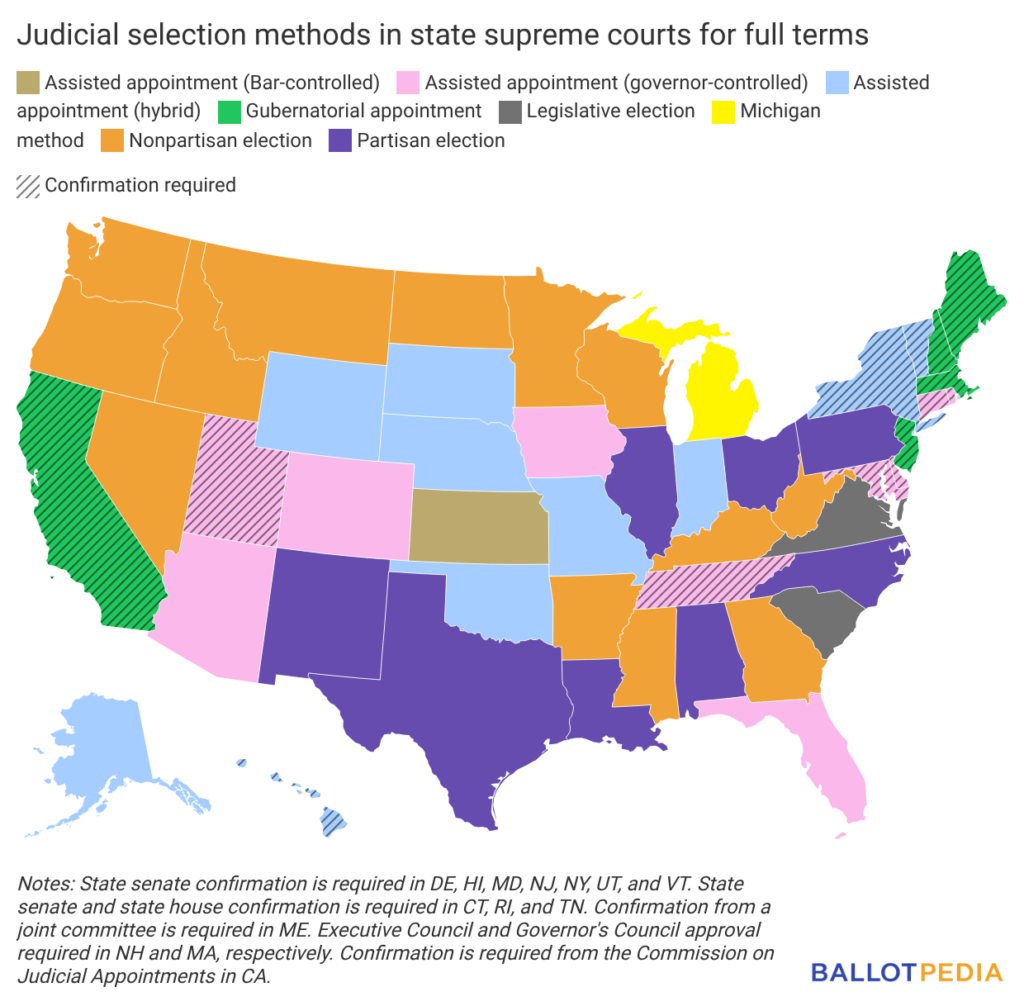
Currently, Kansas is one of 21 states that use the assisted appointment method. This is the most common selection method. The next most common is nonpartisan elections, which are used in 13 states, followed by partisan elections in eight states, gubernatorial appointment and legislative confirmation in five, legislative elections in two, and the Michigan Method (partisan convention, nonpartisan general election) in one state.
Supporters of the measure argue that adopting elections would improve transparency in the process. State Senate President Ty Masterson (R) said: “Critics of elections warn of politics but every system is political … Direct elections make the political dynamic explicit, not hidden in backrooms by bar members who think they’re better than the rest of us.” Opponents of the measure argue that it resulted from the court issuing decisions that the legislature disagreed with. ACLU of Kansas director Micah Kubic said: “This is a blatant attack by the legislators on our justices, and it’s part of a decades-long pattern of politicians attempting to punish the judicial branch for issuing decisions on education and reproductive freedom that they disagree with.”
While Kansas does not currently hold elections, justices stand for a retention election, in which voters vote yes or no to retain them. In Ballotpedia’s analysis going back to 1990, no Kansas justice has lost a retention election, and no justice has received less than 52% of the vote in favor of retention.
To read more about the ballot measure, click here. To read more about state supreme court selection methods, click here.