
On June 1, 2026, the Centers for Medicare & Medicaid Services (CMS) released an Interim Final Rule with Comment Period (IFC) governing how states implement Medicaid work requirements — also known as community engagement requirements — enacted into law as part of the One Big Beautiful Bill Act (OBBBA). The nearly-400 page document establishes standards for how states verify compliance with work requirements, determine exemptions, and adhere to federal reporting requirements. Individuals can submit comments on the rule electronically or by mail to the Federal Register until July 31.
The OBBBA, the 2025 budget reconciliation bill, established mandatory work requirements for most able-bodied adults ages 19-64 beginning Dec. 31, 2026, in states that expanded Medicaid under the Affordable Care Act (otherwise known as Obamacare). To date, 40 states and Washington D.C. have expanded Medicaid to cover childless adults under 65 earning incomes up to 138 percent of the federal poverty level. Georgia and Wisconsin have partially expanded the program. A June 2025 Congressional Budget Office (CBO) analysis estimated that, once implemented in all 42 states and D.C., work requirements would apply to roughly 18.5 million Americans.
Under the OBBBA, Medicaid beneficiaries subject to work requirements must provide evidence that they are either employed, participating in community service or an approved work program, or enrolled at least part time in an educational program for at least 80 hours a month. Individuals subject to work requirements must submit documentation demonstrating their compliance with the law at the time of enrollment and every six months thereafter. Adults subject to work requirements are eligible for an exemption if they meet certain criteria. For example, some former foster care youth are exempt, as are some American Indians, Alaska Natives, and the parents or caretakers of children under 13.
Among other provisions, the rule is notable for specifying when individuals considered “medically frail” are exempt from work requirements, and outlining how states must verify this designation.
The OBBBA defines medically frail individuals as those who are blind, disabled, struggling with a substance use disorder, those who have “a physical, intellectual or developmental disability that significantly impairs their ability to perform 1 or more activities of daily living,” or a “serious or complex medical condition.” The OBBBA specified that medically frail were one of several groups excluded from work requirements.
State Medicaid agencies are charged with developing a list of conditions that qualify as medical frailty within the parameters of the law. However, the CMS’ rule says that having a medical frailty isn’t enough, in and of itself, to exempt individuals from work requirements in most circumstances, and states will be responsible for verification: “The phrase ‘medically frail or who otherwise has special medical needs’ connotes diminished functional capacity that significantly impairs an individual’s ability to meet ordinary demands. In this context, the relevant demand is meeting the community engagement requirement. Accordingly, we interpret the statute to require consideration of the severity of an individual’s condition as relevant to whether that individual is capable of meeting the community engagement requirement.”
The rules prompted some healthcare and patient advocacy groups to warn that it would impose an unnecessary burden on some of the sickest patients in the healthcare system and goes beyond the text of the law.
America’s Physician Groups (APG), a national association that says it represents nearly 260,000 physicians, said, “These statements suggest that individuals on Medicaid with chronic or serious conditions may be forced into a nearly endless cycle of doctors’ visits to determine how ill they really are and whether they can work; that states will similarly have to digest endless streams of such information about enrollees; and that states will also have substantial latitude to force enrollees off the program through subjective interpretations about their illnesses and their ability to work.”
CMS Administrator Mehmet Oz said, “We hope by guiding able-bodied individuals in this initiative, we aim to support their path to independence, but hopefully they don’t need to depend on Medicaid, and are supported by employer-sponsored health plans that would free up critical space in the program for our most vulnerable population to receive the care they deserve.”
The rule also establishes standards for how states verify that medically frail beneficiaries are unable to work. States must attempt to use insurance claims data or other relevant, reliable information to verify that an individual is medically frail. However, if a state cannot acquire such information, individuals are allowed to self-attest that they are medically frail through 2027. Beginning in 2028, individuals can self-attest to confirm eligibility or compliance only one time. After that, the rule requires that individuals submit documentation proving their health status if states cannot determine eligibility on their end.
Background
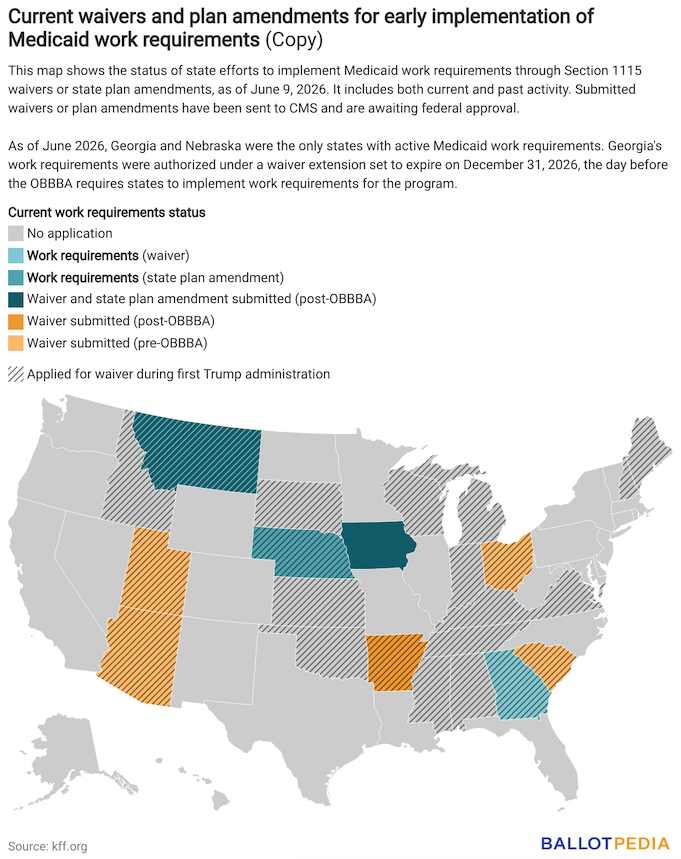
Before the OBBBA, states could apply for a waiver to implement work requirements, but only two states had ever successfully implemented a Medicaid work requirement. Arkansas briefly implemented work requirements under a waiver that was granted under the first Trump administration before the Biden administration revoked it. Georgia was similarly granted a waiver to implement work requirements for the program and implemented them after a court case was ruled in the state's favor. Georgia has been the only state with active work requirements for Medicaid since July 1, 2023.
Nebraska became the first state to implement work requirements under the OBBBA on May 1, 2026.
The OBBBA included a provision that allowed states to speed up implementation, called a state plan amendment. Nebraska is the first to use the mechanism, but two other states, Montana and Iowa, plan to use state plan amendments to implement work requirements on July 1 and Dec. 1 respectively.
State plan amendments aren't the only way to implement the work requirements ahead of schedule. States can still apply for Section 1115 waivers, which require approval from the federal Centers for Medicare and Medicaid Services (CMS). Seven states — Arizona, Arkansas, Iowa, Montana, Ohio, South Carolina, and Utah — have active applications for Section 1115 waivers that would implement work requirements before the Jan. 1, 2027 deadline to do so. Two of these states, Iowa and Montana, have since adopted state plan amendments.