



On June 3, 2026, the North Carolina General Assembly overrode Gov. Josh Stein's (D) veto of HB 87, titled the Educational Choice for Children Act (ECCA), opting the state into the federal education tax credit scholarship program.
Stein vetoed HB 87 on Aug. 6, 2025. In his 2025 veto message, Stein said, "Once the federal government issues sound guidance, I intend to opt North Carolina in so we can invest in the public school students in need of after school programs, tutoring, and other resources. Therefore, HB 87 is unnecessary, and I veto it."
The regulations to implement the program were pending as of June 5. In a statement about the veto override on June 3, Stein said that although the U.S. Treasury (Treasury) hadn't yet issued guidance, he saw potential for the program to benefit public school students.
Stein said, "We are working on a solution to make it easy for North Carolinians like me who want to direct their federally reimbursed donations to scholarship-granting organizations that directly benefit public school students, and I look forward to sharing more once the federal guidance has been provided. Together, we can elevate high-impact programs that support public school kids with tutoring, after-school programs, summer learning, workforce development, and more."
The North Carolina House of Representatives voted 73-46 on May 20, 2026, to override the veto, with all Republican and one unaffiliated representative supporting the bill and all Democrats opposing it. One Democratic representative was absent. The North Carolina Senate voted 30-19 on June 3, 2026, to override the veto, along the same party lines, with one Democratic senator absent.
About the ECCA, North Carolina Sen. Michael Lee (R) said, "A lot of folks have just kind of tied this to private schools or other types of nonpublic-type institutions. That’s really not true. This really applies for all children in all schools, and it’s pretty clear."
North Carolina Sen. Jay Chaudhuri (D) said, "We are being asked to opt into a program built on an unfinished foundation. Is it wise for us to layer in a new federal program when we don’t have any established rules?"
About the program
The U.S. school choice tax credit scholarship is a nonrefundable tax credit, allowing individuals to receive federal tax credits for donations up to $1,700 to authorized scholarship-granting organizations (SGOs). It is a dollar-for-dollar nonrefundable tax credit, meaning individuals can lower their federal tax liability by $1 for every $1 donated to accredited SGOs; if a taxpayer donates more than $1,700, they will not receive a tax refund for the amount over $1,700. The total amount of credits the program can offer is not capped.
SGOs distribute donated scholarship funds to eligible families for a variety of private or public educational expenses, including private school tuition, tutoring services, textbooks, and more. To qualify for scholarships, students had to live in households earning no more than 300% of the area's median gross income (AGMI) and be eligible to enroll in K-12 schools. EdChoice published an interactive U.S. map on May 21, 2026, displaying what 300% of AGMI would be for FY 2026 across the country. The program will take effect January 1, 2027.
States that elect to participate must submit a list of SGOs that taxpayers can donate to to receive the federal tax credit. Students in states that do not opt in cannot receive scholarships funded under the program, but donors in those states can still receive a federal tax credit by donating to SGOs in participating states. As enacted, the program will not affect state budgets.
The U.S. Treasury must issue regulations that will shape how the program runs, what the requirements are for participating states, or who can benefit from the program. The regulations, once issued, could affect state participation. They were pending as of June 4, 2026, though the Internal Revenue Service (IRS) issued a notice with a request for comment on policies to implement the program on November 26, 2025. The IRS issued a notice saying states could begin electing to participate starting January 1, 2026. View the policy proposals that Ballotpedia has compiled here.
What are other states doing?
As of June 4, 31 states had either formally opted in to the program, passed legislation to opt in, or otherwise indicated their intent to participate. The governors of three states – Hawaii, New Mexico, and Oregon – said they would not participate. Legislation requiring the state to participate failed in Arizona and Wisconsin.
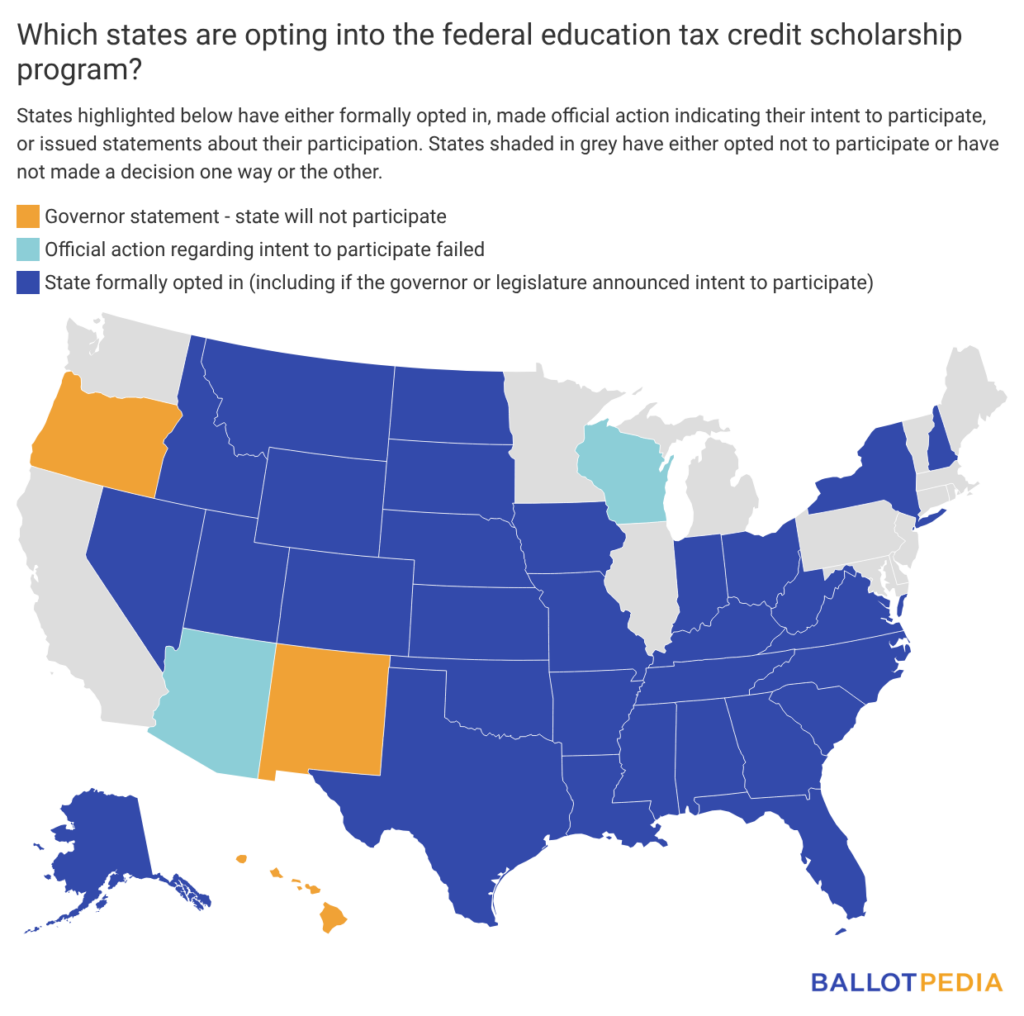
Of the states that have indicated their participation:
- Six have Democratic trifectas. Three states — Virginia, Colorado, and New York — have indicated participation in the program, while three states — Hawaii, New Mexico, and Oregon — have said they would not participate, though all three governors of those states are reconsidering participation, according to EdWeek
- Twenty-three have Republican trifectas. All twenty-three states — Alabama, Arkansas, Florida, Georgia, Idaho, Indiana, Iowa, Louisiana, Mississippi, Missouri, Montana, Nebraska, New Hampshire, North Dakota, Ohio, Oklahoma, South Carolina, South Dakota, Tennessee, Texas, Utah, West Virginia, and Wyoming — said they would participate in the program.
- Seven have divided governments. The Republican-controlled legislatures in Kansas, Kentucky, and North Carolina overrode their Democratic governors' vetoes of bills requiring the state to opt into the program. In Arizona and Wisconsin, legislation to indicate participation failed. Alaska and Nevada formally opted into the program.
View Ballotpedia's coverage of the federal education tax credit scholarship program here, and coverage of state participation here.