


Welcome to the Thursday, June 18, 2026, Brew.
By: Briana Ryan
Here’s what’s in store for you as you start your day:
- Arizona Legislature refers six of the seven new ballot measures with unanimous Republican support and no Democratic support
- Three Trump-endorsed U.S. Senate candidates win their respective primaries
- CMS releases interim final rule for Medicaid work requirements, defines medical frailty exemption
Arizona Legislature refers six of the seven new ballot measures with unanimous Republican support and no Democratic support
The Arizona Legislature approved seven measures for this year's November ballot before adjourning on June 13, six of which received only Republican votes and no Democratic votes. These measures join three others that the Legislature certified during the 2025 legislative session.
Arizona is one of 11 states with a divided government. Republicans control the Legislature, and Gov. Katie Hobbs is a Democrat. To put a measure on the statewide ballot, both legislative chambers must approve the bill by a simple majority vote (31 votes in the House and 16 in the Senate). Republicans currently have 33 seats in the House and 17 in the Senate. The governor does not need to sign the bill to certify it for the ballot.
In total, eight of the ten legislatively-referred measures on the November ballot received unanimous Republican support and no Democratic support. Two measures received some support from Democrats.
Between 2014 and 2024, 13 of the 25 measures that the Legislature put on the ballot received only Republican support and no Democratic support.
Eight of the 25 measures received a majority of Republican support and some Democratic support. Two of the 25 measures received a majority of Democratic support and some Republican support. Two received bipartisan support.
Arizona is one of 37 states where one political party controls enough legislative seats to refer a constitutional amendment to the ballot without needing support from the minority party. Arizona is also one of six such states where the governor is from the opposing party. While governors play no direct role in the constitutional amendment process, a legislature may choose to refer a measure to the ballot if the governor has vetoed, or is likely to veto, a statutory version. In Arizona, the Legislature can also refer statutory measures without the governor's signature.
Elections for governor and legislative chambers are also taking place in November. To gain a Democratic trifecta, Democrats must retain the governorship and gain majorities in both legislative chambers. To gain a Republican trifecta, Republicans must retain majorities in both legislative chambers and gain the governorship.
For Republicans to retain control of the Senate, they cannot lose more than one seat, and to retain control of the House, they cannot lose more than two seats. For Democrats to gain control of the Senate, they need to win at least three seats, and to gain control of the House, they need to win at least four seats.
Here's a closer look at some of the measures the Legislature certified during the 2026 legislative session.
Three addressed topics already on the ballot in other states this year.
The Prohibit Race- or Ethnicity-Based Preferential Treatment, Public Education Offices, and Disciplinary Policies Amendment is one of two on the ballot this year nationwide that address affirmative action. The measure would prohibit government agencies from requiring an individual to endorse preferential treatment toward or discrimination against an individual based on race or ethnicity.
The Require Schools and Athletic Associations to Restrict Use of Restrooms, Locker Rooms, and Other Private Spaces Based on Sex Measure is one of three on the ballot this year nationwide that address sports eligibility requirements based on sex. The measure would prohibit schools and athletic associations from authorizing a student, athlete, employee, or other individual from using a restroom, locker room, shower room, or other private space that is not designated for their sex, as recorded on their original birth certificate. It would also remove a provision allowing any student, including females, to participate in any interscholastic or intramural athletic team or sport designated for males.
The Voter Identification and Citizenship Voting Requirements Amendment is one of six nationwide that address voter ID requirements, and one of six nationwide that address citizenship voting requirements. It would make the following changes to the state's election laws:
- specify that only citizens may vote in any election in Arizona,
- prohibit a foreign national from making contributions in an effort to influence an Arizona election, and prohibit others from knowingly accepting such contributions,
- require voters to provide government-issued identification to cast a ballot, and
- grant voters the right to have their vote tabulated at their voting location.
One of the seven measures received Democratic votes.
All Republicans and six Democrats in the Legislature voted to refer to the Prohibit New Photo Traffic Enforcement Systems Measure. It would prohibit the government from installing and using new photo enforcement systems to identify people who violate certain traffic ordinances, including traffic signs, markings, signals, and speed restrictions. It would also require local governments to receive voter approval to continue using existing photo enforcement systems.
The three other measures are:
- Prohibit School District Payroll Deductions for Labor Organization Dues and Collective Bargaining Agreements Amendment
- Prohibit State Confiscation of Military Family Empowerment Scholarship Account Funds and Void Conflicting Laws Amendment
- Arizona Require Certain School Districts to Spend 60% of Operational Spending on Direct Instruction Measure
Historical context
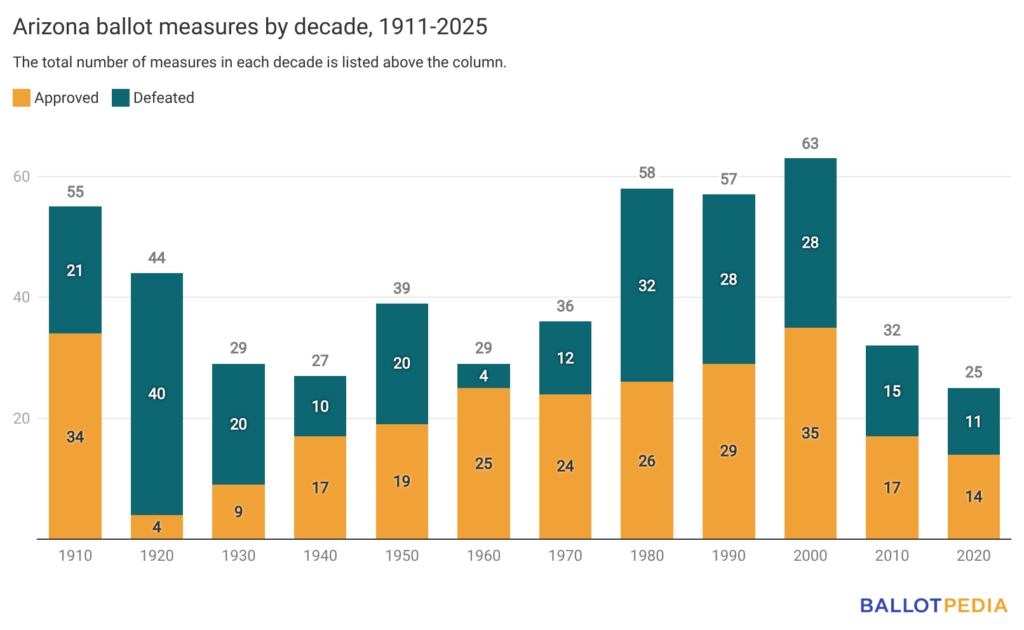
Between 1911 and 2025, Arizona voters decided on 494 measures. Voters approved 253 (51.2%) measures and rejected 241 (48.8%) measures. The Legislature referred 255 of the 494 measures to the ballot. Voters approved 151 (59.2%) measures and rejected 104 (40.8%) measures.
Click here to read more about all the measures Arizona voters will decide this year.
Three Trump-endorsed U.S. Senate candidates win their respective primaries
On June 18, voters in Oklahoma and Washington, D.C., headed to the polls to vote in several primaries. Voters in Georgia and Alabama also decided primary runoff elections. Here's a look at some noteworthy elections and where they stand as of June 17 at 3:30 p.m. EST.
Trump-endorsed U.S. Senate candidates win their respective primaries
All three U.S. Senate candidates in a Republican primary or primary runoff that President Donald Trump (R) endorsed won.
- In the primary runoff in Alabama, Barry Moore defeated Jared Hudson 55.8% to 44.2%.
- In the primary runoff in Georgia, Mike Collins defeated Derek Dooley 55.5% to 44.5%.
- In the primary in Oklahoma, Kevin Hern defeated four other candidates with 69.8% of the vote.
Seventeen of the 22 U.S. Senate candidates Trump has endorsed so far this year have won their respective primaries. The other five candidates are running in primaries that have not yet occurred.
All three of those Trump-endorsed candidates are also members of the U.S. House of Representatives. So far this year, five of the 16 U.S. House members who retired to run for the U.S. Senate won their respective primaries and five lost. Six candidates either advanced to a runoff or are running in primaries that have not yet occurred.
Trump endorsements have mixed results in gubernatorial Republican primaries
Unlike his U.S. Senate primary endorsements, Trump's endorsements in the gubernatorial Republican primaries in Georgia and Oklahoma had mixed results:
- In the primary runoff in Georgia, Rick Jackson defeated Trump-endorsed Burt Jones 52.6% to 47.4%. Georgia Gov. Brian Kemp (R) also endorsed Jones.
- In the primary in Oklahoma, Gentner Drummond and Trump-endorsed Mike Mazzei advanced to a primary runoff. In a field of nine candidates, Drummond won 26.3% of the vote, and Mazzei won 26%.
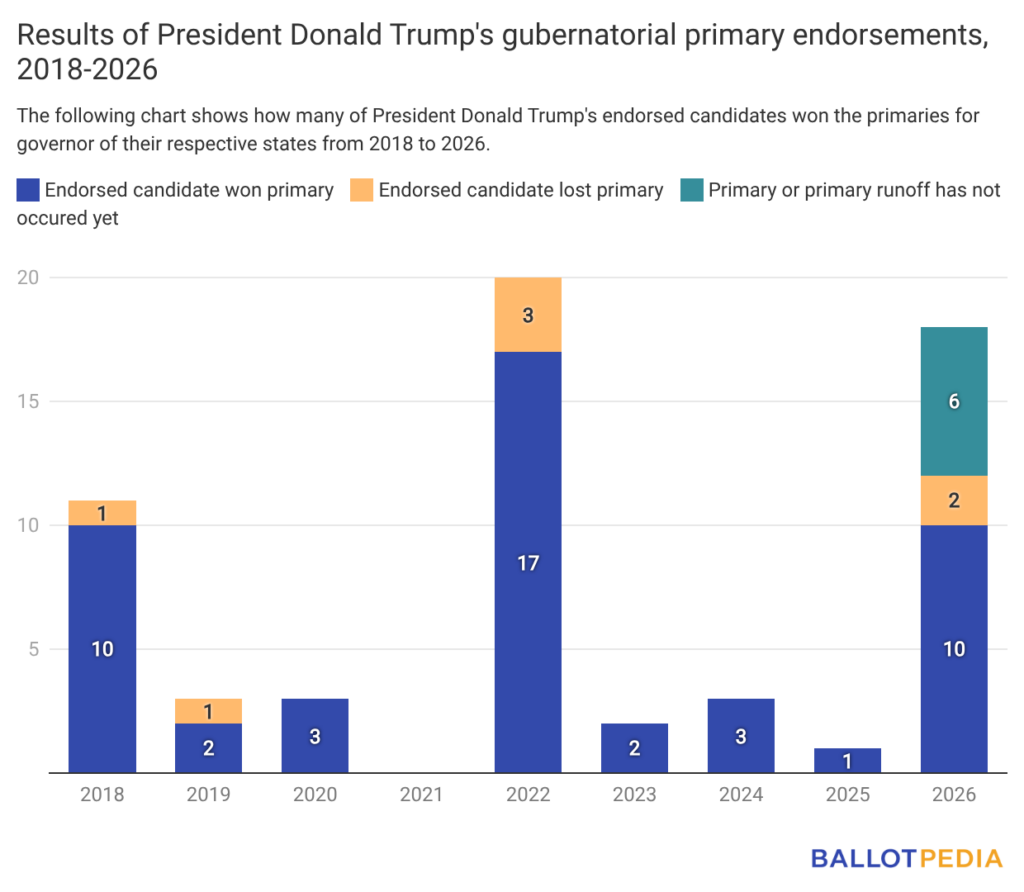
Ten of the 18 gubernatorial candidates Trump has endorsed so far this year have won their respective primaries, and two have lost. Six candidates either advanced to a runoff or are running in primaries that have not yet occurred.
Here's what happened in the three other battlegrounds that we were watching:
- The seven-candidate open Democratic primary for mayor of D.C. has not been called yet. Currently, Janeese Lewis George, a Democratic Socialist, is in the lead with 52.8% of the vote, and Kenyan McDuffie, a centrist Democrat, is in second place with 36.6%.
- Robert White defeated four other candidates in the open Democratic primary to be D.C.'s non-voting delegate to the U.S. House — a race that was the most expensive primary or general election for the seat. White won outright with 63.2% of the vote to second-place finisher Brooke Pinto's 21.5%.
- Jon Echols defeated Jeff Starling in the open Republican primary for Attorney General of Oklahoma, where they have campaigned on their different backgrounds. Echols, a business owner and member of the Oklahoma House of Representatives, defeated Starling, a lawyer and Oklahoma's secretary of energy, 55% to 45%.
Click here to check out all the election results from June 16.
CMS releases interim final rule for Medicaid work requirements, defines medical frailty exemption
On June 1, the Centers for Medicare & Medicaid Services (CMS) released an Interim Final Rule with Comment Period (IFC) governing how states implement Medicaid work requirements — also known as community engagement requirements — enacted into law as part of the One Big Beautiful Bill Act (OBBBA).
The rule establishes standards for how states verify compliance with work requirements, determine exemptions, and adhere to federal reporting requirements. Individuals can submit comments until July 31.
The OBBBA, the 2025 budget reconciliation bill, established mandatory work requirements for most able-bodied adults ages 19-64 beginning Dec. 31, 2026, in states that expanded Medicaid under the Affordable Care Act. For a list of adults exempt from the requirements, click here. Currently, 40 states and Washington D.C., have expanded Medicaid to cover childless adults under 65 earning incomes up to 138% of the federal poverty level. Georgia and Wisconsin have partially expanded the program.
Under the OBBBA, Medicaid beneficiaries subject to work requirements must provide evidence at the time of enrollment and then every six months that they are either employed, participating in community service or an approved work program, or enrolled at least part-time in an educational program for at least 80 hours a month.
The rule requires states to use all available sources, including from the Internal Revenue Service and other public assistance programs, to verify work requirement compliance at application and renewal. It also specifies when individuals considered medically frail are exempt from work requirements, and says how states must verify this designation.
The rule also establishes standards for how states verify that medically frail beneficiaries are unable to work. States must attempt to use insurance claims data or other relevant, reliable information to verify that an individual is medically frail. However, if a state cannot acquire such information, individuals are allowed to self-attest that they are medically frail through 2027. Beginning in 2028, individuals can self-attest to confirm eligibility or compliance only one time. After that, the rule requires individuals to submit documentation of their health status if states cannot determine eligibility on their own.
Before the OBBBA, states could apply for a waiver to implement work requirements, but only two states had ever successfully done so. Arkansas briefly implemented work requirements under a waiver granted during the first Trump administration, before the Biden administration revoked it. Georgia was similarly granted a waiver to implement work requirements for the program, and it did so after a court ruled in the state's favor. Georgia has been the only state with active work requirements for Medicaid since July 1, 2023.
Nebraska became the first state to implement work requirements under the OBBBA on May 1, under a state plan amendment, a provision included in the law that allows states to speed up implementation. Two other states currently have plans to implement work requirements through state plan amendments before the Jan. 1, 2027 OBBBA deadline: Montana (July 1) and Iowa (Dec. 1).
Click here for more information on the implementation of Medicaid provisions from the One Big Beautiful Bill Act.