


Welcome to the Tuesday, June 23, 2026, Brew.
By: Lara Bonatesta
Here’s what’s in store for you as you start your day:
- Five Republican state legislative supermajorities and three Democratic ones are highly exposed to breaking in 2026
- It’s Election Day in four states
- Four candidates running in Republican primary for Michigan’s 10th Congressional District
Five Republican state legislative supermajorities and three Democratic ones are highly exposed to breaking in 2026
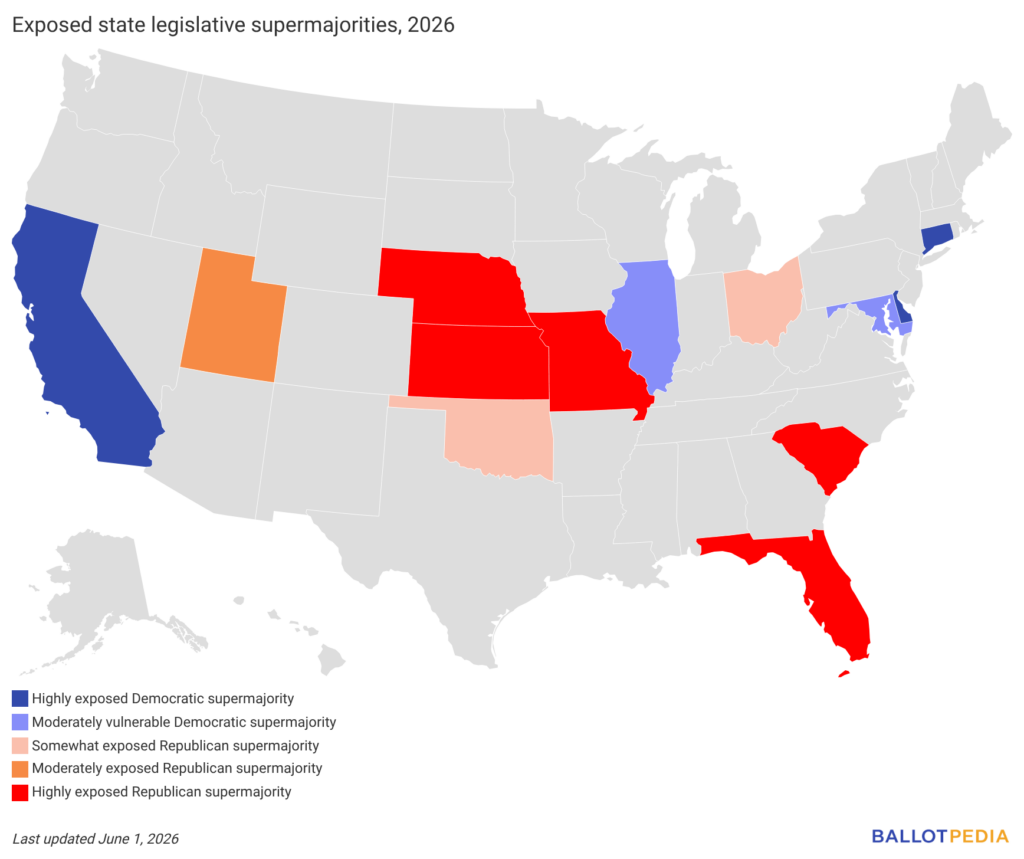
In eight states holding legislative elections this year, fewer than 5% of seats would need to change party control to break an existing supermajority. We call those state supermajorities highly exposed to breaking. If a majority party loses its supermajority, they lose the ability to override a governor's veto without votes from the minority party.
The Republican supermajority in Florida is the closest to breaking, where a one-seat loss in the Senate would bring the party's majority below the 27-seat threshold required to override the governor’s vetoes.
Ballotpedia assessed the possibility that existing state legislative supermajorities could be broken and the potential for new supermajorities to form in the 2026 elections. According to this analysis, 13 state legislative supermajorities are exposed to breaking in the 2026 elections, including the eight rated highly exposed. Democrats are defending five exposed supermajorities, and Republicans are defending eight.
The analysis scored each chamber individually, assessing the percentage and raw number of seats that would have to change party control for a supermajority to be gained or lost in the chamber. There are currently 27 state legislative supermajorities: 19 Republican supermajorities and eight Democratic supermajorities. The remaining 23 states have no supermajority.
The Republican supermajorities in Florida, Kansas, Missouri, Nebraska, and South Carolina were rated highly exposed to breaking, because Republicans are fewer than five seats or less than five percentage points more than the supermajority threshold in at least one of those states' legislative chambers:
- Florida Republicans have a 27-12-1 supermajority in the Senate, where a one-seat loss would result in the party falling below the two-thirds threshold of 27 seats.
- Kansas Republicans have an 88-37 supermajority in the House, where a five-seat loss (or 4% of the 125 seats up for election) would result in the party falling below the two-thirds threshold of 84 seats.
- Missouri Republicans have a 24-10 supermajority in the Senate and a 111-52 supermajority in the House. A two-seat loss in the Senate or a three-seat loss in the House would result in the party falling below the respective two-thirds thresholds of 23 and 109.
- Nebraska Republicans have a 33-14-2 supermajority in the Senate, where a four-seat loss would result in the party falling below the three-fifths threshold of 30 seats.
- South Carolina Republicans have an 88-36 supermajority in the House, where a six-seat loss (or 4.8% of the 124 seats up for election) would result in the party falling below the two-thirds threshold of 83 seats.
The Democratic supermajorities in California, Connecticut, and Delaware are rated highly exposed to breaking:
- California Democrats have a 30-10 supermajority in the Senate, where a four-seat loss would result in the party falling below the two-thirds threshold of 27 seats.
- Connecticut Democrats have a 25-11 supermajority in the Senate and a 102-49 supermajority in the House. In both chambers, a two-seat loss would result in the party falling below the two-thirds threshold.
- Delaware Democrats have a 15-6 supermajority in the Senate and a 27-14 supermajority in the House. In both chambers, a three-seat loss would result in the party falling below the three-fifths threshold.
In five additional states, less than 15% of seats up for election would need to change party control to break a supermajority. These are the Democratic supermajorities in Illinois and Maryland, and the Republican supermajorities in Ohio, Oklahoma, and Utah.
Potential new supermajorities
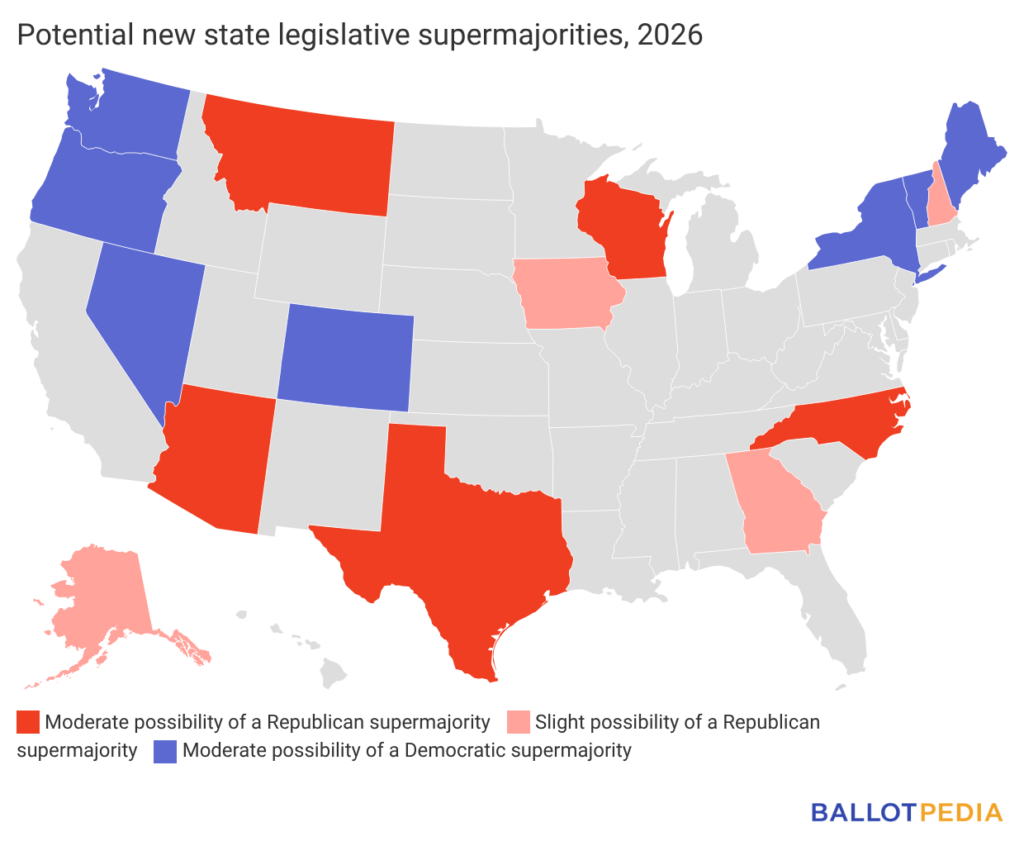
Ballotpedia also assessed the chances of new supermajorities forming in states where one party already has simple majority control of both state legislative chambers. Possible Democratic supermajority pickups are Colorado, Maine, Nevada, New York, Oregon, Vermont, and Washington. Possible Republican pickups are Alaska*, Arizona, Georgia, Iowa, Montana, New Hampshire, North Carolina, Texas, and Wisconsin. (Note: Alaska Republicans have a numerical majority in both legislative chambers and are three Senate seats and six House seats from supermajority status, but multipartisan coalitions currently control both chambers.)
Additional information
Forty-six states are holding elections for 88 of the country's 99 state legislative chambers this year. While the supermajority exposure and potential ratings highlight a subset of states with particularly close legislative supermajorities, supermajority status could change in up to 45 states. A supermajority is not possible in New Mexico, where Democrats are below the supermajority threshold in the state Senate, which does not have elections in 2026.
Click here to learn more about the supermajority outlook in the 2026 elections.
It’s Election Day in four states
Maryland, New York, and Utah are holding statewide primaries today, June 23, and South Carolina is holding a statewide primary runoff. Here’s a look at the battlegrounds we’re covering.
Maryland
Maryland, where Democrats hold six of seven Congressional seats, has at least three notable Congressional Democratic primaries.
In the 5th Congressional District, incumbent Steny Hoyer (D), who has been in office since 1981, is not running for re-election. In the Democratic primary, Rushern Baker III, Quincy Bareebe, Adrian Boafo, and Harry Dunn lead in fundraising, endorsements, and media attention. Hoyer endorsed Boafo, who is currently a state legislator. Baker was previously the Prince George's County Executive, Bareebe is the CEO of Royal Home Care, and Dunn is a former member of the U.S. Capitol Police who was present during the breach of the U.S. Capitol on Jan. 6, 2021.
The 6th Congressional District Democratic primary features both the current and most recent former incumbent. David Trone, who was elected in 2018, ran for U.S. Senate in 2024 rather than for re-election, and that year endorsed April McClain Delaney to succeed him. McClain Delaney was elected that year with 53% of the vote. This year, Trone, McClain Delaney, and six other Democrats are running in the district that had the smallest margin of victory in the state in 2024.
Incumbent Kweisi Mfume, Mark Conway, and two others are running in the state's 7th Congressional District Democratic primary. Mfume served in the House from 1987 to 1996, when he resigned to serve as president of the National Association for the Advancement of Colored People (NAACP). He was elected again in 2020. Conway has served on the Baltimore City Council since 2020. WBAL's Katarina Hein said the race "is expected to center on experience versus new leadership in Baltimore’s representation in Washington." Major election forecasters rated the general election Solid/Safe Democratic.
New York
In New York, where Democrats hold 19 U.S. House seats and Republicans hold seven, there are six notable primaries.
In the 7th Congressional District Democratic primary, where incumbent Nydia Velazquez (D), who was first elected in 1992, is not running for re-election, Vichal Kumar, Antonio Reynoso, Claire Valdez, and Julie Won are running. Velazquez endorsed Reynoso, and New York City Mayor Zohran Mamdani (D) endorsed Valdez. Major election forecasters rated the general election as Solid/Safe Democratic.
Endorsements are also split in the 10th Congressional District Democratic primary, in which incumbent Rep. Daniel Goldman and former New York City Comptroller Brad Lander are running. Governor Kathy Hochul (D-N.Y.) and U.S. Rep. Hakeem Jeffries (D-N.Y.) endorsed Goldman. Mamdani and U.S. Sen. Bernie Sanders (I-Vt.) endorsed Lander. Major election forecasters rated the general election Solid/Safe Democratic.
In the 12th Congressional District Democratic primary, where another incumbent first elected in 1992 – Jerrold Nadler (D) – is retiring, eight candidates are running. Among them are state legislators Alex Bores and Micah Lasher, attorney and Lincoln Project cofounder George Conway, and writer Jack Schlossberg, who is also the grandson of former President John F. Kennedy (D). Nadler endorsed Lasher on Feb. 9. Major election forecasters rated the general election Solid/Safe Democratic.
Incumbent Adriano Espaillat, Darializa Avila Chevalier, and two others are running in the 13th Congressional District Democratic primary. City & State New York's Sahalie Donaldson said, "[Espaillat]'s staunch support of Israel puts him out of favor with the growing contingent of left-leaning New Yorkers in the district – and played a big role in Avila Chevalier challenging him – the rest of his voting record is fairly progressive." The City Reporter's Claudia Irizarry Aponte said, "Avila Chevalier’s campaign is seeking to replicate the magic of Mamdani’s campaign.” New York Attorney General Letitia James (D) endorsed Espaillat. Mamdani endorsed Chevalier. Major election forecasters rated the general election Solid/Safe Democratic.
In the 15th Congressional Democratic primary, incumbent Ritchie Torres, Michael Blake, and Jose Vega are running. In an interview, Blake said, "We need to focus on cost of living. We have to focus on how people need us to help them with groceries as opposed to Richie’s [sic] helping to support a genocide." Torres spokesman Benny Stanislawski said, "Michael Blake is not interested in the Bronx; he’s only interested in using it to run for office for the fifth time, and the result will be the same as before: another loss." Major election forecasters rated the general election Solid/Safe Democratic.
In the 17th Congressional District Democratic primary, Cait Conley, Beth Davidson, Effie Phillips-Staley, and two others are running. Decision Desk HQ and Roll Call both included incumbent Michael Lawler (R) on their lists of the most vulnerable U.S. House incumbents in 2026. Major election forecasters rated the general election a Toss-up or Lean Republican.
Utah:
These races are taking place in the context of redistricting. On Nov. 10, 2025, Judge Dianna Gibson ordered Utah to adopt a new U.S. House map after she ruled the process used to adopt the previous map was unconstitutional.
In the 1st Congressional District, which Inside Elections with Nathan L. Gonzales' Nathaniel Rakich said, "is now a Democratic-leaning seat that covers most of Salt Lake County," four Democrats are running: Nate Blouin, Michael Farrell, Ben McAdams, and Liban Mohamed.
The incumbents of Utah’s 2nd and 3rd Congressional Districts are both running for different districts.
Incumbent Blake Moore (R-1) and Karianne Lisonbee are running in the Second District Republican primary. Utah Senate President Stuart Adams (R) endorsed Moore, and Utah House Speaker Mike Schultz (R) endorsed Lisonbee. Major election forecasters rated the general election Solid/Safe Republican.
Incumbent Celeste Maloy (R-2) and Phil Lyman are running in the Republican primary in the Third District. At the Utah Republican Party’s nominating convention on April 25, Maloy defeated Lyman 51% to 49% after two rounds of voting.
Click here to read more about the elections we’re covering on June 23.
Four candidates running in Republican primary for Michigan’s 10th Congressional District
Four candidates — Michael Bouchard, Steffan Demetropoulos, Justin Kirk, and Robert Lulgjuraj — are running in the Republican primary for Michigan's 10th Congressional District on Aug. 4. Bouchard and Lulgjuraj lead in polling, fundraising, and media attention.
Incumbent John James (R) is seeking the Republican gubernatorial nomination rather than running for re-election. Democrats are targeting the district, which covers southern Macomb County and portions of Oakland County, as a potential pickup opportunity in the 2026 midterms. The race is rated Lean Republican/Toss-up by independent race raters.
Inside Elections' Jacob Rubashkin wrote that despite entering the race months later than Lulgjuraj, "Bouchard begins with a clear advantage thanks to his name and political connections. After 28 years as sheriff, eight years in the legislature, and statewide runs for Senate and governor, his father is among the best-known Republicans in the state." Bouchard said, "I absolutely love the support my father and some of our lifelong friends have brought," and that "the majority of our donors are new to supporting a Bouchard, and I think that's because I'm the only one in this race with the experience that I bring to the table." Lulgjuraj said, "I thank the family for their service, but I am the best qualified academically, resume-wise, and my strong MAGA conservative values to represent this district well, and I'm from here."
Bouchard is a U.S. Army captain. He graduated from Michigan State University's ROTC program and served in the Army's 82nd and 101st Airborne Divisions. He earned a Bronze Star for his work on a joint task force fighting ISIS.
Lulgjuraj is a Macomb County assistant prosecuting attorney. He worked as a prosecutor in Wayne and Macomb Counties and served on the Sterling Heights Ethnic Community Committee. Lulgjuraj would be the first Albanian-American to serve in Congress since former U.S. Rep. Joseph DioGuardi (R) represented New York's 20th Congressional District from 1985 to 1989.
Click here to see our full coverage of the Republican primary in Michigan’s 10th Congressional District.