


Welcome to the Friday, June 26, 2026, Brew.
By: Briana Ryan
Here’s what’s in store for you as you start your day:
- The average state constitution has been amended 130 times
- Endorsed candidates won 88% of races in California's June 2 primaries
- 142 statewide ballot measures have been certified this year — above the average in even-numbered years
The average state constitution has been amended 130 times
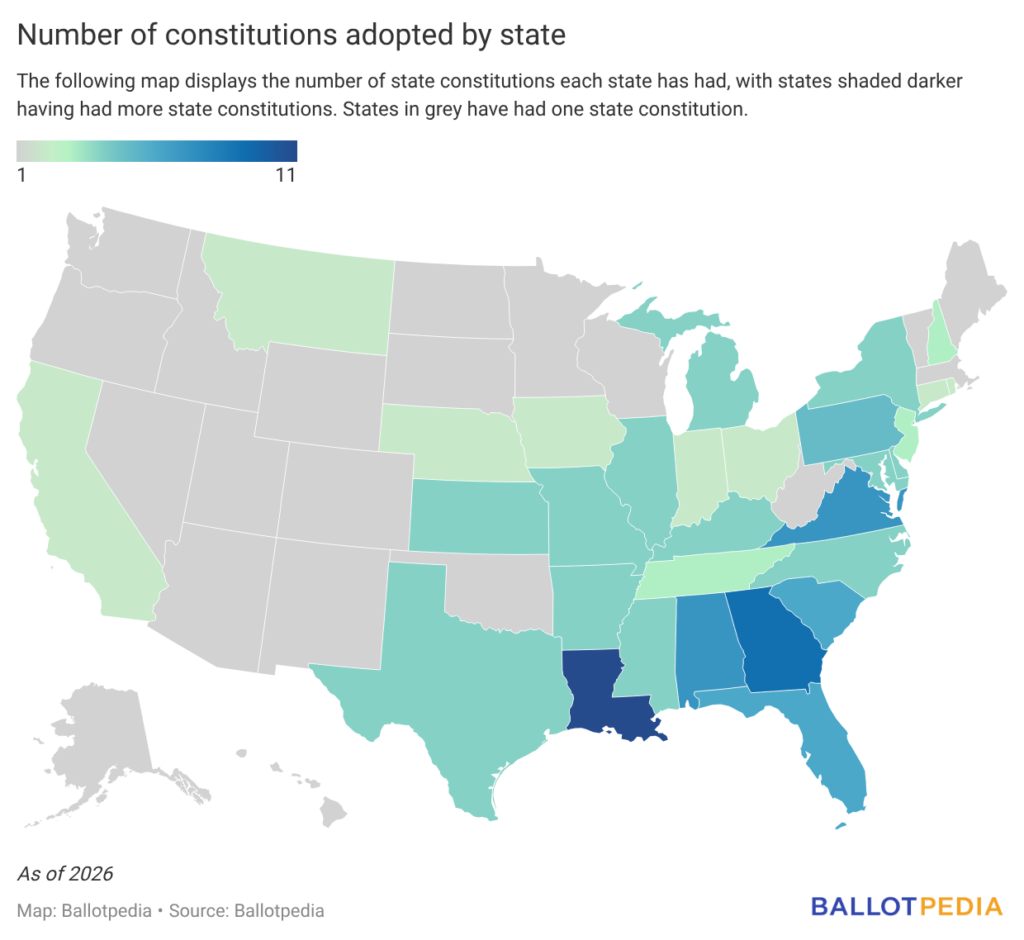
State constitutions are amended far more than the U.S. Constitution — 130 times on average. Louisiana has had 11 state constitutions, more than any other state, and Alabama's is the longest in the country at 338,000 words.
In the June 24 episode of Office Hours, Ballotpedia founder and CEO Leslie Graves joined host Norman Leahy to discuss state constitutions, why they changed far more often than the U.S. Constitution, and how these documents reflect our priorities and expectations at different levels of government. Today, we'll dive deeper into what those documents are and how they keep changing.
A state constitution is the governing document of a U.S. state, establishing the structure of state government and guaranteeing certain rights like the U.S. Constitution does at the federal level. Some states have had multiple constitutions, and since each state drafts its own, there is great diversity among them, though all share some basic concepts.
Twenty states have had one state constitution since statehood. On average, states have had between two and three constitutions since statehood.
The process for proposing and ratifying state constitutional amendments is different from state to state. Forty-nine of the 50 states require voter approval for the ratification of state constitutional amendments. Delaware does not require voters to approve state constitutional amendments.
State legislatures in 49 states can vote to send constitutional amendments to voters for ratification. Additionally, 18 states also allow citizens to initiate constitutional amendments. You can learn more about the rules for legislative constitutional amendments here and the rules for initiated constitutional amendments here.
Constitutional conventions or state commissions can also propose amendments. The last time voters decided on convention-referred constitutional amendments was in 1986 in Rhode Island. In 1984, voters approved a constitutional convention question, and the convention referred 14 constitutional amendments to the ballot in 1986.
Unlike legislatures, commissions are bodies granted the authority to refer measures (constitutional or statutory) through legislation or constitutional language. Two states have regular commissions with the power to refer measures to statewide ballots. In Arizona, the commission can refer statutes related to government salaries. In Florida, the Constitution Revision Commission and Taxation and Budget Reform Commission, which meet every 20 years, can refer constitutional amendments to the ballot.
The average state constitution has approximately 39,000 words. The U.S. Constitution, including its amendments, has 7,591. The longest state governing document is the Alabama Constitution, at approximately 338,000 words.
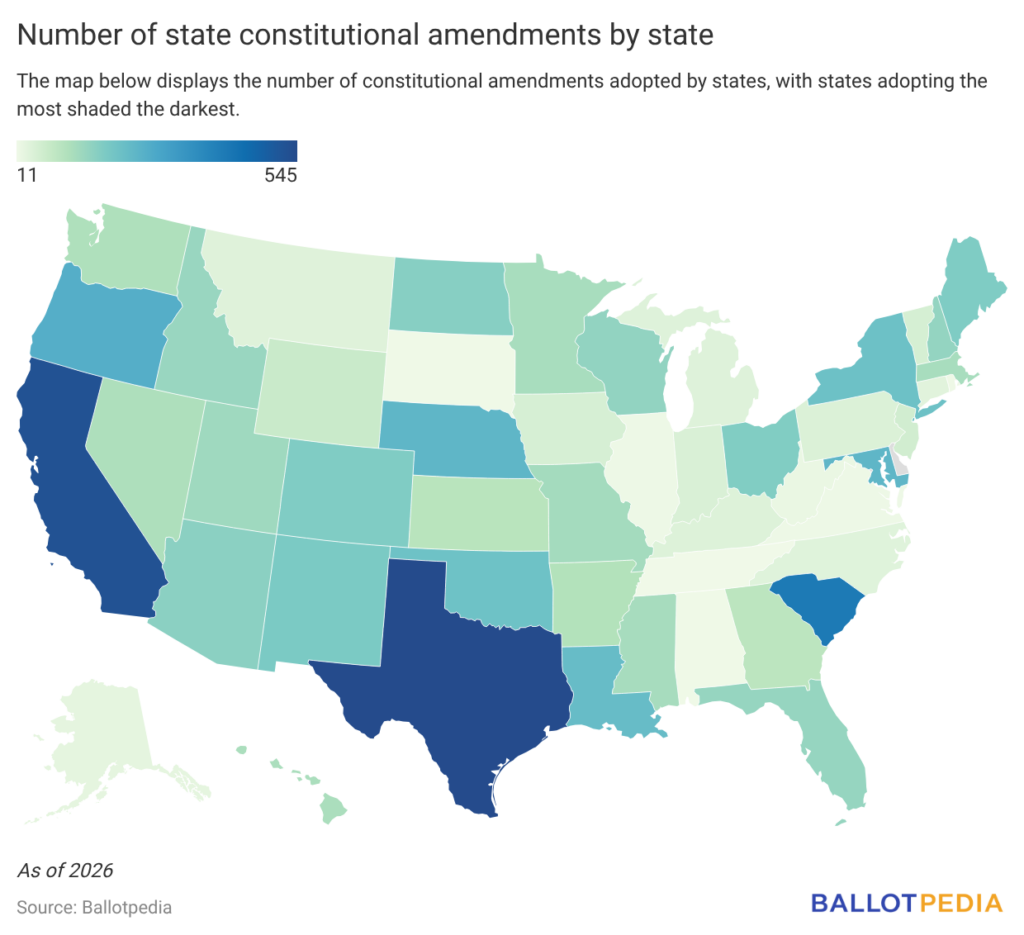
The average state constitution has been amended approximately 130 times. The Texas Constitution has been amended the most, with 545 amendments. The oldest state constitution still in effect is the Massachusetts Constitution, which took effect in 1780. It has been amended 121 times. The newest is the Alabama Constitution, which voters ratified in 2022.
The full version of every state constitution is published on Ballotpedia — click here to find and read your state's. Also, click here to check out the June 24 episode of Office Hours to listen to the full conversation on state constitutions.
Endorsed candidates won 88% of races in California's June 2 primaries
In California's June 2 primaries, candidates endorsed by what we call Recognized Endorsement Contributors (RECs) won 88% of their races, according to our tracking of 1,778 endorsements from 124 groups ranging from labor unions to advocacy groups to newspaper editorial boards.
Endorsements are one of the ways voters learn who candidates are and what they stand for — especially in down-ballot races where little other information is available. Ballotpedia identifies endorsements from organizations we call Recognized Endorsement Contributors (RECs): a wide range of groups that issue endorsements providing voters with valuable information and, ultimately, contributing to an information environment that fosters a more civically engaged and informed electorate.
Twelve RECs active in California's June 2 primaries issued more than 50 endorsements each. The table below displays the organizations and their endorsee success rates. The candidates these organizations endorsed won 88% of their races, lost 10%, and the remaining races were still too close to call.
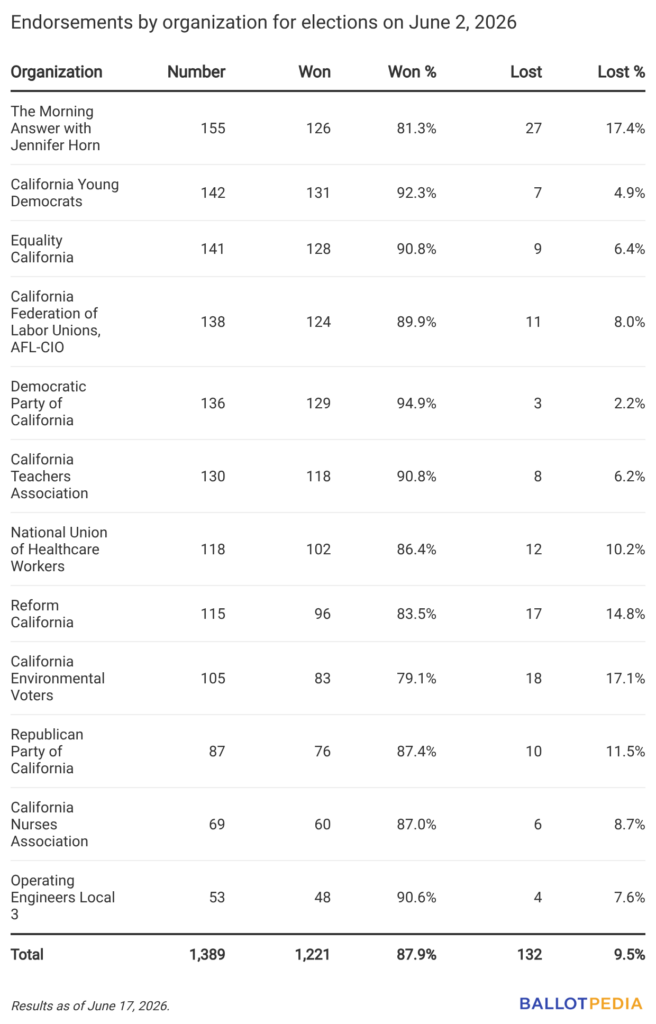
Among these organizations, three endorsed candidates from both major political parties. Click the links below to explore their endorsements:
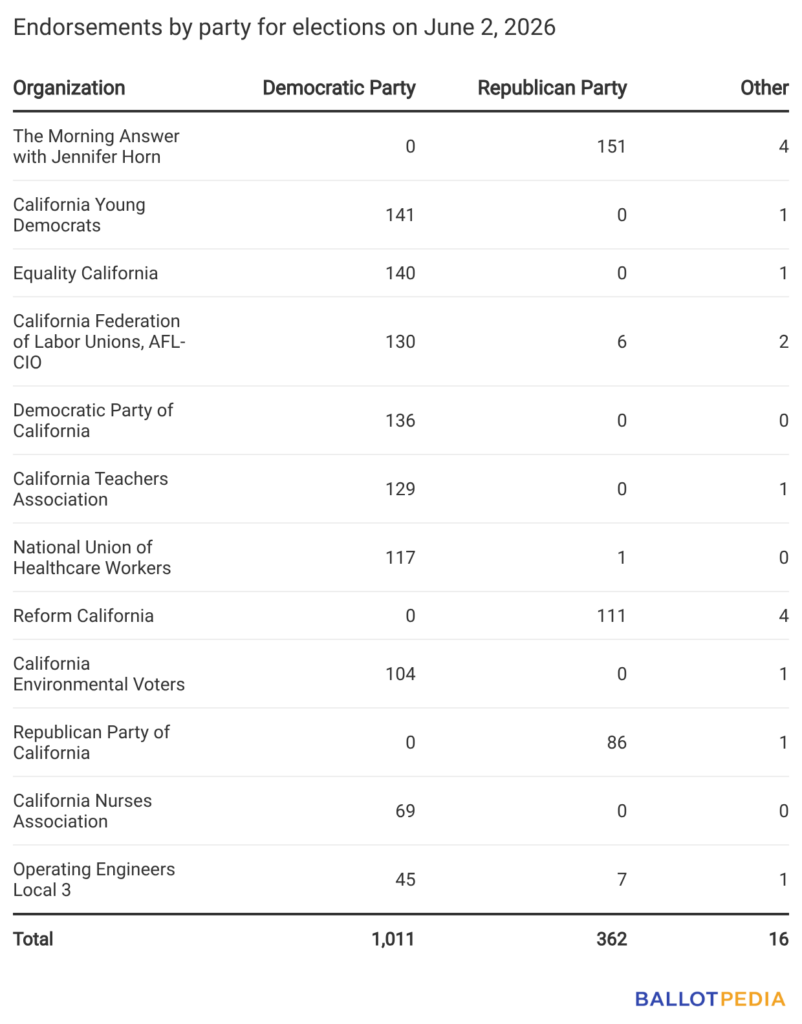
- California Federation of Labor Unions, AFL-CIO: Endorsed 130 Democratic candidates and six Republican candidates.
- National Union of Healthcare Workers: Endorsed 117 Democratic candidates and one Republican candidate.
- Operating Engineers Local 3: Endorsed 45 Democratic candidates and seven Republican candidates.
The remaining organizations endorsed candidates from one major political party. The chart below displays the candidate affiliations for RECs' endorsees.
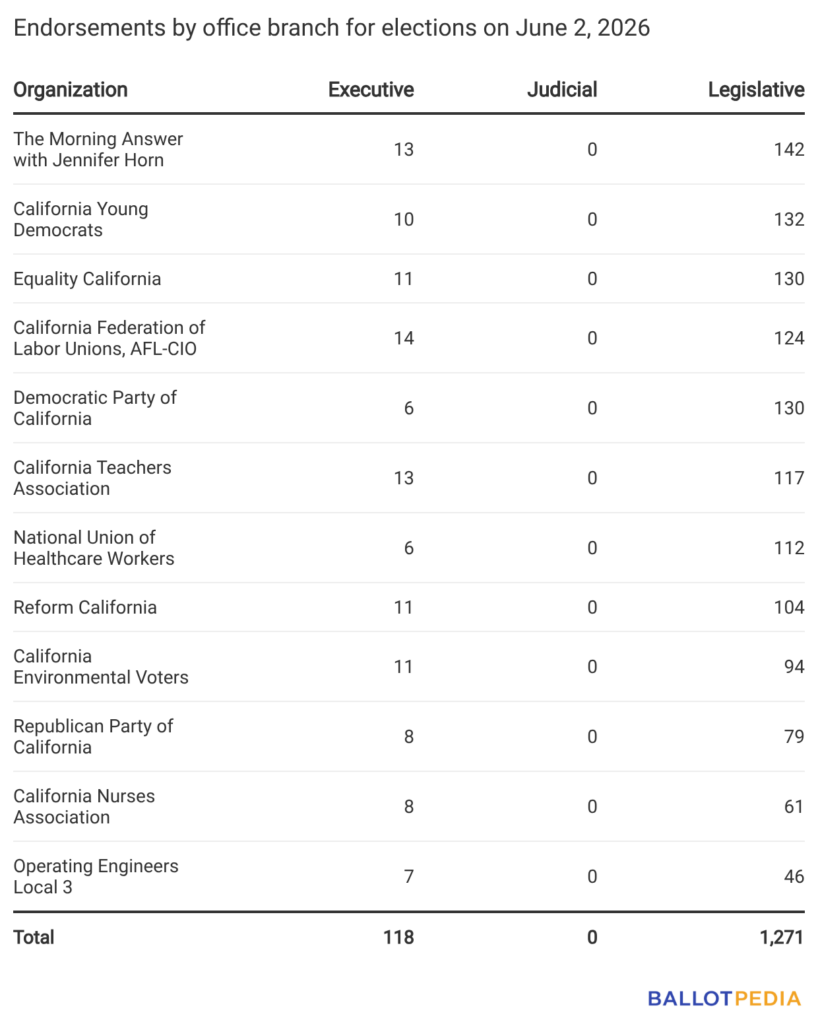
The majority of these endorsements (91%) came in legislative races, with another 9% in executive races. None of these RECs endorsed in judicial races. The table below shows these RECs' endorsements by branch of government.
Endorsements reveal alliances, ideological leanings, and potential policy priorities in ways that campaign platforms and quotes from a candidate sometimes can't. Endorsements also play a practical role in campaigns. Many endorsers — especially for statewide and national candidates — can provide candidates with volunteer support, access to possible campaign donors, and give candidates a degree of credibility and notoriety.
Ballotpedia is identifying endorsements made by organizations in races at all levels of government, with a particular focus on groups that endorse candidates at the local level. Endorsements are one component of Ballotpedia's goal to provide robust information — data that helps voters understand who a candidate is and what their political philosophy is — for every office on the ballot.
Click here for more information on recognized endorsement contributors (RECs).
142 statewide ballot measures have been certified this year — above the average in even-numbered years
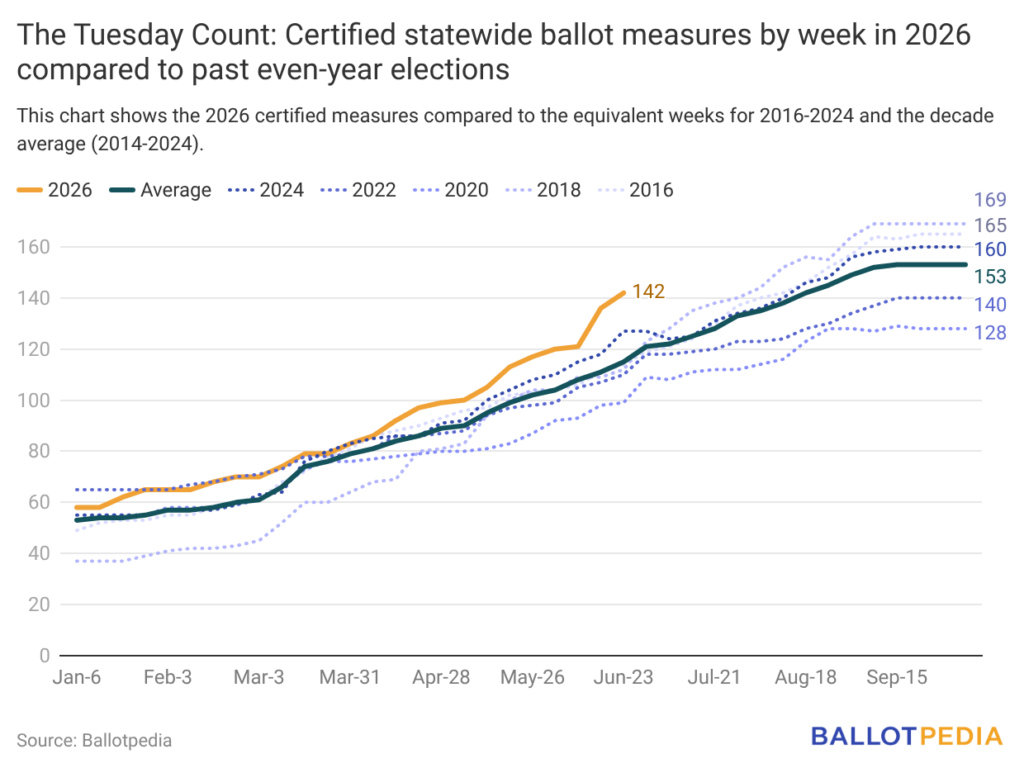
As of June 23, 142 measures have been certified for statewide ballots this year — more than the historical average of 115 at this point in even-numbered years from 2014 through 2024. From 2014 through 2024, an average of 153 statewide measures were certified in even-numbered years.
Over the past two weeks, 21 new measures were certified:
- Arizona Prohibit New Photo Traffic Enforcement Systems Measure
- Arizona Prohibit Race- or Ethnicity-Based Preferential Treatment, Public Education Offices, and Disciplinary Policies Amendment
- Arizona Prohibit School District Payroll Deductions for Labor Organization Dues and Collective Bargaining Agreements Amendment
- Arizona Prohibit State Confiscation of Military Family Empowerment Scholarship Account Funds and Void Conflicting Laws Amendment
- Arizona Require Certain School Districts to Spend 60% of Operational Spending on Direct Instruction Measure
- Arizona Require Schools and Athletic Associations to Restrict Use of Restrooms, Locker Rooms, and Other Private Spaces Based on Sex Measure
- Arizona Voter Identification and Citizenship Voting Requirements Amendment
- California Establish Immunology and Immunotherapy Research Institute Initiative
- California Establish Personal Injury Lawyer Regulations Initiative
- California Expedited Environmental Review Process for Certain Projects Initiative
- California One-Time Wealth Tax for State-Funded Healthcare, Education, and Food Assistance Programs Initiative
- California Renew State Income Tax Increase for Education Funding Initiative
- California Require Background Checks and Sexual Assault Reporting by Rideshare Companies Initiative
- California Revenue Use Requirements for New Special Taxes Amendment
- Colorado Require Vehicle-Related and Fuel Tax Revenue to Be Used for Road Transportation Initiative
- Ohio Voter Identification Requirement Amendment
- Rhode Island Economic and Infrastructure Development Bond Measure
- Rhode Island Environment and Watershed Protection and Development Bond Measure
- Rhode Island Higher Education Facilities Bond Measure
- Rhode Island Historical Center and Cultural Grants Bond Measure
- Rhode Island Housing Development Bond Measure
Signatures are pending verification for 12 citizen initiatives:
- California Prohibit Taxes on Retirement Holdings and Personal Savings Amendment
- California State University Staff First-Time Homebuyer Down Payment Loan Program Initiative
- Idaho Medical Marijuana Legalization Initiative
- Idaho Reproductive Freedom and Privacy Act Initiative
- Michigan Citizenship Verification and Voter Identification Initiative
- Michigan Utility and Government Contractor Campaign Finance Regulations Initiative
- Missouri Congressional Map Referendum
- Missouri Initiative and Referendum Powers and Legislative Change Requirements Amendment
- Montana CI-132, Require Nonpartisan Judicial Elections Initiative
- Montana CI-133, Add Right to Initiative and Referendum Power to Declaration of Rights Amendment
- Montana Initiative 194, Exclude Political Spending from Artificial Persons’ Charter Powers Initiative
- Oregon Criminalize Hunting, Fishing, and Intentional Injury to Animals Initiative
The next signature deadline is July 1 in Ohio.
Click here for more information about the measures on statewide ballots this year.