


Welcome to the June 29 edition of Robe & Gavel, Ballotpedia’s newsletter about the Supreme Court of the United States (SCOTUS) and other judicial happenings around the U.S.
"All men are created equal. No matter how hard they try, they can never erase those words. That is what America is about."
- Harvey Milk
We are in the home stretch, dear reader. SCOTUS has released most of its opinions for the year. As usual, we’ve got some more opinions for you, so let’s get right to it and gavel in!
Follow Ballotpedia on X and Bluesky or subscribe to the Daily Brew for the latest news and analysis.
We #SCOTUS and you can, too!
Grants
SCOTUS has accepted six new cases to its merits docket since our June 22 issue. To date, the court has agreed to hear arguments in 59 cases for the 2025-2026 term. SCOTUS dismissed one case after it was accepted. The Court accepted 21 cases for the 2026-2027 term.
Click the links below to learn more about these cases:
- RiseandShine Corporation v. PepsiCo, Inc.
- Hoffmann v. WBI Energy Transmission, Inc.
- International Partners for Ethical Care, Inc. v. Ferguson
- Wassily v. Blanche
- Republican National Committee v. Mi Familia Vota
- Montoya Palacios v. Liggins
Arguments
The Supreme Court will not hear any arguments this week. Click here to read more about SCOTUS's current term.
In its October 2024 term, SCOTUS heard arguments in 65 cases. Click here to read more about SCOTUS's previous term.
Opinions
SCOTUS has ruled on thirteen cases since our June 22 edition. The court has issued rulings in 63 cases so far this term. Four cases are still under deliberation. By this time during the October 2024 term, SCOTUS had released 66 opinions.
Click the links below to read more about the specific cases SCOTUS ruled on since June 22:
June 23
- Blanche v. Lau was argued before the Court on April 22. The case concerns legal requirements that would allow the government to deport a Lawful Permanent Resident (LPR) who has been accused of committing a crime.
The outcome: In a 6-3 opinion, the Court vacated and remanded the judgment of the U.S. Court of Appeals for the Second Circuit, holding that the government does not need to establish clear and convincing evidence before rejecting a Lawful Permanent Resident (LPR) from re-entry into the United States under 8 U.S.C. § 1182(a)(2)(A)(i)(I).
- Pung v. Isabella County, Michigan, was argued before the Court on Feb. 25. The case concerns the Fifth Amendment’s Takings Clause and the Eighth Amendment’s Excessive Fines Clause.
The outcome: In a 9-0 opinion, SCOTUS vacated and remanded the judgment of the U.S. Court of Appeals for the Sixth Circuit, holding that when a government confiscates property through foreclosure, it is not required to compensate the former owner for the hypothetical market price of a home. Rather, it is only required to return the surplus profits to the owner based on the price at which the property was actually sold.
- Landor v. Louisiana Department of Corrections and Public Safety was argued before the Court on Nov. 10. The case concerns the Religious Land Use and Institutionalized Persons Act of 2000 (RLUIPA).
The outcome: In a 6-3 opinion, the Court affirmed the judgment of the U.S. Court of Appeals for the Fifth Circuit, holding that individuals cannot be held liable in their personal capacities under a Spending Clause statute unless they have voluntarily and knowingly consented to answer lawsuits under the statute. Because the individual defendants in this case did not voluntarily and knowingly consent to face Religious Land Use and Institutionalized Persons Act (RLUIPA) liability in an agreement with the federal government, Landor’s case cannot proceed against them.
- Exxon Mobil Corp. v. Corporación Cimex, S.A. was argued before the Court on Feb. 23. The case concerns the Helms-Burton Act (LIBERTAD).
The outcome: In a 6-3 opinion, SCOTUS reversed and remanded the judgment of the U.S. Court of Appeals for the District of Columbia Circuit, holding that the Helms-Burton Act nullifies the sovereign immunity of Cuban agencies and instrumentalities. Plaintiffs who sue Cuban agencies or their instrumentalities under the Act are not required to also satisfy one of the Foreign Sovereign Immunities Act’s enumerated exceptions to foreign sovereign immunity.- Instrumentalities are agencies that perform functions for or on behalf of other agencies.
- Cisco Systems, Inc. v. Doe I was argued before the Court on April 28. The case concerns the Alien Tort Statute and the Torture Victim Protection Act.
The outcome: In a 6-3 opinion, SCOTUS held that courts may not create new causes of action for violations of international norms under the Alien Tort Statute. The Torture Victim Protection Act, which has an express cause of action against someone who ‘subjects’ another to torture, does not provide for aiding-and-abetting liability.
June 25
- Wolford v. Lopez was argued before the Court on Jan. 20. The case concerns the Second Amendment and laws about licensed concealed carry permit holders bringing handguns on private property open to the public.
The outcome: In a 6-3 opinion, the Court reversed and remanded the judgment of the U.S. Court of Appeals for the Ninth Circuit, holding that a Hawaii law that prohibited licensed concealed-carry permit holders from carrying handguns on private property open to the public without the property owner's express authorization violates the Second and Fourteenth Amendments.
- Mullin v. Al Otro Lado was argued before the court on March 24. The case concerns the Immigration and Nationality Act, 8 U.S.C. 1101 et seq (INA).
The outcome: In a 6-3 opinion, the Court reversed and remanded the judgment of the U.S. Court of Appeals for the Ninth Circuit, holding that an alien standing in Mexico “arrives in the United States” only when he crosses the border, not by attempting, and failing, to set foot in this country. The INA neither entitles an alien standing in Mexico to apply for asylum nor requires an immigration officer to inspect him.
- Mullin v. Doe was argued before the court on April 29. The case concerns Executive Order 14159, which directed the Secretary of Homeland Security to limit Temporary Protected Status (TPS) designations of foreign nationals.
The outcome: In a 6-3 opinion, the Court reversed and remanded the judgment of the U.S. Court of Appeals for the Second Circuit. The Supreme Court concluded that the federal law creating the TPS program generally bars courts from reviewing non-constitutional claims regarding decisions to end the TPS designations for Haiti and Syria. The Court also ruled that the constitutional claim that the Trump administration terminated Haiti’s TPS designation due to the racial makeup of the country's population will likely fail.
- Monsanto Company v. Durnell was argued before the Court on April 27. The case concerns the Federal Insecticide, Fungicide, and Rodenticide Act.
The outcome: In a 7-2 opinion, the Court reversed and remanded the judgment of the Missouri Court of Appeals, holding that the Federal Insecticide, Fungicide, and Rodenticide Act (FIFRA) expressly prevents Durnell’s state-law failure-to-warn claim because it would require Monsanto to add a cancer warning to the herbicide Roundup’s label.
June 29
Federal court action
Nominations
President Donald Trump (R) has not announced any new Article III nominees since our June 29 edition.
The president has announced 57 Article III judicial nominations since taking office on Jan. 20, 2025. For more information on the president’s judicial nominees, click here.
Committee action
On June 18, the Senate Judiciary Committee reported six new nominees out of committee.
- Benjamin Flowers, to be U.S. Circuit Judge for the Sixth Circuit.
- Matthew Schwartz, to be U.S. Circuit Judge for the Second Circuit.
- Michael Hendershot, to be U.S. District Judge for the Northern District of Ohio
- Rob Jones, to be U.S. District Judge for the Southern District of Texas
- Jeffrey Kuntz, to be U.S. District Judge for the Southern District of Florida
- John Marck, to be U.S. District Judge for the Southern District of Texas
Confirmations
The Senate has not confirmed any nominees since our June 22 issue.
Vacancies
For information on judicial vacancies during President Trump’s term, click here.
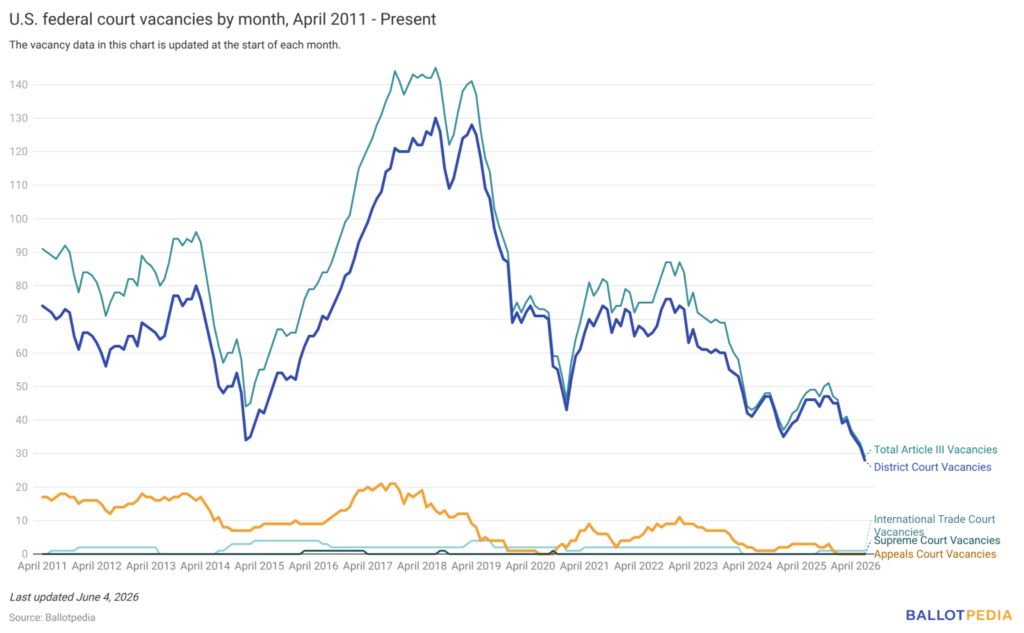
Do you love judicial nomination, confirmation, and vacancy information? We figured you might. Our monthly Federal Vacancy Count monitors all the faces and places moving in, moving out, and moving on in the federal judiciary. Click here for our most current count.
Need a daily fix of judicial nomination, confirmation, and vacancy information? Click here for continuing updates on the status of all federal judicial nominees.
Or, keep an eye on our list for updates on federal judicial nominations.
Looking ahead
We’ll be back on July 13 with a new edition of Robe & Gavel. Until then, gaveling out!
Contributions
Myj Saintyl compiled and edited this newsletter, with contributions from Sam Post, Ellie Mikus, and Spencer Richardson.