


In this week’s edition of Economy and Society:
- California delays first emissions reporting deadline to November
- Federal court blocks Kansas proxy advisor disclosure law
- Indiana becomes third state to lose proxy advisor legal battle
- Fourteen-state coalition challenges an insurer over climate advocacy
- ESG legislation update
- French court orders oil company to report emissions
- Heritage Foundation argues ESG delivers less than promised
In the states
California delays first emissions reporting deadline to November
What’s the story?
The California Air Resources Board (CARB) delayed the state’s first corporate emissions reporting deadline from Aug.10, 2026, to Nov. 10, 2026. CARB gave companies with more than $1 billion in annual revenue that do business in California an additional three months to report their direct (Scope 1) and indirect (Scope 2) greenhouse gas emissions under SB 253.
CARB approved the regulations in February 2026 but withdrew them from the California Office of Administrative Law in order to revise the rules. The regulator will open the revised regulations for public comment over a 15-day period before resubmitting them for final approval. A CARB representative said, “A new proposed reporting deadline of November 10 will help ensure reporting entities have additional clarity following approval of the final regulation before reporting is due.”
CARB released a preliminary list identifying more than 4,000 companies likely to comply with the requirement.
Why does it matter?
The extension gives companies more time to prepare emissions inventories while they await the final reporting requirements. Companies in California must still complete comprehensive emissions inventories covering direct and indirect energy emissions — CARB's postponement merely extends their timeline.
The postponement also provides temporary relief amid ongoing legal challenges. The U.S. Court of Appeals for the Ninth Circuit issued an injunction in November 2025 pausing enforcement of SB 261, which requires climate risk disclosures from companies with more than $500 million in revenue, while litigation continues.
What’s the background?
California passed SB 253 and SB 261 in October 2023. SB 253 requires annual greenhouse gas disclosures covering Scope 1, 2, and 3 emissions. SB 261 requires climate-related financial risk disclosures aligned with the Task Force on Climate-Related Financial Disclosures framework. The laws apply to both public and private companies, making California's requirements broader than SEC's proposed federal climate disclosure rule, which covers only public companies.
For the first reporting year, CARB limited requirements to Scope 1 and Scope 2 emissions, deferring Scope 3 (supply chain emissions) reporting until 2027.
Federal court blocks Kansas proxy advisor disclosure law
What’s the story?
Judge Holly L. Teeter, appointed by President Donald Trump (R), of the U. S. District Court for the District of Kansas issued a preliminary injunction on June 24, 2026, halting enforcement of the Proxy Advisory Transparency Act (SB 375). The bill required proxy advisors to disclose when their voting recommendations differed from company management's positions and were not supported by written financial analyses.
Institutional Shareholder Services and Glass Lewis filed separate lawsuits challenging the law. Both companies argued the law violated their First Amendment rights by discriminating based on viewpoint. Judge Teeter agreed.
Judge Teeter wrote that the bill "regulates speech based on whether the expressed opinion is for or against company management." Teeter said the law discriminates based on viewpoint and fails to meet strict scrutiny, the standard courts apply to laws restricting constitutionally protected speech. The injunction prevented the law from taking effect on July 1, 2026.
Why does it matter?
Judge Teeter's injunction prevents Kansas from requiring proxy advisors to disclose information only when their voting recommendations oppose company management. The decision affects other states considering similar legislation. According to Bloomberg Law, at least a dozen states introduced proxy advisor regulation bills this year.
ISS and Glass Lewis account for more than 90% of the proxy advisory market. The companies provide voting recommendations to millions of institutional investors who rely on their analysis.
Kansas Attorney General Kris Kobach (R) defended the law stating that he, "values First Amendment rights and would not argue that SB 375 satisfies strict scrutiny should the Court agree with Plaintiffs that SB 375 discriminates based on viewpoint."
What’s the background?
The Kansas Legislature passed SB 375 in April 2026 after overriding Gov. Laura Kelly's (D) veto. The law required proxy advisors to make certain disclosures when recommending action against company management, authorize the attorney general to investigate violations, and establish a private right of action for enforcement.
The lawsuits continue a legal strategy the firms launched in July 2025 over a similar Texas law, SB 833. That lawsuit is pending. That law required disclosure when proxy advice is based on non-financial factors like diversity, equity, and inclusion (DEI) and environmental, social, and governance (ESG).
President Donald Trump (R) issued an executive order on Dec. 11, 2025, directing the Securities and Exchange Commission to expand oversight of Glass Lewis and ISS. The order instructs the SEC to revisit and potentially rescind rules for proxy advisors that implicate DEI and ESG policies.
Indiana becomes third state to lose proxy advisor legal battle
What’s the story?
U.S. District Court Judge Matthew Brookman, appointed by President Joe Biden (D), of the U.S. District Court for the Southern District of Indiana, issued a preliminary injunction on June 28, 2026, blocking enforcement of HB 1273, Indiana's proxy disclosure law. The ruling gave ISS and Glass Lewis their third consecutive legal victory against state restrictions on proxy advisory services.
The Indiana law, set to take effect July 1, required proxy advisors to disclose a written financial analysis when recommending votes against company management, or state that no such analysis was conducted. Judge Brookman agreed that the law violated the firms' First Amendment rights through viewpoint discrimination.
Why does it matter?
Glass Lewis said the court rulings "safeguard core First Amendment principles by rejecting speaker and viewpoint discrimination and ensure we can continue to deliver the objective research that our clients have come to expect." ISS said the law was "an unconstitutional exercise of power over the free market."
ISS and Glass Lewis also challenged proxy advisor laws in Kansas (see above) and Kentucky, and face separate litigation in Florida over consumer protection and antitrust allegations, which both companies deny.
Fourteen-state coalition challenges an insurer over climate advocacy
What’s the story?
A coalition of 14 state attorneys general, led by Iowa Attorney General Brenna Bird (R), sent a letter to Chubb Insurance alleging the company violates consumer protection law by letting climate advocacy influence its agricultural underwriting decisions. The attorneys general claim Chubb developed their underwriting policy in partnership with the Environmental Defense Fund and that the arrangement harms farmers and ranchers who do not meet certain climate criteria.
The letter states, "Based on its public statements, Chubb appears to use insurance underwriting to punish farmers and ranchers that do not meet climate-activist criteria." The attorneys general argue Chubb concealed underwriting criteria and violated Iowa's laws that require insurers to base coverage decisions and rates on actuarial data, not ideological factors.
Chubb denied the allegations stating the accusations "are based on an incorrect assessment of the facts." The company said they "look forward to the opportunity to engage directly with the attorneys general to discuss the facts and demonstrate our commitment to the 120,000 farmers and 107 million acres we insure today.”
Bird said that farmers "shouldn't have decisions on their insurance coverage be influenced by the goals of environmental activists."
Why does it matter?
Consumers' Research raised similar concerns about sustainability initiatives last year. Its executive director Will Hild said Chubb "should be focused on providing fair, actuarially sound insurance" rather than "advancing a far left political agenda that threatens American agriculture and drives up prices for consumers."
Click here to view more state attorney general activities opposing ESG.
ESG legislation update
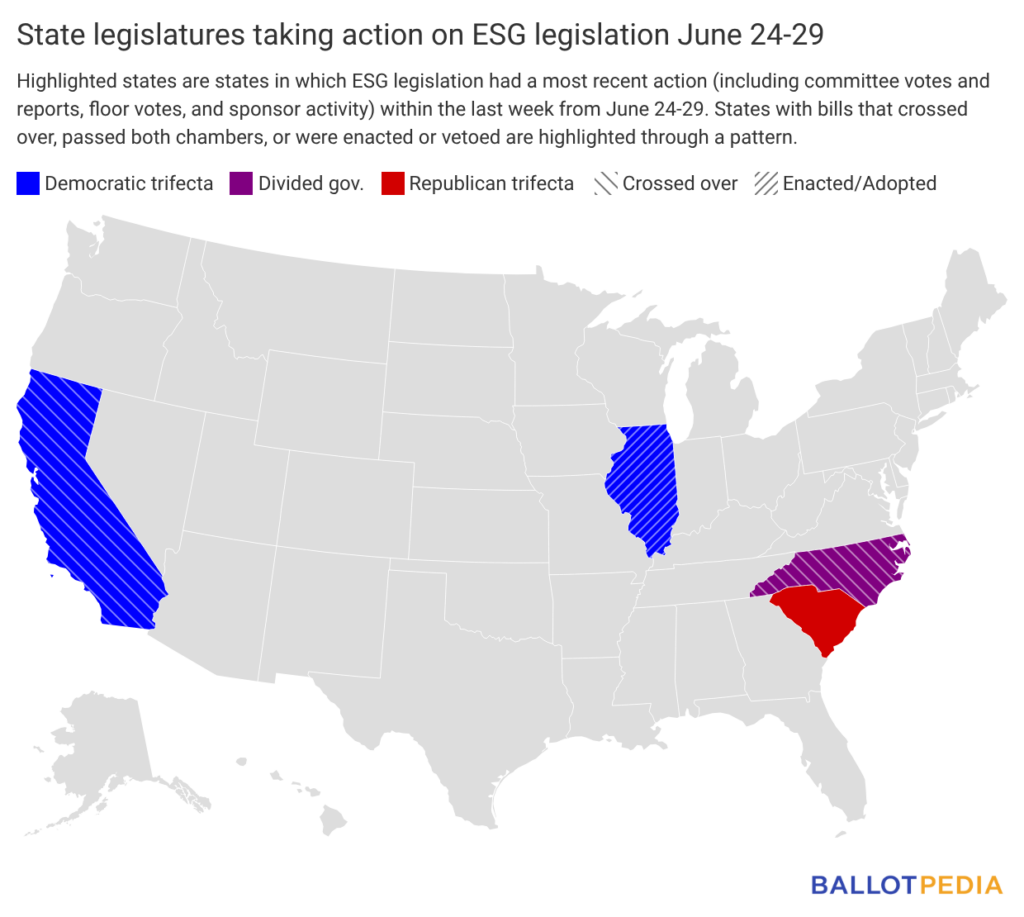
Four states took action on Four ESG-related bills since June 23. Illinois Gov. J.B. Pritzker (D) signed SB 4006 into law on June 26. The bill requires certain insurers, upon direction of the state insurance department, to participate in the National Association of Insurance Commissioners Climate Risk Disclosure Survey, establishing a state climate risk disclosure framework for insurers.
States with legislative activity on ESG last week are highlighted in the map below. Click here to see the details of each bill in the legislation tracker.
Around the world
French court orders oil company to report emissions
What’s the story?
A Paris court ruled on June 25, 2026, that TotalEnergies, a French oil and gas company, must account for greenhouse gas emissions from the consumption of its oil and gas products in its legally required climate impact report. The court gave the company six months to update its vigilance plan to include Scope 3 emissions — greenhouse gas emissions from customers' use of its oil and gas products. The court scheduled a follow-up hearing for January 2027 to review the revised plan.
Environmental groups and the City of Paris filed a lawsuit in 2020 under France's 2017 duty of vigilance law, which requires large companies to assess and prevent their operation's effects on the environment. TotalEnergies said the court "did not uphold the claims brought by the associations and the City of Paris, which sought to prohibit TotalEnergies from developing or undertaking new oil and gas projects or to require it to reduce its oil and gas production."
Why does it matter?
The ruling marks the first time France's duty of vigilance law has been applied to climate change. The environmental groups said, "This decision marks a significant step forward, confirming that the duty of vigilance fully applies to climate risks generated by multinational corporations.”
Senior attorney at the Center for International Environmental Law Sébastien Duyck said the law "is a key legal path to corporate accountability.” Duyck added that the French law has “served as a model for other laws of the same nature in other countries and at the EU level."
In the spotlight
Heritage Foundation argues ESG delivers less than promised
What’s the story?
The Heritage Foundation's Stefan Padfield wrote in a June 10 column that ESG portfolios underperform conventional strategies. Padfield cited a forthcoming study in the Journal of Financial Stability analyzing more than 22,000 observations from 2003 to 2023.
The research found that portfolios with higher ESG ratings lost money and became riskier. When a portfolio's ESG rating increased, average returns fell by 30 points and volatility rose 3.7%. ESG portfolios showed a 6.3% higher annual volatility and 7.1% higher potential losses than traditional portfolios.
Padfield argued that the claim the ESG ratings capture forward-looking risks is false and wrote:
ESG investing is a preference, not an edge. Investors who want to express values through capital allocation can do so; those who want to maximize risk-adjusted returns are not obviously helped by integrating ESG scores into their portfolios.
Why does it matter?
Global ESG-labeled assets surpassed $30 trillion by the mid-2020s. Padfield called on regulators to stop mandating ESG disclosures and treat ESG as investor preference rather than financial strategy.