


In this week’s edition of Economy and Society:
- Labor Department submits revised ESG rule to White House
- ESG legislation update
- European Commission finalizes sustainability reporting rules
- World bank drops climate finance target
- Google cuts operational emissions but Scope 3 emissions increase 25%
In Washington, D.C.
Labor Department submits revised ESG rule to White House
What’s the story?
The Employee Benefits Security Administration (EBSA), part of the Department of Labor, submitted a proposed rule to the Office of Information and Regulatory Affairs (OIRA) on June 30, 2026. The proposed rule would restrict plan fiduciaries from prioritizing environmental, social, and governance (ESG) and diversity, equity, and inclusion (DEI) factors when selecting investments and exercising shareholder rights, reversing Biden-era guidance that permitted such considerations alongside financial metrics.
The EBSA drafted the rule in response to a February 2025 executive order from President Donald Trump (R) directing federal agencies to review regulations that exceed statutory authority or implicate matters of social, political, or economic significance without clear congressional authority.
The proposed rule would replace guidance the Biden administration issued on ESG investing within ERISA retirement plans — 401(k)s, pension plans and similar accounts covering millions of workers.
Why does it matter?
The regulatory change reflects the Trump administration's broader effort to restrict ESG and diversity, equity, and inclusion (DEI) considerations across federal policy. In December 2025, Trump signed an executive order directing the Securities and Exchange Commission (SEC) to review and potentially rescind regulations on proxy advisors who prioritize ESG and DEI initiatives. The administration has also increased scrutiny of Labor Department fiduciaries' use of proxy advisors.
The House of Representatives passed legislation on January 15 with similar aims, requiring financial institutions and advisors to base investment decisions solely on economic factors, excluding political or social impacts. The Senate has not advanced the measure.
ERISA governs approximately 670,000 retirement plans covering roughly 90 million workers and retirees.
What’s the background?
The Trump administration issued an ESG rule in 2020 that restricted plan fiduciaries from considering environmental and social factors in investment decisions. The Biden administration abandoned that rule in 2021 and issued a rule permitting fiduciaries to consider ESG factors alongside financial metrics. The current proposed rule reverses the Biden approach.
In December 2025, the Department of Labor announced it would revise its ESG guidance following Trump's return to office. The agency did not disclose the rule's specific contents before submission to OIRA.
In the states
ESG legislation update
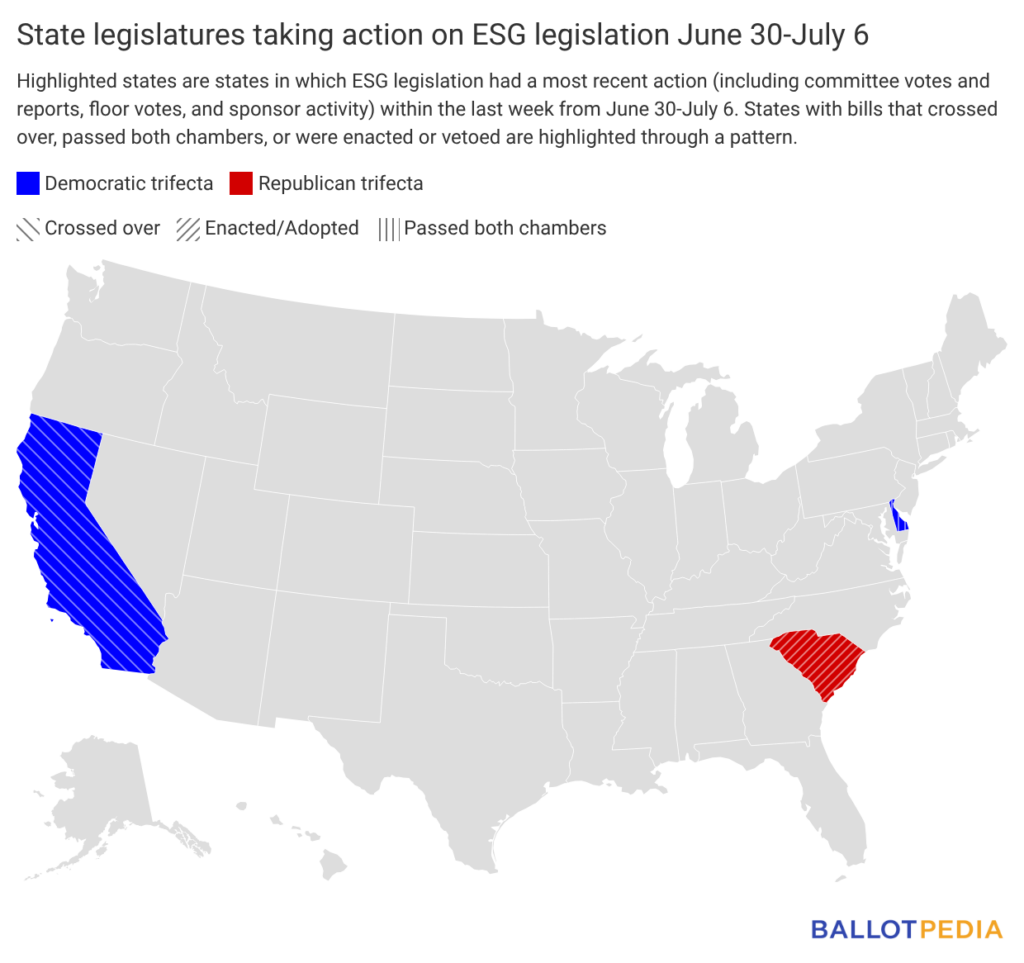
Three states took action on three ESG-related bills since June 30, 2026. In South Carolina, Governor Henry McMaster (R) signed the Guarantee Banking Act on June 30, 2026, prohibiting large financial institutions from denying or restricting banking services based on customers' religion, political views, speech, or other non-financial factors, and requiring institutions to provide written explanations when denying service. The law takes effect December 30, 2026.
Delaware HB500 passed both chambers on July 1, 2026.
States with legislative activity on ESG last week are highlighted in the map below. Click here to see the details of each bill in the legislation tracker.
Around the world
European Commission finalizes sustainability reporting rules
What’s the story?
The European Commission adopted finalized European Sustainability Reporting Standards (ESRS) on June 7, 2026, completing a regulatory revision that began in early 2025. The standards apply to companies subject to the European Union's (EU's) mandatory Corporate Sustainability Reporting Directive (CSRD) and establish a voluntary reporting standard for smaller companies.
The finalized ESRS substantially reduces reporting requirements compared to earlier versions, cutting mandatory datapoints by 61% and eliminating all voluntary disclosures—a total reduction exceeding 70%.
In the finalized ESRS, the Commission largely mirrored provisions from a draft released in May 2026. The Commission included one significant clarification: asset managers managing investments on behalf of clients do not have to disclose sustainability information on those client investments, as the information relates to the client's activities rather than the asset manager's operations.
The Commission will transmit the delegated acts underlying the finalized standards to the European Parliament and Council and the standards will enter into force unless either body objects. EU member states and lawmakers must approve the asset manager exemption proposal separately.
Why does it matter?
The new standards complete the Commission's Omnibus I initiative, which substantially scaled back reporting obligations for companies. The Commission exempted companies with less than €450 million in revenue and 1,000 employees — exempting 90% of companies the CSRD originally covered. The EU had previously set the threshold at 250 employees.
The standards will exempt firms managing portfolios on a fiduciary basis from reporting requirements, reducing administrative burden and avoiding duplicate reporting under existing EU disclosure rules.
Three leading European investor groups — the European Sustainable Investment Forum, the European Federation of Financial Analysts Societies, and the Institutional Investors Group on Climate Change — opposed the exemption. The European Sustainable Investment Forum said, "Actual portfolio holdings provide the most objective evidence of how policies translate into practice—rather than merely described in theory."
What’s the background?
The European Commission introduced amendments to the CSRD and the Corporate Sustainability Due Diligence Directive (CSDDD) in February 2026 to "cut red tape and simplify EU rules" and support European competitiveness. The European Parliament approved the amendments in December 2025 by a 428-218 vote.
The European Financial Reporting Advisory Group (EFRAG) submitted technical revisions to the ESRS in December 2025. The Commission maintained most of EFRAG's changes in its May draft while adding some clarifications and flexibilities.
World bank drops climate finance target
What’s the story?
The World Bank announced in late June 2026 that it will retire its commitment to direct 45% of its financing to projects with climate co-benefits. The organization said it will extend its Climate Change Action Plan — its strategy to help countries and private sector clients address climate and development challenges together — but will drop the specific financing target.
In April 2026, Treasury Secretary Scott Bessent argued that the target distorted the bank's core mission. Bessent said, "The World Bank must maintain focus on its core mission of reducing poverty and increasing economic growth," adding that meeting this goal "means jettisoning the World Bank Group's 45% climate finance target that breeds inefficiency, distorts economic decision making, and moves the Bank away from its core mission."
Why does it matter?
The U.S. is the World Bank's largest shareholder, and the Trump administration views climate finance targets as conflicting with the organization's poverty-reduction mandate.
The World Bank's climate finance activity reached over $39 billion in 2025 — more than double the $17 billion in 2020. In 2025, the World Bank surpassed its 45% target for the first time, achieving 48% of total financing directed to climate projects, including $16.6 billion for adaptation and $22.6 billion for mitigation.
Despite retiring the target, the World Bank said, "work on climate is and will remain firmly client driven, supporting them in delivering on their own ambitions as set out in their national plans and Nationally Determined Contributions (NDCs)."
What’s the background?
The World Bank set a 35% climate finance target in late 2020 for the subsequent five-year period, directing 50% of that financing toward adaptation and resilience. The organization increased the target to 45% in 2023. In June 2021, the World Bank launched its Climate Change Action Plan with a commitment to increase climate financing to an average of 35% of total World Bank Group financing.
President Trump said that climate change is "the greatest con job ever perpetrated on the world" and has worked in his second term to undo climate policies from prior administrations. On his first day in office, Trump signed an executive order to withdraw the U.S. from the Paris Agreement.
On Wall Street and in the private sector
Google cuts operational emissions but Scope 3 emissions increase 25%
What’s the story?
Google released its 2026 Environmental Report on July 1, 2026, reporting a 2% reduction in direct (Scope 1) and indirect (Scope 2) greenhouse gas emissions in 2025, despite a 37% increase in electricity consumption driven largely by artificial intelligence infrastructure expansion.
However, Google's overall carbon footprint increased because supply chain emissions (Scope 3) grew by 25% in 2025. Scope 3 emissions account for approximately 80% of Google's total emissions. They include greenhouse gases from data center construction and electricity use across suppliers in the Asia-Pacific region operating on grids that rely heavily on fossil fuels.
The company signed agreements to purchase over 12 gigawatts of net-new renewable energy in 2025 — its largest annual procurement in history.
Google's Chief Sustainability Officer Kate Brandt said:
While the path to achieving our climate ambitions will not be linear—given our AI infrastructure buildout is currently accelerating faster than the grid is decarbonizing—we remain focused on scaling abundant and affordable clean power globally and progressing technological innovations that drive down emissions across our operations and the broader industry.
Why does it matter?
Google's experience illustrates the tension facing technology companies pursuing aggressive climate goals while scaling AI infrastructure. The company set a 2030 target in 2020 to run its entire business on carbon-free energy in every region where it operates. The report shows that target is becoming harder to achieve as AI infrastructure demand outpaces grid decarbonization — the company's overall carbon footprint grew despite reducing direct operational emissions.
Scope 3 emissions growth poses a particular challenge. Suppliers in the Asia-Pacific region operate on grids lacking sufficient renewable energy capacity due to land constraints, high construction costs, and regulatory barriers. Google is pursuing Clean Energy Addendum programs requiring its highest-impact suppliers to commit to 100% clean electricity matches by the end of 2029, but supply chain decarbonization will require coordinated action across the industry.