


Welcome to Ballot Bulletin: Ballotpedia's Weekly Election Policy Digest. Every Tuesday, we deliver the latest updates on election policy around the country, including nationwide trends and recent legislative activity.
In this week’s edition, we cover 12 bills state legislatures acted on last week and look at New Jersey’s newly enacted state-level voting rights act.
The state of election legislation in the U.S.
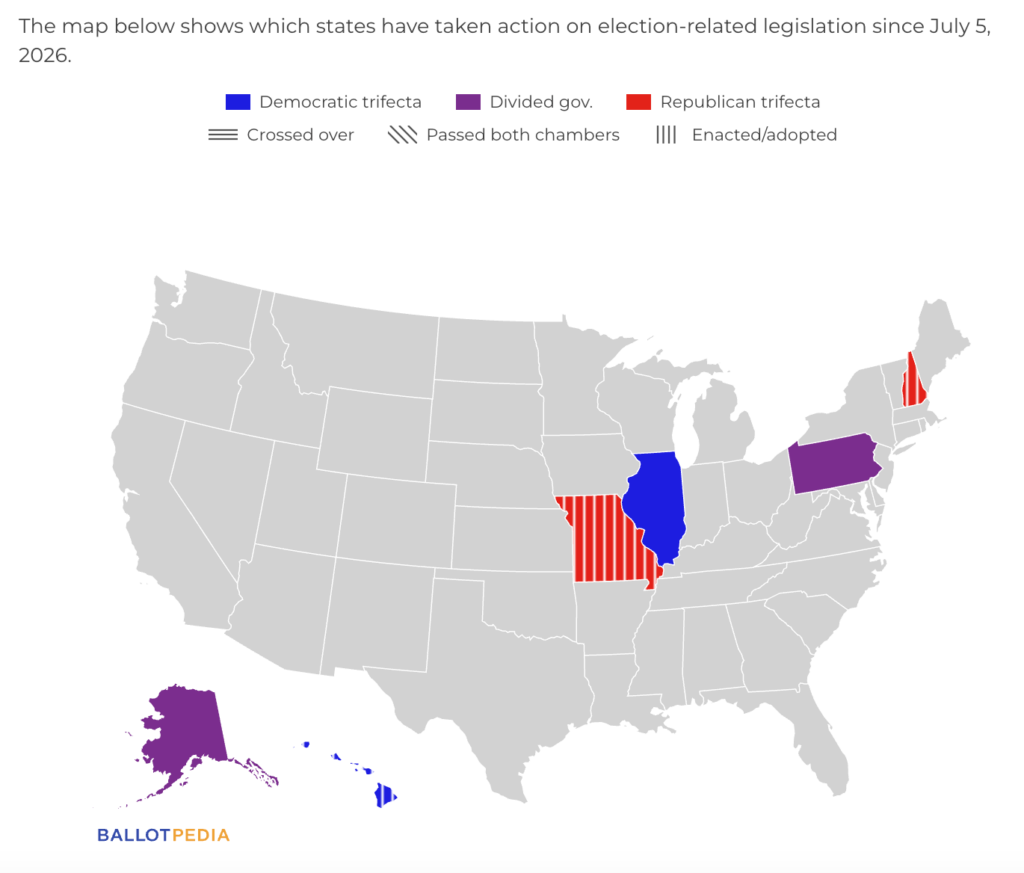
Lawmakers in six states acted on 12 election-related bills last week. Nine state legislatures are in regular or special sessions. Last week, four bills were enacted, no bills passed both chambers of a state legislature, and one bill was vetoed.
Of the bills acted on last week, four (33.3%) are in states with Democratic trifectas, six (50%) are in states with Republican trifectas, and two (16.7%) are in states with divided government. The most active bill categories last week were campaign finance (6), voters and voter qualifications (2), ballot measures (2), and offices (2).
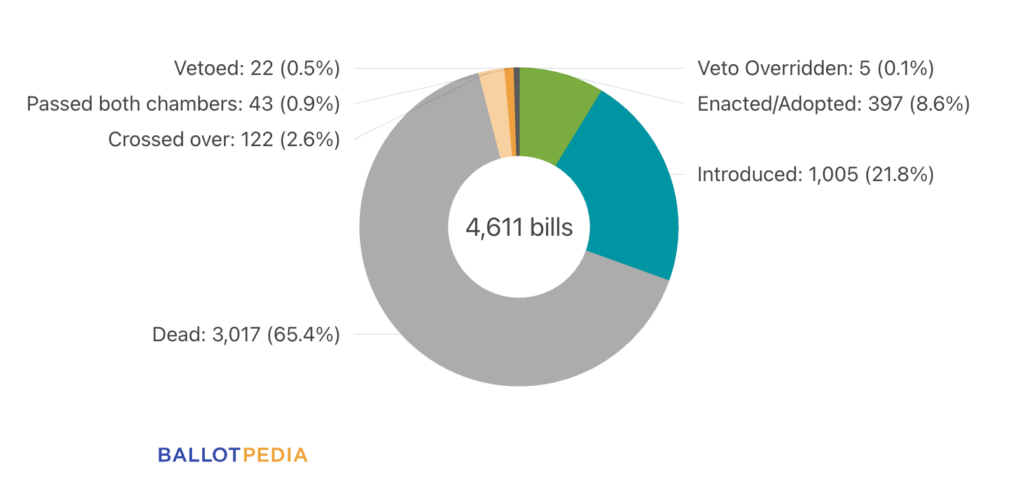
We are currently tracking 4,611 election-related bills across the country. The chart below breaks down the status of those bills based on where they stand in the legislative process:
Enacted bills
Four bills were enacted or adopted last week:
Bills passing both chambers
No bills passed both chambers of a state legislature last week.
To see a full list of bills awaiting gubernatorial action, click here.
Vetoed bills
One bill was vetoed this week:
- Alaska (Divided government)
To see a list of all bills vetoed this session, click here.
All bills
The chart below shows all bills Ballotpedia is currently tracking, broken down by partisan sponsor.
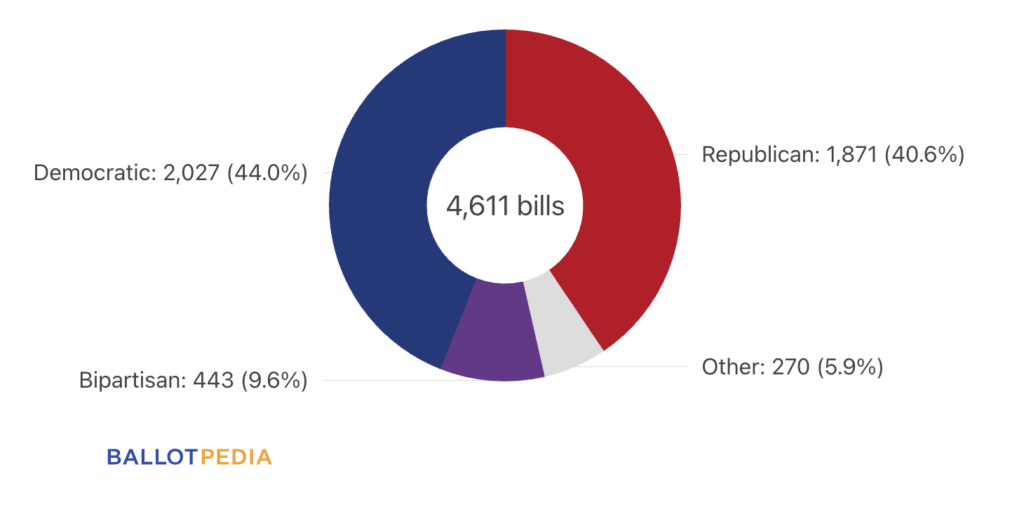
We are currently following 4,611 election-related bills, including bills carried over from the previous year.
- Trifecta status
- Democratic: 1,981 (43%)
- Republican: 1,649 (35.8%)
- Divided: 981 (21.3%)
- Partisan sponsorship
- Democratic: 2,027 (44%)
- Republican: 1,871 (40.6%)
- Bipartisan: 443 (9.6%)
- Other: 270 (5.9%)
In the news
On July 9, President Donald Trump (R) removed the three remaining members of the Election Assistance Commission (EAC), leaving the four-member board without any commissioners. According to multiple outlets,Trump fired two Democratic commissioners, Thomas Hicks and Benjamin Hovland, and requested the resignation of the one remaining Republican commissioner, Christy McCormick. The fourth commissioner, Donald Palmer, resigned from the commission in April to accept a position at the Heritage Foundation.
A White House official stated, "The President, and head of the Executive Branch, reserves the right to remove individuals that may not be totally aligned with the important task of securing America’s elections and ensuring every legal vote is counted. The Slaughter decision gives the President precedence to do so."
On June 29, the U.S. Supreme Court upheld Trump’s dismissal of Federal Trade Commissioner Rebecca Slaughter in Trump v. Slaughter, ruling that it is within the president’s executive powers to dismiss members of the independent agency.
Rick Hasen, professor of election law at the University of California, Los Angeles, said that it was unclear whether the Supreme Court’s ruling applied to the EAC and Federal Election Commission, as “the question has not been tested as to whether political entities created with bipartisan balance might be subject to another exception.”
The EAC is a federal commission responsible for developing election administration guidance and helping states comply with federal voting law. The dismissal of the three members means that the EAC is unable to conduct official business until at least three commissioners are appointed by the president and confirmed by the U.S. Senate. The EAC has full-time staff members in addition to the four commissioners who may continue limited operations.
Here are other news stories from across the country:
- On July 7, the U.S. District Court for the Northern District of Georgia rejected the Department of Justice’s request for the names of all 2020 election workers in Fulton County, Georgia. The DOJ filed a grand jury subpoena on April 20 for the list of names. In the district court’s opinion, Judge William Ray II said that a grand jury, used to investigate crimes and bring indictments, is not the appropriate vessel for allegations of electoral fraud brought by the federal government. Ray also said the DOJ’s subpoena should be dismissed because “anyone in power (perhaps the next administration of a different party) could use the Grand Jury process similarly to subpoena personal information of citizens (perhaps that of their political opponents) with no legitimate law enforcement purpose.”
- On July 7 and 8, respectively, the U.S. District Court for the Northern District of Florida and the U.S. District Court for the District of Columbia issued two opinions on whether states may use the Department of Homeland Security’s (DHS) Systematic Alien Verification for Entitlements (SAVE) system to check the citizenship of registered voters. The July 7 decision in Florida, written by Judge T. Kent Wetherell, requires DHS to continue allowing Florida, Ohio, Iowa, and Indiana to use the SAVE database to comply with a settlement reached last year. On July 8, D.C. District Judge Sparkle Sooknanan denied the federal government’s appeal of the court’s June 22 order barring states from accessing the database. Writing in the court’s memorandum opinion, Sooknanan said that the federal government could not seek relief from the June 22 order since it entered into a settlement in Florida while litigation challenging the use of the SAVE database was pending in the D.C. Court.
- On July 6, the DOJ appealed the June 27 decision of the U.S. District Court for the Western District of Pennsylvania denying the department access to Pennsylvania’s unredacted voter list. Writing for the court in its initial dismissal, Chief Judge Cathy Bissoon said that unredacted voter files do not constitute records subject to review by the U.S. Attorney General under the Civil Rights Act. Bissoon also noted that the department had filed the original complaint in the wrong jurisdiction. The DOJ appealed losses in similar lawsuits in Maryland and New Hampshire.
Policy spotlight: New Jersey becomes the 11th state to enact a state-level voting rights act
The story below is adapted from a recent Ballotpedia News story by Andrew Bahl.
On July 2, New Jersey Gov. Mikie Sherrill (D) signed legislation making New Jersey the 11th state to enact a state-level voting rights act.
Since the passage of the Voting Rights Act of 1965, which prohibits racial discrimination in voting nationwide, some states have enacted state-level voting rights acts. The provisions of these laws vary, but they generally include policies that mirror or expand on the federal Voting Rights Act. Those policies apply to local governments in the state.
Assembly Bill 1715 prohibits the use of voting policies that result “in a denial or abridgement of the right of members of a protected class to vote.”
The bill also prohibits political subdivisions from taking actions that result in vote dilution or that create a material disparity in access to voting opportunities or impair the “opportunity or ability of a protected class member to participate in the political process.”
Individuals or groups may file a court action against a local government alleging a violation of the law. A plaintiff must first give the local government a chance to remedy the issue before filing a lawsuit.
The law also requires political subdivisions that meet certain demographic criteria to provide assistance in languages other than English. Local governments of a certain size or that were deemed to have violated state or federal law in a voting case must submit changes to voting policies to the state attorney general’s office for pre-clearance before they can take effect.
The New Jersey Senate passed the final version of the bill 25-14 on June 30, with 25 Democrats voting in favor and 14 Republicans voting against. The New Jersey General Assembly then passed the amended bill 57-21 later that day, with 57 Democrats voting in favor and 21 Republicans voting against.
Rep. Verlina Reynolds-Jackson (D) said that by “strengthening safeguards against discrimination, improving language access, increasing transparency, and creating stronger protections for voters, New Jersey is reaffirming that our democracy works best when every eligible voice has an equal opportunity to be heard.”
During a hearing on the bill in May, Sen. Kristin Corrado (R) said, “I think it’s important to note, the incidents that you’re highlighting — we have addressed them in this state already. We do take the right to vote extremely seriously, and we’ve taken steps to proactively address that.”
The provisions of the bill take effect on August 15, 2026, with the exception of the language accessibility requirement, the preclearance requirement, and a requirement that the Division of Elections maintain a database with election statistics. Those three requirements take effect on October 1, 2027.
Of the 11 states with a state-level voting rights act, four have a provision that requires some local governments to obtain state approval for changes to voting policies, 10 have a prohibition on vote dilution, 10 allow private individuals or groups to sue over local or state policies they believe to be discriminatory, and four include requirements that voting materials be available in languages other than English.
The first state to enact a state-level voting rights act was California in 2002, followed by Illinois in 2011. Every other state enacted its law between 2018 and 2026. All 11 states had Democratic trifectas when they enacted their laws.
New Jersey is the fourth state in 2026 to enact a new state-level voting rights act, or to expand an existing law. Virginia and Washington both expanded existing state-level voting rights acts, while Maryland enacted a new law.
Both chambers of the Delaware General Assembly have passed HB 444, which would enact a state-level voting rights act. Once the bill is formally sent to Gov. Matt Meyer (D), he will have 10 days, excluding Sundays, to sign or veto it.