


Welcome to the Tuesday, July 21, 2026, Brew.
By: Lara Bonatesta
Here’s what’s in store for you as you start your day:
- Sixty-nine members of the U.S. Congress are not running for re-election this year — the most in at least 26 years
- Idaho initiative to create a statutory right to abortion becomes the fourth abortion-related measure on 2026 ballots
- Four Republicans running for Tennessee’s only Democratic-held district after redistricting shifted the seat toward Republicans
Sixty-nine members of the U.S. Congress are not running for re-election this year — the most in at least 26 years
Sixty-nine members of Congress — 11 Senators and 58 Representatives — are not running for re-election this year, the most since at least 2000 and 30% more than the 53 who did not run in 2024.
These figures are likely final — 49 of 50 state filing deadlines have passed, and all members of Louisiana's Congressional delegation (the lone outstanding filing deadline) have declared their intentions.
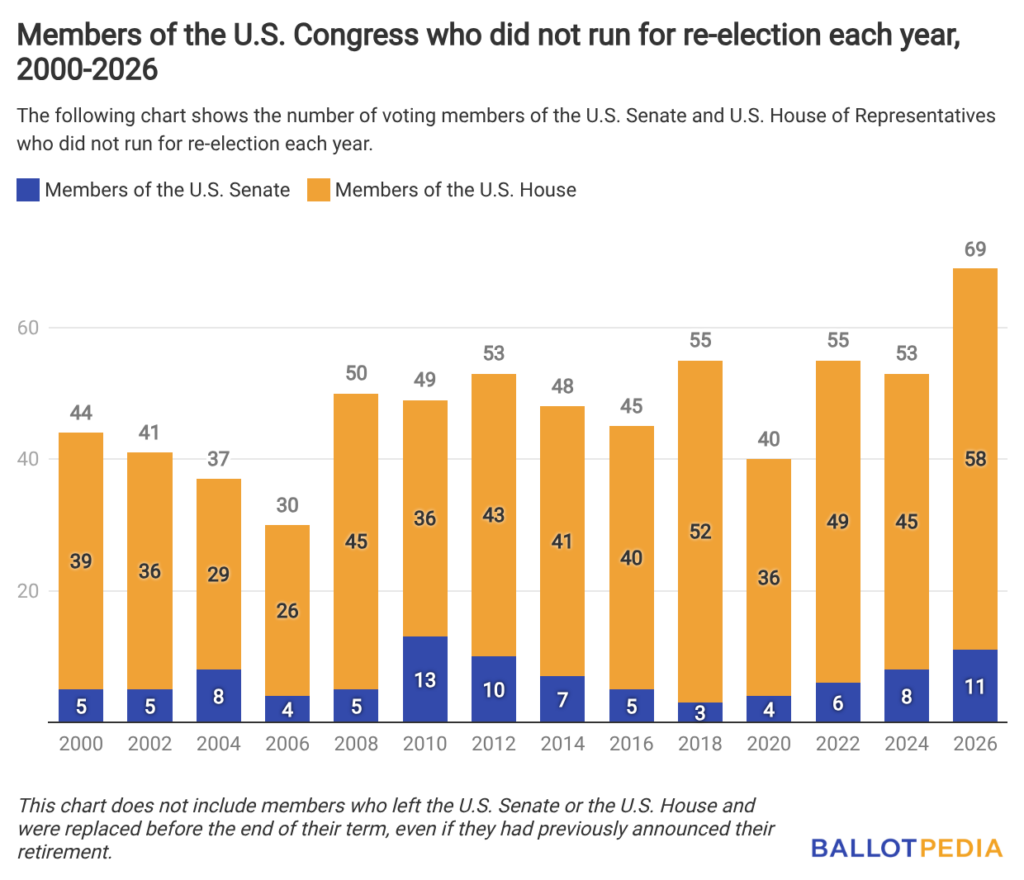
By chamber, this is the most U.S. Representatives not running for re-election and the second-most Senators not running for re-election, dating back to 2000.
U.S. Senate
Seven Republicans and four Democrats are not running for re-election to the U.S. Senate, marking the most Republican retirements dating back to 2000. In that period, Republican retirements have outnumbered Democrat retirements in six of 14 cycles. Democratic retirements outnumbered Republican ones in eight of 14 cycles.
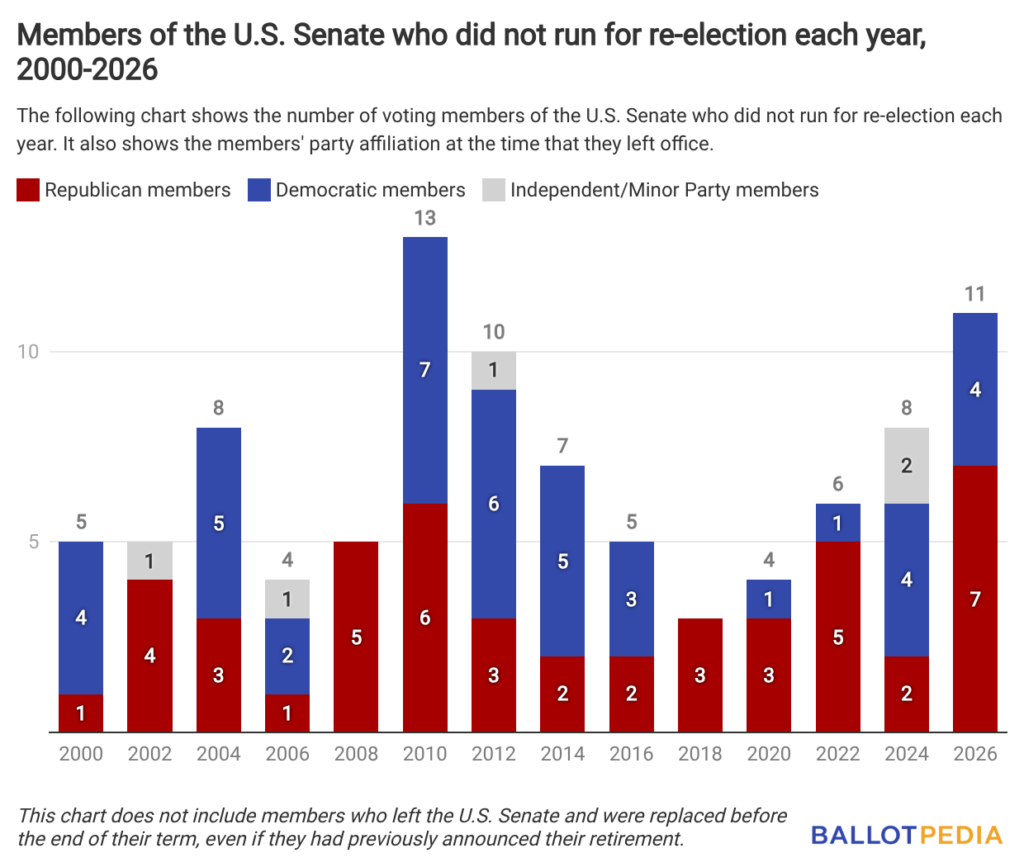
According to race ratings, Republicans and Democrats are both leaving three seats open that are not considered either solid/safe Republican or solid/safe Democratic.
- Joni Ernst (R) is retiring from her seat in Iowa, which is described as lean Republican.
- Gary Peters (D) is retiring from his seat in Michigan, which is described as a toss-up.
- Tina Smith (D) is retiring from her seat in Minnesota, which is described as likely Democratic.
- Steve Daines (R) is retiring from his seat in Montana, which is described as solid/likely Republican.
- Jeanne Shaheen (D) is retiring from her seat in New Hampshire, which is described as lean/tilt Democratic.
- Thom Tillis (R) is retiring from his seat in North Carolina, which is described as a toss up or lean Democratic.
In other words, 75% of Democratic retirements are from states that race raters do not consider safe, compared to 43% of Republican ones.
U.S. House of Representatives
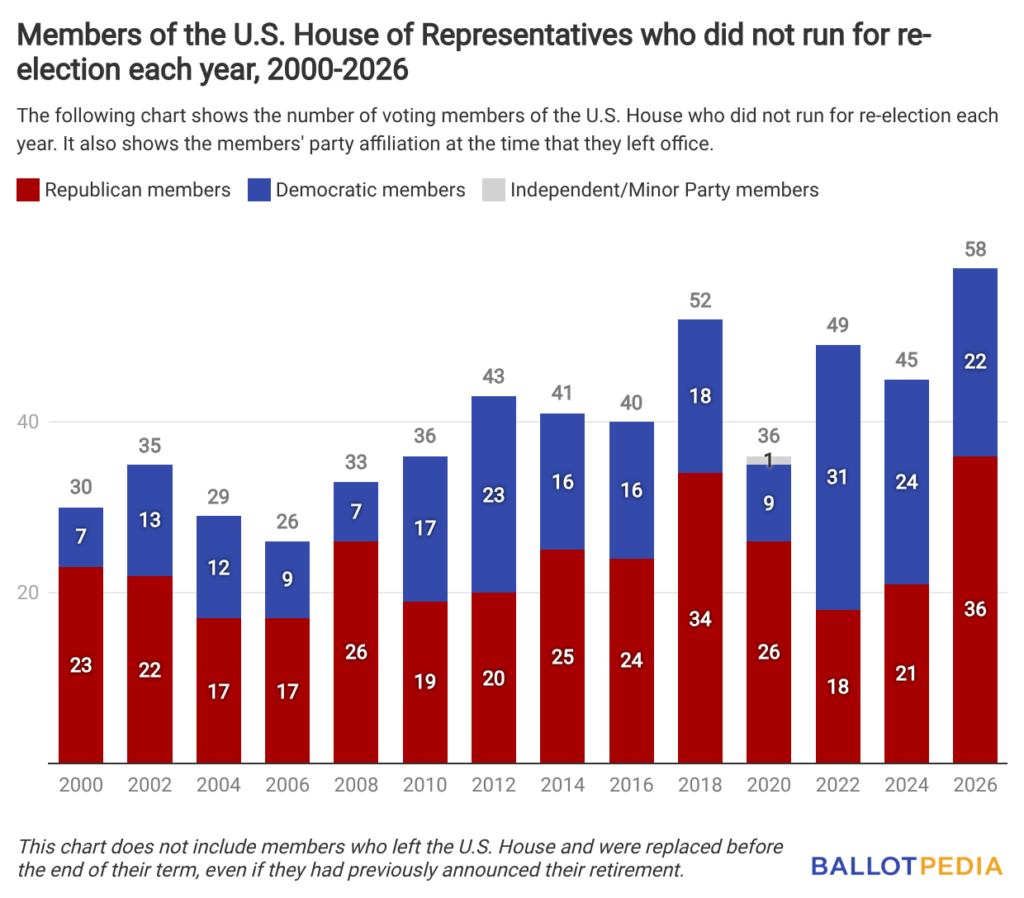
Thirty-six Republicans and 22 Democrats are not running for re-election. As in the Senate, this is the most Republican retirements since at least 2000. In that period, Republican retirements have outnumbered Democrat retirements in 11 of 14 cycles. Democratic retirements outnumbered Republican ones in three of 14 cycles.
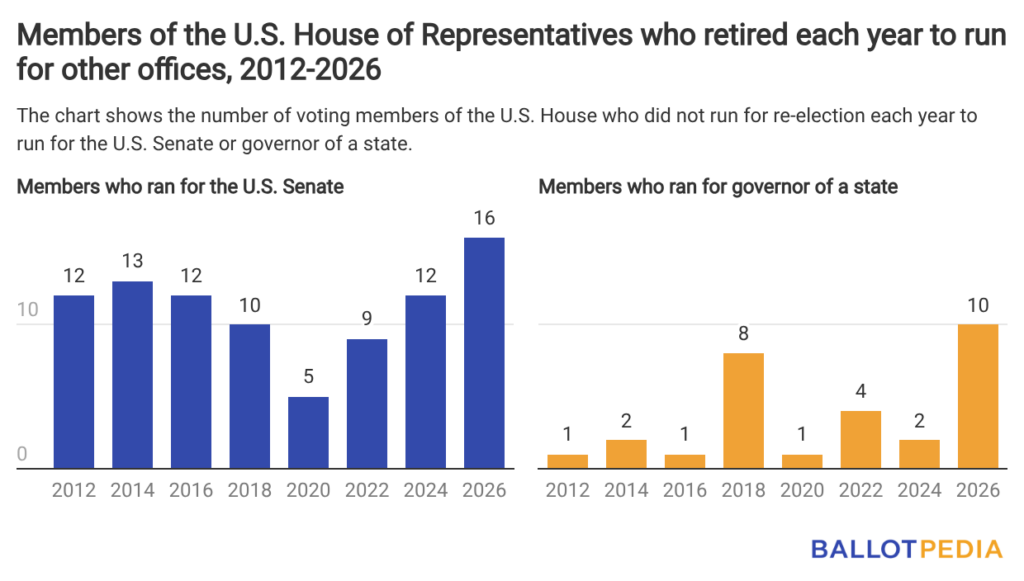
Twenty-seven U.S. Representatives are neither running for re-election nor running for another office, the most since at least 2012. There are also more Representatives running instead for U.S. Senate or governor than in any year since 2012.
According to race ratings, Republicans are leaving nine seats open in districts not considered solid/safe Republican, and Democrats are leaving four open in districts not considered solid/safe Democratic.
- The four Democratic-held districts each fall under one of the following categories: solid/safe Republican, likely/lean Republican, likely Democratic, or likely/lean Democratic.
- Five of those Republican-held districts each fall under one of the following categories: toss-up, likely/lean Republican, toss-up or lean/tilt Republican, likely Republican, or likely/solid/safe Republican.
- Two retirements are in Republican-held districts considered lean/tilt Democratic and two are in Republican-held districts considered solid/likely Republican.
In other words, 18% of Democratic retirements are from districts not considered solid/safe Democratic compared to 25% of Republican retirements from districts not considered solid/safe Republican.
Click here to read more about the U.S. Congress members who did not run for re-election this year.
Idaho initiative to create a statutory right to abortion becomes the fourth abortion-related measure on 2026 ballots
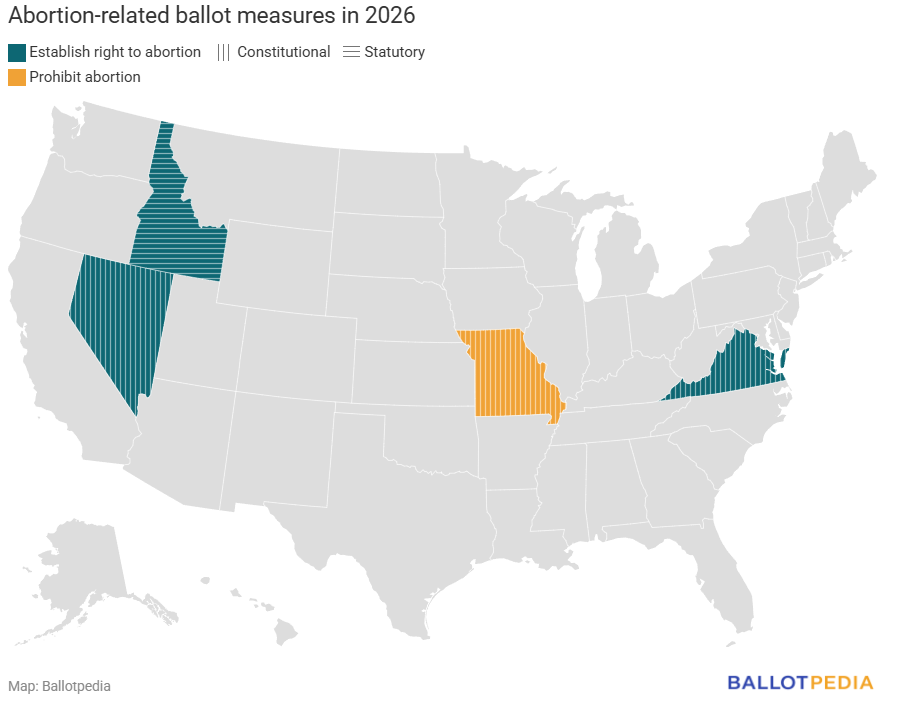
Idaho will be the seventh state with a Republican trifecta to decide on a ballot measure backed by groups that describe it as pro-choice or pro-reproductive rights since 2016, and the fourth state to decide an abortion-related ballot measure this year. The Idaho secretary of state announced on July 13 that Idahoans United for Women and Families submitted enough valid signatures to place the Idaho Reproductive Freedom and Privacy Act Initiative on the ballot.
So far, the measure in Idaho is the only abortion-related measure on a statewide ballot measure this year that is a citizen-initiated state statute. Three other states will decide on legislatively referred constitutional amendments this year, which are more difficult to alter once enacted.
The Idaho initiative is the third initiative on 2026 statewide ballots that would create a state right to abortion. The other two are Nevada Question 6 and the Virginia Right to Reproductive Freedom Amendment.
A fourth measure, Missouri Amendment 3, would repeal the state's constitutional right to abortion that voters approved in 2024, prohibit abortion, and prohibit certain medical procedures for transgender minors.
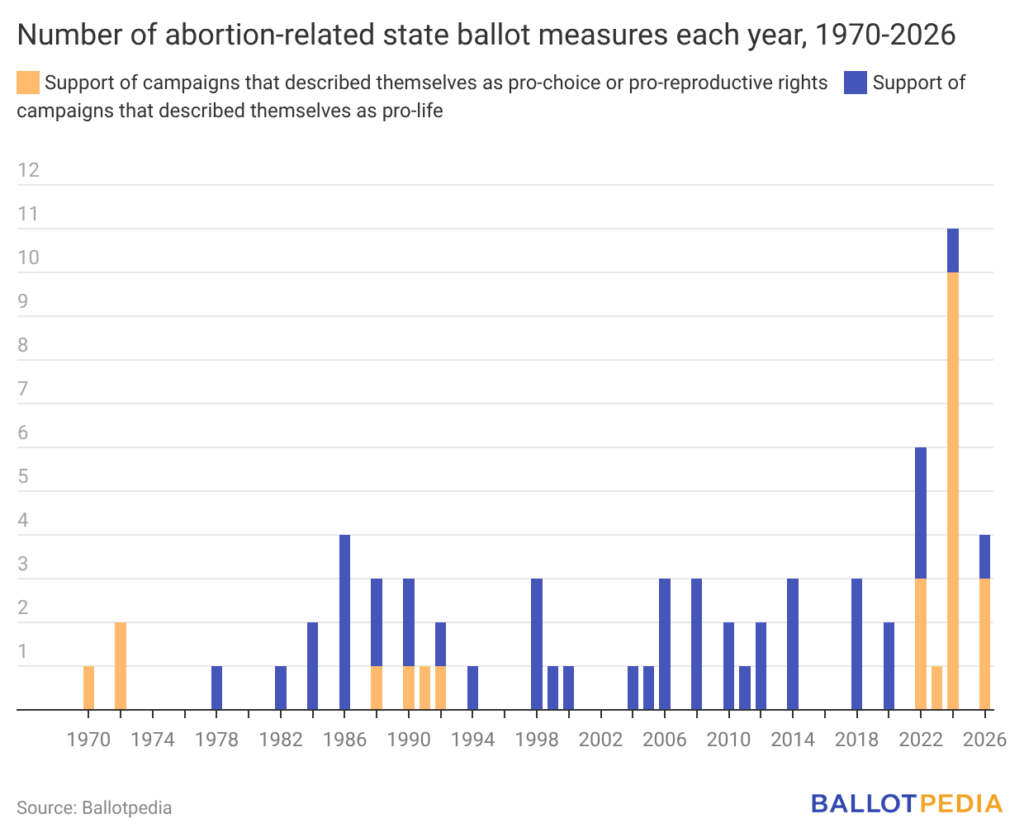
The 2026 measures follow a record year for abortion-related ballot measures in 2024, when voters decided 11 statewide measures — the most in a single year. 2026 is tied with 1986 as the year with the third most abortion-related measures on statewide measures. 2026 is also tied with 2022 for the year with the second most measures with support from campaigns that describe themselves as pro-choice.
The Idaho initiative states that “Every person has the right to reproductive freedom and privacy." It would state that each person has the right to “make personal decisions about reproductive healthcare that directly impacts the person’s own body,” and define personal decisions to include the following:
- abortion
- childbirth care
- contraception
- fertility treatment
- miscarriage care
- prenatal, pregnancy, and postpartum care.
The measure would state that the government could regulate abortion after the point of fetal viability, except in cases of a medical emergency.
Back to Idaho, organized by Idahoans United for Women and Families, is the campaign supporting a ‘yes’ vote on the initiative. The Democratic Party of Idaho publicly endorsed the initiative. Right to Life Idaho publicly opposes the initiative.
From 1970 through 2025, voters decided 65 abortion-related ballot measures. Forty-four measures had the support of organizations that described themselves as pro-life. Of those, voters approved 12 (27%) and rejected 32 (73%). Twenty-one measures had the support of organizations that described themselves as pro-choice or pro-reproductive rights. Of those, voters approved 15 (71%) and rejected six (29%).
As we mentioned above, there have been record-breaking numbers of abortion-related measures with backing from pro-choice groups since 2022 – when the U.S. Supreme Court ruled in Dobbs v. Jackson Women’s Health Organization that the U.S. Constitution does not confer a right to abortion.
Since the Dobbs decision, voters have approved 11 of 14 measures with backing from pro-choice groups – all constitutional amendments providing a right to an abortion. The three amendments that voters defeated included one in Florida, which received a 57.2% Yes vote but needed 60% to pass, one in Nebraska, and one in South Dakota. Voters have approved one of four measures with backing from pro-life groups. Nebraska's Initiative 434 was approved, while measures were defeated in Kansas, Kentucky, and Montana.
Forty-four abortion-related measures appeared on the ballot nationally in the years between SCOTUS’s Roe v. Wade decision in 1973 and its Dobbs v. Jackson Women’s Health Organization decision in 2022. Five measures had backing from pro-choice groups. Of those, four were approved, and one was defeated. Thirty-nine measures had backing from pro-life groups. Of those, ten were approved, and 29 were defeated.
Click here to learn more about abortion ballot measures in 2026.
Four Republicans running for Tennessee’s only Democratic-held district after redistricting shifted the seat toward Republicans
Four Republicans are running in the primary on Aug. 6 for Tennessee’s 9th Congressional District, a district including parts of Memphis that retiring incumbent Rep. Steve Cohen (D) won by 45.6 percentage points in 2024 but that, under new Congressional district maps, voted 59.9% to 38.8% for President Donald Trump (R) that same year.
The Tennessee Legislature redrew the majority-minority Memphis district in a May 2026 special session. Governor Bill Lee (R) called the special session after the U.S. Supreme Court ruled in Louisiana v. Callais that the Voting Rights Act did not require Louisiana to add a second majority-minority congressional district.
Rep. Cohen is one of 69 members of Congress not seeking re-election this year. He has represented the old 9th District since 2007. Cohen originally ran for re-election but withdrew from the race on May 15, the final day of the special qualifying period, after the state enacted new Congressional maps.
Charlotte Bergmann, Brent Taylor, Jeremy Thompson, and Todd Warner are running. Bergmann is a multiple-time Republican nominee in the former district, Thompson is a retired U.S. Army sergeant, and Taylor and Warner are both state legislators.
Bergmann is a small business owner, former member of the Tennessee Republican Party State Executive Committee, and five-time general election challenger against Cohen. Before starting her business, Bergmann was an information technology project manager at FedEx. Bergmann's campaign website described her as "a passionate advocate for reducing crime, promoting school choice, job creation, economic growth, and putting America First."
Taylor was elected to represent Tennessee Senate District 31 in 2022. His career experience includes working as a funeral director. He previously served on the Memphis City Council and Shelby County Election Commission. Taylor said, "If we want strong borders, and we want to end illegal immigration, and we want to support President Trump and his laying out and implementing his agenda, and we want to provide impeachment insurance for President Trump in these final two years in office, we have to win."
Thompson is a retired U.S. Army Sergeant First Class who worked in military intelligence and special operations support. He also worked as a volunteer firefighter, EMT, and reserve deputy sheriff. Thompson is executive director of the Special Operations Association of America and a restaurant owner. Thompson's campaign website says he is running because "he believes our best days are still ahead of us. His campaign is focused on making life more affordable, holding Washington accountable, and supporting America’s military, veterans, and first responders." As of July 20, only Taylor included a list of endorsements on his campaign website. His endorsements included President Donald Trump (R), both of Tennessee’s U.S. Senators, and three members of Tennessee’s U.S. House delegation
Warner was elected to represent Tennessee House District 92 in 2020. He is a corn and soybean farmer and formerly worked for United Telephone. Previously, he served on the Marshall County School Board and as an alderman in Chapel Hill. Warner said, "President Trump showed us what real leadership looks like. Tennessee doesn't need another polished politician reading from consultant talking points. We need a fighter who will secure the border, defend our God-given rights, cut wasteful spending, protect our rural way of life and put Tennessee families first."
On the Democratic side, there are four candidates running. Among them are two Democratic state legislators — Sen. London Lamar, Rep. Justin Pearson – as well as M. LaTroy A-Williams (D) and Jim Torino (D).
Click here to learn more about the Republican primary in Tennessee's 9th Congressional District.