


Welcome to the Thursday, July 23, 2026, Brew.
By: Lara Bonatesta
Here’s what’s in store for you as you start your day:
- Wisconsin Democrats ask state commission to let mail-in voters recast ballots after changes to gubernatorial candidate field
- One top-100 mayor has left office early this year, and proceedings are underway to remove another from office
- Idaho voters have decided on 228 statewide measures since 1892
Wisconsin Democrats ask state commission to let mail-in voters recast ballots after changes to gubernatorial candidate field
Wisconsin’s statewide primary is less than a month away, on Aug. 11, and after multiple high-profile changes in the Democratic gubernatorial candidate field in recent weeks, the state Democratic Party is asking the Wisconsin Election Commission to allow voters who have already submitted mail-in ballots to vote again.
While seven Democratic candidates will appear on the primary ballot, two of them have suspended their campaigns. Missy Hughes, the former CEO of Wisconsin Economic Development Corporation, was the first candidate to do so on June 22. Sara Rodriguez, who is the Lieutenant Governor, suspended her campaign on July 17.
A third candidate, David Crowley, suspended his campaign on July 8 but then announced that he was reentering the race on July 18, following Rodriguez’s withdrawal. Four other Democratic candidates — Mandela Barnes, Joel Brennan, Francesca Hong, and Kelda Roys — are also running.
Spoiled ballots debate
More than 80,000 voters have returned mail-in/absentee ballots since clerks began sending absentee ballots to voters in June. Whether people who have already voted for a candidate who withdrew can change their vote is now the subject of legal debate.
A spoiled ballot is a ballot that has been marked incorrectly and is not counted by election officials. Wisconsin state law allows voters to spoil their ballot two times. That is, a voter can say that their ballot has been marked incorrectly and receive a replacement ballot two times. According to state law, this is permitted in cases where a voter “by accident or mistake, spoils or erroneously prepares a ballot.”
On July 9, the day after Crowley dropped out of the race, the Wisconsin Election Commission voted 4-2 to approve new guidance replacing the previous guidance that they had issued on May 27.
According to the Commission, the new guidance made two changes:
- “Clarified that a voter may receive up to two replacement absentee ballots for a total of three (which includes the original).
- Determined that if a voter returns their voted ballot and later changes their mind about who they would like to vote for or because the candidate they originally voted for has dropped out of the race, this does not constitute an ‘accident or mistake.’ The ballot cannot be spoiled and reissued for any reason.”
In other words, voters who cast ballots for one of the candidates who suspended their campaigns would not be permitted to vote again.
The Wisconsin Elections Commission is a six-member bipartisan commission composed of three commissioners representing the Democratic Party and three commissioners representing the Republican Party. According to the commission’s website, each party’s respective Legislative leadership appoints two Democratic members and two Republican members. The governor appoints one Democratic member and one Republican member, both subject to Senate confirmation, who must be former municipal or county clerks.
The Wisconsin Democratic Party sent a letter to the commission on July 21, asking them to rescind the guidance and remove any social media posts and media statements about it.
Wisconsin Democratic Party Chair Devin Remiker said, “Allowing voters to spoil and recast their ballots was standard practice in Wisconsin prior to attempts by Republicans to file frivolous lawsuits to muddy the waters…The Wisconsin Elections Commission recently issued guidance that advises clerks not to allow voters to request a new ballot. We believe that guidance was issued improperly …. If the WEC does not act immediately and retract this guidance, some voters will not be able to truly participate in our Democratic primary process.”
Wisconsin Republican Party Chairman Brian Schimming said, “Their primary is already chaotic enough… Election laws should not be changed to rescue one party from the consequences of its own actions.”
What’s at stake and the contest between centrist and progressive Democrats
The Democratic gubernatorial primary features conflict between candidates characterized as centrist or moderate Democrats and Democratic socialists.
Governor Tony Evers (D) endorsed Crowley when he re-entered the race. Wisconsin Public Radio's Shawn Johnson and Rich Kremer said Evers' endorsement "underscored a schism in the state Democratic Party between traditional Democrats and Madison Rep. Francesca Hong, the democratic socialist who has energized the party’s progressive base."
Crowley, Hong, and Barnes lead in endorsements, polls, and fundraising.
Crowley was elected Milwaukee County Executive in 2020 and served in the Wisconsin Assembly from 2017 to 2020. His campaign website said, "To win, the democratic nominee must do three things: boost turnout in Milwaukee, grow margins in the suburbs, and hold the line in rural communities. David is the only candidate who can do all three with the results to prove it."
Hong, who has received endorsements from local chapters of the Democratic Socialists of America (DSA), was elected to the Wisconsin Assembly in 2020. She works as a chef and community organizer. In a campaign ad, Hong said, "We can fully fund our public schools and have universal childcare. We can guarantee paid leave and have cheaper health care. We can fix a rigged system that puts oligarchs over workers and small businesses."
Barnes was elected lieutenant governor on a ticket with Evers in 2018 and ran for U.S. Senate in 2022 rather than seeking re-election. He served in the Wisconsin Assembly from 2013 to 2017. U.S. Sen. Adam Schiff (D) endorsed Barnes. In a campaign ad, Barnes said, "The only way for our state to move forward is to reject the Washington way and get things done the Wisconsin way. It isn't about left or right. It's not about who can yell the loudest. It's about whether people can afford to live in the state they call home."
With Evers not running for re-election, this is the first open race for governor since 2010. The general election is rated a Toss-up. Control of the state government is at stake, with both parties looking to gain a trifecta. Wisconsin is one of 11 states with a divided government. Democrats last had a trifecta in 2010, and Republicans last had one in 2018.
Click here to learn more about Wisconsin’s Democratic gubernatorial primary.
One top-100 mayor has left office early this year, and proceedings are underway to remove another from office
A hearing to remove Mayor Paulette Guajardo (Nonpartisan) is underway in Corpus Christi, Texas, the 58th largest city in the country by population. One other mayor in the 100 largest cities, Charlotte, North Carolina's Vi Lyles (D), has left office early this year.
The Corpus Christi City Council voted 5-3 on March 24 to begin a removal process and 5-2 on April 14 to move forward with the process.
Hearings in the removal proceedings began on Wednesday, July 22, and are expected to continue on Thursday, July 23.
The mayor of Corpus Christi is part of the city council. The city’s charter says that a majority vote of all council members, excluding the challenged member, is required to remove a member from office. The charter also says that in the event of a vacancy in the mayor’s office, the at-large city council member who received the most votes in the last election will become the mayor. In this case, that member is Carolyn Vaughn, who received 17.2%, or 32,974 votes, in the Nov. 5, 2024 general election.
A group of citizens, including multiple-time city council candidate Rachel Caballero, filed a petition with the city council to remove Guajardo in August 2025. The petition alleged that in April 2024, Guajardo used an altered map in a presentation to the city council to get them to award $2 million in tax incentives for a hotel development project.
The petition states, “Paulette Guajardo pushed for approvals so that her friend / campaign contributor, by use of an altered FEMA/federal document, would get $2,000,000.00 of taxpayer money - and Paulette Guajardo did so with full knowledge of FEMA/federal document had been altered/tampered/forged. This is ‘misconduct’ and ‘malfeasance’ on the part of Paulette Guajardo.[sic] and thus ground for removal.”
In March 2026, Guajardo told the Corpus Christi Caller Times that she “would urge the Council to dismiss the complaint” and “it has no legal or factual merit.” Guajardo said, “The matter has been examined and rejected by multiple law enforcement agencies, and it represents an irresponsible use of public funds."
In April, Guajardo sued the city and the five council members who voted to advance the process, asking U.S. District Court Judge George Hanks Jr. to block the removal process from continuing. In her complaint, Guajardo alleged that the removal process violated her Fourteenth Amendment rights to due process and equal protection. She also said the process was a retaliation against her use of her First Amendment rights. On Wednesday, July 15, Hanks denied Guajardo’s request for an injunction and dismissed the case, allowing the removal process to continue.
Guajardo appealed Hanks’ decision, and on July 21, the U.S. Court of Appeals denied her motion to stay the proceeding.
The last mayor of one of the country’s 100 most populous cities to be removed from office was former Oakland mayor Sheng Thao, who voters recalled 60.6% to 39.4% on Nov. 5, 2024. Thao was one of two mayors in this group to leave office early in 2025. The other was Hialeah, Florida, Mayor Esteban Bovo Jr. (R), who left office on May 27, 2025, to take a job in D.C.
Corpus Christi is one of 22 cities in the country’s 100 most populous holding mayoral elections this year. Guajardo has said she intends to run for re-election. The filing deadline for the election is Aug. 17.
Other recent municipal news from America’s 100 most populous cities
- On July 21, Chandler, Arizona, held a nonpartisan primary for mayor. Matt Orlando, endorsed by local Democratic groups, leads Jeff Weninger, a Republican state legislator. The city's current term-limited mayor, Kevin Hartke, is a Republican. One mayoral office in one of the 100 largest cities had changed party hands so far this year. In Irving, Texas, Albert Zapanta (Unaffiliated) was elected to succeed Rick Stopfer (R) on May 2.
- On July 7, Todd Johnson was sworn in as mayor of Pierre, South Dakota. Johnson defeated incumbent Steve Harding in the mayoral election on June 2. Harding was the first incumbent mayor of a state capital to lose a bid for re-election this year. No incumbents in the nation’s 100 most populous cities have lost bids for re-election so far this year.
Click here to learn more about mayoral elections in 2026.
Idaho voters have decided on 228 statewide measures since 1892
Since 1892, Idaho voters have decided on 228 state ballot measures, approving 162 (71%) and defeating 66 (29%).
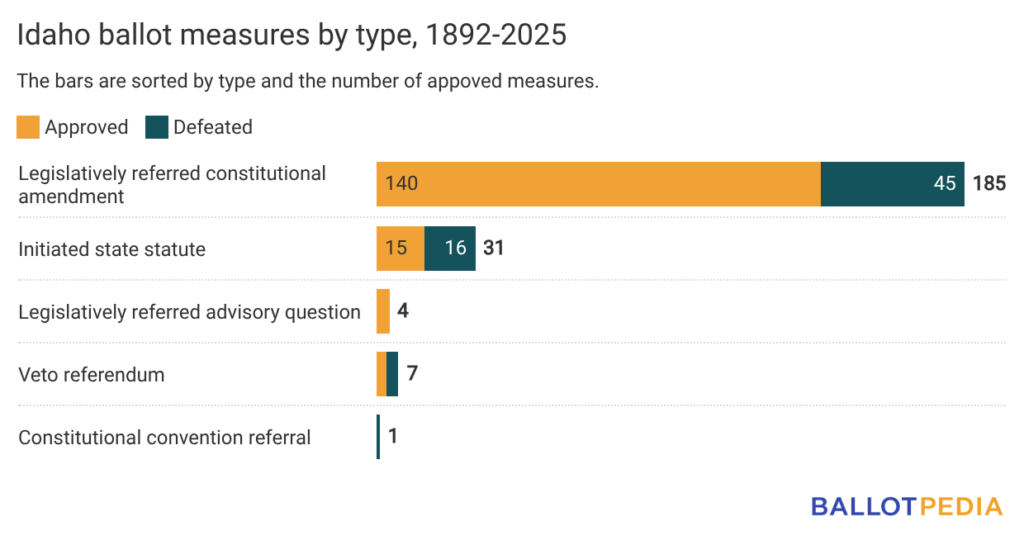
In Idaho, the Legislature can place constitutional amendments and advisory questions on the ballot, while citizens can initiate state statutes and veto referendums. Between 1892 and 2025, the Idaho Legislature has put 189 measures on the ballot, including 185 constitutional amendments and four advisory questions. Voters decided on 31 initiated state statutes and seven veto referendums. Voters also decided on one constitutional convention referral.
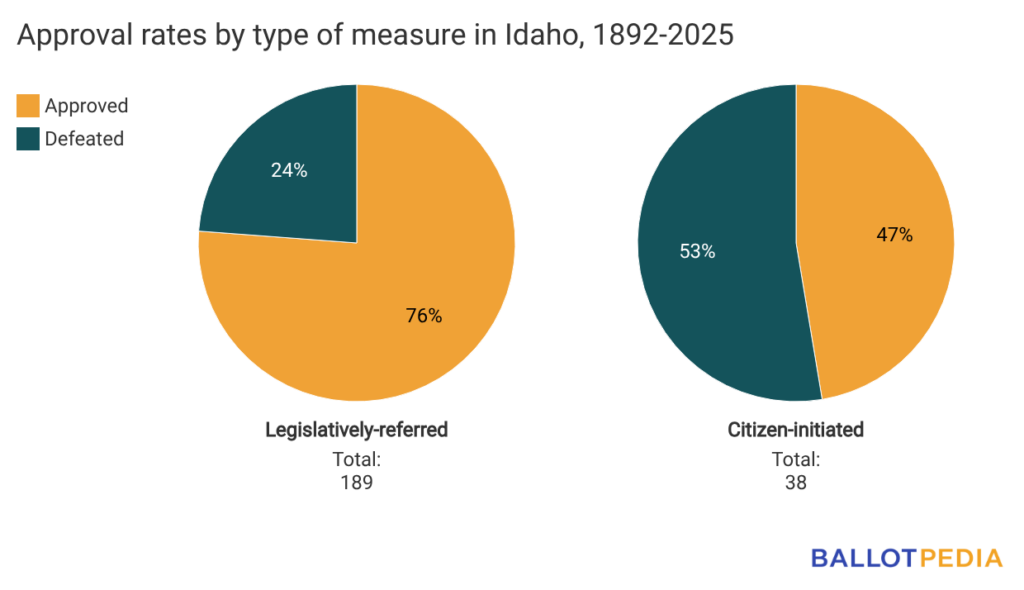
Questions the Legislature put on the ballot have had a higher success rate than citizen initiatives. Voters approved legislatively referred measures 76% of the time, as compared to 47% for ballot initiatives.
There are five different types of ballot measures in Idaho. Legislatively referred constitutional amendments have appeared on the ballot the most (185). Legislatively-referred advisory questions had a 100% approval rating. Veto referendums had the lowest success rate, with three measures approved and four defeated. Voters rejected one constitutional convention referral.
Idaho ballot measures have addressed 106 unique topics, with some measures addressing multiple topics. Top topics included salaries of government officials (16 measures), local government officials and elections (14 measures), state legislative authority (14 measures), local government organization (13 measures), and bond issues (13 measures).
Below is a selection of notable ballot measures in Idaho's history. For a more detailed list, see here.
- In 1896, voters approved the Women’s Suffrage Amendment, extending voting rights to women, becoming the fourth state to do so. Voters approved the amendment 24 years before the ratification of the 19th Amendment to the U.S. Constitution.
- In 1912, Idaho voters approved three constitutional amendments establishing direct democracy processes in the state. The Veto Referendum Process Amendment authorized voters to petition for a statewide vote on legislation the Legislature passed. The Initiative Process Amendment established a process allowing citizens to propose state statutes. The Public Officials Recall Amendment authorized voters to recall public officials, except judges.
- In 1978, voters approved the Right to Keep and Bear Arms Amendment 82.5% to 17.5%. The amendment replaced language in Idaho’s original Constitution that allowed the Legislature to regulate the exercise of the right to bear arms with language stating that the right to keep and bear arms shall not be abridged. It continued to allow laws regulating concealed weapons, firearm possession by convicted felons, crimes committed while possessing a firearm, and firearm use. The amendment also prohibited firearm or ammunition licensing, registration, and special taxation, as well as firearm confiscation except when the firearm was used to commit a felony.
- In 2024, voters rejected the Top-Four Ranked-Choice Voting Initiative. The initiative would have replaced Idaho’s partisan primary elections with top-four primaries and established ranked-choice voting for general elections for federal, state, and certain local offices.
Two of Idaho’s ballot measures were decided by less than a single percentage point of the vote.
The measure with the closest margin was Proposition 2, a veto referendum voters decided on in 2002. Voters approved the measure, upholding a state law repealing term limits for elected officials in the state. The vote was 50.23% to 49.77%, a margin of 0.46 percentage points.
The measure with the largest margin was HJR 2, which authorized the Legislature to pass workplace health and safety laws for factory, smelter, mine, and ore reduction workers. The vote was 96.01% to 3.99%, a margin of 92.02 percentage points.
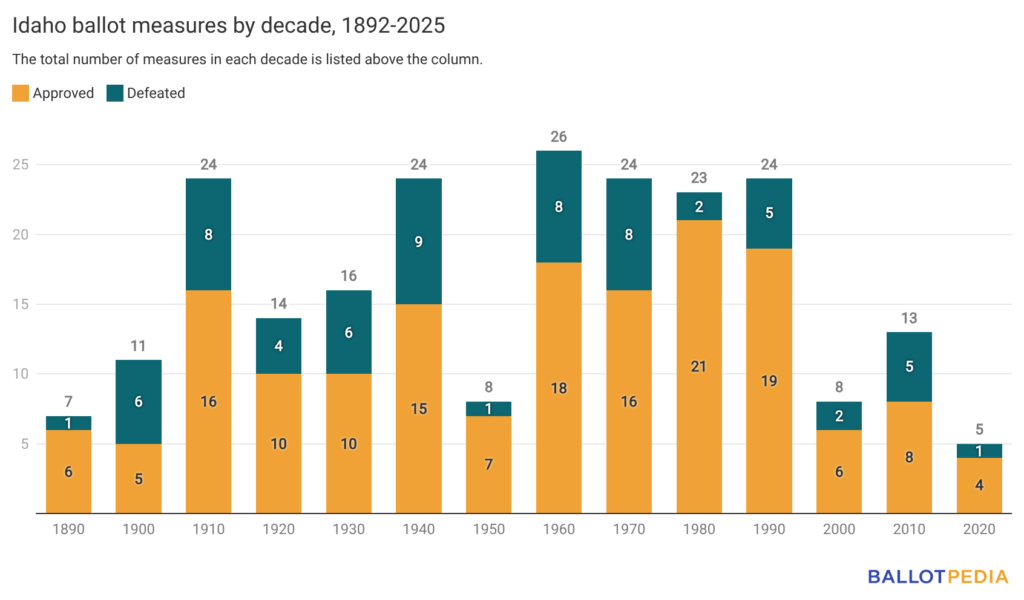
The decade with the most ballot measures was the 1960s, with 26. Eighteen measures (69.2%) were approved, and eight (30.8%) were defeated. The 1980s had the highest approval rate, with 21 of 23 (91.3%) measures approved. The decade with the lowest approval rate was the 1900s, with 5 of 11 (45.5%) approved.
The inventory of Idaho statewide ballot measures is part of Ballotpedia's Historical Ballot Measure Factbooks, which document nearly 200 years of direct democracy in the United States. This ongoing research effort will provide an unparalleled resource for researchers, reporters, and voters on how ballot measures have evolved, the issues they've covered, and the role they have played in our civic life.