


Welcome to the Wednesday, July 29, 2026, Brew.
By: Lara Bonatesta
Here’s what’s in store for you as you start your day:
- Voters to decide on at least six statewide voter ID measures this year, the most ever in a single year
- No initiatives will be on Oregon’s November ballot for the first time in an even year since 1966 after hunting ban proposal fails to qualify
- AIPAC, Progressive Victory, and Donald Trump endorsed candidates in Washington’s 3rd Congressional District top-two primary
Voters to decide on at least six statewide voter ID measures this year, the most ever in a single year
Voters will decide at least six ballot measures related to voter identification requirements in 2026. That’s the largest number of voter identification measures on the ballot ever in a single year.
Each of these measures would establish or expand voter identification requirements in state constitutions.
Legislatures placed four of the measures on the ballot, while the other two are citizen initiatives. Oklahoma voters will decide on one measure on Aug. 25, and Arizona, California, Nevada, North Carolina, and Ohio voters will decide on the other five on Nov. 3. Initiatives on voter identification are also pending signature verification in Colorado and Michigan.
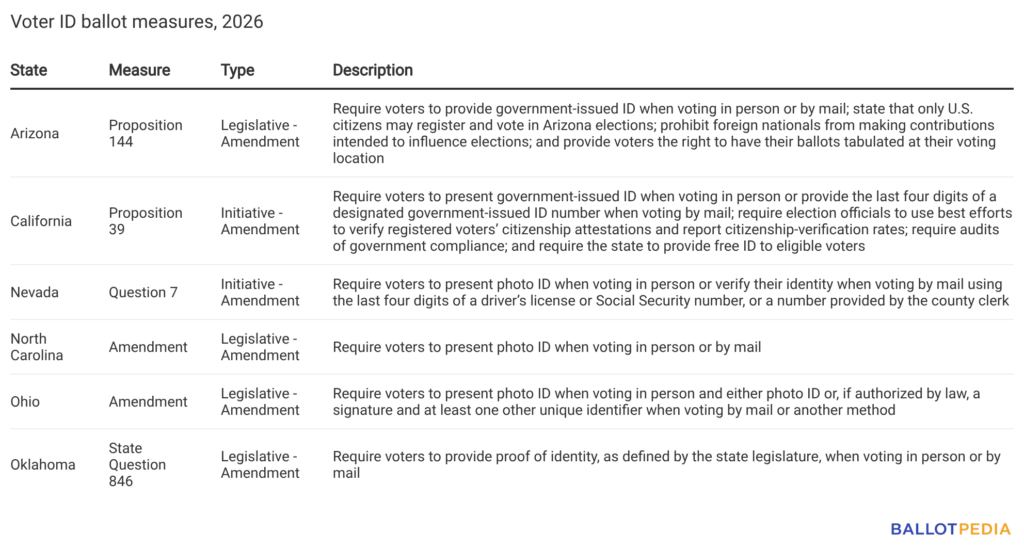
The measures have various provisions, which are outlined in the table below. To learn more about each measure, click here.
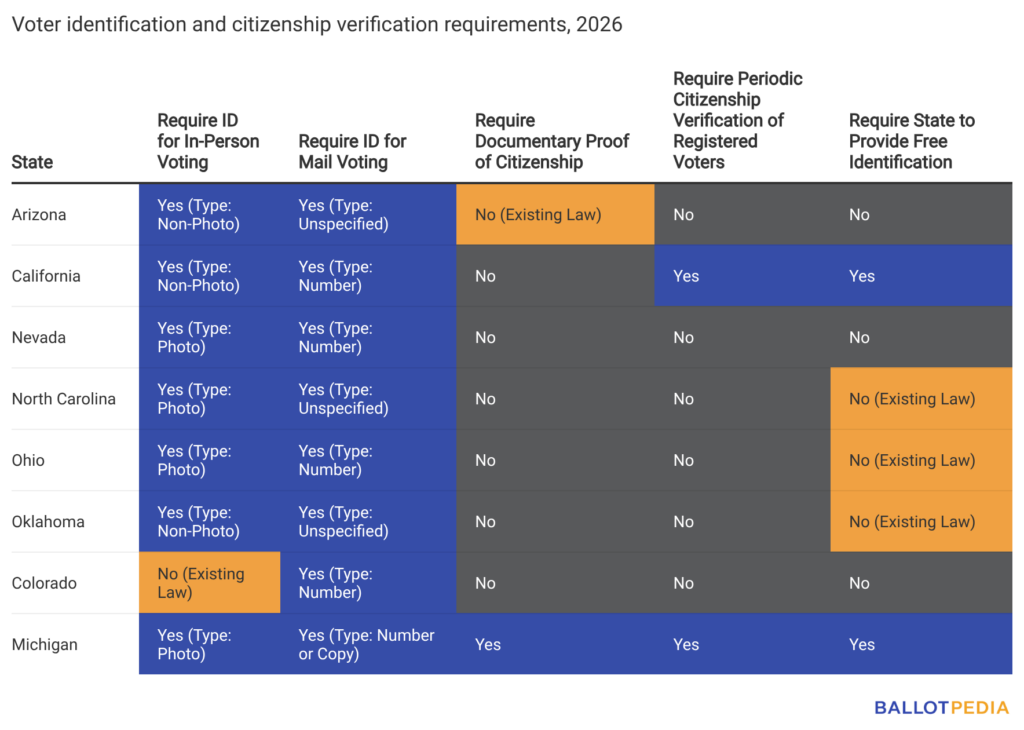
Ballotpedia classified each of the legislatively referred measures as having Republican support, based on the vote breakdown by party. For more information on how we develop our partisan direction index scores, click here.
California Proposition 39 has raised the most money among the voter identification measures currently certified for the ballot. According to campaign finance reports covering activity through March 30, the supporting campaign has raised $11.9 million, and the opposing campaign has raised $66,489.83. For more information on campaign finance, endorsements, and polling for these measures, click here.
Between 2004 and 2025, voters in 12 states decided on 13 ballot measures related to voter identification requirements. Voters approved 10 of these measures and rejected three. The average vote in favor of the measures was 60.3%, with the highest at 79.5% in Arkansas (2018) and the lowest at 35.8% in Maine (2025).
Click here to learn more about voter ID ballot measures in 2026.
No initiatives will be on Oregon’s November ballot for the first time in an even year since 1966 after hunting ban proposal fails to qualify
The Oregon Secretary of State announced on July 24 that an initiative to ban hunting in the state did not submit enough valid signatures to qualify for the November ballot. It was the only initiative to submit signatures by the July 2 deadline. This means 2026 will be the first even-numbered year since 1966 without an initiative on Oregon’s general election ballot.
The initiative, which sponsors called the People for the Elimination of Animal Cruelty Exemptions (PEACE) Act, would have removed certain exemptions to animal cruelty laws, criminalizing hunting, fishing, and intentional injury to animals. The only exceptions allowed under the initiative for harming or killing a protected animal were self-defense against an immediate threat to yourself, other humans, or other animals, and good veterinary practices defined in state law.
The campaign submitted 142,784 signatures for verification. The secretary of state’s office reported that 104,262 signatures were valid. The signature requirement for initiated state statutes is 117,173 signatures (6% of the votes cast in the last gubernatorial election).
While previous animal treatment measures have addressed certain hunting methods, wildlife trafficking, farm animal confinement, animal fighting, animal racing, and animal experimentation, none have sought to criminalize all hunting, fishing, slaughtering animals for food, and livestock husbandry. Twenty-four states guarantee a right to hunt and fish in their state constitutions. Vermont’s constitution has contained these rights since 1777, when the state adopted its first constitution. Florida most recently amended its constitution in 2024.
Ninety-one ballot initiatives were filed in Oregon for the 2026 election cycle, including three veto referendums. One veto referendum qualified for the May primary ballot. It was defeated, meaning the challenged law that would have increased the state’s gas tax was repealed. The measure was originally slated to appear on the November ballot, but the Oregon Legislature passed, and Gov. Tina Kotek (D) signed a bill moving the referendum to the May ballot.
Between 2010 and 2024, an average of 62 ballot initiatives were filed each election cycle in Oregon, with an average of four initiatives certified for the ballot in even-numbered years.
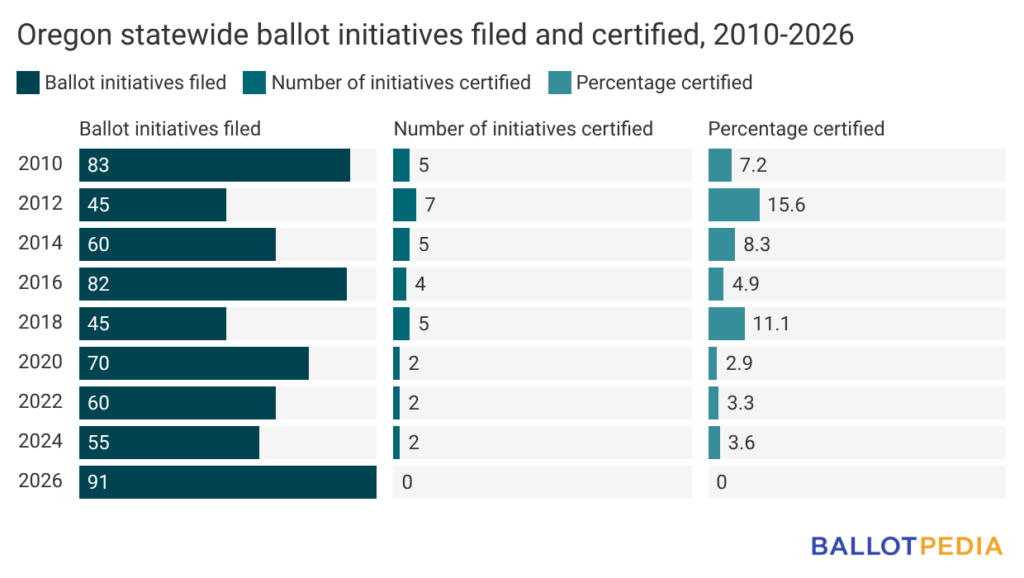
Click here to learn more about Oregon’s 2026 ballot measures, and here to learn more about ballot measures on the right to hunt and fish.
AIPAC, Progressive Victory, and Donald Trump endorsed candidates in Washington’s 3rd Congressional District top-two primary
Incumbent Marie Gluesenkamp Perez (D), Brent Hennrich (D), John Braun (R), and six other candidates are running in the Aug. 4 top-two primary for Washington's 3rd Congressional District. Gluesenkamp Perez, Hennrich, and Braun lead in fundraising and local media attention.
The Seattle Times' Danny Westneat wrote, "Gluesenkamp Perez has a traditional GOP opponent, state Senate Minority Leader John Braun, R-Centralia. But she’s also facing a more-robust-than-expected fusillade from the left, in progressive challenger Brent Hennrich."
Gluesenkamp Perez was first elected in 2022. Her career experience includes being a business owner of an auto repair shop. The American Israel Public Affairs Committee (AIPAC) endorsed her. Gluesenkamp Perez's campaign website says she is "ranked as one of the most bipartisan lawmakers in the House and regularly works across the aisle to fix what's broken.”
Hennrich is a former cinema operations manager with Cinemark and Christie Digital Systems. Hennrich ran for the 3rd District in 2022 but suspended his campaign and did not appear on the primary ballot. Progressive Victory endorsed him. Hennrich’s campaign website says he supports universal healthcare and that “The affordability crisis is caused by one thing: the subsidy of billionaires and corporations, rather than helping the many.”
Braun was elected to the Washington Senate in 2012 and has served as minority leader since 2020. He is a U.S. Navy veteran and manufacturing executive. President Donald Trump (R) endorsed him. Braun's campaign website says he "spent 31 years in the submarine force, built a 350-employee company in Chehalis, and led the fight against Olympia's tax surge. Now he's running to bring that same discipline to Washington, D.C."
According to the most recent campaign finance reports filed with the FEC, as of July 15:
- Gluesenkamp Perez had raised $6,292,683 and spent $4,254,323
- Hennrich had raised $258,757 and spent $242,200
- Braun had raised $2,035,255 and spent $930,574
Also running are Austin Braswell (D), Troy Rasband (D), Lawrence Kellogg (R), John Roco (R), Antony Barran (Cascade Party), and John Saulie-Rohman (Independent Party).
In a top-two primary, all candidates running for a particular office appear on the same primary ballot. The top two finishers advance to the general election regardless of their partisan affiliation.
Major election forecasters rated the general election as a toss-up, lean Democratic, or likely Democratic. Gluesenkamp Perez defeated Joe Kent (R) 51.7%–47.9% in 2024 and 50.1%–49.3% in 2022.
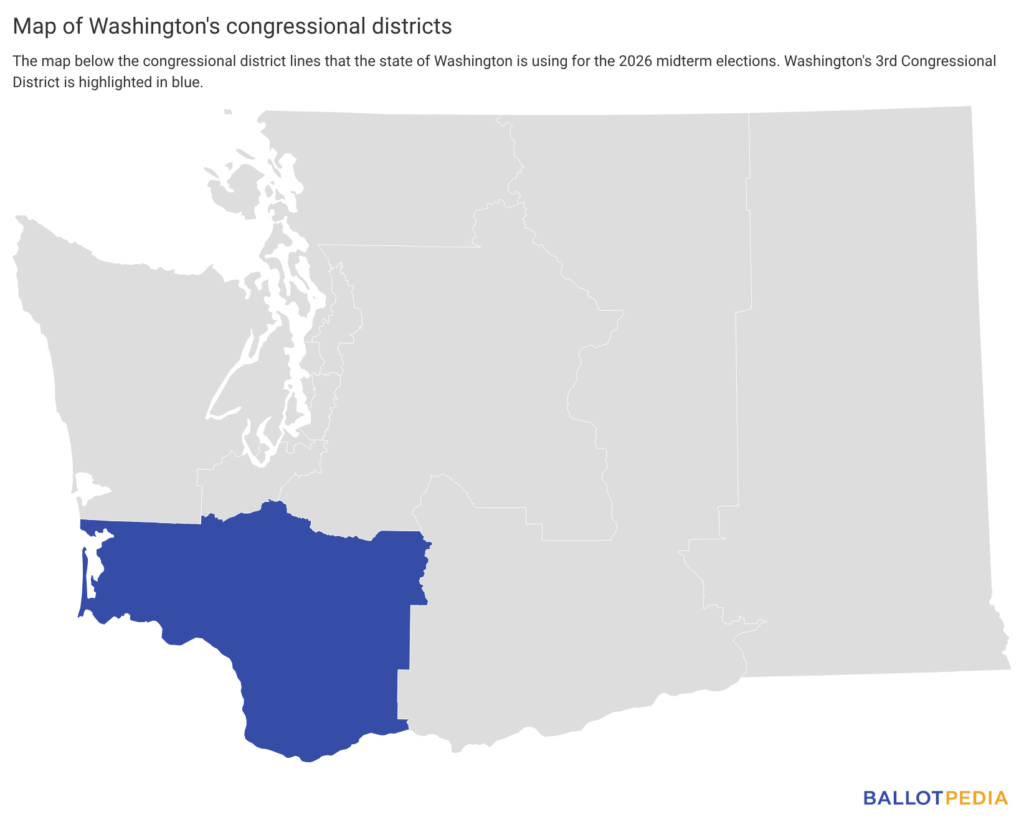
Click here to learn more about the Aug. 4 primary in Washington’s 3rd Congressional District. Also, if you’re a Washington voter, check out our Sample Ballot Lookup here to prepare for election day.
Editor’s note: This article was updated to correct the state referenced in the final paragraph from Oregon to Washington.