


Welcome to the Thursday, July 30, 2026, Brew.
By: Briana Ryan
Here’s what’s in store for you as you start your day:
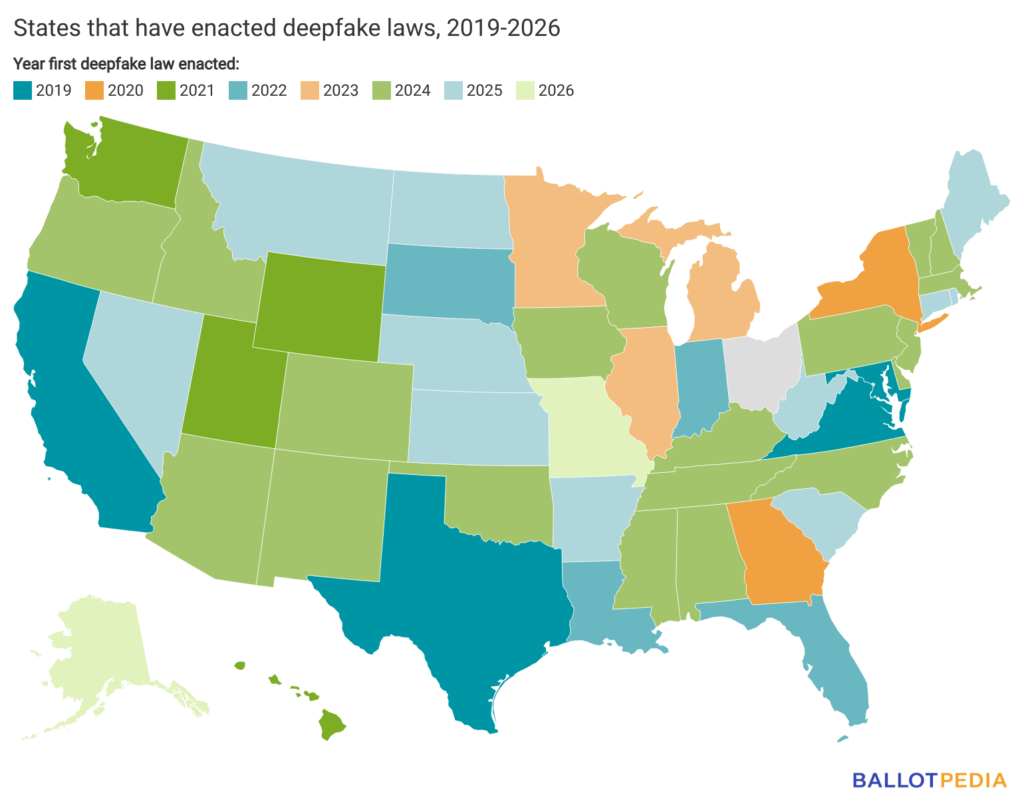
- 49 states have passed at least one deepfake law since 2019
- Troy Jackson becomes the first replacement nominee for the U.S. Senate in Maine’s history
- Four states this year have enacted laws requiring their education departments to develop AI frameworks for school districts
49 states have passed at least one deepfake law since 2019
Today, Ballotpedia is releasing our third annual deepfake legislation report. Two years after the launch of our Artificial Intelligence Deepfake Legislation Tracker in June 2024, the report provides an update on the status of state legislation intended to regulate deepfakes.
Deepfakes are videos, images, or audio files that individuals create or manipulate using artificial intelligence in order to realistically portray something that did not occur. According to the U.S. Government Accountability Office, “Deepfakes rely on artificial neural networks, which are computer systems modeled loosely on the human brain that recognize patterns in data. Developing a deepfake photo or video typically involves feeding hundreds or thousands of images into the artificial neural network, ‘training’ it to identify and reconstruct patterns—usually faces.”
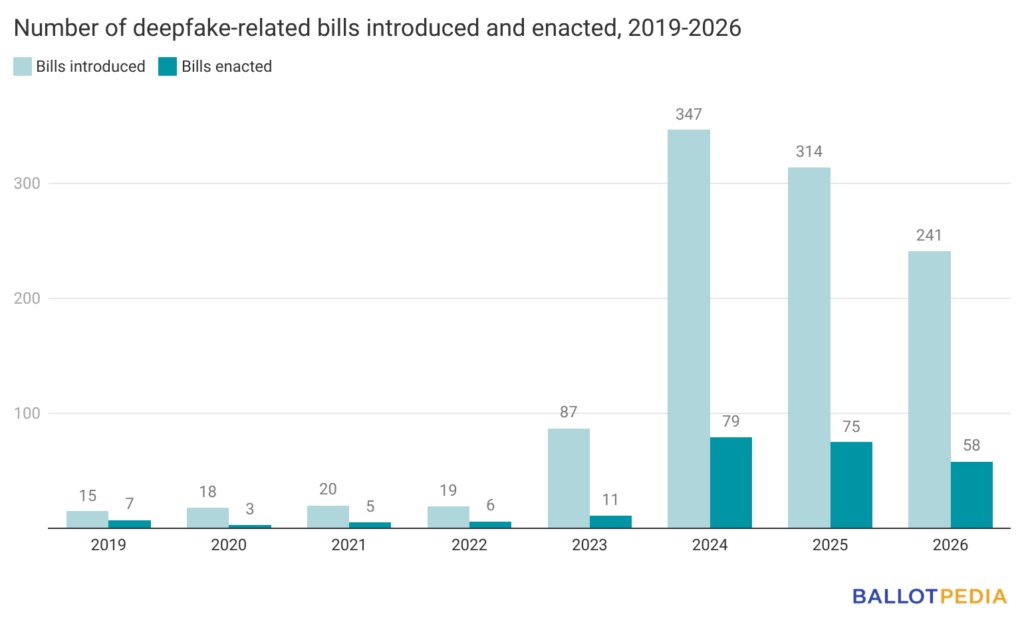
State lawmakers have enacted 58 bills related to deepfakes so far this year, down from the 64 bills enacted by the same point in 2025. Forty-nine states have now passed at least one deepfake law since 2019.
Eighty-seven percent of deepfake laws were enacted in 2024 or later.
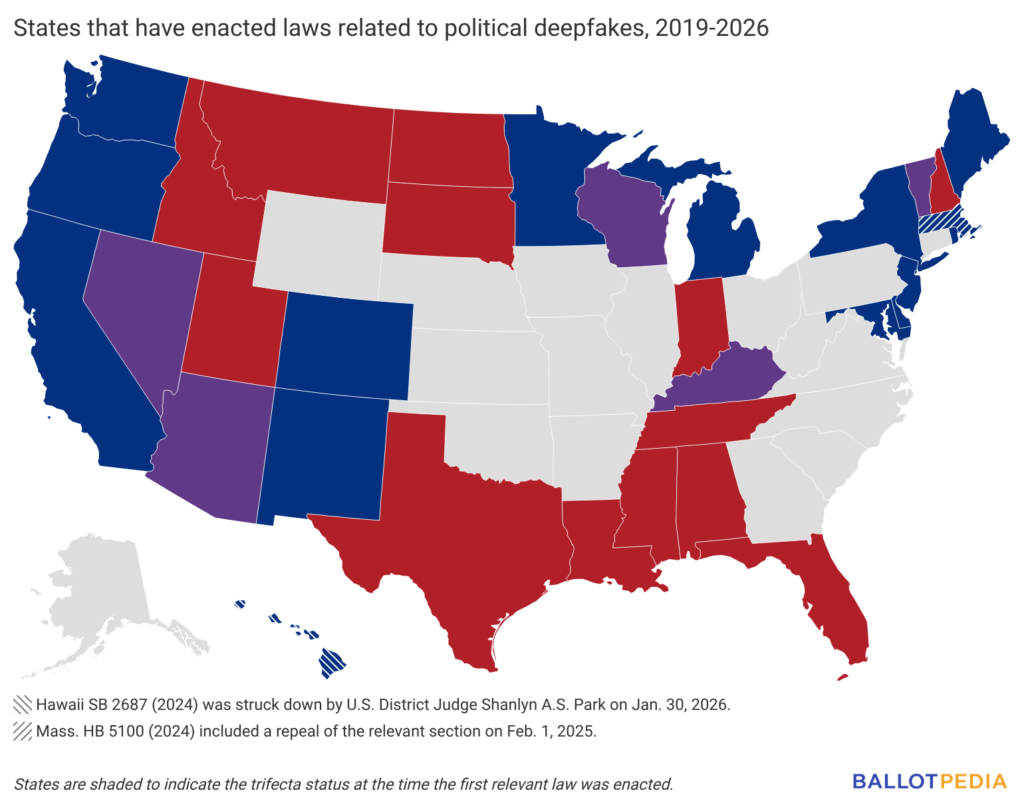
Thirty-three states have enacted laws regulating political deepfakes, up from 28 in July 2025. Laws passed in Massachusetts and Hawaii are no longer in effect.
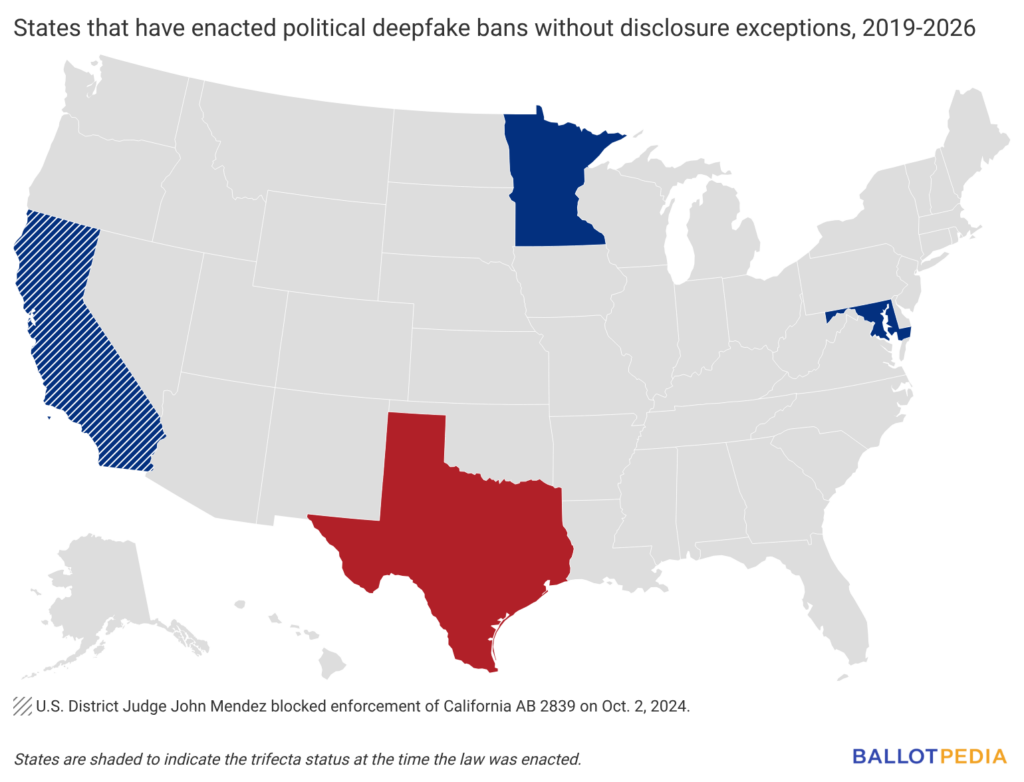
In most states that have passed laws related to political deepfakes, the law makes an exception for materials containing a disclosure statement. However, four states have political deepfake prohibitions that do not include an exception for materials containing a disclosure statement. A federal district judge struck down California’s law in 2025, and the state appealed to the U.S. Court of Appeals for the Ninth Circuit.
Forty-eight states have enacted laws related to pornographic deepfakes, up from 45 a year ago. Some of those laws specifically address the creation and distribution of child sexual abuse material, while others address the nonconsensual creation and distribution of adult intimate images. Thirty-six states have passed laws addressing both.
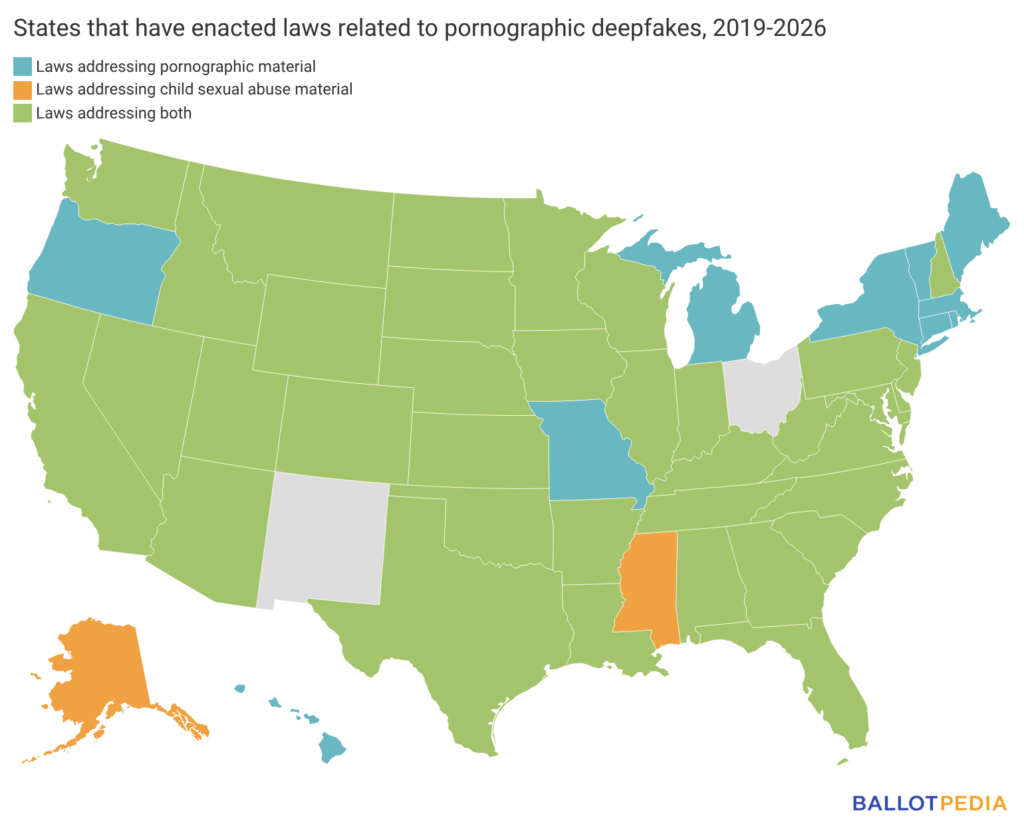
Click here to read this year’s report.
Troy Jackson becomes the first replacement nominee for the U.S. Senate in Maine since 1918
On July 25, Troy Jackson (D) won the nominating convention to replace Graham Platner (D) as the Democratic nominee for the U.S. Senate general election in Maine. This is the first time since 1918 that a U.S. Senate nominee has been replaced in Maine.
After a woman accused Platner of sexually assaulting her in 2021, the Maine Democratic Party held a meeting on July 8 of more than 100 state committee members. During the meeting, state committee members voted to hold a nominating convention if Platner withdrew from the general election. After the vote, Platner announced that he would withdraw from the general election and officially withdrew on July 10.
On July 25, 601 delegates voted on a replacement candidate during the nominating convention. Before that convention, delegate nominating conventions were held in all 16 of the state’s counties to select 500 of those delegates. The number of delegates from each county was based on voter turnout in the 2024 Democratic primary. The remaining 101 delegates were state committee members.
Only individuals who were registered Democrats as of June 9 were able to vote in the delegate nominating conventions and participate as convention delegates.
During the nominating convention, Jackson defeated Saundra Pelletier (D) 566 votes to five votes. Jackson will now face incumbent Sen. Susan Collins (R), who first took office in 1997, in the general election.
As of July 21, The Cook Political Report, DDHQ/The Hill, and Sabato's Crystal Ball rated the general election as a toss-up. Inside Elections rated it tilt Republican.
Jackson is the 28th replacement nominee for a U.S. Senate candidate since 1918 and the 15th Democratic replacement candidate. 2026 is tied with 1936 and 2002 for the second-most Senate nominee withdrawals (voluntary, misconduct-related, or due to death), with three withdrawals each. The year with the most withdrawals was 2014, with five.
In addition to Platner, there have been two other nominee withdrawals in U.S. Senate elections this year: Cindy Burbank (D), who withdrew from the Nebraska general election on July 17, and then-incumbent Sen. Lindsey Graham (R-S.C.), who died on July 11. There will be a special Republican primary on Aug. 11 to select a new Republican nominee in South Carolina. However, it is unlikely that there will be one in Nebraska after the state's Democratic Party endorsed the nonpartisan candidate, Dan Osborn, in August 2025.
Additionally, the Democratic nominee for the U.S. Senate in Idaho, David Roth (D), said on July 28, "In the coming weeks, I will work with my team to meet our remaining financial obligations and complete the formal withdrawal process."
Since 1918, only seven U.S. Senate replacement nominees — three Democrats, three Republicans, and one Farm-Labor Party member — have been elected. The most recent was Frank Lautenberg (D-N.J.), who was elected in 2002.
Click here to read more about the U.S. Senate general election in Maine, and here to read more about the history of replacement candidates.
Four states have enacted laws this year requiring their education departments to develop AI frameworks for school districts
A growing number of teachers are using artificial intelligence (AI) for school-related work. But according to a June 2026 NPR/Ipsos poll of teachers, more than half of respondents say their districts either haven’t offered guidance on how to use it, or they’re not sure what the guidance is. As AI usage becomes more common in K-12 education, lawmakers in some states are mandating that state education officials develop recommendations for how to use the technology — and requiring districts to adopt policies based on that guidance.
In Idaho (SB 1227), Maryland (SB 720), Oklahoma (SB 1734), and Virginia (SB 394), new laws enacted in 2026 direct state education departments to release AI guidance that districts will need to use to inform their own policies. As of July 29, 35 states have released AI recommendations for districts.
New laws make demands of both state education departments and districts
State education departments have been releasing AI guidance for K-12 public schools since 2023. The California Department of Education, one of the earliest to do so, published a guidance document titled “Artificial intelligence in California: Learning with AI, Learning about AI” in September 2023. Like most other state AI guidance, California’s was meant to help districts become acquainted with and think through some of the challenges posed by generative AI tools like ChatGPT. Districts were not required to comply with the guidance.
New laws in Idaho, Maryland, Oklahoma, and Virginia are different in that they require districts to adopt AI policies that align with the state guidance.
- Idaho’s SB 1227, which Gov. Brad Little (R) signed on March 18, directs the Idaho Department of Education to develop a statewide framework for AI usage in K-12 public schools, prioritizing “human-centered oversight, transparency, safety, and data security” and ensuring “that no generative artificial intelligence replaces or eliminates a human teacher.”
- Maryland’s SB 720 requires the state Department of Education to release AI guidance for districts. Districts must adopt AI policies that align with the state guidance within 120 days. The law also requires the Maryland State Department of Education to incorporate AI literacy into K-12 computer science standards, among other provisions. Gov. Wes Moore (D) signed SB 720 on May 26. The Maryland State Department of Education released its guidance in June.
- Oklahoma Gov. Kevin Stitt (R) signed SB 1734, the Oklahoma Responsible Technology in Schools Act, on May 13. The law requires the Oklahoma Department of Education to issue AI guidance for school districts. The law also requires districts to adopt AI policies that conform with the Oklahoma Department of Education’s before the beginning of the 2027-28 school year. The Oklahoma Department of Education had previously released an AI guidance document in 2024.
- In Virginia, Gov. Abigail Spanberger (D) signed SB 394 on April 13. The law requires the Virginia Department of Education to collect data on student AI use and release guidance for districts on deploying AI in schools based on that information. In 2024, the Virginia Department of Education released a five-page document titled “Guidelines for AI Integration Throughout Education in the Commonwealth of Virginia.”
More than two-thirds of states have released AI guidance for K-12 public schools
Since 2023, state education departments in 35 states have released documents on the use of AI in K-12 public schools. In most states, districts are not required to follow the guidance.
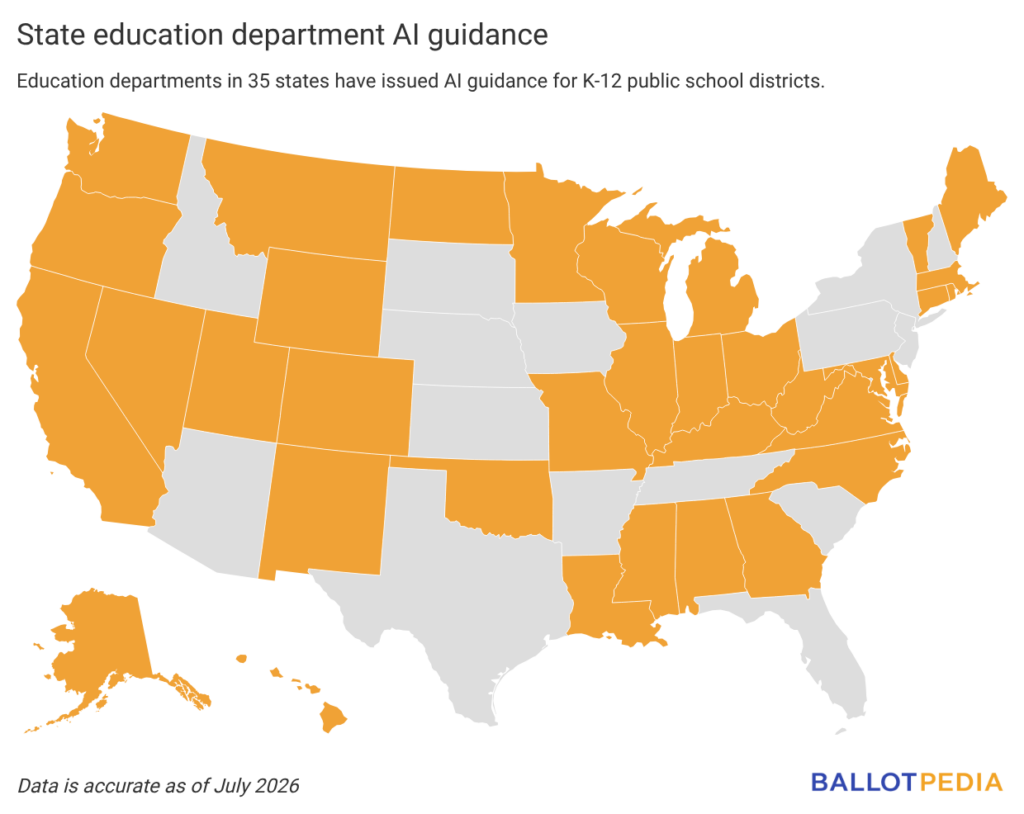
The guidance documents commonly address the relationship between AI and humans, AI literacy, student privacy, equity and bias, academic integrity policies, and the use of AI detection tools.
Click here to learn more about state education department AI guidance. Click here to subscribe to Hall Pass, Ballotpedia’s weekly newsletter on school board elections and K-12 education policy, including AI in the classroom.