


Arizona voters will not decide Proposition 143 or Proposition 145 after two separate Maricopa County Superior judges ruled they violated the state’s separate amendment rule and were unconstitutional.
Proposition 143
On July 24, Judge Gregory Como issued a ruling stating that Proposition 143 was unconstitutional.
Proposition 143, a legislatively referred constitutional amendment, would have prohibited a school district and its employees from using public money or resources to support a labor organization, deducting any payment from an employee's paycheck to pay for membership dues, or distributing communications on behalf of a labor organization if they consume public resources. Additionally, it would have prohibited the state or other political subdivisions from creating an exclusive representation or collective bargaining agreement with any labor organization. Proposition 143 would have superseded any existing contract, memorandum, agreement, or ordinance.
The Arizona Education Association filed the original complaint with the Maricopa County Superior Court on June 25. The complaint stated that the ballot title of Proposition 143 was misleading and that the measure combines two unrelated subjects: school districts' funding of union activities and prohibiting the state from negotiating with unions.
Judge Como issued a five-page opinion stating that Proposition 143 was unconstitutional because it violated the state's separate amendment rule. It explained that the measure concerned two unrelated subjects. The ruling stated, "there is no ambiguity. [Proposition 143] flatly prohibits the State of Arizona or any local government from contracting with any labor union."
The ruling instructed the Arizona Secretary of State not to place the measure on the November 2026 ballot. As of July 29, no supporters of the measure have announced plans to appeal the ruling.
Proposition 145
Additionally, on July 29, the Maricopa County Superior Court announced that Judge Joseph Kreamer ruled that Proposition 145 was unconstitutional.
Proposition 145, also a legislatively referred constitutional amendment, would have prohibited the state from confiscating money from the scholarship account of a child of a military family. That would include Empowerment Scholarship Accounts. Proposition 145 would also have voided any ballot measure or law passed after Nov. 1, 2026, that violates the amendment. This provision would have applied to Proposition 212, a ballot initiative that proposed for the November 2026 ballot.
The Arizona Education Association filed the lawsuit with the Maricopa County Superior Court on June 26. It stated that Proposition 145 violated the state’s separate amendment rule and referenced the provision that would void Proposition 212 if approved by voters in November. The lawsuit stated, “By cloaking this sweeping consequence in the borrowed goodwill of a ‘Military Families… Protection Act,’ HCR 2048 inflicts precisely the concealment the Constitution’s title requirement forbids — denying notice to both the legislators who voted on the measure and the voters who will vote on it in November."
Proposition 212 would change the state's laws surrounding the Empowerment Scholarship Account program. For example, it would limit eligibility in the program to families that earn less than $150,000 per year beginning in the 2027-2028 school year and adjusted annually by 2%. It would also list luxury items that could not be purchased with ESA funds. Proposition 212 is not certified for the 2026 ballot. Sponsors of the measure have submitted signatures to the secretary of state and are awaiting verification of the validity of those signatures.
Judge Kreamer’s ruling stated, “The clear import of this ‘Separate Amendment Rule’ is that voters must be allowed to express their separate opinion as to each proposed constitutional amendment.” It stated that the protection of vouchers for military families and the broad override of any measure that would amend the state’s Empowerment Scholarship Account program were not sufficiently linked.
The ruling instructed the Arizona secretary of state not to place the measure on the November 2026 ballot. A spokesperson for Senate President Warren Petersen (R-14) and House Speaker Steve Montenegro (R-29) announced that they intend to appeal the ruling.
Separate-vote requirements in other states
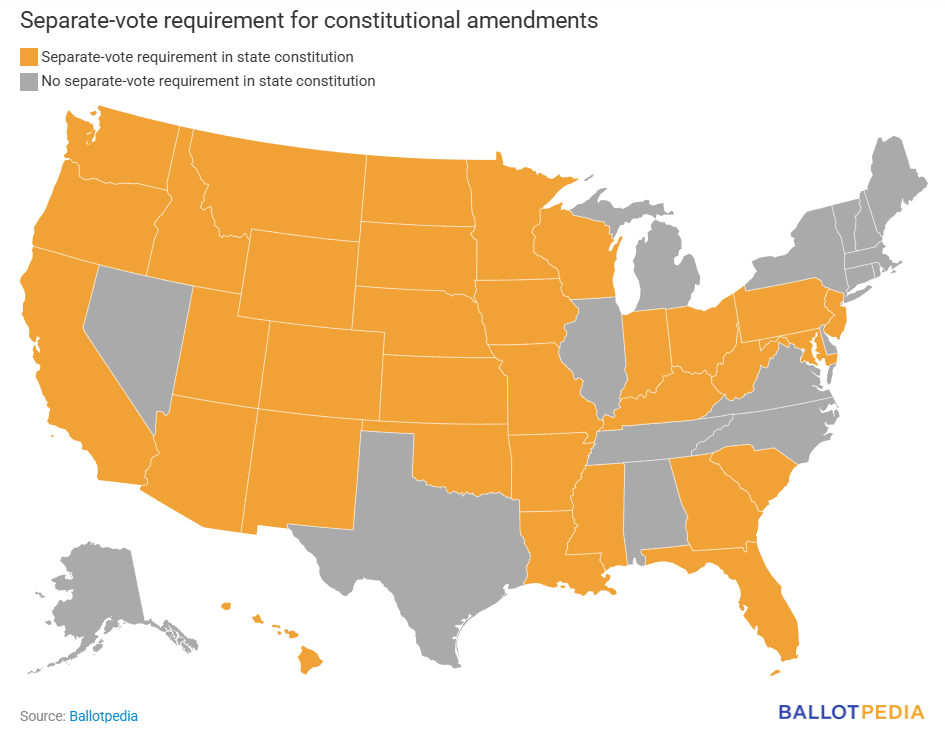
What the Arizona constitution refers to as a separate amendment rule is called a separate-vote requirement in other states. In states with this requirement, each proposed constitutional amendment placed on statewide ballots must be decided by voters as separate ballot questions.
Currently, 33 states have some form of a separate-vote requirement.
Certified measures removed from statewide ballots
Between 2014 and 2026, state courts removed or disqualified a total of 19 measures in eight states after officials certified them to appear on the ballot. An average of 3 measures were disqualified due to court rulings in each even-numbered election year during this period.
Seven of the 19 measures (36%) were removed based on state constitutional issues, such as violating single-subject or separate-vote requirements.
In Arizona, a certified ballot measure was most recently removed from the ballot by a court ruling in 2022. That year, the Arizona Supreme Court removed two certified ballot measures from the 2022 ballot:
- Election and Voting Policies Initiative - While the secretary of state originally qualified the initiative for the ballot after determining that sponsors had submitted enough valid signatures, the court ruled that some of those signatures were actually invalid and that the measure had failed to make the ballot by 1,458 signatures.
- Reduce Number of Income Tax Brackets to Flat Rate of 2.50% Referendum - The court ruled that veto referendums in Arizona cannot repeal tax decreases or increases, except in cases when a tax would fund a new government department.
Additional reading: