


Welcome to Hall Pass, a newsletter written to keep you plugged into the conversations driving school board governance, the politics surrounding it, and education policy.
In today’s edition, you’ll find:
- On the issues: The debate over standardized testing
- School board filing deadlines, election results, and recall certifications
- Judges in Arizona’s Maricopa County rule two education-related measures unconstitutional, blocking them from the 2026 ballot
- Extracurricular: education news from around the web
- Candidate Connection survey
On the issues: The debate over standardized testing
In this section, we curate reporting, analysis, and commentary on the issues school board members deliberate when they set out to offer the best education possible in their district. Missed an issue? Click here to see the previous education debates we’ve covered.
According to Testing in American Schools: Asking the Right Questions, a 1992 Office of Technology Assessment report written for Congress, “standardized examinations have been used at least since the mid- 19th century to keep district and State education authorities, and the legislatures that fund them, informed about the general quality of schools and schooling.” Proponents promoted testing as a tool for measuring student achievement and holding school leaders accountable.
As the report explains, standardized testing has also been, from the beginning, controversial among education advocates. Critics said that standardized tests promote rote memorization of information over a rich understanding of the source material. Samuel Gridley Howe, a medical doctor and education advocate who helped found the first and oldest school for the blind in the U.S. in 1829, gave an example of how tests can promote memorization over understanding, saying students “could give the date of the embargo but not explain what it did.”
Debates about the role of standardized tests in schools have continued through to the present day. Below, we present two contrasting perspectives on the value of standardized tests in today’s schooling.
Andrew Cline, the director of the Josiah Bartlett Center for Public Policy, a free-market think tank in New Hampshire, says studies show standardized test scores predict how students perform academically in later grades and in higher education. Cline says poor test scores act as a signal, helping schools identify and intervene on behalf of struggling students and tweak or replace weak curriculum. Cline also says standardized test scores show that more school funding doesn’t necessarily translate into higher scores. Cline recommends that colleges and universities rely on standardized test scores for admissions rather than replace them with subjective criteria like essays and extracurricular activities.
Olli-Pekka Heinonen, the director general of International Baccalaureate, an educational nonprofit based in Switzerland, and the former Finnish Minister of Education, says standardized tests are a rigid and outdated tool for preparing students for an unpredictable future. Heinonen says the U.S.’ emphasis on testing has made teachers’ jobs harder and sapped the joy of learning from students. He says challenges like AI and climate change will require a more dynamic, cooperative, and human-centered approach to education — priorities that are harder to measure than the traditional academic goals of school.
Standardized Tests Help Students by Creating a Framework for Accountability | Andrew Cline, D.C. Journal
“Much of the opposition to standardized tests stems not from the idea that they don’t work but from the realization that they do. Quality accountability measures always generate resistance, whether from those to whom they apply or from ideologues who imagine that systemic oppression lurks behind all traditions and scientific standards.
“Standardized testing is fun for no one. It can be misused and improperly implemented. It’s been shown to measure, predict and improve academic outcomes accurately. Eliminating it would harm the students whom such ill-conceived moves are allegedly designed to help.”
Standardized Tests Were Built for a Predictable World. That World Is Gone. | Olli-Pekka Heinonen, D.C. Journal
“In the United States, the pressures of high-stakes testing and narrow success metrics have contributed to teacher burnout and student disengagement. We also see growing movements calling for change: project-based learning, competency-based assessment and new models of student voice. These are not fringe ideas. They signal that the old model is approaching its limits.
“Instead of asking how to improve the current system incrementally, we should be asking a deeper question: What is the purpose of education today? If it is merely to sort individuals into roles within an economy, then we will continue to underprepare them for the moral and planetary challenges ahead. However, if it is to help fully form human beings, young people who are curious, collaborative and courageous, then we must change not only what we teach but how we think about learning itself.”
School board update: filing deadlines, election results, and recall certifications
In 2026, Ballotpedia will cover elections for more than 30,000 school board seats. We’re expanding our coverage each year with our eye on covering the country’s more than 80,000 school board seats.
Upcoming school board elections
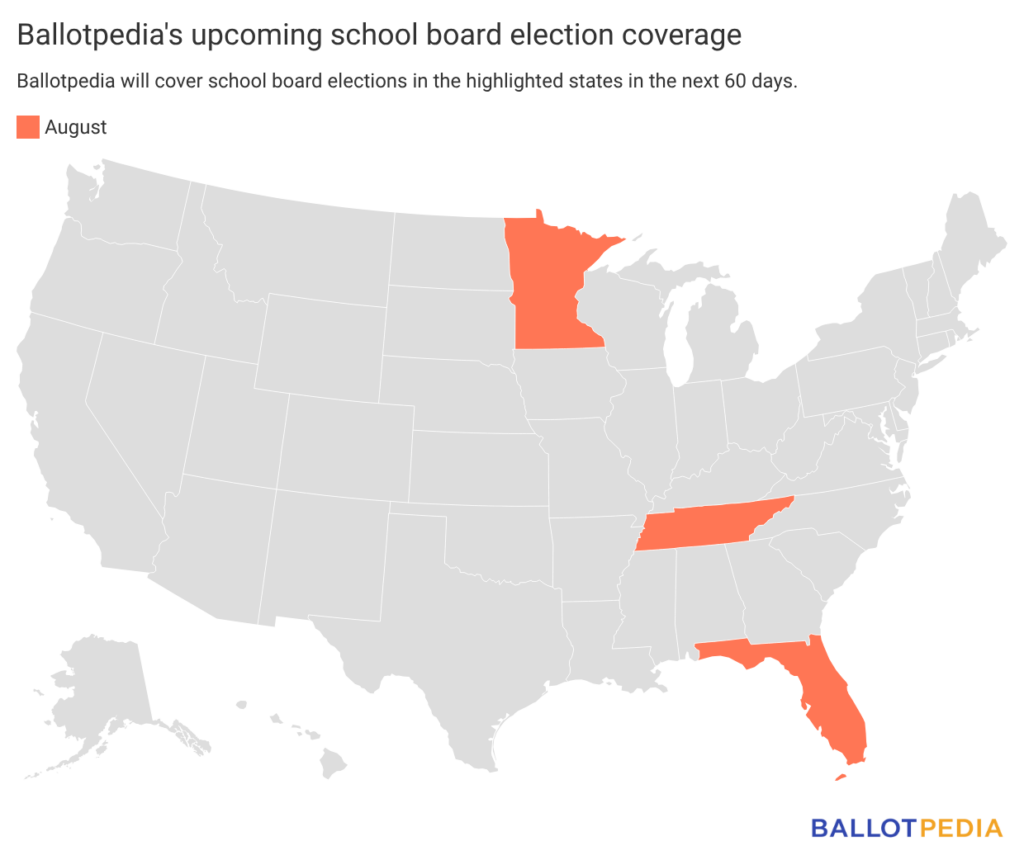
- Tennessee will hold general elections on Aug. 6.
- Minneapolis Public Schools, in Minnesota, will hold a primary on Aug. 11.
- Florida will hold primaries on Aug. 18.
Click here to learn more about this year’s school board elections.
Judges in Arizona’s Maricopa County rule two education-related measures unconstitutional, blocking them from the 2026 ballot
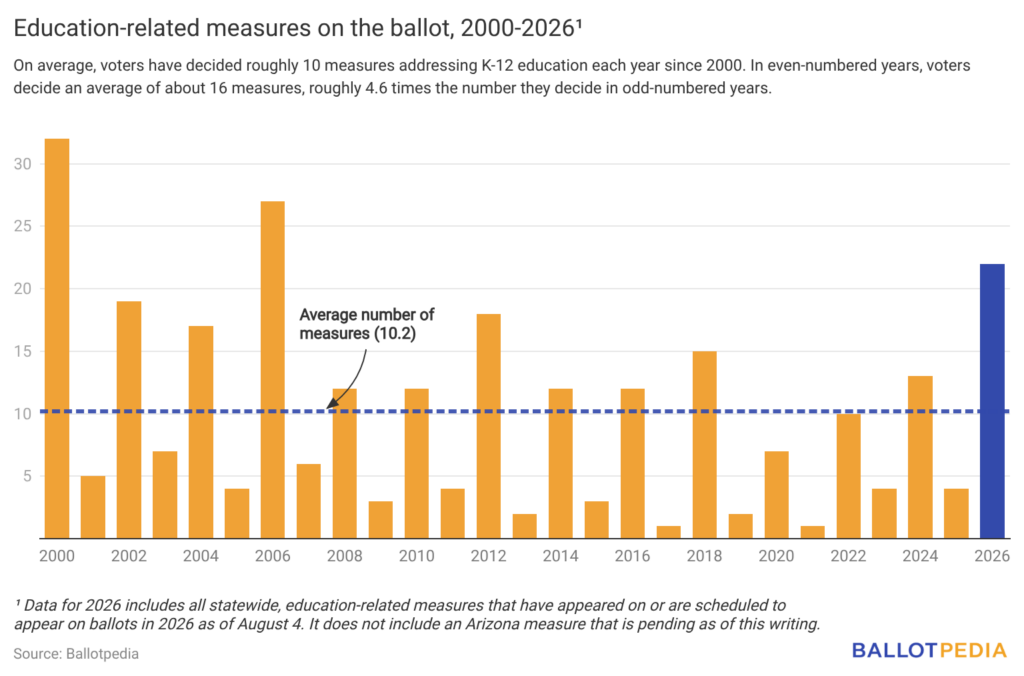
Before last week, voters in the Grand Canyon State were set to decide five education-related measures, with a sixth pending — the most of any state this year. Voters in New Mexico and Alabama, the states with the next-highest number of measures addressing K-12 education, will decide four and three, respectively.
But last week, Maricopa County judges removed two Republican-backed measures from the ballot, ruling them unconstitutional. Proposition 143 concerns public-sector unions, while Proposition 145 concerns private school choice. The judges ruled the measures violated the state’s separate amendment rule.
Here’s a look at what the measures would have done and why the courts removed them from the ballot.
Judges ruled measures violated the Arizona Constitution’s separate amendment rule
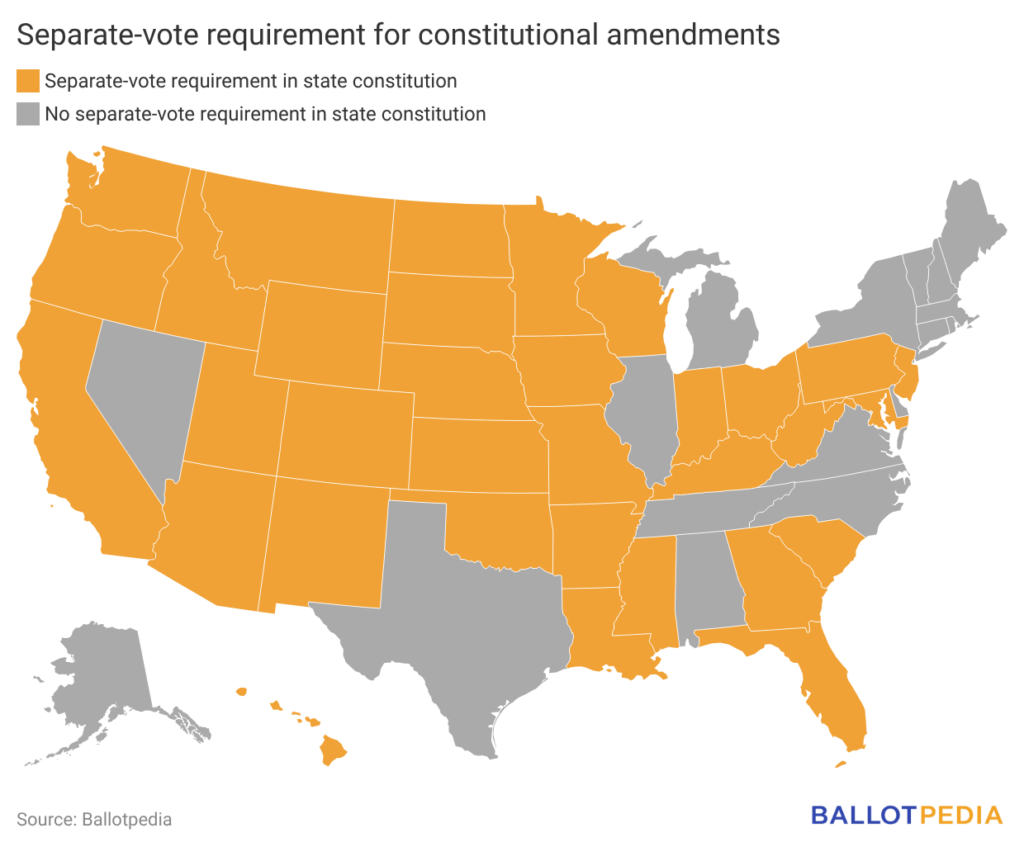
What the Arizona constitution refers to as a separate amendment rule is called a separate-vote requirement in other states. In the 33 states (including Arizona) with this requirement, each proposed constitutional change placed on statewide ballots must be decided by voters as separate ballot questions.
Maricopa County Superior Court Judges Gregory Como and Joseph Kreamer ruled that both Propositions 143 and 145 asked voters to weigh in on distinct constitutional changes.
Proposition 143, a legislatively referred constitutional amendment, would have prohibited a school district and its employees from using public money or resources to support a labor organization, deducting any payment from an employee's paycheck to pay for membership dues, or distributing communications on behalf of a labor organization if they consume public resources. Additionally, it would have prohibited the state or other political subdivisions from creating an exclusive representation or collective bargaining agreement with any labor organization.
State Rep. Justin Olson (R-10) introduced the measure to the state House in January.
Aaron Withe, the CEO of the Freedom Foundation, a think tank that says it is “battering the entrenched power of left-wing government union bosses,” said, “teachers’ unions have long counted on government resources to do their organizing for them. Arizona voters will now have the chance to weigh in on whether taxpayer resources should be funding union politics in public schools.”
Marisol Garcia, president of the Arizona Education Association (AEA), the state’s largest teachers union with more than 22,000 members, said the measure would “override existing agreements and contracts between school districts and employees and ban payroll deduction for union dues, while allowing it for things like insurance companies, retirement companies."
The AEA filed the original complaint with the Maricopa County Superior Court on June 25. The complaint stated that the ballot title of Proposition 143 was misleading and that the measure combines two distinct constitutional changes: school districts' funding of union activities and prohibiting the state from negotiating with unions.
Judge Como’s ruling, issued on July 24, said the measure concerned two changes. Como wrote, "there is no ambiguity. [Proposition 143] flatly prohibits the State of Arizona or any local government from contracting with any labor union." Como’s ruling instructed the Arizona Secretary of State not to place the measure on the November 2026 ballot. As of this writing, no supporters of the measure have announced plans to appeal the ruling.
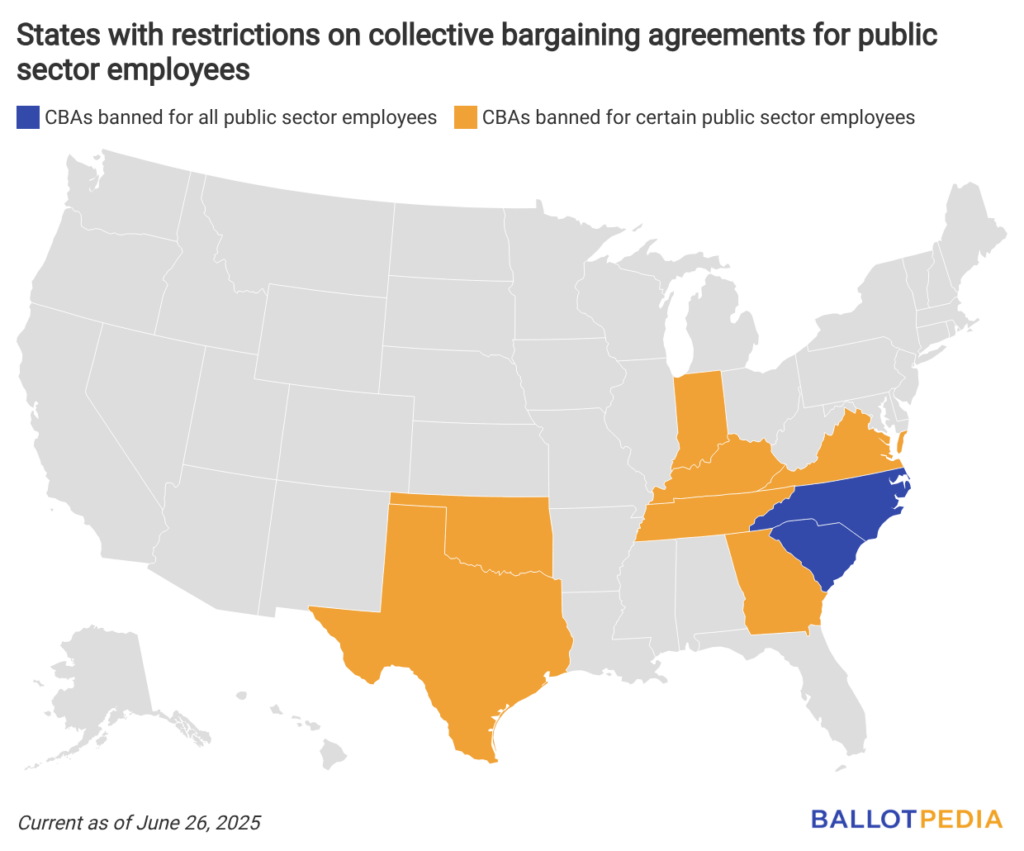
As of 2026, there is no statewide prohibition on collective bargaining for any class of public employee in Arizona. A total of nine states have some form of restrictions on collective bargaining agreements (CBAs) between an employer and a public sector labor union. Three states, North Carolina, South Carolina, and Utah, have banned collective bargaining agreements for all public sector employees.
Proposition 145, also a legislatively referred constitutional amendment, would have prohibited the state from taking money from the scholarship account of a child of a military family. That would include funds in the Empowerment Scholarship Account program, the state’s universal private school choice program. The program provides between $7,000 to $10,500 per student (and more for students with disabilities) for qualifying educational expenses, including private school tuition, curriculum, and tutoring.
Proposition 145 would also have voided any ballot measure or law passed after Nov. 1 that violates the amendment, including Proposition 212, Arizona’s only pending measure for the 2026 ballot. Proposition 212 would limit eligibility in the Empowerment Scholarship Account program to families making under $150,000 per year and place additional restrictions on some types of purchases.
Proposition 212 supporters submitted more than 421,451 signatures to the secretary of state’s office on July 2. The threshold is 255,949 valid signatures. On July 20, the Goldwater Institute, a free-market public policy and litigation organization, sued to block Proposition 212 from qualifying for the ballot, alleging the group behind the measure, Protect Education, Accountability Now, submitted ineligible signatures. As of this writing, a hearing had not yet been scheduled.
The AEA filed the lawsuit against Proposition 145, alleging the measure violates the state’s separate amendment rule. On July 29, Judge Kreamer wrote that “The clear import of this ‘Separate Amendment Rule’ is that voters must be allowed to express their separate opinion as to each proposed constitutional amendment.” Kreamer instructed the Arizona secretary of state not to place the measure on the November 2026 ballot. A spokesperson for Senate President Warren Petersen (R-14) and House Speaker Steve Montenegro (R-29) announced that they intend to appeal the ruling.
Arizona has a divided government: Democrat Katie Hobbs is governor, while Republicans control both chambers of the state legislature.
Education on the ballot in 2026
Excluding Arizona’s Proposition 212, which is pending, 21 education-related statewide measures have appeared or are scheduled to appear on ballots across the country in 2026. Voters in Louisiana rejected two education-related measures in May, while nineteen will appear on ballots on Nov. 3.
Click here to see all 2026 certified and pending education-related ballot measures.
In the coming weeks, we’ll take a deep dive into the most consequential education-related measures voters will decide on Nov. 3, both in Arizona and elsewhere — so stay tuned for that.
Extracurricular: education news from around the web
This section contains links to recent education-related articles from around the internet.
- The Hidden Factor in Student Success: Family Structure | Wall Street Journal
- States Start to Crack Down on 4-Day School Weeks | Education Week
- America’s teacher shortage is worse than you think, but there’s a way to fix it | The Washington Post
- Policy Focus: Safe, Seen, and Supported: What Actually Keeps K–12 Schools Secure | Independent Women’s Forum
- Klobuchar vows to ban cell phones in Minnesota classrooms if elected governor | Northern News Now
Take our Candidate Connection survey to reach voters in your district
Today, we’re looking at survey responses from three of the four candidates running in the Nov. 3 general election for two seats on the Higley Unified School District school board, in Arizona. Incumbents Anna Van Hoek and Amanda Wade are running, as is challenger Michelle Morris. Kurt Brooks had not completed the survey as of this writing.
Higley Unified is the 20th-largest district in Arizona, with roughly 13,000 students. It is located southeast of Phoenix. Two of the five seats on the board are up for the election this year.
Van Hoek was first elected in 2023. Her career experience includes working as a banking professional, as well as in television, law enforcement, and insurance. Here’s how she answered the question, “What areas of public policy are you personally passionate about?”
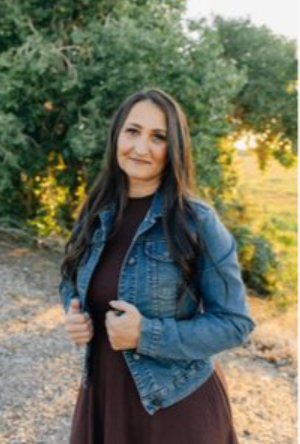
“The public policy areas I care most about are education, parental rights, government transparency, and fiscal accountability. As a school board member, I believe parents are a child's first and most important teacher, taxpayers deserve openness and responsible stewardship, and every decision should be measured by whether it helps students succeed academically. My focus has always been on putting students first while ensuring the community's trust is earned through transparency and sound governance.”
Click here to read the rest of Van Hoek’s responses.
Wade was first elected in 2023. Her career experience includes working as a social studies teacher. Here’s how Wade answered the question, “What areas of public policy are you personally passionate about?”
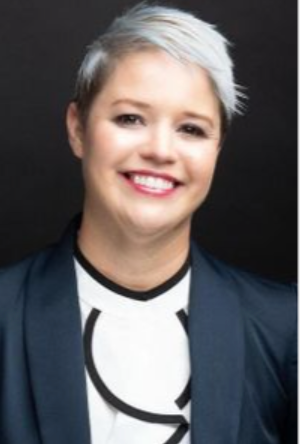
“I have spent my adult life either working for or volunteering in public schools. My passion and support for public education are what led me to running for this office in the first place. I spent my career teaching Government which means my love and passion for civic engagement and civic mindedness didn't end with my professional choice. I also work routinely with my husband supporting veterans' issues, especially for disabled vets through organizations like the Wounded Warrior Project and IAVA. I believe in community and I spend my free time doing what I can to get involved in local community events.”
Click here to read the rest of Wade’s responses.
Morris’ career experience includes working as a certified public accountant. Here’s how she answered the question, “What areas of public policy are you personally passionate about?”
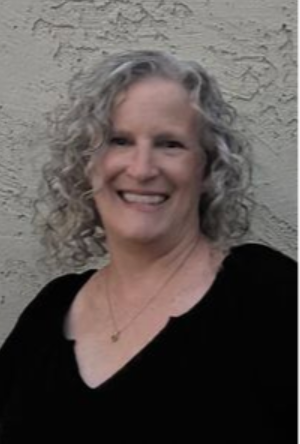
“I am passionate about ensuring all students have the opportunity, support and resources needed to reach their full potential knowing every child has unique strengths, needs and abilities. I am equally committed to being fiscally responsible and transparent with our community. The community deserves open communication and confidence that every decision is made with integrity and accountability. Finally I believe teachers and staff are the foundation of student success. They deserve to feel valued, respected and supported.”
Click here to read the rest of Morris’ responses.
As a reminder, if you're a school board candidate or incumbent planning to run this year, click here to take the survey. If you complete the survey, your answers will appear in your Ballotpedia profile. Your responses will also appear in our sample ballot. If there is an election in your community, share the link with your candidates and urge them to take the survey!