


Welcome to the Tuesday, Aug. 11, 2026, Brew.
By: Briana Ryan
Here’s what’s in store for you as you start your day:
- State lawmakers enacted 37 bills on ballot measures and direct democracy through mid-2026
- Two candidates are running in the Aug. 25 Republican primary runoff for governor of Oklahoma — one of the four gubernatorial primary runoffs this year
- President Donald Trump issued two executive orders in July, the second-lowest monthly total this term
State lawmakers enacted 37 bills on ballot measures and direct democracy through mid-2026
States have enacted 37 bills and resolutions this year concerning the three powers of direct democracy — the ballot initiative, referendum, and recall election.
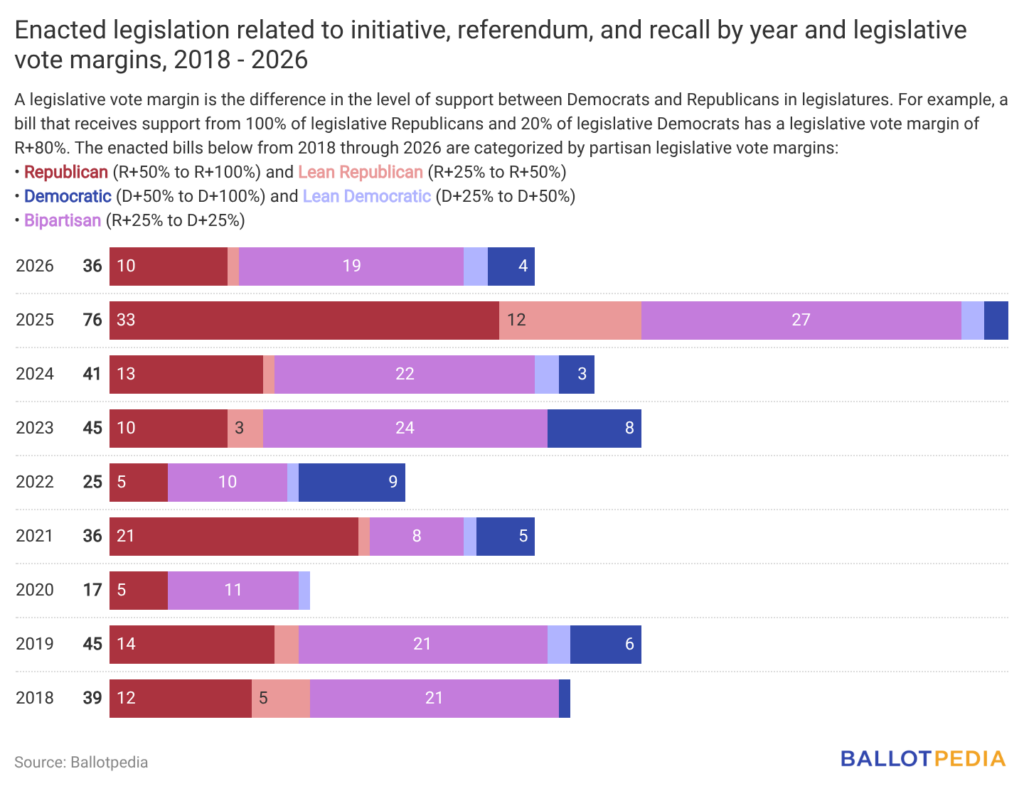
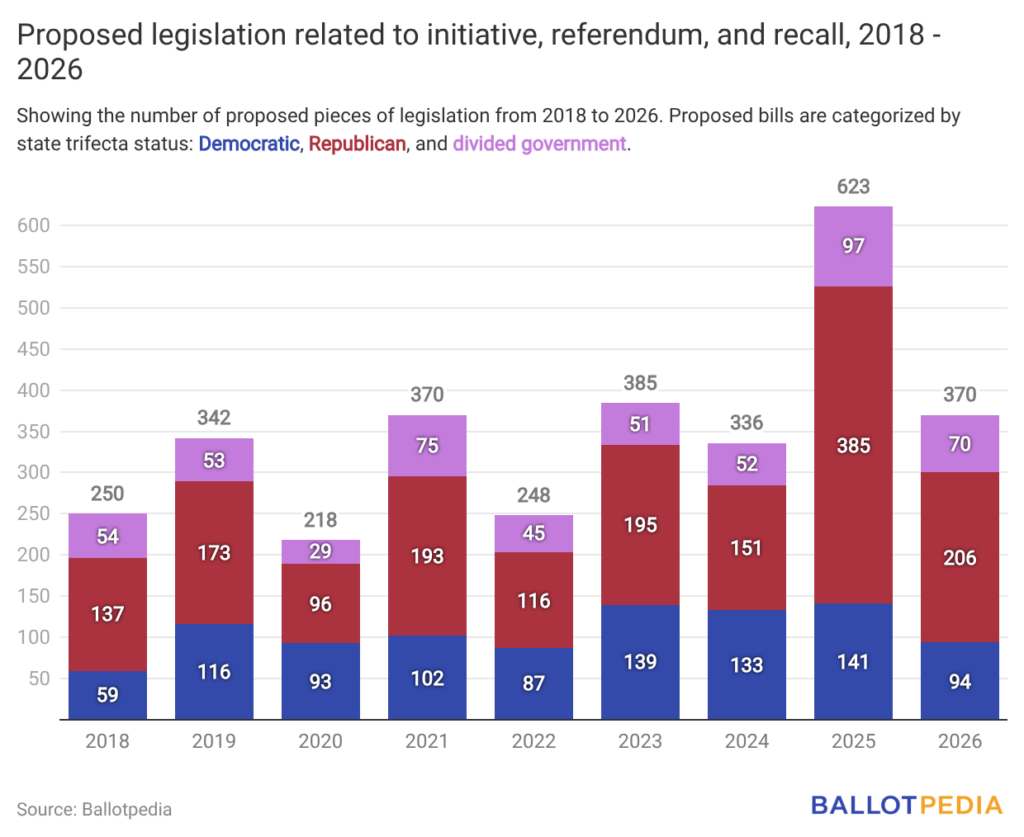
With most legislative sessions adjourned for the year, that's fewer than last year's record high of 78 bills and below the annual average of 41 from 2018 through 2025. At the same time, legislators have introduced 370 bills on the topic, tying with 2021 for the third-highest number since 2018.
Three of the most common areas of legislative changes this year have been:
- Readability requirements for ballot measures: Colorado, Maryland, and New York enacted three bills, one each, requiring officials to use plain, simple, clear, or easily understood language when writing ballot questions, titles, summaries, or explanatory statements. Of these, two were passed with Democratic majorities, and one was passed with bipartisan support. No bills were adopted to eliminate such requirements.
- Laws governing foreign spending in ballot measure campaigns: Alabama, Arizona, Iowa, and Nebraska enacted four bills, one each, prohibiting or increasing restrictions on foreign donor contributions to ballot measure campaigns Of these, three were passed with bipartisan support, and one was passed by a Republican majority. No bills were adopted to permit or decrease such restrictions.
- Laws governing referendums for local tax changes: Georgia, Louisiana, South Carolina, and South Dakota enacted four bills, one each, requiring referendums for local tax changes. Of these, two were passed with Democratic majorities, one with a Republican majority, and one with bipartisan support. No bills were adopted to remove such requirements.
State comparisons
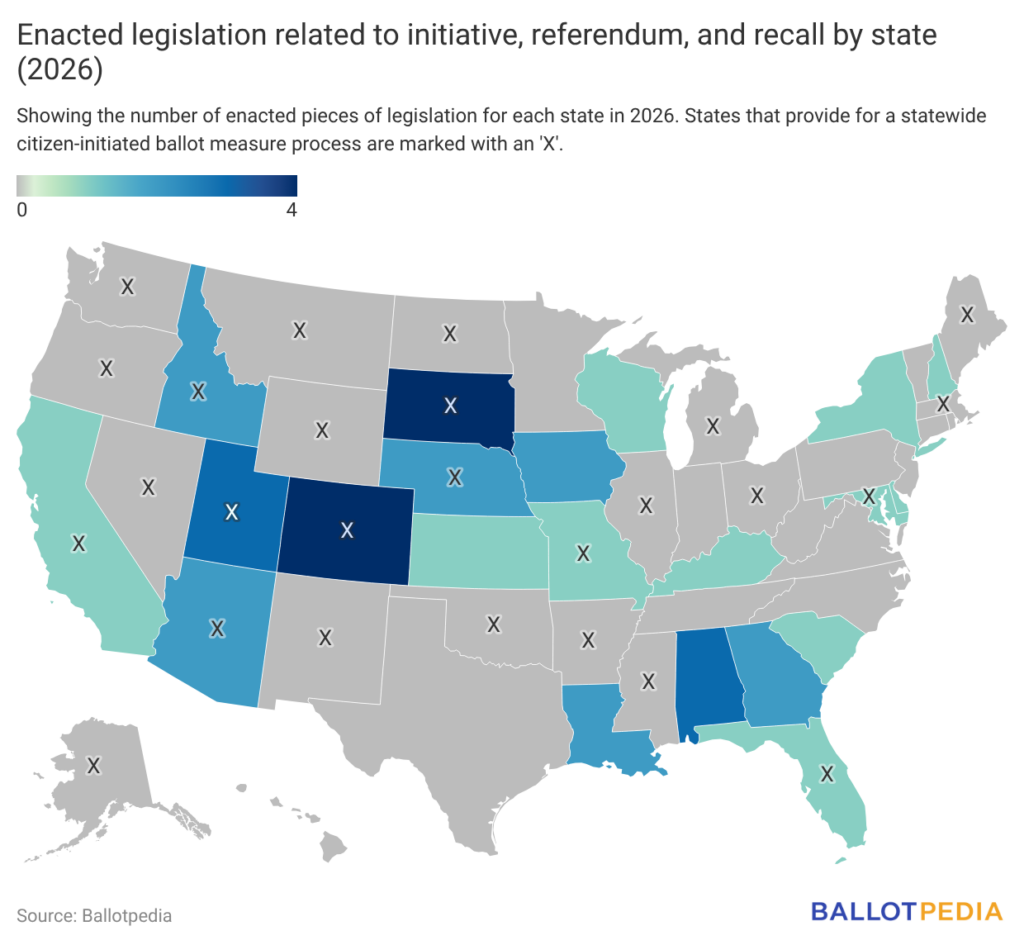
Nineteen states enacted 37 bills concerning direct democracy. Legislatures also passed four bills that their governors vetoed.
- Colorado and South Dakota enacted the most bills, with four each.
- Alabama and Utah enacted the second-most bills, with three each.
- Arizona, Idaho, Iowa, Louisiana, and Nebraska enacted the third-most bills, with two each.
Legislative vote margins
This year, 19 of the 37 enacted bills (51.4%) passed with bipartisan backing, 11 (29.7%) with Republican majorities, and six (16.2%) with Democratic majorities. One measure (2.7%) in New Hampshire passed by a voice vote. In 2025, two measures in Maine and New Hampshire also passed by a voice vote.
Ballot measures
This year, two legislatures put measures on the Nov. 3 ballot that would change ballot measure processes and require voter approval for ratification:
- Alabama School District Consolidation Amendment would establish a process for consolidating two or more county school districts via voter approval.
- Arizona Proposition 144 would prohibit foreign nationals from making contributions to state elections, including ballot measures, among other changes.
- Arizona Proposition 319 would prohibit the government from using traffic photo enforcement systems without voter approval.
In 2025, five legislatures put seven measures on this year's ballots. Voters have already decided on two of those seven measures:
- Missouri Amendment 4 would have required voter approval of citizen-initiated constitutional amendments in each congressional district, rather than statewide. It also would have prohibited foreign nationals and foreign adversaries, as defined, from spending to support or oppose ballot measures, with penalties for violations. Amendment 4 would also have added language regarding penalties for ballot initiative signature petition fraud, among other changes. Voters defeated it 80.3% to 19.7%.
- North Dakota Constitutional Measure 1 (June 2026) created a single-subject requirement for constitutional amendments. Voters approved it 66.4% to 33.6%.
Voters will decide the other five measures on Nov. 3:
- Two — North Dakota Constitutional Measure 1 (Nov. 2026) and South Dakota Constitutional Amendment L — would require a 60% supermajority of voters to approve constitutional amendments. Currently, 11 states require a supermajority vote or other vote threshold for constitutional amendments.
- Idaho HJR 4 would provide that only the Idaho Legislature has the authority to legalize marijuana, narcotics, or other psychoactive substances. Currently, seven states limit the scope or content of citizen initiatives.
- Utah 60% Vote Requirement for Ballot Initiatives to Increase or Expand Taxes Amendment would require citizen initiatives to receive at least 60% voter approval to make certain tax-related changes.
- Utah Publication Requirements for Constitutional Amendments Measure would require that constitutional amendments be published, in a manner approved by the Utah Legislature, for 60 days immediately before the next general election. Currently, 32 states have publication requirements for proposed constitutional amendments.
Enacted legislation compared to proposed legislation
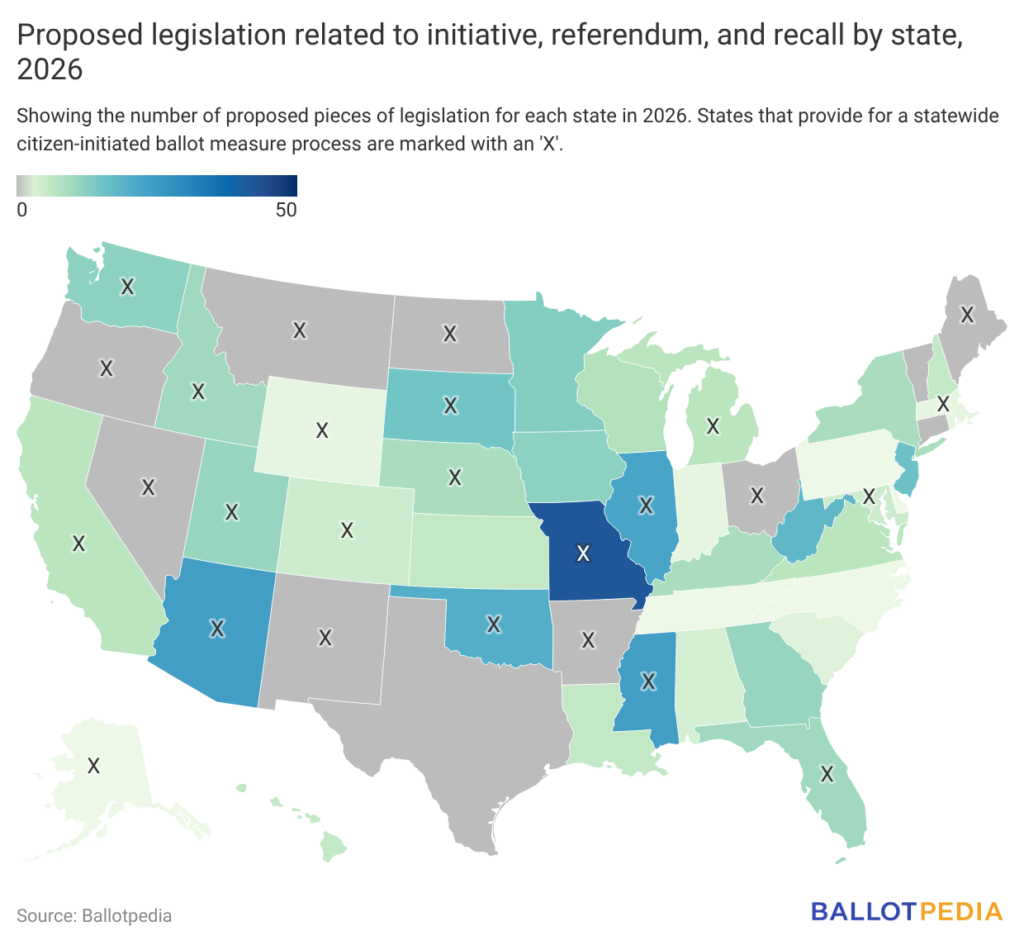
Legislators in 39 states introduced 370 legislative proposals related to the powers of direct democracy, tying with 2021 for the third-highest number of proposed bills since 2018. The second-highest number of proposed bills was in 2023 with 385, and the highest was in 2025 with 623.
Thirty-seven of the 370 proposals introduced this year have been enacted. Missouri introduced the most proposals, at 42, enacting one. Arizona and Mississippi introduced the second-most proposals — both at 24 — with the former enacting two (contingent on voter approval), and the latter enacting none.
Of the 370 proposals, 206 (55.7%) were in Republican trifecta states, 94 (25.4%) in Democratic trifecta states, and 70 (18.9%) in states with divided governments.
Based on a state's trifecta status during a given year from 2018 to 2026, 1,652 (52.6%) proposals were in Republican trifecta states, 965 (30.7%) in Democratic trifecta states, and 526 (16.7%) in states with divided governments.
From 2018 to 2026, states enacted 363 (11.5%) of the 3,143 bills concerning the three powers of direct democracy introduced in legislatures.
Click here to check out this year's analysis of changes to laws governing ballot measures.
Two candidates are running in the Aug. 25 Republican primary runoff for governor of Oklahoma — one of the four gubernatorial primary runoffs this year
Gentner Drummond (R) and Mike Mazzei (R) are running in the Aug. 25 Republican primary runoff for governor of Oklahoma — one of four gubernatorial primary runoffs this year. Incumbent Gov. Kevin Stitt (R) is term-limited.
In Oklahoma, winners in primary contests are determined by majority vote. The top two candidates participate in a runoff election if no candidate wins a majority in the first round of balloting. Drummond and Mazzei advanced to the primary runoff after defeating seven other candidates in the June 16 Republican primary. Drummond received 25.9% of the vote in the primary, and Mazzei received 25.5%.
Ten gubernatorial primary runoffs — two Democratic, eight Republican, and one Libertarian — have happened since 2018. The candidate who received more votes in the primary won half of those runoffs.
Both candidates have contributed to their own campaigns, mirroring Stitt, who, the Oklahoma Voice's Nuria Martinez-Keel wrote, "put $4.9 million of his own funds into his 2018 gubernatorial campaign and nearly $2 million when running for reelection." As of the most recent filing report on June 8, Drummond has contributed approximately $2.5 million to his campaign, and Mazzei has contributed approximately $11 million.
Drummond has served as attorney general of Oklahoma since 2023 and previously worked as a senior attorney at The Drummond Law Firm. The Oklahoma Fraternal Order of Police and the Oklahoma City Firefighters Association endorsed Drummond.
Mazzei served in Stitt's administration as Secretary of Budget from 2019 to 2020, and represented District 25 in the Oklahoma Senate from 2004 to 2016. Stitt and President Donald Trump (R) endorsed Mazzei.
Reuters' Ernest Scheyder wrote that one issue dividing the two candidates is a proposal to construct an aluminum smelter in Inola, Oklahoma. According to Scheyder, the aluminum smelter would be the largest in the Western Hemisphere.
Drummond opposes the project, saying, "I'm not going to let it be built ... We have to protect farmland." Mazzei supports the project, saying he's "proud to stand with President Trump and support a project he's made clear is a national security imperative."
As of Aug. 4, The Cook Political Report and Inside Elections rated the general election Solid Republican. Sabato's Crystal Ball rated it as Safe Republican.
Click here to read more about the Republican primary runoff for governor of Oklahoma.
President Donald Trump issued two executive orders in July, the second-lowest monthly total this term
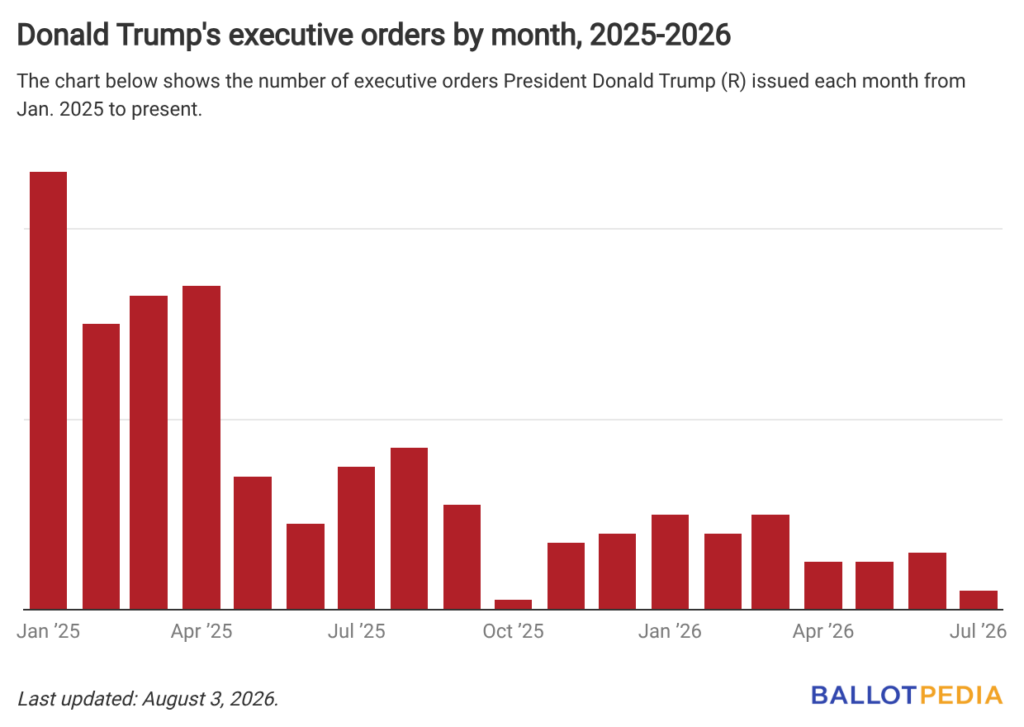
President Donald Trump (R) issued two executive orders in July, the second-fewest of any month in his second term. As of July 31, Trump had signed 271 executive orders in his second term.
The July executive orders addressed defense supply chains and the Smithsonian Institution.
Trump issued 46 executive orders in January 2025, more than in any other month of his second term. In fact the number of executive orders that Trump issued from February 2026 to July 2026, 36, is less than the total for January 2025. October 2025 was the month when Trump issued the fewest executive orders of his second term, with one.
Among all U.S. presidents, Trump has issued the ninth-most executive orders, with 491 orders across his two terms in office so far. Franklin D. Roosevelt (D) issued the most executive orders of any U.S. president, with a total of 3,721 during his time in office. William Henry Harrison (Whig) issued the fewest, having issued none during his one month in office. Three presidents issued only one executive order each: James Madison (Democratic-Republican), James Monroe (Democratic-Republican), and John Adams (Federalist).
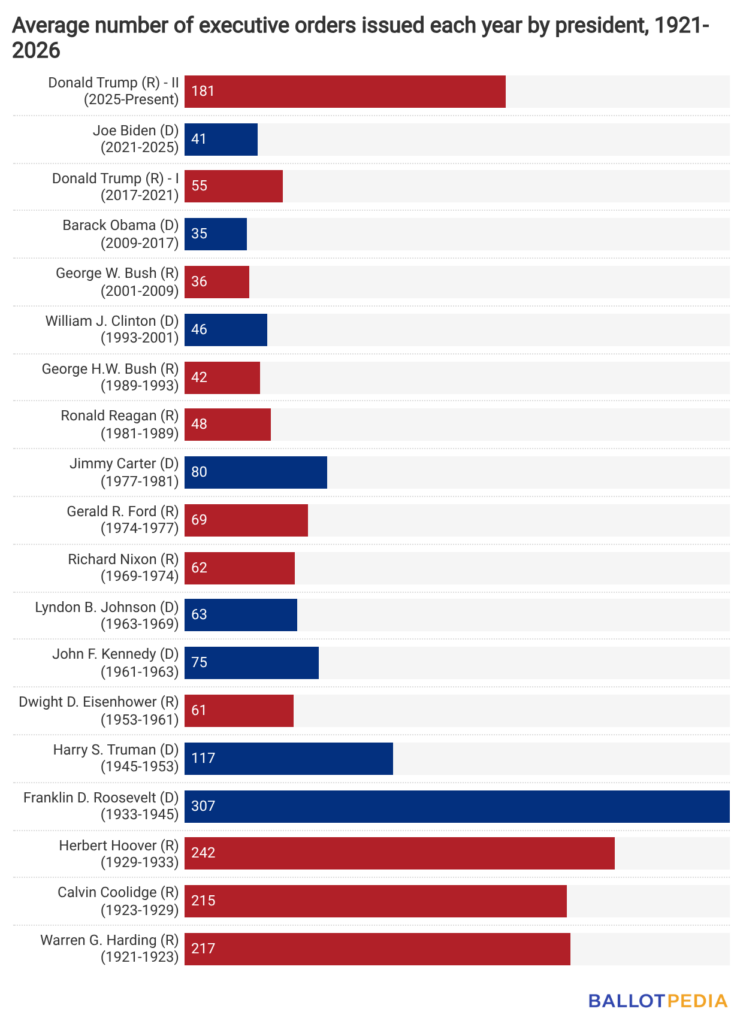
Trump has issued an average of 181 executive orders per year in office in his second term, the highest average among the seven presidents who have held office since 1981. In his first term, Trump averaged 55 executive orders per year, the second-highest in that time. Joe Biden (D) averaged 41 per year, the third-fewest in that time. Franklin D. Roosevelt (D) issued an average of 307 executive orders per year, the most of any U.S. president.
Click here for more information about Trump’s executive orders and actions in his second term.