This edition of Checks and Balances features highlights from Ballotpedia’s 2026 Administrative State Legislative Tracker report, and the transfer of most federal employee appeals from the Merit Systems Protection Board to the Office of Personnel Management
In the states
2026 administrative state legislation: 38 states enacted 225 bills
Ballotpedia’s administrative state legislation tracker is a free, publicly available tool that allows users to view and filter state and federal legislation governing agency structure, authority, oversight, and transparency.
According to Ballotpedia's Administrative State 2026 Legislation Report, states passed more bills in 2026 that increase agency power than decrease it, making this the first year since Ballotpedia began tracking legislation related to the administrative state in 2024 where that’s the case. Both Republican and Democratic trifecta states enacted more bills that increase administrative agency power than decrease it. A total of 38 states passed laws across a range of administrative topics such as agency structure, permitting processes, sunrise and sunset reviews, judicial deference, and more.
Here are some highlights from the report.
Lawmakers in 45 states considered 1,722 bills and resolutions that would decrease or increase agency authority and influence or otherwise affect the administrative state. Thirty-eight states enacted 225 of those bills or resolutions, or 13% of proposed bills. The total number of new administrative state laws is less than in 2025, but more than 2024.
- Thirty-two states enacted 94 laws that decrease agency control.
- Twenty-nine states enacted 101 laws that increased agency control.
- Twenty-six laws did not clearly increase or decrease agency control.
- Four laws increased agency control in some ways and decreased it in others.
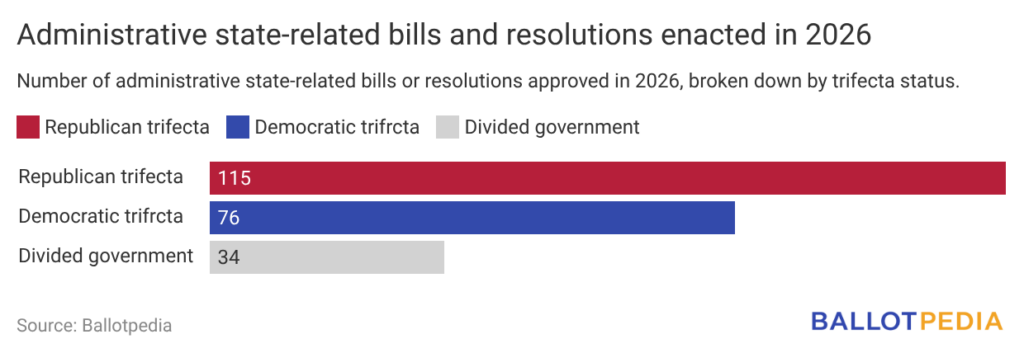
- States with Republican trifectas enacted 48 bills (in 13 states) that increase agency power, and 46 bills (in 17 states) that decrease agency power.
- States with Democratic trifectas enacted 39 bills (in nine states) that increase, and 31 (in nine states) that decrease agency power.
- Divided governments adopted 14 bills (in seven states) that increase, and 17 bills (in six states) that decrease agency power.
Ballotpedia’s five pillars of the administrative state provide a framework to analyze administrative agency actions and policies that govern them according to how the agencies interact with the three branches of government, the public, and each other.
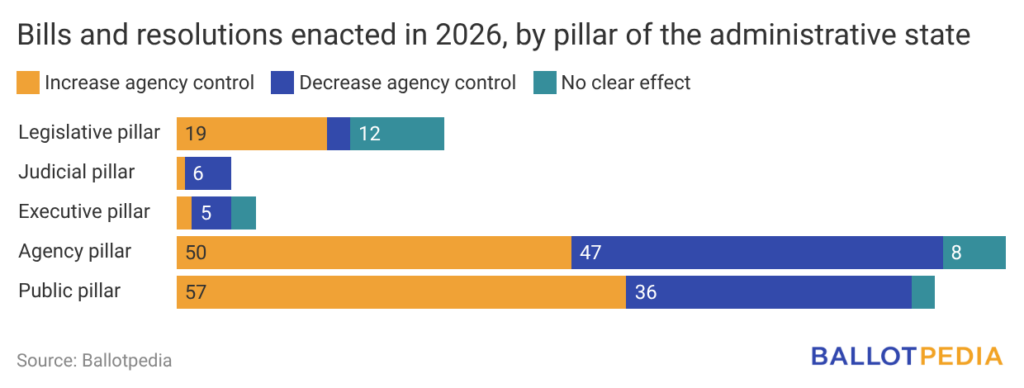
- The legislative control pillar describes the relationship between agencies and lawmakers and the related reform proposals and legal doctrines. Lawmakers in 17 states enacted 34 bills and resolutions, including four REINS-related bills, that Ballotpedia classified under this pillar.
- The executive control pillar describes the interplay between agencies and the executive branch. Lawmakers in seven states enacted 10 bills and resolutions that Ballotpedia classified under this pillar.
- The judicial control pillar describes the interplay between agencies and the courts, including the level of deference given to agency rules. Lawmakers in six states enacted seven bills and resolutions, including five judicial deference-related bills, that Ballotpedia classified under this pillar.
- The agency control pillar describes the dynamics among agencies and sub-agencies. Lawmakers in 33 states enacted 105 bills and resolutions that Ballotpedia classified under this pillar.
- The public control pillar describes how agencies relate to the people and organizations subject to their rules, including procedural rights, enforcement, and adjudication. Lawmakers in 31 states enacted 96 bills and resolutions that Ballotpedia classified under this pillar.
Governors vetoed 13 bills that the state legislature did not override. Seven of these bills came from states with divided governments. Four were in states with Democratic trifectas, and two from a Republican trifecta. Nine of the vetoed bills would have decreased agency control, three would have increased it, and one would have decreased it in some ways and increased it in others.
Ballotpedia also tracked 192 federal bills related to the administrative state in the 119th Congress, none of which were enacted into law in 2026.
Click here to read our full report.
Want to learn more?
Pick of the news
North Carolina Governor signs bill restricting judicial deference. North Carolina Gov. Josh Stein (D) signed SB 445 into law. Among other provisions, the bill prohibits administrative law judges from deferring to state agencies’ interpretations of regulations, instead requiring courts to determine the meaning of regulatory text de novo. Carolina Journal
Delaware creates state Office of Surgeon General. Delaware Gov. Matt Meyer (D) signed an executive order creating a state Office of Surgeon General, responsible for public health messaging. Meyer also appointed Dr. Neil Hockstein, chair of the Delaware Health Care Commission, to serve in the new post. Spotlight Delaware
In Washington
Federal employee appeals to be transferred from Merit Systems Protection Board to the Office of Personnel Management
On July 31, the Office of Personnel Management (OPM) issued final rules which would transfer most terminated federal employee appeals to itself. Under the rules, OPM will hear appeals from employees terminated or demoted as part of a reduction in force (RIF), due to a suitability action, or when the employee was in a probationary period. These appeals are currently the responsibility of the Merit Systems Protection Board (MSPB). The transfer of responsibilities will take effect Sept. 2, 30 days after OPM released guidance documents implementing the rules on Aug. 3. OPM officials say that this move will speed up the employee appeals process, while critics say that OPM will be a less-neutral arbitrator than the MSPB.
What is the MSPB?
The MSPB was founded as an independent agency in 1978, and is responsible for upholding the federal workforce merit system and for hearing employee appeals. Its three commissioners are appointed by the president and require Senate confirmation. Between 2017 and 2022, the board was unable to make final determinations on employee cases because it lacked a two-member quorum. The MSPB also lost a quorum between March and October 2025 after President Donlad Trump (R) dismissed board member Cathy Harris. On Dec. 5, the District of Columbia Circuit Court of Appeals decided in Harris v. Bessent that the president had the power to dismiss members of the board.
The U.S. Supreme Court declined to hear Harris’ appeal on June 30. The Court denied certiorari in this case following its June 29 Trump v. Slaughter decision, in which it ruled that the president had the power to dismiss a commissioner of the Federal Trade Commission, another multi-member independent agency. According to internal documents, in early July MSPB leadership instructed employees to stop describing it as an “independent” agency in job postings. Mentions of the board being “independent” have since been removed from the MSPB website.
What do the final rules do?
According to the July 31 final rules and Aug. 3 guidance documents, the OPM will decide employee appeals in cases involving RIFs, suitability actions, or probationary employees. Cases will be decided based on the employee’s written record rather than the formal investigation and hearing-based process that MSPB currently uses. OPM’s Merit System Accountability and Compliance office will hear cases involving RIFs and probationary employees, while OPM’s suitability office will hear cases involving a suitability action. Terminated or demoted employees will have 30 days to file an appeal with OPM. Both parties will have 30 days to appeal OPM’s written decision.
The rules also change the procedure for RIFs, from using tenure and seniority when deciding which employees to retain, to using employee performance (with veterans’ preference as a secondary criterion, and tenure and seniority being used as a tiebreaker). Another OPM rule released earlier in July affects this process because it limits the share of an agency’s employees who can be rated highly on performance reviews.
On Aug. 12, the MSPB issued a final rule in the Federal Register removing references to its authority to hear RIF, suitability, and probationary employee appeals.
What were the reactions?
In a Substack post, OPM director Scott Kupor wrote that “the current MSPB backlog stretches to many months and, in some cases, years. That is not good for employees who deserve timely resolution of their appeals and it is not good for agencies, which are left in management limbo while cases wind through a slow and costly adjudicatory process. Our proposed internal appeal processes are designed to be faster, more efficient, and, critically, structurally independent, with separate staff handling determinations and appeals.” According to one of the final rules, these “safeguards against arbitrary or predetermined decision-making” will include a requirement that “OPM personnel assigned to adjudicate appeals must be insulated from officials who participated personally and substantially in the challenged personnel action or provided case-specific advice concerning that action… and OPM-employee appeals must beassigned to an administrative law judge, whose initial decision may be disturbed only on limited grounds.”
At a Partnership for Public Service event in May Richard Vitaris, a retired MSPB administrative law judge, said that “the board is an independent agency that doesn’t have a dog in the fight [when hearing employee appeals]. Board judges independently review what happened against the regulation… If you take that authority away from the board and give it to OPM, there’s a greater danger that agency actions would be rubber stamped.” In a March statement, the National Treasury Employees Union said that “suitability and RIF appeals belong before a neutral body like the MSPB, not a federal agency dedicated to carrying out the Administration’s agenda like OPM. OPM claims that it is ‘streamlining’ appeals, but the result will be a less fair process for federal employees.”
Want to learn more?
Pick of the news
Trump dismisses members of the Election Assistance Commission. President Trump dismissed two members of the Election Assistance Commission and accepted the resignation of a third, leaving the Commission without leaders. The Election Assistance Commission is an independent agency created in 2002, and is responsible for serving as an election administration resource. Reuters
Office of Personnel Management cuts workforce. The Office of Personnel Management (OPM), responsible for managing the federal workforce, reduced its own workforce by 35% between December 2024 and March 2026. The OPM is shrinking its workforce further with an ongoing deferred resignation program. Government Executive
2026 Unified Regulatory Agenda released, more deregulation planned. The Office of Information and Regulatory Affairs released the Trump administration’s 2026 Regulatory Plan and the Unified Agenda of Federal Regulatory and Deregulatory Actions. The Plan identified 702 existing regulations for elimination. National Law Review
All but one of 284 cancelled Energy Department grants were to Democratic-voting states. All but one of 284 clean energy grants which were cancelled last October would have gone to projects in states that voted for Kamala Harris (D) in 2024 and that have two Democratic senators, according to court filings by the Department of Energy in a suit by a group of California-based researchers. According to an Energy Department filing, these cancellations were not “based on any programmatic, statutory, cost-reduction or performance-based factor.” They were “based solely on the political identity of the grant recipient’s state, i.e., whether the recipient’s location and/or place of performance was in a Blue State or a non-Blue State.” New York Times
Featured commentary
What is the future of Federal Reserve independence after the Slaughter and Cook cases? University of North Carolina Law professor and former Biden administration official Graham Steele writes that the Supreme Court’s decision in Trump v. Cook did not resolve questions surrounding the future independence of the Federal Reserve in the wake of the Trump v. Slaughter decision. Steele says that Trump v. Cook did not address whether the Fed’s regulatory functions will remain as independent as Fed monetary policy. Click here to read the full article.
In the Media:
- Politico, “DOGE self-deletes on July 4th. The grand experiment fell apart long before that”
- Washington Post, “DOGE was supposed to be dead. Its remnants are everywhere.
- Politico, “The Consumer Financial Protection Bureau’s curious resurgence”
- SCOTUSblog, “The administrative agency cases were not the court’s only significant separation of powers decisions this term”
- Stateline, “Democrats, Republicans alike focus on states’ rights as a way out of America’s political woes”
Regulatory highlight
In this section, we highlight a few of the several regulations reviewed by the Office of Information and Regulatory Affairs (OIRA) each month and discuss an aspect of the federal Congressional Review Act (CRA), an increasingly used mechanism for repealing executive agency regulations. In this edition, we provide an update on how federal legislators have used the Congressional Review Act in the 119th Congress and how it looks for the rest of the legislative session.
Notable regulations
- The Office of Information and Regulatory Affairs (OIRA) completed its review of a Small Business Administration (SBA) final rule rescinding its policy requiring the SBA to engage in notice-and-comment rulemaking when not required by the Administrative Procedure Act. However, SBA retained the right to practice it on a case-by-case basis.
Congressional Review Act
The Congressional Review Act (CRA) allows Congress to repeal executive agency rules with joint resolutions of disapproval. Under the CRA, Congress has 60 working days after a rule has been submitted to Congress to introduce a joint resolution of disapproval.
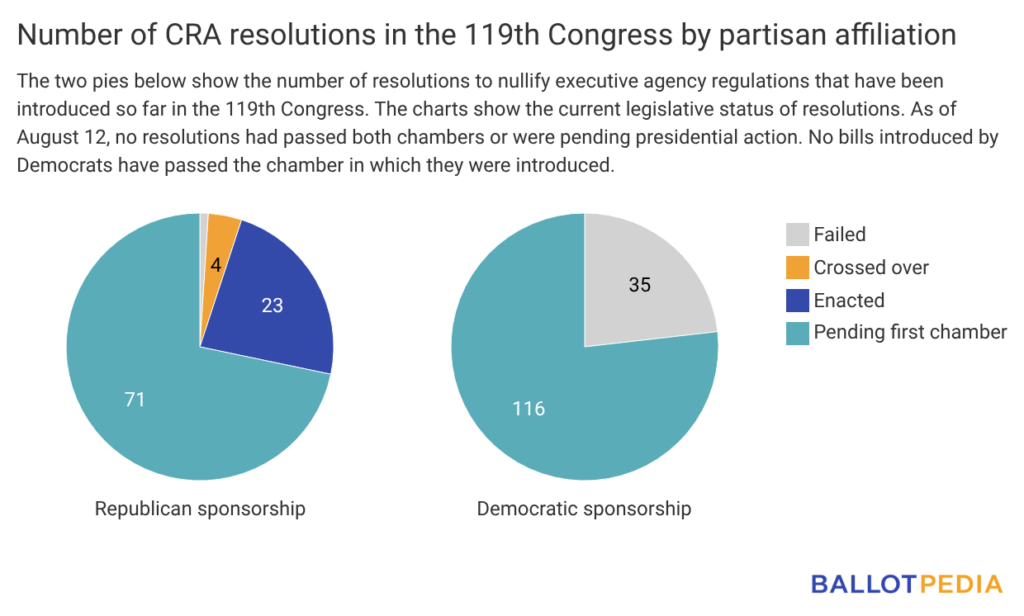
As of Aug. 12, federal legislators have introduced 230 resolutions of disapproval to nullify agency regulations so far in the 119th Congress. Since the last edition of Checks & Balances, Republican legislators have introduced 12 resolutions, and Democrats have introduced three. Since the last edition, no resolutions advanced, and the Senate rejected motions to consider three CRA resolutions introduced by Democrats.
The 12 Republican-sponsored resolutions aim to repeal Environmental Protection Agency (EPA) regulations related to California emissions waivers under the Clean Air Act (CAA) issued between 2013 and 2025. The EPA submitted the regulations to Congress for review in June. Ballotpedia covered the rescission of three CAA waivers in 2025.
What to look out for: The U.S. Court of Appeals for the Sixth Circuit will rehear a case that will define the extent to which agencies can issue regulations similar to those repealed under the CRA.
Want to learn more?
- Rescinding Unnecessary Notice and Comment Procedures
- Congressional Review Act
- Federal agency rules repealed under the Congressional Review Act
- Appeals court to reconsider key Congressional Review Act prohibition | E&E News
Legislative Tracking Update
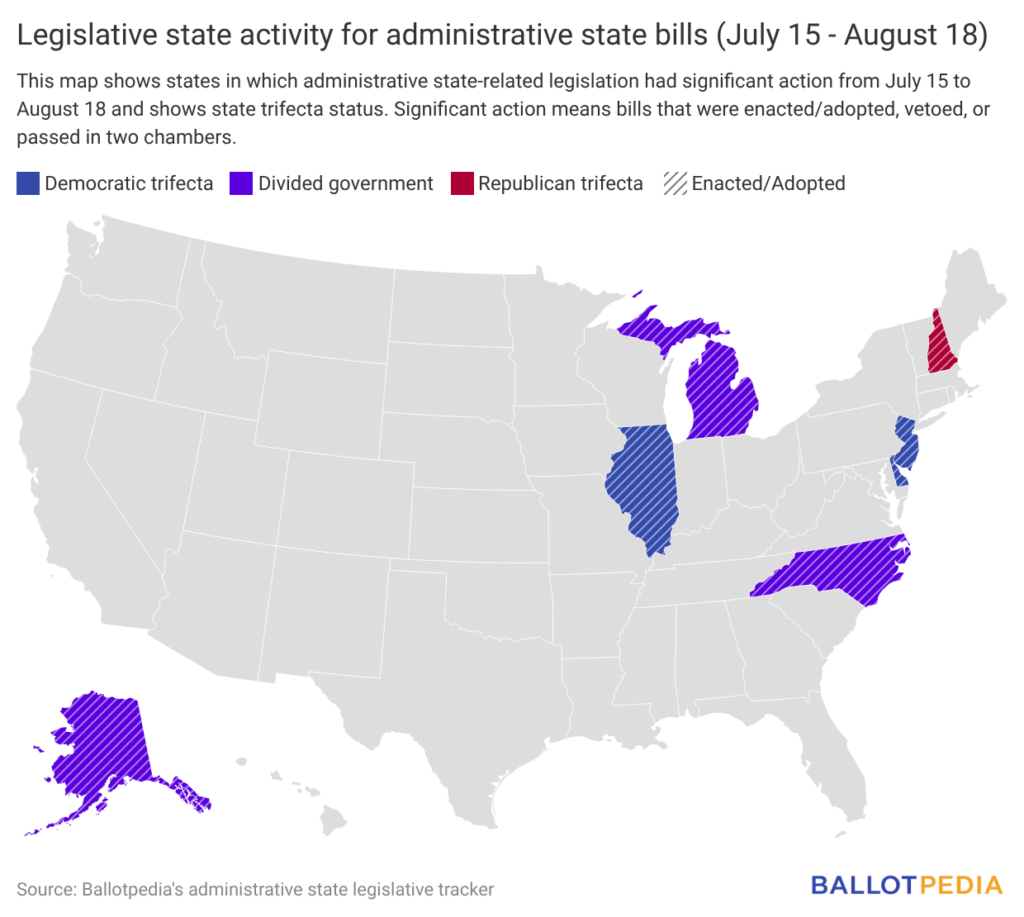
Since our last newsletter edition, Ballotpedia tracked significant legislative action (enactments, vetoes, and passage through both chambers) in seven states on seven bills related to the administrative state, as of Aug. 18.
Alaska Gov. Mike Dunleavy (R) signed one bill. Delaware Gov. Matt Meyer (D) signed one bill. Illinois Gov. J. B. Pritzker (D) signed one bill. Michigan Gov. Gretchen Whitmer (D) signed one bill. New Hampshire Gov. Kelly Ayotte (R) signed one bill. New Jersey Gov. Mikie Sherrill (D) signed one bill. North Carolina Gov. Josh Stein (D) signed one bill.
Ballotpedia tracked a total of 1,916 bills related to the administrative state in 2026, as of August 18.