


Welcome to the Friday, Aug. 21, 2026, Brew.
By: Briana Ryan
Here’s what’s in store for you as you start your day:
- Virginia kicks off our 50 States in 50 Days series
- Democratic National Committee votes against proposed limitation on ranked-choice voting for delegate allocation
- 152 statewide ballot measures have been certified this year — above the average in even-numbered years
Virginia kicks off our 50 States in 50 Days series

Every weekday until Election Day, the Daily Brew will feature 50 States in 50 Days, a preview of each state's Nov. 3 elections — all 50 states, in the order that voting begins in each. First up: Virginia.
Virginia will use the same congressional maps as in 2022 and 2024, after the state supreme court blocked the certification of a constitutional amendment voters approved 51.7% to 48.3% in April that would have permitted the General Assembly to redistrict.
Want to see what's on your ballot this November? Click here to use our Sample Ballot Lookup Tool. Now let's take a closer look at what's happening in Virginia.
Early voting opens Sept. 18 and ends Oct. 31.
Polls open on Election Day at 6:00 a.m. and close at 7:00 p.m.
Voter ID is required. Acceptable forms of ID include voter confirmation documents, a Virginia driver's license, or a U.S. passport. Click here for the full list of acceptable forms of ID. Voters may also sign a statement, subject to felony penalties, that they are the named registered voter whom they claim to be. Voters who do not have identification and do not sign a statement must vote a provisional ballot.
Absentee/mail-in ballots must be requested by Oct. 23 and returned by Nov. 3.
There are also a few differences in election policy between this year's elections and those in 2024.
The deadline to register to vote has moved from 21 days before the election to 10 days before the election. The deadline for registering by mail and online is Oct. 23.
Early voting hours were also expanded. Previously, it was up to the counties to decide whether to have early voting on the second or third Sunday before the election. Now it must be available in all counties for at least five hours between 11:00 a.m. and 5:00 p.m. on the second and third Sundays before the election.
Current party control
Democrats represent six congressional districts, and Republicans represent five. Both of Virginia's U.S. Senators are Democrats.
Democrats have a 21-19 majority in the Virginia Senate and a 63-36 majority with one vacancy in the Virginia House of Delegates. Because the governor is a Democrat, Virginia is one of 16 states with a Democratic trifecta. Virginia's attorney general and secretary of state are also Democrats. As a result, Virginia is one of 21 states with a Democratic triplex. Conservatives have a 4-3 majority on the state supreme court.
Offices on the ballot
Elections are taking place for the U.S. Senate and the U.S. House of Representatives. There will also be a special election to fill a vacancy in the state House.
Virginia is one of 32 states this year where we are providing comprehensive election coverage down to the local level.
Battleground elections
In Virginia's 2nd Congressional District election, incumbent Rep. Jennifer Kiggans (R), Elaine Luria (D), DeVinche Albritton (I), Makiba Gaines (I), and Bishop Staten (I) are running. This election is the second rematch in the district since 2018. Kiggans defeated Luria, then the incumbent, in 2022. In 2020, Luria defeated Scott Taylor (R), who was the incumbent she defeated in 2018.
In Virginia's 7th Congressional District election, incumbent Rep. Eugene Vindman (D), Douglas Ollivant (R), and Alaha Ahrar (I) are running. A Democrat has won the last two elections for the district, but none by more than five percentage points. In 2022, then-incumbent Rep. Abigail Spanberger (D) won by 4.6 percentage points. In 2024, Vindman won by 2.7 percentage points.
Statewide ballot measures
There are three statewide measures on the ballot this year. From 1926 through 2026, Virginia voters decided on 107 ballot measures, or two per even-numbered year. During that period, voters approved 92 measures and defeated 15.
Here's a closer look at the three measures.
Question 1 would establish a right to reproductive freedom. It is one of four measures nationwide related to abortion this year, after a record year for abortion-related measures in 2024, when 11 were on the ballot nationwide. Virginia's measure is one of three this year that would provide for a state right to abortion.
Question 2 would repeal the provision in the state constitution defining marriage as between one man and one woman and prohibit the state from denying a marriage license to two adults based on sex, gender, or race. If approved, Virginia would be the fifth state to repeal a constitutional provision defining marriage as between one man and one woman, which, before Obergefell v. Hodges, prohibited same-sex marriage.
Question 3 would amend the state constitution to state that persons convicted of felonies lose their right to vote only while incarcerated and have their political rights, including voting, restored upon release from incarceration. Currently, Virginia is one of three states in which voting rights are never restored for individuals convicted of any felony without the state acting to restore the person's rights.
Local ballot measures
We'll be adding information about local measures in Virginia as they are certified ahead of the Nov. 3 election.
Join us again tomorrow when we'll preview elections in Minnesota, the North Star State.
Click here to see every edition of 50 States in 50 Days as we publish them, and here to use our Sample Ballot Lookup Tool.
Democratic National Committee votes against proposed limitation on ranked-choice voting for delegate allocation
The Democratic National Committee (DNC) voted on Aug. 15 to reject a rule proposed by its Rules and Bylaws Committee (RBC) that would have limited the use of ranked-choice voting for delegate allocation in the 2028 Democratic presidential primary.
The proposed rule, which the RBC passed at its May meeting, said that ranked-choice voting could not be used to express presidential preferences in the delegate allocation process, and if it was used pursuant to state law, only the first-preference votes would be used for delegate allocation.
Since the rule was not adopted by a vote of the full DNC, the delegate allocation process for the 2028 Democratic presidential primary will follow the same rules the party used in 2024, which required states to assign delegates to presidential candidates in proportion to the percentage of votes they receive in a primary, as long as a candidate receives 15% of the vote. Candidates who receive less than 15% of the vote are not awarded delegates.
According to Independent Voter News, under the 2024 DNC rules, if a state uses ranked-choice voting and no candidate reaches 15% of the vote, the lowest candidate is eliminated. Their votes are redistributed to second-preference candidates, and the process repeats until only candidates with 15% of the vote remain, at which point delegates are allocated proportionally.
The proposed rule would have changed the process so that only first-preference votes were counted when determining delegate allocation, meaning only candidates receiving 15% or more of the first-preference vote would have received delegates allocated proportionally.
Following the proposal of the RBC rule, members of the D.C. Democratic State Committee wrote an open letter calling on the DNC to vote against adopting the rule.
They wrote: "Where the ban will have an impact is in disenfranchising voters. DC law requires use of ranked ballots, and the proposed rule simply refuses to count those ballots correctly. Thus, many voters may unknowingly waste their vote by ranking a longshot candidate first – and expecting their vote to transfer to a more viable candidate – but it won’t. As such, the rule as it stands will confuse and disenfranchise voters during the 2028 primaries."
In response to criticism about the proposed rule change, DNC RBC co-chair Jim Roosevelt issued the following statement: "Ranked Choice Voting is incompatible with the party’s delegate allocation process at this time, since RCV is a winner-take-all system while the DNC uses proportional delegate allocation. However, the Rules and Bylaws Committee respects the right of every state to make their own decisions on important voting procedures, which is why the rules include clear guidance for states with statutory requirements like Maine."
Seven states have laws authorizing or requiring the use of ranked-choice voting for certain elections, three of which use ranked-choice voting for some statewide elections.Nineteen states have laws prohibiting or restricting the use of ranked-choice voting.
Alaska, Hawaii, Kansas, Nevada, and Wyoming used ranked-choice voting in the 2020 Democratic presidential primary. Maine was the only state that used ranked-choice voting in the 2024 presidential primaries.
Two jurisdictions currently have state or local laws requiring the use of ranked-choice voting in presidential primaries: Maine, which instituted ranked-choice voting in presidential primaries by law in 2020, and Washington, D.C., which instituted ranked-choice voting in presidential primaries by ballot measure in 2024.
Click here to read more about RCV.
152 statewide ballot measures have been certified this year — above the average in even-numbered years
As of Aug. 18, 152 measures have been certified for statewide ballots — more than the historical average of 142 at this point in even-numbered years from 2014 through 2024. From 2014 through 2024, an average of 153 measures were certified in even-numbered years.
One measure — Proposition 145 — was removed from the Arizona ballot after the state supreme court ruled it violated the state constitution’s separate-amendment provision.
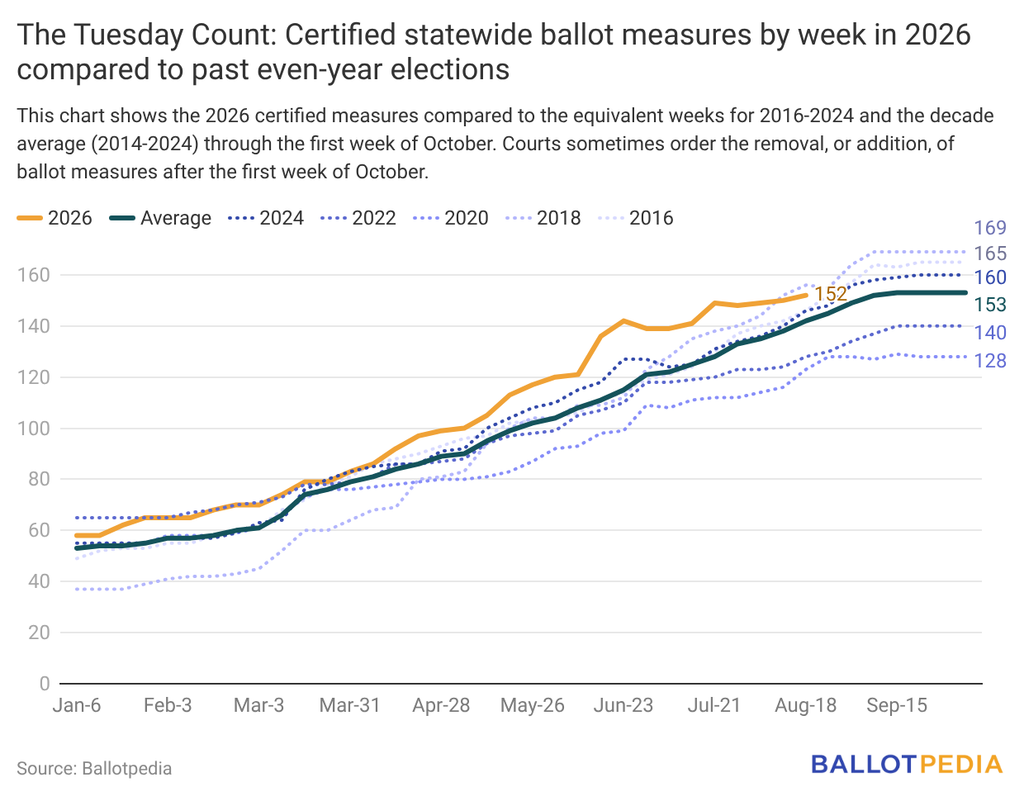
Over the past two weeks, four new measures were certified for the ballot:
- Colorado Right to Purchase and Sell Natural Gas for Cooking or Heating in Homes and Businesses Amendment
- Montana CI-132, Require Nonpartisan Judicial Elections Initiative
- Montana CI-133, Add Right to Initiative and Referendum Power to Declaration of Rights Amendment
- Montana I-194, Exclude Political Spending from Artificial Persons’ Charter Powers Initiative
Signatures are pending verification for 13 citizen initiatives:
- Colorado Cap Individual and Corporate Income Tax at 4.4% Initiative
- Colorado Establish a Graduated Income Tax Amendment
- Colorado Require Congressional Maps to be Approved by Both a Nonpolitical Commission and the Colorado Supreme Court Amendment
- Colorado Require Plain Language and Eighth-Grade Reading Level for Ballot Measures Initiative
- Colorado Require Voter Identification Number for Mail-In Ballots Initiative
- Colorado Right to Hunt and Fish Initiative
- Colorado Sporting Goods Sales Tax for Environmental Funding Initiative
- Michigan Citizenship Verification and Voter Identification Initiative
- Michigan Utility and Government Contractor Campaign Finance Regulations Initiative
- Nebraska Online Sports Betting Amendment
- Nebraska Regulate Online Sports Betting Initiative
- Nebraska Require a Four-Fifths Vote for Legislative Ballot Initiative Changes Amendment
- Nebraska Sex Requirement for School and College Sports Amendment
State officials rejected three initiatives with submitted signatures. Those initiatives are pending court rulings:
- Arkansas Fundamental Right to Initiative and Referendum and Citizen-Initiated Measures Process Amendment
- Missouri Congressional Map Referendum
- Missouri Initiative and Referendum Powers and Legislative Change Requirements Amendment
The next deadline is Aug. 25 in Oklahoma, when election officials must complete signature verification. Oklahoma has no fixed deadline for submitting initiative signatures.
Click here for more information about the measures on statewide ballots this year.