


Welcome to the Monday, Aug. 24, 2026, Brew.
By: Lara Bonatesta
Here’s what’s in store for you as you start your day:
- States enact 14 ESG-related bills in 2026, the fewest since 2021
- Minnesota’s trifecta status could be decided in the Nov. 3 elections
- Arizona courts block two conflicting school choice-related ballot measures, leaving 2026 without a citizen initiative
States enact 14 ESG-related bills in 2026, the fewest since 2021
State legislatures passed 14 environmental, social, and corporate governance (ESG)-related bills during the 2026 legislative sessions, including two that became law after lawmakers overrode gubernatorial vetoes. This was the fewest ESG bills enacted in a single year since 2021, and the third-fewest in the seven years Ballotpedia has tracked ESG legislation.
ESG investing is an asset management approach that considers the environment, social issues, and corporate governance practices. ESG investing is part of a broader public policy debate about whether asset managers should consider, for example, factors like a company's emissions, labor practices, or board composition in investment decisions or focus exclusively on financial returns, especially in public pensions. The discussion extends to policies governing the factors governments consider when awarding public contracts and policies prohibiting or requiring companies to consider non-financial factors when doing business.
The 2026 legislative sessions continued the partisan divide that has characterized state ESG policymaking. Republican-controlled state governments enacted most new laws and generally focused on limiting the use of ESG considerations in public investments, financial services, and corporate governance. Democratic-controlled state governments enacted no legislation supporting ESG policies this year.
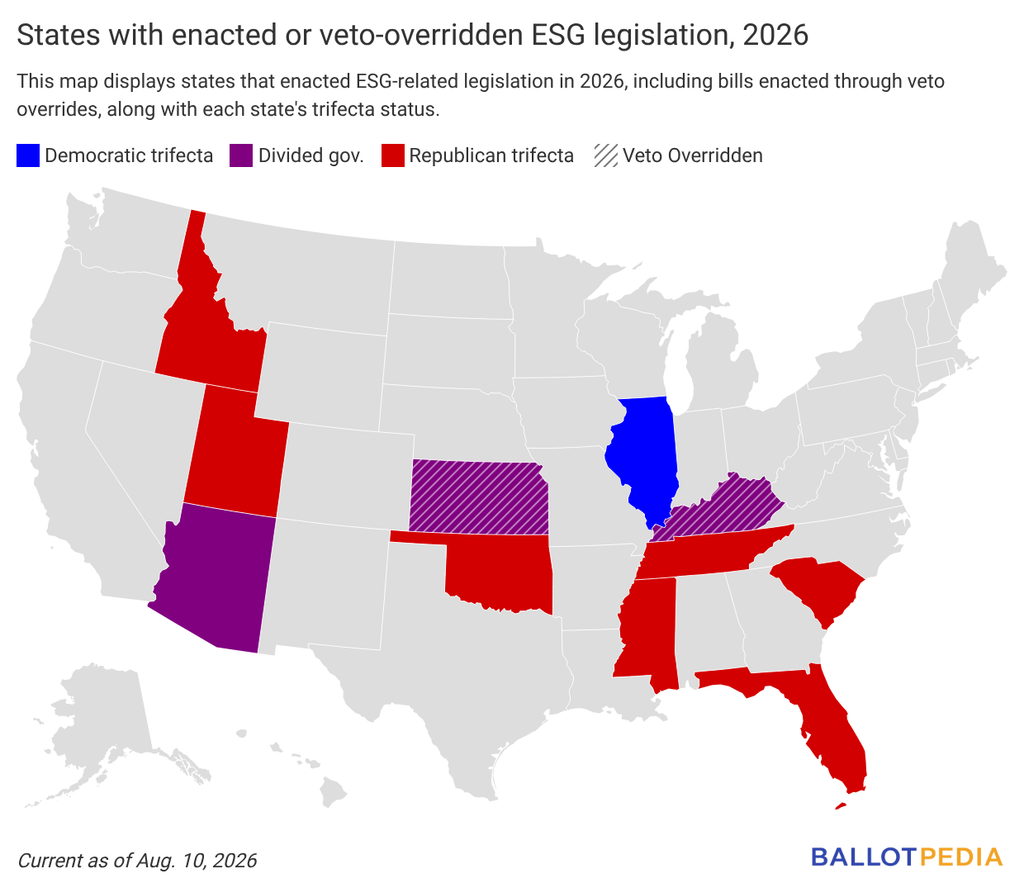
States with Republican trifectas enacted 10 of the 14 laws, states with Democratic trifectas enacted one, and states with divided governments enacted three.
- Tennessee, Oklahoma, Indiana, Kentucky, and Kansas enacted proxy advisor disclosure laws. Proxy advisors provide non-binding recommendations to shareholders in public companies — such as pension funds, endowments, or other asset managers — about how to vote on company issues such as executive pay packages, board membership, and other shareholder and management proposals. These laws require certain disclosures when voting recommendations rely on nonfinancial factors rather than financial analysis.
- Oklahoma, Mississippi, and Tennessee enacted or expanded sole fiduciary standards requiring public pension fiduciaries to base investment and proxy voting decisions only on financial factors. Fiduciaries are individuals or entities — such as pension board trustees — that are legally responsible for managing a pension fund’s assets in the interest of fund beneficiaries. State laws typically set the specific duties and requirements for fiduciaries, which vary from state to state.
- Florida and Idaho enacted restrictions on diversity, equity, and inclusion (DEI) programs, while Arizona put a related constitutional amendment on the 2026 ballot.
- South Carolina and Utah passed laws prohibiting certain financial services providers or payment systems from restricting services based on ESG-related criteria.
- Illinois was the only Democratic-trifecta state to enact an ESG-related law, requiring certain insurers to participate in the National Association of Insurance Commissioners' Climate Risk Disclosure Survey.
ESG legislation by trifecta, 2020–2026
State legislatures enacted 155 ESG-related bills in 40 states between 2020 and 2026. Of those, 118 laws (76%) opposed ESG practices, while 37 (24%) supported them.
States with Republican trifectas enacted 94 laws in that period (or 61% of all laws), all of which opposed ESG practices. Here were the most common policy approaches:
- Thirty-seven bills restricted banks and financial institutions from using ESG-based criteria or social credit scoring to close customer accounts or deny services.
- Thirty-one bills required public investment decisions to focus only on financial factors (these are known as sole fiduciary standards).
- Twenty-three bills prohibited certain state investments in or contracts with companies that boycott specified industries.
South Dakota was the only Republican trifecta state that did not enact an ESG law in that period.
Democratic trifecta states enacted 38 ESG laws. Thirty-three laws supported ESG policies, while five opposed them. Here were the most common policy approaches:
- Twelve bills required ESG-related criteria in certain state contracts or licensing decisions.
- Eight bills allowed public fund managers to consider ESG data and other nonfinancial factors in investment decisions.
- Six bills required companies to disclose certain ESG-related information, such as emissions or climate-related risks.
States with divided governments enacted 23 ESG laws. Nineteen opposed ESG practices, while four supported them.
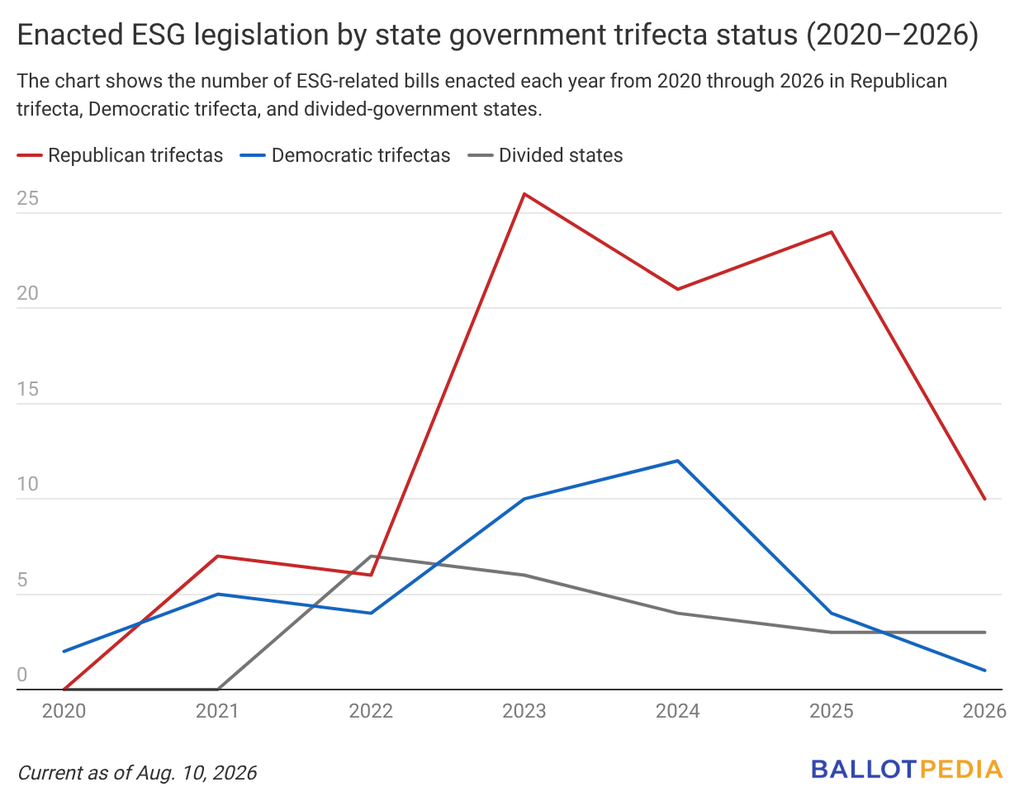
The focus of ESG legislation has changed over time. Anti-boycott and sole fiduciary legislation peaked in 2023, with 12 and 17 enacted bills, respectively. Anti-discrimination and ESG-scoring legislation increased in the following years. Seven bills were approved in 2023. Thirteen were approved in 2024. Fourteen were approved in 2025, before falling to five in 2026.
To learn more about the ESG legislation states have passed since 2020, click here.
Minnesota’s trifecta status could be decided in the Nov. 3 elections

Welcome to the next installment of our 50 states in 50 days series, covering Minnesota. To view our archive of past editions, click here.
Minnesota’s trifecta status could be decided in the Nov. 3 elections. The state has an open governor’s race. Democrats have a one-seat majority in the state Senate, and a numerical 67-66 majority with one vacancy in the House. The chamber has a Republican speaker, who is currently running for governor.
Want to see what’s on your ballot this November? Click here to use our Sample Ballot Lookup Tool. Now let’s take a closer look at what’s happening in Minnesota.
Early voting opens Sept. 18 and ends Nov. 2.
Polls open on Election Day at 7:00 a.m. and close at 8:00 p.m.
Voter ID is not generally required. If you are registering to vote at the polls or have not voted in at least four years, you will need to bring proof of residency to the polls. Acceptable forms of ID include a valid Minnesota driver’s license, or a U.S. Passport. Click here for the full list of acceptable forms of ID.
Absentee/mail-in ballots must be requested by Nov. 2 and returned by Nov. 3.
Current party control
There are eight members of Minnesota’s U.S. House delegation. Democrats and Republicans each represent four congressional districts. Both of Minnesota’s U.S. Senators are Democrats.
Gov. Tim Walz, who is not running for re-election, is a Democrat. Democrats have a 34-33 majority in the Minnesota Senate.
Following the 2024 elections, Democrats and Republicans each won 67 seats in the Minnesota House, evenly splitting the chamber for the first time since 1978. The parties reached a power-sharing agreement in which Lisa Demuth (R), who is now running for governor, was named speaker of the House, and Democrats and Republicans co-chaired committees. Currently, there are 67 Democrats and 66 Republicans in the chamber with one vacancy.
Because the lower chamber is split, Minnesota is one of 11 states with a divided government.
Minnesota's attorney general and secretary of state are also Democrats. As a result, Minnesota is one of 21 states with a Democratic triplex. Democratic governors have appointed all seven judges on the Minnesota Supreme Court.
Offices on the ballot
Elections are taking place for the U.S. Senate, the U.S. House of Representatives, all five elected state executive offices, and all 201 state legislative seats.
Two state supreme court justices and five intermediate appellate court judges are also up for nonpartisan election, but none of those elections are contested.
Minnesota is one of 32 states this year in which we are covering all local elections for school boards and municipal offices.
Battleground elections
In the state Senate, Republicans would need to gain one seat to win a majority. Democrats would need to either retain all of their seats or gain seats to keep their majority. In 2022, the last time all 67 seats were up for re-election, the chamber's majority went from a 34-33 Republican majority to a 34-33 Democratic majority.
In the state House, Democrats would need to retain all of their seats and gain at least one seat to win a majority. Republicans would need to gain two seats to win a majority. The seat that is currently vacant – House District 21A – was last represented by Joe Schomacker (R), who resigned on June 21. In 2022, the last time Schomacker had a major party challenger, he was re-elected 74.3% to 25.6%.
In addition to the election in both of the state legislative chambers, here are two statewide races that we are watching.
With Walz not running for re-election, the governor’s race is open for the first time since 2018. U.S. Sen. Amy Klobuchar (D) and Demuth are running. In 2022, Walz defeated Scott Jensen (R) 52.3% to 44.6%. As of Aug. 18, The Cook Political Report and Sabato’s Crystal Ball rated the election Solid Democratic. Inside Elections rated it Likely Democratic.
Minnesota will also have its first U.S. Senate race without an incumbent since 2006. Lt. Gov. Peggy Flanagan (D) and former reporter and sports broadcaster Michele Tafoya (R) are running. Incumbent Tina Smith (D), who first assumed office in 2018, is not running for re-election. Major race forecasters have all rated the election Likely Democratic. The Cook Political Report's Jessica Taylor wrote, "While Republicans haven’t won a Senate race here since 2002, and haven’t won a statewide election since 2006, the state has shifted a bit toward the GOP over the past three presidential elections." In the six presidential elections from 2004 to 2024, Democratic presidential candidates won the state's popular vote. In the 2020 presidential election, Joe Biden (D) won 52% of the vote to Donald Trump's (R) 45%. In 2024, Kamala Harris (D) won 51% of the state's popular vote to Trump's 47%.
Statewide ballot measures
Voters will decide on one statewide measure this year. From 1857 – the year Minnesota voters ratified the state constitution and the year before Minnesota was admitted to the union – to 2025, Minnesota voters decided on 218 ballot measures, approving 123 and defeating 95. In that period, voters decided an average of three measures per even year.
The Minnesota Alter Management and Investment Policies for Permanent School Fund Amendment would amend the constitution to change the administrative policies surrounding the investment and distribution of the Minnesota Permanent School Fund. Specifically, it states that the fund’s managers would need to preserve its purchasing power over time.
Local ballot measures
We’ll be adding information about local measures in Minnesota as they are certified ahead of the Nov. 3 election.
Join us Tuesday when we'll preview elections in South Dakota, the Mount Rushmore State.
Click here to see every edition of 50 States in 50 Days as we publish them, and here to use our Sample Ballot Lookup Tool.
Arizona courts block two conflicting school choice-related ballot measures, leaving 2026 without a citizen initiative
Arizona voters will not decide on Proposition 212 or Proposition 145 this November after two separate Arizona Supreme Court rulings on Aug. 18 blocked both measures from the ballot.
Without Proposition 212 on the ballot, 2026 will be the first even-numbered year since 2014 with no citizen initiatives on the statewide ballot.
As we mentioned in our Aug. 7 edition of the Daily Brew, Proposition 145 is one of two certified measures to be removed from the ballot in Arizona this year and the fourth since 2014. The other certified measure that was removed was Proposition 143. (Note: Proposition 212 is not part of this count because it was never certified.)
Between 2014 and 2026, state courts removed or disqualified 20 measures in eight states after officials certified them for the ballot. Eight of the 20 measures (40%) were removed due to state constitutional issues, such as violations of single-subject or separate-vote requirements.
Proposition 212 and Proposition 145 both related to Arizona's Empowerment Scholarship Account (ESA) program. Proposition 212 would have restricted ESA eligibility and spending. Proposition 145 would have prohibited the state from confiscating military families' ESA funds and voided any conflicting ballot measures, such as Proposition 212.
Proposition 212
On Aug. 18, Arizona Supreme Court Chief Justice Ann Timmer issued a ruling upholding the Maricopa County Superior Court’s ruling that mandated specific methods for counting duplicate signatures on petitions for Proposition 212, an initiated state statute. Specifically, the ruling that the Supreme Court upheld said that the Secretary of State and county officials should remove duplicate signatures before determining the overall validity rate of signatures submitted in a county. Those methods resulted in not enough signatures being verified to place Proposition 212 on the November ballot.
Proposition 212 would have limited eligibility for Arizona’s Empowerment Scholarship Account program to families earning less than $150,000 per year. This requirement would have started in the 2027-2028 school year, with the threshold adjusted 2% annually. Families would not have been able to use ESAs to purchase luxury items, including out-of-state travel, dining, amusement park tickets, home appliances, or home improvements. The initiative would have prohibited paying family members from ESAs, except for students with disabilities.
On July 2, the Protect Education, Accountability Now campaign submitted 421,451 signatures to the Arizona Secretary of State supporting Proposition 212. The Secretary of State is responsible for counting the signatures submitted and determining which are valid. A duplicate signature, for example, would be invalid.
On July 20, the Goldwater Institute filed a complaint stating that the campaign submitted a number of invalid signatures, including duplicates, that the Secretary of State should not count.
On Aug. 13, Maricopa County Superior Court ruled that said when counting signatures, the Secretary of State and county officials should remove duplicate signatures before determining the overall validity rate of signatures submitted in a county. In response, Protect Education, Accountability Now appealed to the state supreme court, saying that removing signatures before determining a validity rate could result in a duplicate signature being subtracted from the number of valid signatures twice.
Proposition 145 officially blocked from ballot
In a separate ruling on Aug. 18, the Supreme Court also ruled that Proposition 145 cannot be placed on the November ballot. The ruling upheld the decision of the Maricopa County Superior Court, which blocked the measure from the ballot because it violated the state constitution’s separate amendment rule.
Proposition 145 would have prohibited the state from confiscating money from the scholarship account of a child of a military family. That would include Empowerment Scholarship Accounts. Proposition 145 would also have voided any ballot measure or law passed after Nov. 1 that violated the amendment. This would have applied to Proposition 212.
We wrote more about Proposition 145 in our Aug. 7 edition of the Daily Brew, along with Proposition 143, which was removed from the ballot last month. To see that coverage, click here.
Click here to learn more about Arizona’s 2026 ballot measures and here to see a list of certified state ballot measures that courts have removed from the ballot.