


Welcome to the Tuesday, Aug. 25, 2026, Brew.
By: Briana Ryan
Here’s what’s in store for you as you start your day:
- Laws in 12 states provide school boards with differing powers and duties depending on the type of district they represent
- November midterms in South Dakota will be first general elections under proof of citizenship law
- Twenty-one Democratic incumbents are running in contested primaries for the Massachusetts House this year — the most since at least 2010
Laws in 12 states provide school boards with differing powers and duties depending on the type of district they represent
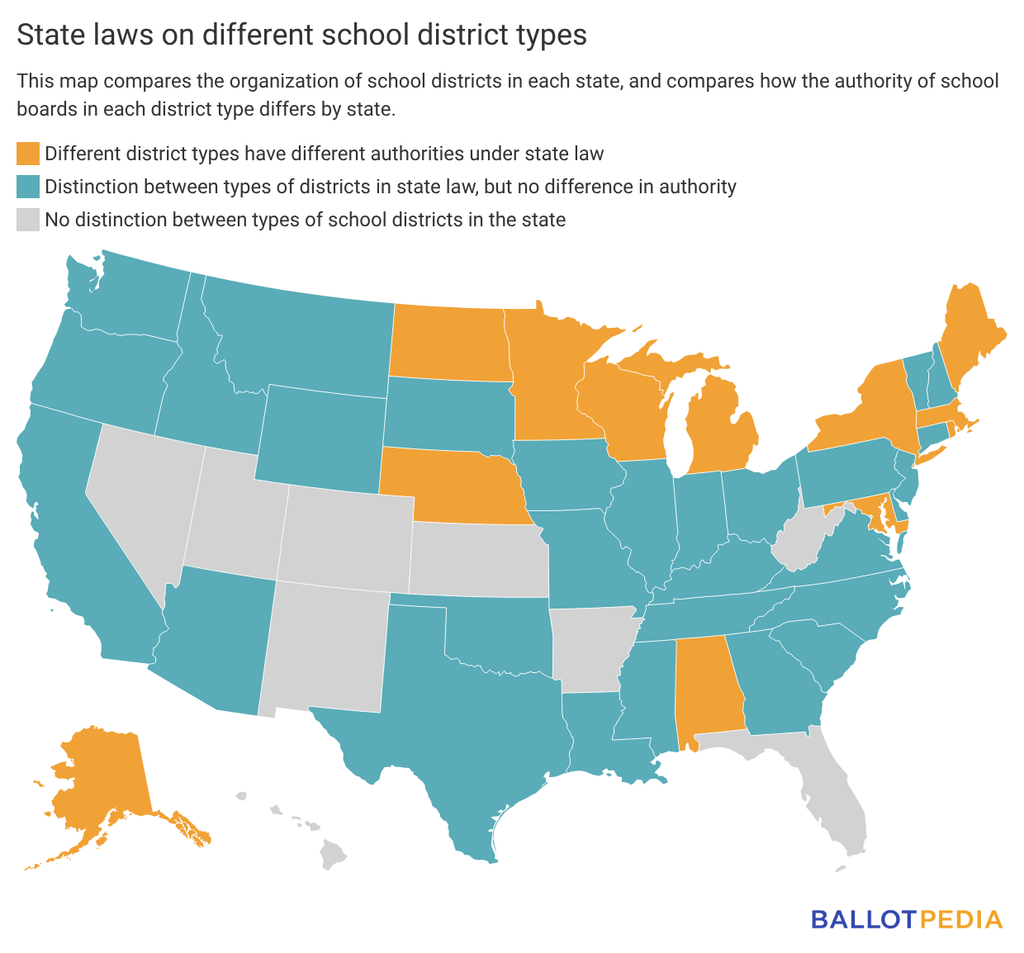
Most states either have only one type of school district or do not distinguish different powers and duties for school boards in different types of school districts. However, laws in 12 states give school boards in different types of school districts distinct powers and duties. These boards may have different levels of control over district taxing or financing, and they may have different numbers of elected members.
States may differentiate school districts based on government structure (city or county), grades served (e.g., elementary, secondary, or K-12), or the student population size. Typically, variations in powers and duties between boards in a given state correspond to factors like student population size or district location. For example:
- Alabama: Enumerates different powers and duties for school boards in county and city school districts. For example, Alabama law requires county boards of education to fix a uniform start date for schools in the county each year, with specific requirements for any schools that must start later. State law does not require this of city school boards.
- Maine: Applies a set of powers and duties for all school boards but stipulates additional powers and duties specific to the boards of each of the four district types (regional school units, school administrative districts, community school districts, and municipal school units). State laws specific to each district type authorize different committees for each of their boards.
- Maryland and North Dakota: Establish school districts and boards in their most populous cities — Baltimore and Fargo, respectively — with separate powers and duties from all other school districts. Maryland state law also includes some powers, duties, and limitations for the Prince George's County Board of Education.
Here's a breakdown of school district types across the U.S.:
- Twenty-nine states distinguish between types of school districts in state law, but do not distinguish between the powers and duties of boards in each district type.
- Twelve states have different types of districts, and give the boards of those districts distinct authorities.
- Nine states do not distinguish between types of school districts.
Of the 12 states that grant school boards distinct powers and duties based on the type of district:
- Nine — Alaska, Maine, Massachusetts, Michigan, Nebraska, New York, Rhode Island, North Dakota, and Wisconsin — have one statute enumerating the powers and duties of all school boards in the state and separate statutes granting additional authorities for one or more district types.
- Three — Alabama, Minnesota, and Maryland — enumerate the powers and duties of each type of school district separately.
School board authority
Ballotpedia conducted this research as part of its school board authority project. The project seeks to lay out the authority for school boards in each state, as well as constraints on that authority through state or federal law, collective bargaining, or case law.
Click here to read more about local school board authority across the 50 states.
November midterms in South Dakota will be first general elections under proof of citizenship law
Welcome to our next installment of our 50 states in 50 days series, covering South Dakota. To view our archive of past editions, click here.
This year’s November midterms will be the first general elections after South Dakota enacted a law requiring individuals to provide proof of citizenship when registering to vote in state and local elections. Prospective voters who do not provide such proof may only vote in federal elections.
Documents establishing citizenship include a South Dakota driver’s license or ID card issued since July 2025, a birth certificate, or a passport. (Click here for the full list of acceptable forms of proof of citizenship.)
Individuals who are currently registered to vote in South Dakota do not have to provide proof of citizenship unless they have been removed from the voter rolls. The law, which was enacted in March 2026, was in effect for the state’s June primary. Twelve states have laws requiring proof of citizenship to register to vote in at least some cases, although some of those laws are not currently in effect.
To see what’s on your ballot this November, click here to use our Sample Ballot Lookup Tool. Now let’s take a closer look at what’s happening in South Dakota.
Voters must register in person or via mail by Oct. 19.
In-person absentee voting opens Sept. 18 and ends Nov. 2.
Polls open on Election Day at 7:00 a.m. and close at 7:00 p.m.
Voter ID is required. Acceptable forms of ID include a South Dakota driver's license or nondriver ID card, a U.S. passport, a tribal ID, or a current student photo identification card from a South Dakota high school or South Dakota-accredited institution of higher education. Click here for the full list of acceptable forms of ID. Voters who do not have a photo ID can sign a personal identification affidavit. Those voters will then be given a regular ballot.
Absentee/mail-in ballots must be requested by Nov. 2 and returned by Nov. 3.
Current party control
A Republican represents South Dakota’s At-Large Congressional District. Both of the state’s U.S. Senators are also Republicans.
Republicans have a 32-3 majority in the South Dakota Senate and a 65-5 majority in the South Dakota House of Representatives. Because the governor is a Republican, South Dakota is one of 23 states with a Republican trifecta. South Dakota’s attorney general and secretary of state are also Republicans. As a result, South Dakota is one of 24 states with a Republican triplex. Republican governors appointed all five members of the South Dakota Supreme Court.
Offices on the ballot
Elections are taking place for the U.S. Senate and the U.S. House of Representatives.
There will also be elections for governor, lieutenant governor, attorney general, secretary of state, auditor, commissioner of school and public lands, treasurer, and one of three seats on the public utilities commission. All 35 seats in the state Senate and 70 seats in the state House are up for election.
South Dakota is one of 32 states this year where we are providing comprehensive election coverage down to the local level.
Notable elections
The U.S. Senate election is one of four this year in which the Democratic nominee withdrew from the race. It's also one of three Senate elections in which a replacement nominee has not been selected. That leaves two candidates — incumbent Sen. Mike Rounds (R) and Brian Bengs (I) — left in the race.
Statewide ballot measure
There are four statewide measures on the ballot this year. From 1889 to 2025, South Dakota voters have decided on 366 ballot measures, approving 160 and defeating 206. For more information about the history of South Dakota’s ballot measures, visit its Historical Measures Factbook.
Here’s a closer look at the four measures:
Constitutional Amendment I would condition state Medicaid expansion on federal funding remaining at or above 90%. South Dakota voters approved Medicaid expansion in 2022 with Amendment D, which requires the state to provide benefits to adults between 18 and 65 with incomes below 133% of the federal poverty level. Since the Affordable Care Act disregards 5% of income, Amendment D effectively expanded Medicaid to those with incomes at or below 138% of the federal poverty level. Currently, South Dakota is one of 41 states and Washington, D.C. that have expanded or voted to expand Medicaid.
Constitutional Amendment J would provide that only U.S. citizens may vote in state elections and would disqualify noncitizens from voting in all elections in the state. South Dakota is one of six states that will decide on ballot measures related to citizenship requirements for voting. Between 2018 and 2025, voters decided on 15 measures related to the topic and approved all of them.
Constitutional Amendment K would create a trust fund for unclaimed property, requiring the state treasurer to deposit any unclaimed property funds into the trust after covering claims, expenses authorized by law, and designated deposits to the general fund.
Constitutional Amendment L would require a 60% supermajority vote to approve a constitutional amendment, applying to both citizen initiatives and legislative referrals. Currently, constitutional amendments in South Dakota require a simple majority (more than 50%) of votes to be approved. If approved, South Dakota would be the twelfth state to require a supermajority vote on constitutional amendments.
Local ballot measures
We’ll be adding information about local measures in South Dakota as they are certified ahead of the Nov. 3 election.
Tomorrow, we'll preview elections in Vermont, the Green Mountain State.
Click here to see every edition of 50 States in 50 Days as we publish them, and here to use our Sample Ballot Lookup Tool.
Twenty-one Democratic incumbents are running in contested primaries for the Massachusetts House this year — the most since at least 2010
Twenty-one incumbents are running in contested Democratic primaries for the Massachusetts House of Representatives on Sept. 1 — the most since at least 2010. Since 2010, 14 Democratic state House incumbents have lost re-election in a primary.
These primaries are taking place in the context of Massachusetts voters approving a 2024 ballot measure that authorizes the state Auditor to audit the Massachusetts General Court's operations. Voters approved the measure, Question 1, 72% to 28%,
State Auditor Diana DiZoglio (D) sued the General Court in February, saying it had not complied with her efforts to initiate an audit. On June 2, the state House voted 125-28 to approve a bill limiting the auditor's authority to audit the legislature. All 25 Republicans and three of 132 Democrats voted against the bill.
We identified seven primaries where Democratic challengers to incumbents who voted in favor of the bill limiting audits mentioned transparency in their campaign materials. Those primaries are for the following districts: 10th Middlesex District, 16th Essex District, 18th Middlesex District, 19th Suffolk District, 24th Middlesex District, 25th Middlesex District, and 30th Middlesex District.
Democrats have a 132-25 supermajority in the state House, with one independent and two vacancies, and a 35-5 supermajority in the Massachusetts Senate. All 160 state House seats and all 40 state Senate seats are up for election this year.
Click here to read more about the Democratic primaries in the state House. Also, if you're a Massachusetts voter, check out our Sample Ballot Lookup here to prepare for Election Day.