


Welcome to Ballot Bulletin: Ballotpedia's Weekly Election Policy Digest. Every Tuesday, we deliver the latest updates on election policy around the country, including nationwide trends and recent legislative activity.
In this week’s edition, we cover 31 bills state legislatures acted on last week and look at a vetoed omnibus elections bill in North Carolina.
The state of election legislation in the U.S.
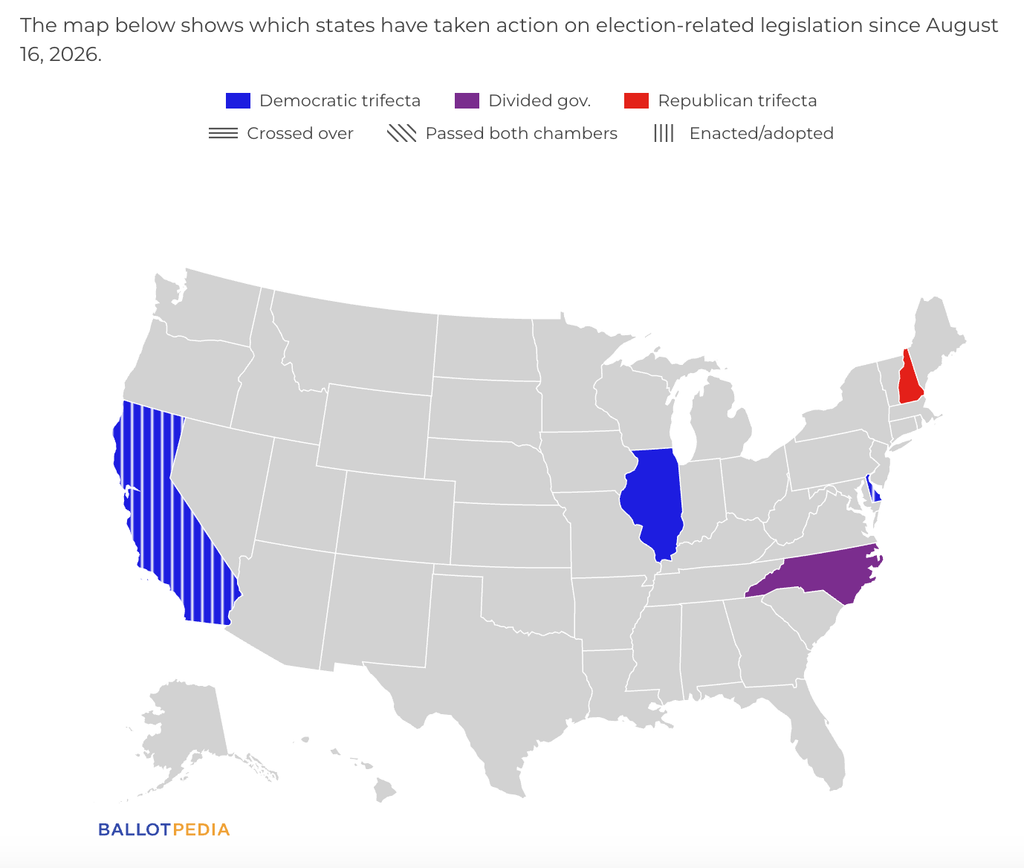
Lawmakers in five states acted on 31 election-related bills last week. Eight state legislatures are in regular or special sessions. Last week, six bills were enacted, four bills passed both chambers of a state legislature, and one bill was vetoed.
Of the bills acted on last week, 29 (93.5%) are in states with Democratic trifectas, one (3.2%) is in a state with a Republican trifecta, and one (3.2%) is in a state with divided government. The most active bill categories last week were campaign finance (14), ballot measures (5), election officials and workers (5), ballots and voting materials (5), election dates and deadlines (5), and voter registration and list maintenance (5).
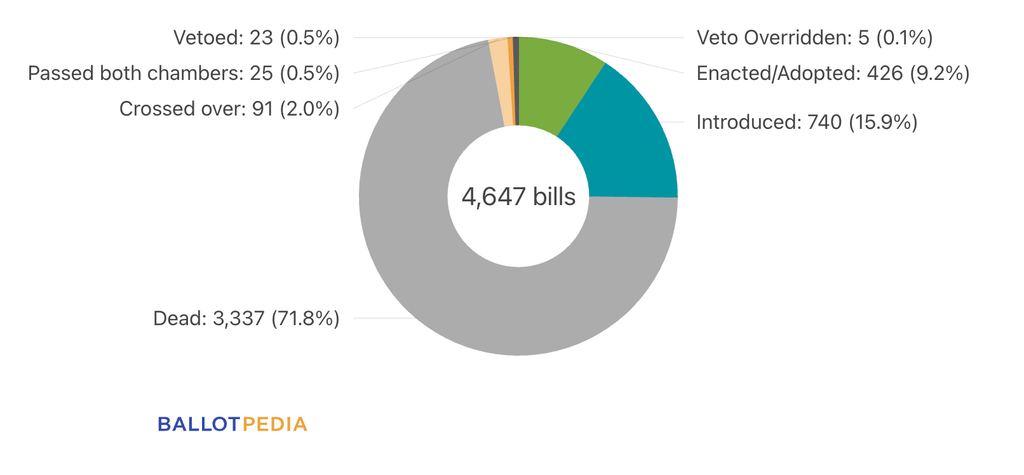
We are currently tracking 4,647 election-related bills across the country. The chart below breaks down the status of those bills based on where they stand in the legislative process:
Enacted bills
Six bills were enacted or adopted last week:
- California (Democratic trifecta)
- Delaware (Democratic trifecta)
Bills passing both chambers
Four bills passed both chambers of a state legislature last week:
To see a full list of bills awaiting gubernatorial action, click here.
Vetoed bills
One bill was vetoed last week. On Aug. 17, North Carolina Gov. Josh Stein (D) vetoed H 958. Read more about the bill in this week’s policy spotlight below.
To see a list of all bills vetoed this session, click here.
All bills
The chart below shows all bills Ballotpedia is currently tracking, broken down by partisan sponsor.
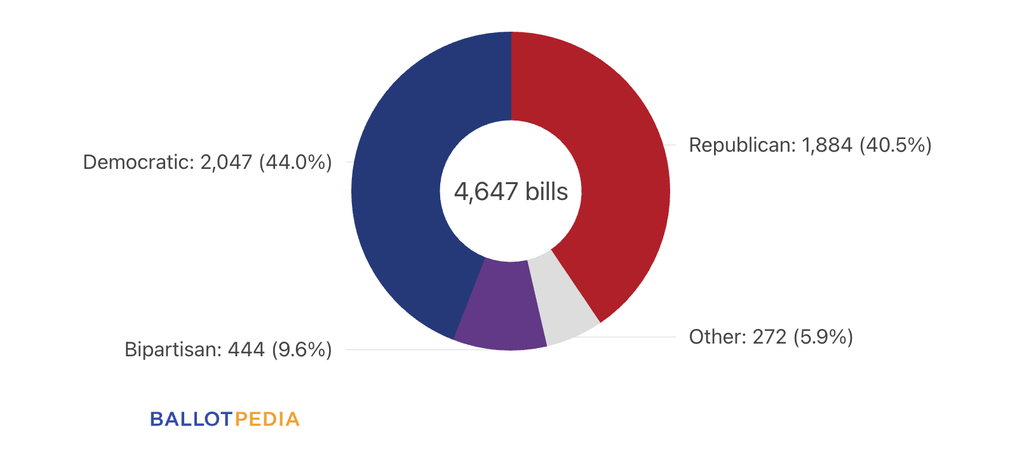
We are currently following 4,647 election-related bills, including bills carried over from the previous year.
- Trifecta status
- Democratic: 1,997 (43%)
- Republican: 1,651 (35.5%)
- Divided: 999 (21.5%)
- Partisan sponsorship
- Democratic: 2,047 (44%)
- Republican: 1,884 (40.5%)
- Bipartisan: 444 (9.6%)
- Other: 272 (5.9%)
In the news
On Aug. 21, the U.S. Postal Service released a final rule to implement President Donald Trump’s (R) March 31, 2026, executive order titled Ensuring Citizenship Verification and Integrity in Federal Elections. As covered in the Aug. 18 edition of Ballot Bulletin, the U.S. District Court for the District of Massachusetts temporarily blocked the implementation of portions of the executive order on mail voting and citizenship checks nationally on Aug. 11.
As covered in the July 7 edition of Ballot Bulletin, Judge Indira Talwani also issued an order on June 25 that blocked portions of the executive order in 23 states and the District of Columbia. The decision blocked Section 2, which requires the U.S. Department of Homeland Security to create lists of citizens eligible to vote in each state, and Section 3, which directs the U.S. Postal Service to provide states with a list of approved mail voters enrolled with USPS. The Department of Justice appealed the decision on July 1.
On July 27, U.S. Solicitor General John Sauer filed an emergency appeal of the June 25 injunction with the U.S. Supreme Court. In the appeal, Sauer said that the injunction “impedes the President’s ability to direct his subordinates and preempts the Executive’s deliberative policymaking.” On Aug. 24, the Supreme Court issued an order staying the 23-state injunction against the executive order. In the unsigned opinion, the court said the plaintiff states and Washington, D.C., lacked standing to sue and that the suit was not ripe for adjudication. The Aug. 11 injunction remains in effect, blocking parts of the order from being implemented nationally.
The justices wrote, “The Court’s disposition of this application does not mean that any measure taken by the Government to implement the Order will necessarily be lawful. On that score, time will tell. But the Order itself does not harm the States, so the District Court lacked jurisdiction to bar the Government from trying to implement it. And for the reasons discussed, that injunction is likely to irreparably harm the Government if it remains in place while the appellate process runs its course.”
In a signed dissent, Justice Ketanji Brown Jackson disputed the majority’s ripeness claim, writing, “There is also more than enough evidence in the record here to support the lower courts’ conclusion that these harms were actual or imminent when the Plaintiff States filed their complaint such that these claims are presently justiciable.”
Here are other news stories from across the country:
- On Aug. 17, the U.S. District Court for the District of Minnesota dismissed a Sept. 25, 2025, complaint from the U.S. Department of Justice seeking Minnesota’s unredacted statewide voter registration list. Writing for the court, Judge Katherine Menendez said the federal government did not have a right to Minnesota’s voter list based on the Civil Rights Act and Help America Vote Act, since the DOJ alleges no specific violation of these statutes by the state. For a list of federal lawsuits seeking access to statewide voter lists, click here.
- On Aug. 18, the U.S. Court of Appeals for the Fourth Circuit struck down a South Carolina law restricting no-excuse mail-in voting to individuals 65 years old and older. In the court’s unanimous ruling, Judge Roger Gregory said that although the Constitution gives states the authority to regulate the time, place, and manner of elections, age-based restrictions on mail-in voting violate the Twenty-Sixth Amendment.
- On Aug. 19, the Cole County Circuit Court in Missouri upheld Secretary of State Denny Hoskins’s (R) rejection of a veto referendum on the state’s newly enacted congressional districts, allowing the maps to move forward. In the ruling, Judge Daniel Green said “The Missouri Constitution does not supply any statement — let alone a clear one — reallocating authority over congressional redistricting away from the General Assembly to a referendum process.” People Not Politicians, a political action committee that previously sued over the maps, announced its intent to appeal the decision.
Policy spotlight: North Carolina Gov. Josh Stein vetoes election omnibus bill
The story below is adapted from a recent Ballotpedia News story by Andrew Bahl.
On Aug. 17, North Carolina Gov. Josh Stein (D) vetoed House Bill 958, an omnibus elections bill that would have made a variety of changes to North Carolina's election laws, including shortening the early voting period for primary elections.
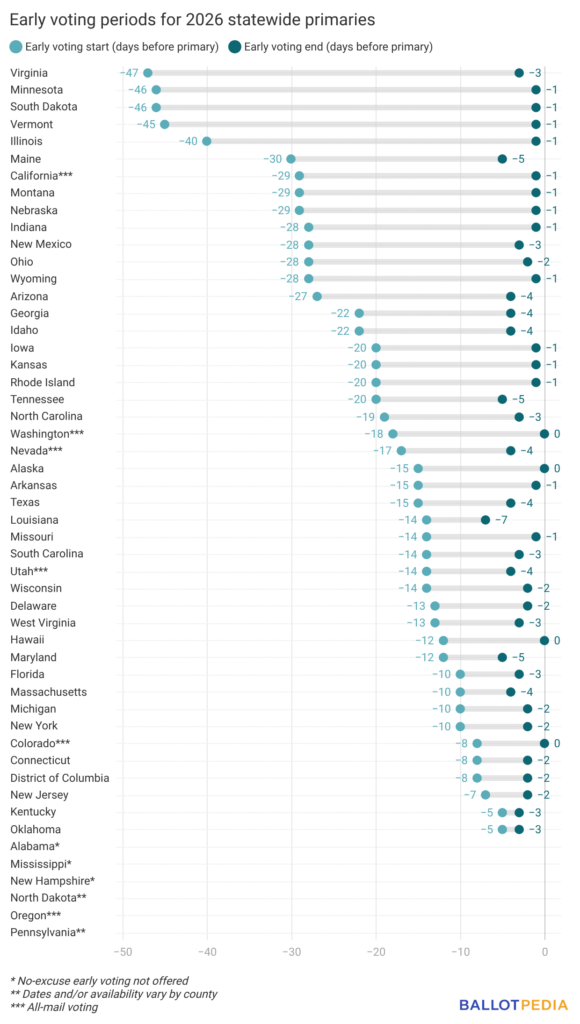
The bill would have required early voting for regular, non-municipal primary or runoff elections to take place in the 10-day period between the second Thursday before the election and the Saturday before the election. It would have set a 10-day limit on early voting for special and municipal elections. Currently, early voting for regular, non-municipal elections is held in the 17-day period beginning on the third Thursday before the election. Under H958, the early voting period for regular general elections would not change.
The bill also would have established a post-election audit of county election systems and controls and increased the reporting threshold for certain campaign contributions. It would have required election officials to receive more frequent reports on individuals who have died and must be removed from the voter registration list.
Stein said, "Instead of trying to undermine our democracy to cling to power, the legislature should focus on improving people’s lives and winning elections fair and square. I am vetoing this anti-voter legislation, and I urge North Carolinians to call their legislators to ask them to uphold my veto. In our democracy, political power rests with you – the people. I intend to keep it that way."
Rep. Hugh Blackwell (R), who chairs the House Election Law Committee, said, "House Bill 958 continues practical election reforms so we all can have greater confidence that every lawful vote in North Carolina is counted fairly and accurately. Gov. Stein’s veto of this legislation puts politics ahead of common sense and the peace of mind voters should have when they cast their ballots."
According to reporting from the Raleigh News & Observer, legislative leaders have said they will not attempt to override any vetoes until after the November midterm elections.
The North Carolina Senate passed the final version of the bill 28-13 on July 28, with 28 Republicans voting in favor and 13 Democrats voting against. The North Carolina House of Representatives approved the bill 62-47 on Aug. 4, with 62 Republicans voting in favor and 46 Democrats and one unaffiliated member voting against.
North Carolina is one of 26 states that require weekend early voting hours, as well as one of 14 states to require early voting to be available during evening hours. Five states — Colorado, Connecticut, Massachusetts, New Jersey, and Oklahoma — have statutes that set different early voting requirements for statewide primary and general elections.
Stein signed a different omnibus elections bill on Aug. 11. House Bill 834 extends the cure period for absentee ballots to 12 p.m. on the fifth business day following the election, rather than the third business day, among other changes to election laws. It was the first election-related bill enacted in North Carolina in 2026.
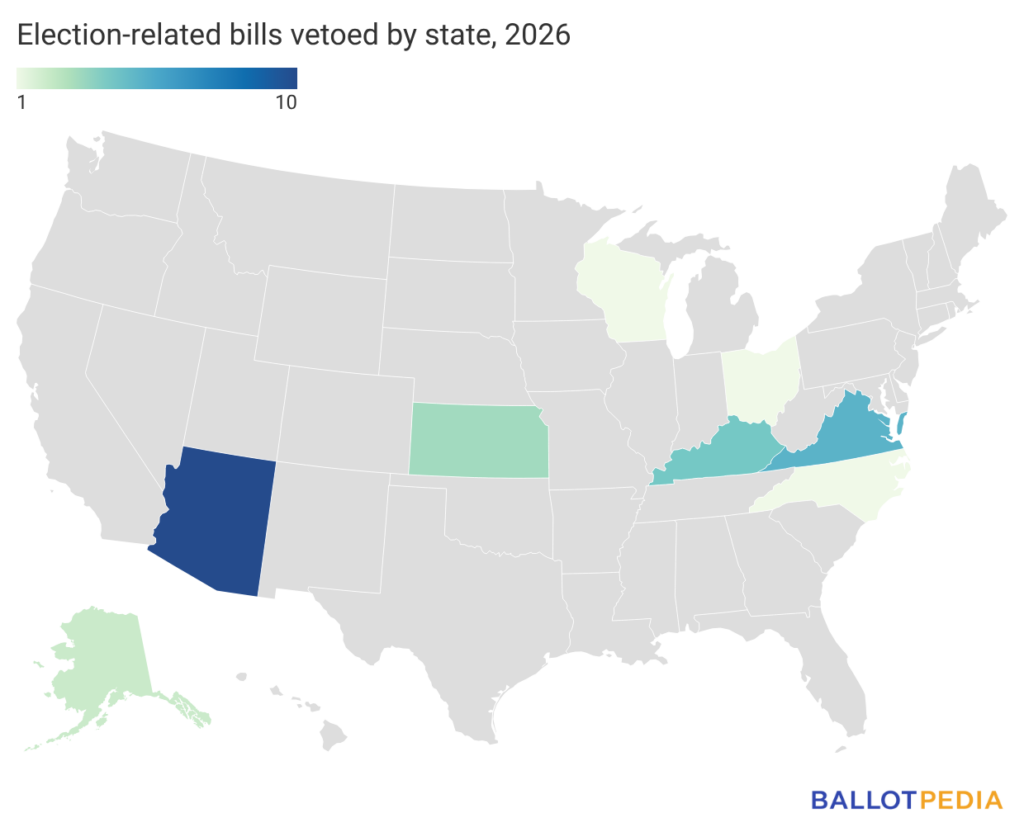
Stein’s veto of H958 was the 27th such action governors have taken on election-related bills this year. Of those vetoes, nineteen came from a Democratic governor in a state with a divided government, including Stein’s. Two vetoes came from a Republican governor in a state with a divided government. Five came from a Democratic governor in a state with a Democratic trifecta. One came from a Republican governor in a state with a Republican trifecta.