


Welcome to the Friday, Aug. 28, 2026, Brew.
By: Lara Bonatesta
Here’s what’s in store for you as you start your day:
- The first blueprints of American Democracy: state constitutions
- North Dakota’s 2026 general elections will be the first held since the state established an election day deadline for returning absentee ballots
- Six statewide candidate filing deadlines in the next two weeks
The first blueprints of American Democracy: state constitutions
Today, we're sharing the seventh installment in our project marking America's 250th anniversary: The Blueprints of Democracy.
State constitutions have a lot in common with the U.S. Constitution. All of them outline the role of government as well as the rights and privileges of citizens.
But state constitutions differ from the U.S. Constitution in that they are more detailed. They address topics like municipal bonds, tax rates, highway funding, and public school boundaries. All these topics, and all that specificity, can lead state constitutions to get outdated rather quickly. If a state wants to fund a new public program or adjust its tax policy, it often must formally amend its constitution in order to do so. Citizen initiatives can also make profound changes in state constitutions.
State constitutions also help define how our federal system of government works. According to the Tenth Amendment to the U.S. Constitution, all powers not delegated to the federal government are reserved to the states. All state governments follow the federal model with executive, legislative, and judicial branches, though states have flexibility in organization.
State constitutions by the numbers
State constitutions can be long. They average 39,000 words, while the U.S. Constitution, including the 27 amendments, has 7,591 words. Alabama’s Constitution, which was revised in 2022, has roughly 338,000 words. The state’s previous constitution, which was adopted in 1901, had more than 420,000 words and had been amended 977 times.
The average state constitution has been amended about 130 times. Among the current constitutions, the Texas Constitution has been amended the most, with 545 amendments. The oldest state constitution still in effect is Massachusetts', which took effect in 1780. It has been amended 121 times.
Many states have also held constitutional conventions to rewrite or heavily revise entire sections. There have been 233 state constitutional conventions, the most recent being Rhode Island’s in 1986. Fourteen states automatically put a question on the ballot at specified intervals for voters to decide whether to call a constitutional convention. In total, states have adopted more than 140 entirely new constitutions throughout American history and amended their constitutions more than 7,000 times.
The state roots of constitutional government
The first state constitutions were written at the outset of the American Revolution and reflected the prevailing views of government authority at the time. According to the University of Wisconsin’s Center for the Study of the American Constitution:
Before the Revolution, all of the colonies operated under written charters that established the form of government, pledged allegiance to the king, and in many instances protected individual rights. Two months before independence was declared, the Second Continental Congress on May 15, 1776, recommended the replacement of these colonial charters with new constitutions amenable to the people. John Adams wrote that the ancient lawgivers would be jealous of the opportunity afforded Americans of writing constitutions for three million people.
These state constitutions were revolutionary for their time in that they clearly established, in writing, freedoms of speech and religion, protections from unreasonable searches, jury trial rights, and due process – concepts that would later influence the creation of the U.S. Constitution and the Bill of Rights.
Evolving constitutions
State constitutions are more dynamic than many people realize. As noted above, they have been amended, or rewritten entirely, many times over the years. Often, these constitutional revisions come in response to broader political movements.
In the early 19th century, the right to vote was extended to more White males as property requirements, a staple of early state constitutions, were rolled back.
Following the Civil War, the former Confederate states were required to rewrite their constitutions to reflect the abolition of slavery before they could be re-admitted to the Union. They complied — until the next wave of constitutional change in those same states actively restricted Black voting and civil rights.
The Progressive Era ushered in a wave of new constitutional changes. In 1898, South Dakota became the first state to adopt the initiative and referendum process, which allowed citizens to place measures on the ballot themselves, bypassing the normal legislative process for enacting laws. This direct democracy innovation emerged from reformers' response to legislative corruption. Today, 26 states have some form of citizen initiatives,18 of which allow citizens to use the initiative process to amend their state’s constitution.
State constitutions have been testing grounds for a host of issues. Some have reshaped the national policy discourse, like on marijuana use. Others have fundamentally altered the national political landscape, like on women’s suffrage.
Click here to see our past installments of our Blueprints of Democracy series.
North Dakota’s 2026 general elections will be the first held since the state established an election day deadline for returning absentee ballots

Welcome to our next installment of our 50 States in 50 Days series, covering North Dakota. To view our archive of past editions, click here.
North Dakota‘s 2026 general elections will be the first since the state passed a law requiring absentee voters to return completed ballots by the close of polls on election day. Previously, there was no set deadline for mail ballot return in state law. Ballots postmarked by the day before the election and received within 13 days of the election (before the county canvass) could be counted.
Want to see what’s on your ballot this November? Click here to use our Sample Ballot Lookup Tool. Now let’s take a closer look at what’s happening in North Dakota.
North Dakota is the only state that does not require voter registration.
Early voting is available in six of North Dakota’s 53 counties: Burleigh, Cass, Grand Forks, Morton, Sioux, and Stutsman. Early voting start dates and end dates vary by county. For more information on hours and locations, click here.
Polls open on Election Day between 7:00 a.m. and 9:00 a.m. and close between 7:00 p.m. and 9:00 p.m., depending on the county. For more information on hours at each polling place, click here.
Voter ID is required. Acceptable forms of identification include a North Dakota driver’s license or nondriver’s identification card, tribal government-issued identification, or a long-term care identification certificate. Click here for the full list of acceptable forms of ID.
Absentee/mail-in ballots must be returned by Nov. 3. There is no deadline for requesting an absentee/mail-in ballot.
Current party control
U.S. Rep. Julie Fedorchak (R) represents North Dakota’s At-Large Congressional District. Both of North Dakota’s U.S. senators are Republicans.
Republicans have a 42-5 majority in the North Dakota Senate and an 83-11 majority in the North Dakota House of Representatives. Because the governor is a Republican, North Dakota is one of 23 states with a Republican trifecta. North Dakota’s attorney general and secretary of state are also Republicans. As a result, North Dakota is one of 24 states with a Republican triplex. Republican governors appointed four members of the North Dakota Supreme Court, and one justice was elected in a nonpartisan election.
Offices on the ballot
Elections are taking place for the U.S. Senate, U.S. House of Representatives, state House, state Senate, seven state executive offices, and state supreme court.
The seven state executive offices up for election are the attorney general, secretary of state, agriculture commissioner, superintendent of public instruction, tax commissioner, and two seats on the North Dakota Public Service Commission.
Twenty-four of the 47 seats in the state Senate and 46 of the 94 seats in the state House are up for election this year. There will also be three special elections for seats in the state House.
Two seats on the North Dakota Supreme Court are up for nonpartisan election, including one special election.
Notable elections
One of the two state supreme court seats up for election this year is contested. Incumbent Jerod Tufte and Ariston Johnson are running in the nonpartisan election. The last incumbent supreme court justice to face a challenger in North Dakota was Lisa Fair McEvers in 2018.
For the first time since 2020, all of North Dakota’s state executive elections this year are contested. The general election for attorney general is a rematch of the 2022 election in which Republican incumbent Drew Wrigley defeated Democrat Timothy Lamb 70.9% to 28.8%.
Statewide ballot measures
There are two measures on the ballot. Since 2000, North Dakota voters have decided on 64 measures, approving 36 and defeating 28. An average of five measures appeared on the ballot in each even year.
Constitutional Measure 1 would require constitutional amendments to receive a 60% supermajority vote to be adopted. Currently, 11 states require a supermajority vote or other vote threshold for constitutional amendments. This is the second measure related to the initiative process that North Dakota voters will decide this year. On June 9, voters approved a measure 66% to 34%, creating a single-subject requirement for initiated constitutional amendments and a separate-vote requirement for legislatively referred constitutional amendments. Voters in California, South Dakota, and Utah will also decide on measures this year that would create supermajority requirements to approve certain types of measures. In total, voters will decide on at least eight ballot measures related to the initiative and referendum process this year, the most since 2000, when voters also decided on eight.
Constitutional Measure 2 would establish the Healthy School Meals for All program in the state, which would require public schools to provide one free breakfast and one free lunch to students. Currently, nine states have policies that provide both a free breakfast and lunch to all students. Three states have policies providing free breakfast to all students.
Local ballot measures
We’ll be adding information about local measures in North Dakota as they are certified ahead of the Nov. 3 election.
Join us again Monday when we'll preview elections in Maine, the Pine Tree State.
Click here to see every edition of 50 States in 50 Days as we publish them, and here to use our Sample Ballot Lookup Tool.
Six statewide candidate filing deadlines in the next two weeks
Although most of this year's primary elections are in the rearview mirror, several states have voter participation deadlines coming up for the remaining primaries. Many states also have upcoming candidate filing deadlines and voter participation deadlines as the Nov. 3 election approaches.
Six states, as well as American Samoa and Guam, have candidate filing deadlines in the next two weeks. The map and bulleted list below show which states have candidate filing deadlines scheduled between Aug. 29 and Sept. 11.
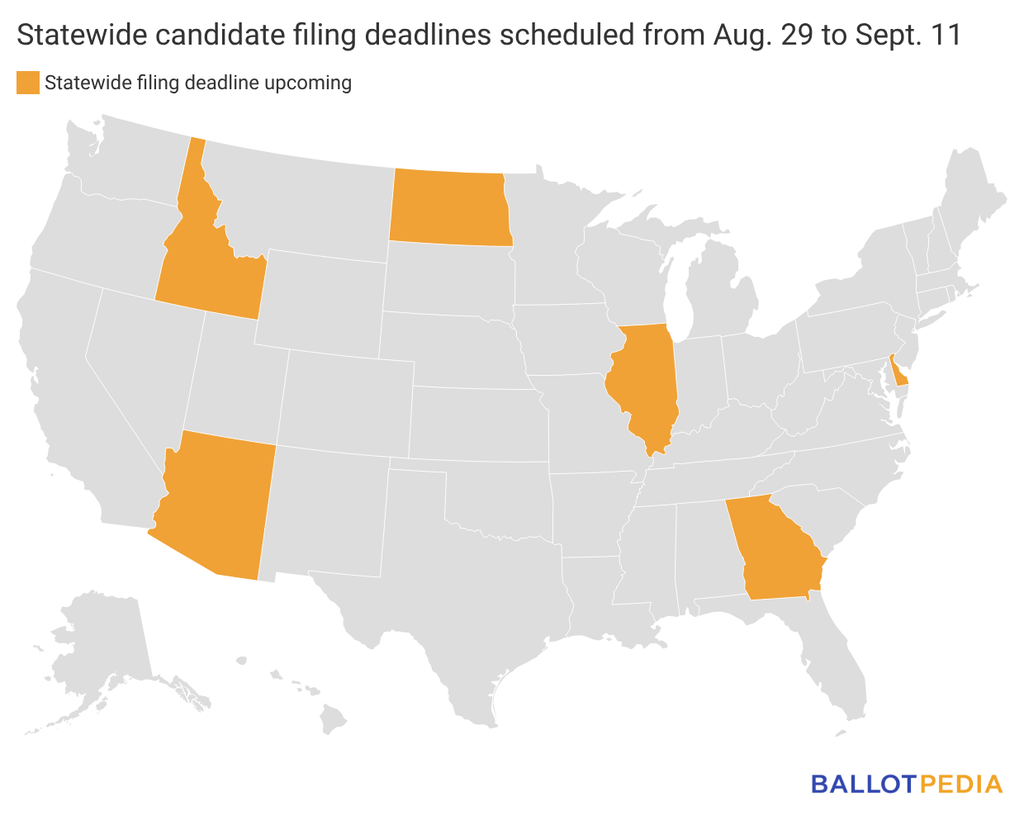
- American Samoa: Sept. 1 (territory-wide candidate filing deadline)
- Arizona: Sept. 4 (statewide general write-in candidate and judicial retention candidate filing deadline)
- Delaware: Sept. 1 (statewide unaffiliated candidate filing deadline)
- Georgia: Sept. 8 (statewide write-in candidate filing deadline)
- Guam: Sept. 4 (judicial retention candidate filing deadline)
- Idaho: Sept. 4 (statewide general write-in candidate filing deadline)
- Illinois: Sept. 3 (statewide general write-in candidate filing deadline)
- North Dakota: Aug. 31 (statewide unaffiliated candidate filing deadline)
Voting in upcoming elections
There are three statewide elections taking place in the next two weeks:
- Massachusetts: Sept. 1 statewide primary election
- New Hampshire: Sept. 8 statewide primary election
- Rhode Island: Sept. 9 statewide primary election
Voter participation deadlines
One state and Guam have early voting periods that start in the next two weeks:
- Delaware: Early voting begins Sept. 2 for the Sept. 15 primary.
- Guam: Early voting begins Sept. 8 for the Nov. 3 general election.
One state and the Northern Mariana Islands have voter registration deadlines in the next two weeks:
- New Hampshire: Sept. 8 is the last day to register in person to vote in the Sept. 8 primary.
- Northern Mariana Islands: Sept. 4 is the last day to register in person or by mail to vote in the Nov. 3 general election.
Two states have absentee/mail-in ballot request deadlines in the next two weeks:
- Delaware: Sept. 11 is the last day to request an absentee/mail-in ballot for the Sept. 15 primary.
- New Hampshire: Sept. 7 is the last day to request an absentee/mail-in ballot in person or online for the Sept. 8 primary.
Click here to see our list of upcoming election dates and filing deadlines.