


States have enacted 419 election-related bills so far this year — the most of any even-numbered session year since Ballotpedia launched its Election Policy Legislation Tracker in 2022.
These figures come from Ballotpedia's State of Election Policy Legislation 2026 Mid-Year Report, which covers election-related legislative activity captured in our legislation tracker through Aug. 14 of this year.
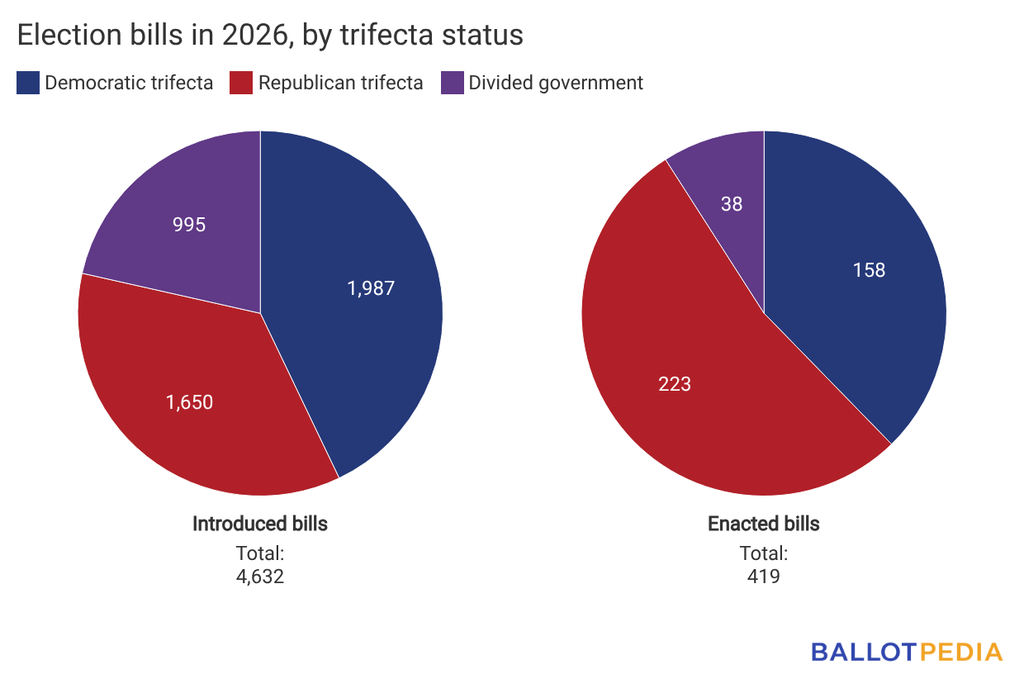
The 419 bills enacted in 44 states represent an 11% decline compared with this point in 2025. But when compared with past even-numbered session years, the 2026 total is 47% more than at this point in 2024, and roughly twice as many bills as were enacted in 2022. Four states — Montana, Nevada, North Dakota, and Texas — do not hold regular legislative sessions in even-numbered years.
Over half of the bills — 53.2% — were enacted in Republican trifecta states. Meanwhile, 37.7% were enacted in states with Democratic trifectas, roughly double the 2025 rate, and 9.1% of bills were enacted in states with divided governments.
Ballotpedia had tracked 4,632 election-related bills and resolutions as of Aug. 14 — nearly as many as were introduced in all of 2025. Of those measures, 42.9% were introduced in states with Democratic trifectas, 35.6% were introduced in states with Republican trifectas, and 21.5% were introduced in states with divided governments.
At this point in the 2024 session, states had introduced 3,635 election-related bills. In 2022, legislators had introduced 2,417 election bills at this point.
Lawmakers across the country have considered bills related to each of the 127 election legislation categories Ballotpedia covers, including the following noteworthy policy topics:
Absentee/mail-in voting
All states allow for some form of absentee/mail-in voting. Connecticut became the 29th state to allow any eligible voter to cast an absentee/mail-in ballot after Gov. Ned Lamont (D) signed HB 5001 into law on May 15.
Thirteen states require voters to provide a valid excuse to vote absentee/by mail. Eight states have automatic mail-in ballot systems, also known as all-mail voting systems.
Delaware is now the only state with a Democratic trifecta that requires voters to provide an excuse to request an absentee/mail-in ballot. Legislators passed SB 3, a constitutional amendment that would require no-excuse absentee voting. It passed both legislative chambers this spring but will only take effect if approved again next session. Delaware is the only state where the legislature can amend the constitution without voter approval.
Eleven of the other 12 states that require voters to provide an excuse to vote absentee/by-mail are Republican trifecta states, while one, Kentucky, has a divided government. None of those states advanced bills to allow for no-excuse absentee/mail-in voting.
Lawmakers in 40 states introduced 320 bills and resolutions related to absentee/mail-in voting. These bills address different elements of the absentee/mail-in voting process, including how and when voters can request and return an absentee/mail-in ballot, when election officials must mail ballots, and deadlines and procedures for curing problems with an absentee/mail-in ballot.
Regulations governing law enforcement presence near polling places
Seven Democratic trifecta states enacted 12 bills or resolutions on the presence of law enforcement, National Guard members, or immigration authorities at or near election sites.
The majority of the bills would prohibit law enforcement personnel from being within a set distance of polling places, tabulation sites, or election offices.
Lawmakers in California, Connecticut, Illinois, New Mexico, Oregon, Rhode Island, and Virginia enacted bills or resolutions related to this topic.
Changes to how primary elections are run
Currently, 14 states require open primaries, 13 require closed primaries, 10 require semi-closed primaries, and five require top-two style primaries for at least some federal or state-level offices. Eleven states give parties discretion to choose participation rules for their primaries.
Legislators introduced 193 bills related to primary elections in 2026. No states have enacted changes to these broader categories this year, but 11 states enacted bills to move a primary election date or change how primaries are administered.
Policies prohibiting or authorizing the use of ranked-choice voting
In 2026, two states with Republican trifectas, Indiana and Ohio, enacted legislation prohibiting the use of ranked-choice voting (RCV), bringing the total number of states with an RCV ban to 19.
Virginia became the first state since 2023 to approve legislation, SB 176, that allows or requires the statewide use of RCV for state or local elections.
Lawmakers have introduced 78 RCV-related bills. Forty-seven would authorize or require the use of RCV in at least some elections, while 20 bills would prohibit or repeal RCV.
Mid-decade redistricting
Three states — Florida, Louisiana, and Tennessee — enacted new congressional maps ahead of the 2026 midterm elections. In Virginia, voters approved a legislatively referred constitutional amendment 51%-48% on April 21 that would enact the maps contained in HB 29. The Virginia Supreme Court, however, ruled that the General Assembly violated procedural requirements when placing the measure on the ballot, overturning the result.
Three states, Indiana, Maryland, and South Carolina, had bills to enact new congressional maps pass one legislative chamber.
State-level voting rights acts
Three states — Delaware, Maryland, and New Jersey — enacted new state-level voting rights acts, or laws that mirror or expand upon the provisions of the Voting Rights Act of 1965. Two other states, Washington and Virginia, amended or expanded their existing state-level voting rights acts in 2026.
This is the first year that multiple states enacted new state-level voting rights acts in the same year. Nationally, 15 states introduced 24 bills to enact or amend state-level voting rights acts.
Changes to voter ID requirements
Thirty-six states require voters to present identification to vote at the polls on election day. Of these states, 24 require voters to present identification containing a photograph, with certain exceptions, and 12 states do not require photo identification. The remaining 14 states do not generally require voters to present identification in order to vote at the polls on election day.
None of the 14 states without voter ID requirements have advanced bills in 2026 to require it. And no state that allows non-photo identification has enacted legislation to require photo identification.
Legislators in three states — Arizona, Ohio, and Oklahoma — put constitutional amendments on the ballot related to voter ID in 2026. Three other states — California, Nevada, and North Carolina — will also have ballot measures in November on new voter ID laws or placing existing requirements in the state constitution.
Eleven states enacted bills modifying their existing voter ID requirements. Notable bills include Louisiana SB 319 and Iowa HF 2501. Legislators have introduced 204 bills related to voter ID so far in 2026.
Policies related to voter registration
Legislators in 44 states introduced 627 bills related to voter registration, which accounts for 13% of all bills introduced in 2026.
These bills change various aspects of the voter registration process, including creating documentary proof of citizenship requirements, changing the data sources election officials are required to use when carrying out voter list maintenance, and expanding automatic voter registration systems.
A common legislative focus in 2026 has been on expanding the data sources that election officials are required to use for voter list maintenance. That includes requiring or authorizing officials to use federal or state datasets, such as the Systematic Alien Verification for Entitlements system (SAVE), to check the citizenship status of individuals who are currently registered to vote.
Six states have enacted legislation on that topic in 2026. Notable enacted bills include KansasHB 2437 and LouisianaHB 691.
Ballotpedia publishes three reports each year that provide ongoing coverage of election-related legislative activity. Click here to see our past reports.