


Welcome to the Monday, Aug. 31, 2026, Brew.
By: Briana Ryan
Here’s what’s in store for you as you start your day:
- 2026 ballot measure count surpasses 153-measure even-year average, reaching 157 with Nebraska and Colorado certifications
- Maine's trifecta status could be decided in the Nov. 3 elections
- Federal judge temporarily blocks USPS rules implementing absentee/mail-in voting executive order
2026 ballot measure count surpasses 153-measure even-year average, reaching 157 with Nebraska and Colorado certifications
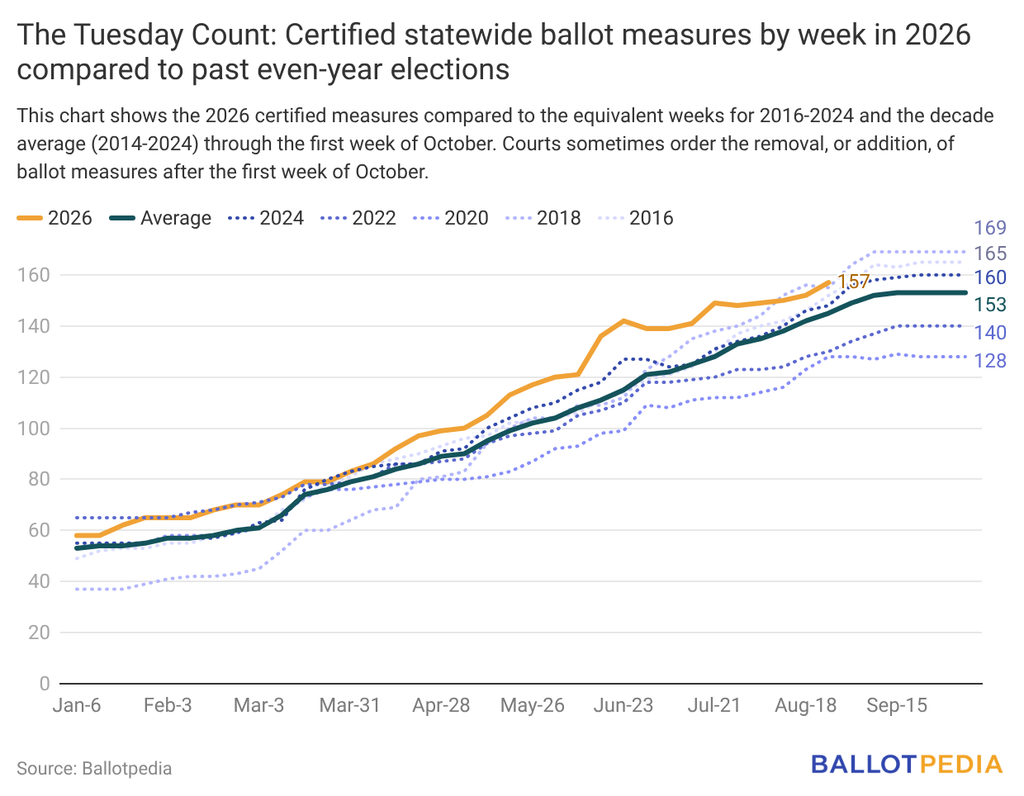
Two citizen initiatives in Nebraska and three in Colorado were recently certified, bringing the nationwide total for statewide ballot measures this year to 157. That's more than the historical average of 153 in even-numbered years from 2014 through 2024.
Certified ballot measures this year are also outpacing 2018, which had the most with 167 measures in a single year between 2014 and 2024. At this point in 2018, 155 measures had been certified. Measures could still qualify in several states this year, meaning the final total may increase. For example, 10 citizen initiatives are still pending signature verification or judicial rulings.
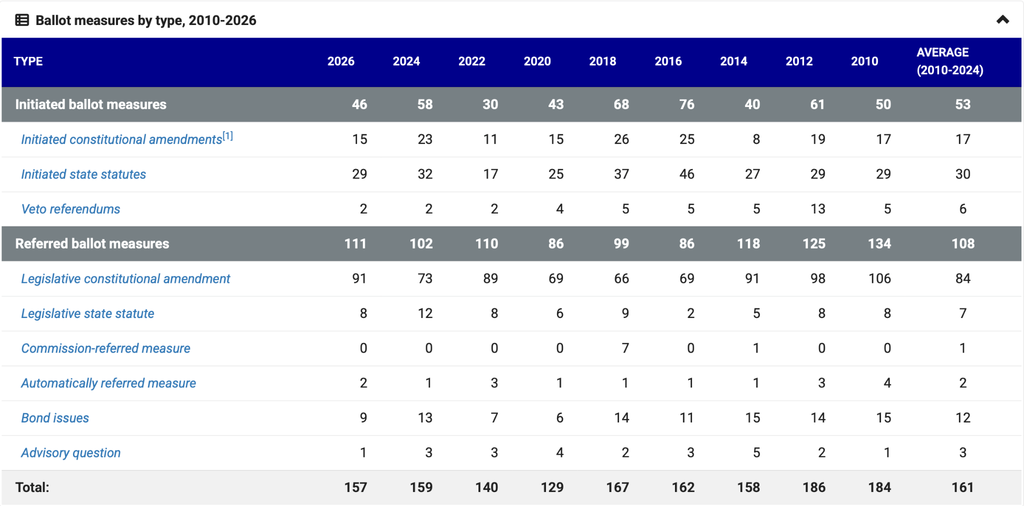
Driving this year’s increase are Louisiana and Massachusetts, both of which have more measures on the 2026 ballot than their annual averages between 2014 and 2024. Louisiana voters will decide on 15 measures, compared to an average of eight. Massachusetts voters will decide on nine measures, compared to an average of four.
Maine and Oregon both have fewer measures on the ballot this year than their annual averages between 2014 and 2024. Maine voters will not decide on any measures, compared with an average of five. Oregon voters will decide on one, compared to an average of six.
There are also more legislatively referred measures on the ballot in 2026 than in recent even-numbered years: 111, compared with an average of 108.
Nebraska measures
The Allow Laws Authorizing Online Sports Wagering Constitutional Amendment would amend the state constitution to allow the state legislature to enact laws authorizing online sports betting. The Allow and Regulate Online Sports Wagering Initiative would amend the state statute to provide a legal framework for authorizing online sports betting. It would also allow the state gaming commission to adopt rules and regulations governing the gaming operators.
Colorado measures
The Establish 4.4% Cap on Individual and Corporate Income Tax Rates Initiative would establish a 4.4% cap on individual and corporate income tax rates, which are currently set at 4.4%. The Right to Hunt and Fish Initiative would establish a state constitutional right to hunt, fish, and take fish and wildlife through traditional methods. It would also allow the Colorado Legislature and executive agencies to regulate it. The Retain Sporting Goods Sales Tax Revenue for Conservation and Wildfire Prevention Fund Initiative would allow the state to retain and spend sales tax revenue from sporting goods and equipment for water, land, forest, wildfire prevention, and outdoor recreation purposes rather than refunding the revenue under the Taxpayer's Bill of Rights (TABOR).
Click here to check out all the statewide measures on the ballot this year.
Maine’s trifecta status could be decided in the Nov. 3 elections
Welcome to our next installment of our 50 States in 50 Days series, covering Maine. To view our archive of past editions, click here.
Maine's trifecta status could be decided in the Nov. 3 elections. The state has an open governor's race. Additionally, all 35 seats in the Maine Senate and all 151 seats in the Maine House of Representatives are up for election.
Democrats currently have a 20-14 majority in the state Senate, with one independent, and a 75-73 majority in the state House, with three independents. Because the governor is a Democrat, Maine is one of 16 states with a Democratic trifecta.
We identified Maine's trifecta as highly exposed to breaking. Republicans would need to win at least four seats to win control of the state Senate, and Democrats would not be able to lose more than two seats. Republicans would also need to win at least two seats to win control of the state House, and Democrats would not be able to lose any seats.
Want to see what's on your ballot this November? Click here to use our Sample Ballot Lookup Tool. Now let's take a closer look at what's happening in Maine.
Maine is one of two states that use ranked-choice voting (RCV) for congressional general elections. Maine has also authorized RCV for all municipal elections, and it is currently used in Portland and Westbrook.
Voters must register online or via mail by Oct. 13. Voters can also register in person through Nov. 3.
Early voting opens Oct. 4 and ends Oct. 29.
Polls open on Election Day between 6:00 and 10:00 a.m., depending on the municipality, and close at 8:00 p.m.
Voter ID is not required to vote in Maine in most cases. Under a 2025 law, voters registering in person, including those registering to vote on Election Day, must provide proof of identity and residence.
The federal Help America Vote Act also requires that individuals in all 50 states who register to vote by mail and who have not voted previously in a federal election in their state must provide either their driver's license or a paycheck, bank statement, current utility bill, or government document showing their name and address.
Absentee/mail-in ballots must be requested by Oct. 29 and received by Nov. 3.
Current party control
Democrats represent both congressional districts. Maine has one independent U.S. Senator who caucuses with Democrats and one Republican U.S. Senator.
In addition to having a Democratic trifecta, Maine is one of 21 states with a Democratic triplex. That’s because the state’s governor, attorney general, and secretary of state are all Democrats. Democratic governors appointed all seven members of the Maine Supreme Judicial Court.
Offices on the ballot
In addition to the gubernatorial and legislative offices mentioned above, elections are taking place for the U.S. Senate and the U.S. House of Representatives.
Maine is also one of 32 states this year where we are providing comprehensive election coverage down to the local level. This year’s ballot includes elections for municipal and county offices as well as for school boards.
Notable elections
Maine will use RCV for both of the following notable elections:
In the U.S. Senate election, incumbent Sen. Susan Collins (R) and Troy Jackson (D) are running. Jackson won a nominating convention to become the Democratic nominee after the Democratic primary winner, Graham Platner (D), withdrew from the race. That was the 28th time since 1918 that a new candidate was selected to replace a U.S. Senate nominee. This seat is the only one Republicans are defending in a state that Kamala Harris (D) won in the 2024 presidential election. Harris defeated President Donald Trump (R) in the state 52.4% to 45.5%. In 2020, Collins defeated Sara Gideon (D) 51% to 42.4%.
In Maine's 2nd Congressional District election, state Auditor Matthew Dunlap (D) and former Gov. Paul LePage (R) are running. Incumbent Rep. Jared Golden (D) is not running for re-election. This election is for one of 23 Democratic-held districts that Trump won in the 2024 presidential election. He defeated Harris in the district 53.5% to 44.5%. Golden defeated Austin Theriault (R) in the district 50.3% to 49.7%.
Statewide ballot measures
There are no statewide measures on the ballot this year. From 2000 to 2025, voters decided on 60 ballot measures, or two per even-numbered year. Including measures decided in odd-numbered years, Maine voters decided on a total of 125 measures during that period, approving 92 and defeating 33.
Local ballot measures
We'll be adding information about local measures in Maine as they are certified ahead of the Nov. 3 election.
Tomorrow, we'll preview elections in Nebraska, the Cornhusker State.
Click here to see every edition of 50 States in 50 Days as we publish them, and here to use our Sample Ballot Lookup Tool.
Federal judge temporarily blocks USPS rules implementing absentee/mail-in voting executive order
On Aug. 27, a U.S. district court judge blocked the implementation of federal rules that would carry out an executive order President Donald Trump (R) issued earlier this year prohibiting the delivery of absentee/mail-in ballots to anyone who is not enrolled by state election officials with the U.S. Postal Service.
U.S. District Judge Indira Talwani's ruling came after USPS filed the final rules implementing the executive order on Aug. 21. The rules require officials to enroll voters in a USPS portal in order for them to receive a mail ballot. The physical ballot mail must also meet set standards and contain certain information, such as a unique ID number for each ballot envelope.
Talwani previously issued two injunctions blocking the implementation of portions of the order. But the U.S. Supreme Court stayed one of those two rulings, which had blocked two parts of the executive order in 23 states and the District of Columbia. In light of the Supreme Court's decision, Talwani then dissolved a separate injunction issued earlier in August that blocked the order from taking effect nationally.
In an unsigned order, the U.S. Supreme Court justices wrote that the federal government was likely to succeed on appeal because the plaintiffs lacked standing to challenge the order when they filed the lawsuit, and that the federal government would be irreparably harmed if the injunction remained in place.
"The Court’s disposition of this application does not mean that any measure taken by the Government to implement the Order will necessarily be lawful,” the order said. “On that score, time will tell. But the Order itself does not harm the States, so the District Court lacked jurisdiction to bar the Government from trying to implement it. And for the reasons discussed, that injunction is likely to irreparably harm the Government if it remains in place while the appellate process runs its course."
The court’s three justices who Democratic presidents appointed — Justices Ketanji Brown Jackson, Elena Kagan, and Sonia Sotomayor — dissented from the decision.
In her dissent, Jackson wrote that the stay "violates well-established precedents concerning this Court’s equitable discretion and needlessly injects chaos and uncertainty into the upcoming midterm elections."
After the Supreme Court ruling, attorneys general from 24 states and the District of Columbia filed a new lawsuit, alleging the final rules are unconstitutional. Other plaintiffs filed amended versions of their previous lawsuits to challenge the rules. The Department of Justice argued in their reply that the final rules were within USPS's authority.
Talwani issued a temporary restraining order, requiring USPS to pause the implementation or enforcement of parts of the rules for 14 days. In her order, Talwani wrote that "The court finds Plaintiffs likely to succeed on the merits of their claims that (1) the USPS lacked authority to issue the Final Rule; (2) the Final Rule is unconstitutional in imposing these requirements on the States; and (3) the Final Rule is unconstitutional in prohibiting non-compliant State and local officials from using the United States Postal Service to mail ballots."
A hearing on a temporary injunction, which would block the rules' implementation for longer than 14 days, will take place on Sept. 3.
In the final rules filed on Aug. 21, USPS said, "Given injunctions currently in place ... the Postal Service will not take actions to implement the rule specifically for the 2026 election unless and until the government obtains relief from those injunctions. If the government obtains timely relief from the injunctions, implementation immediately thereafter will provide election officials as much time as possible before the next election to comply with the rule’s preparation standards for Federal Ballot Mail envelopes, and to prepare to submit data to the Federal Ballot Mail Portal ('Portal'), before the mail-in and absentee ballots subject to this rule are mailed."
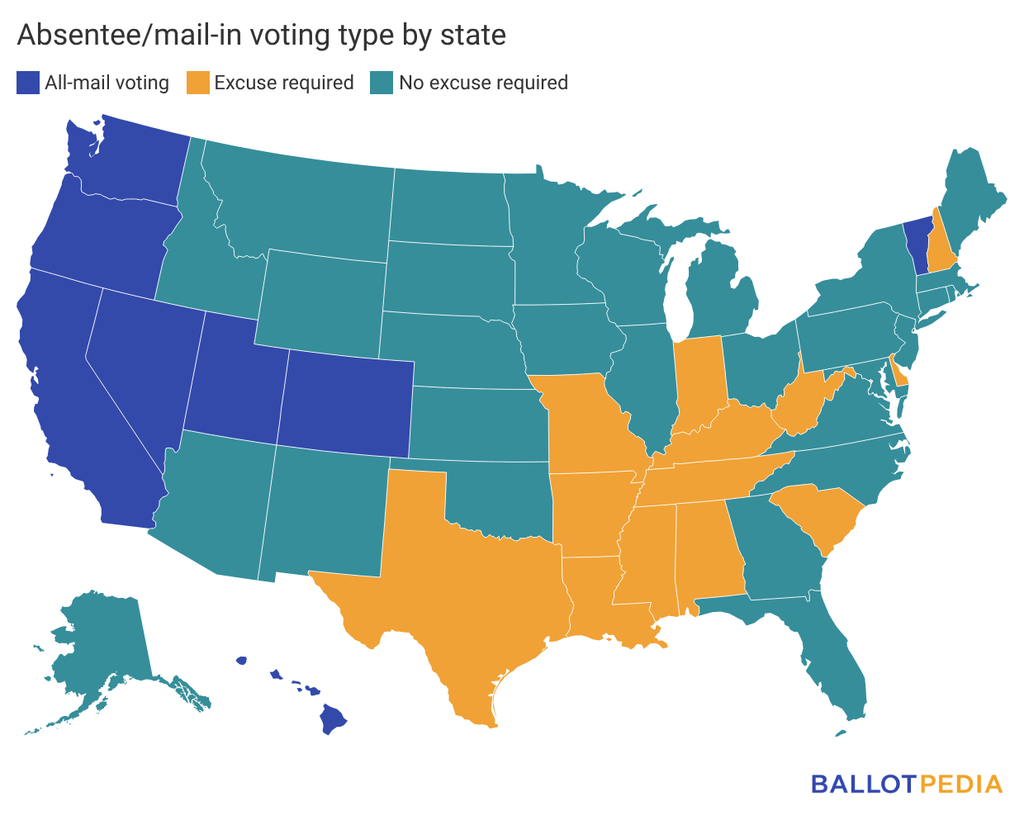
Every state has a method allowing voters to cast ballots without visiting a physical polling place.
Thirteen states require voters to provide a valid excuse to vote by mail. Twenty-nine states allow any eligible voter to cast an absentee/mail-in ballot. Eight states have all-mail voting systems in which every eligible voter is automatically sent a mail ballot.
Click here for more information on litigation surrounding the executive order.