


Welcome to the Tuesday, Sept. 1, 2026, Brew.
By: Lara Bonatesta
Here’s what’s in store for you as you start your day:
- Colorado mail-in ballot voter ID initiative becomes seventh voter ID measure certified for 2026 — the most in a single year
- Nebraska to hold second straight U.S. Senate election without both major parties on the ballot — a first since 1914
- In the Aug. 18 elections, Recognized Endorsement Contributor-backed candidates won 63% of races
Colorado mail-in ballot voter ID initiative becomes seventh voter ID measure certified for 2026 — the most in a single year
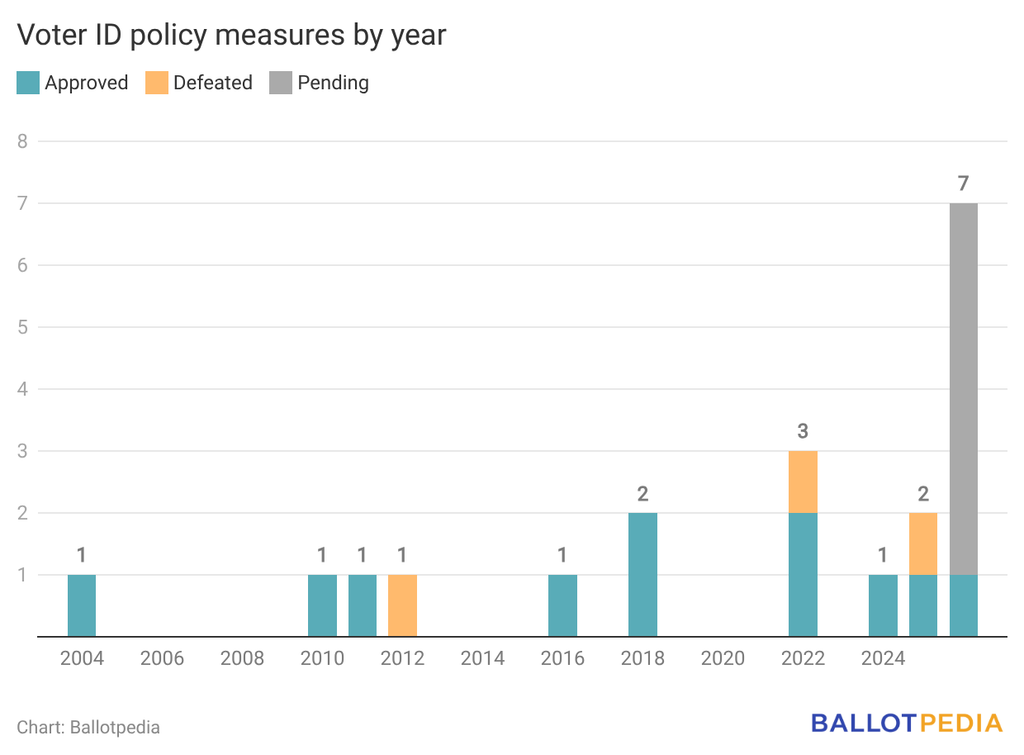
Colorado will be the seventh state to decide on a voter ID measure this year. The seven state measures are the most on this topic in any year. The previous record was three such measures in 2022.
Colorado’s Initiative 362 would add a new section to Article VII of the Colorado Constitution, requiring voters casting mail-in ballots to provide both their signature and an identification number, such as:
- the last four digits of their Social Security number,
- a Colorado REAL ID number,
- a Colorado REAL ID driver's license number, or
- the last four digits of another Colorado identification number meeting federal REAL ID requirements.
Initiative 362 would also require election officials to compare the information voters provide to the statewide voter registration database. If there is any discrepancy:
- the voter must be notified,
- the voter may provide a copy of their identification to correct the discrepancy, and
- the ballot cannot be counted until the discrepancy is corrected.
Currently, Colorado requires voters to sign their mail ballot envelope, but does not require additional identification.
The Colorado secretary of state's office certified Initiative 362 for the ballot on Aug. 26, announcing that its proponents submitted 133,321 valid signatures, surpassing the required minimum of 124,238 to qualify for the ballot.
The Colorado Voter Trust Initiative supports the measure and has raised approximately $2.2 million as of July 2026. As of Aug. 27, a campaign has not formed to oppose the initiative.
Between 2004 and 2025, voters in 12 states decided on 13 ballot measures to create or increase voter identification requirements. Voters approved ten of these measures and rejected three. The average vote was 60.2%, with the highest at 79.5% in Arkansas (2018) and the lowest at 35.8% in Maine (2025).
Michigan Proposal 2 (2022) was the only measure not intended to establish or expand voter identification requirements. Voters approved it 60% to 40%. Instead, it added the state’s existing identification-or-affidavit requirement to the Michigan Constitution, preventing the legislature from eliminating the affidavit option without voter approval.
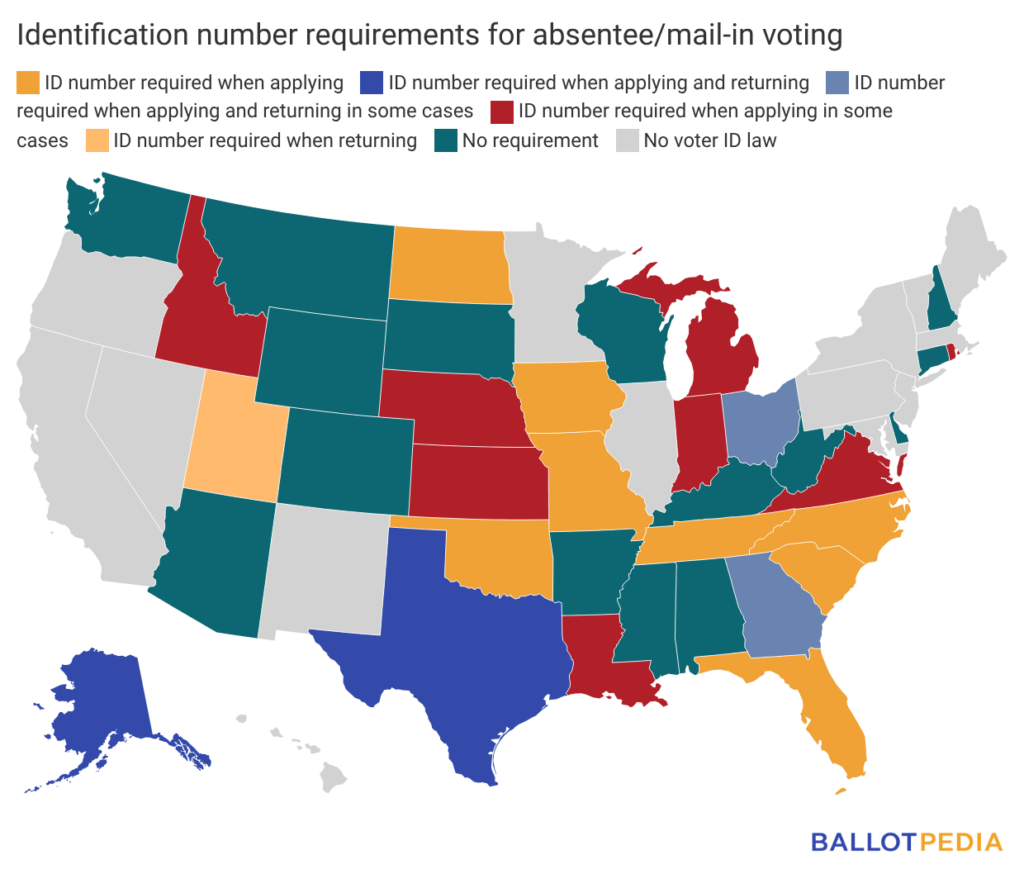
Currently, 21 states require voters to provide a driver's license number, Social Security number, or other identification number to vote by absentee/mail-in ballot.
On Aug. 25, voters in Oklahoma approved State Question 846 54.6% to 45.4%. It created a constitutional requirement for voters to provide legislatively defined proof of identity when voting in any election in the state.
Other voter ID measures are set to appear on the ballot in Arizona, California, Nevada, North Carolina, and Ohio.
Initiative 362 is the eleventh measure that Colorado voters will decide on Nov. 3, appearing alongside nine other citizen initiatives and one legislative referral. Three additional citizen initiatives are currently in the certification process, having submitted signatures to the secretary of state's office.
Click here to read more about the voter ID measure in Colorado, and here to read more about all voter ID measures in 2026.
Nebraska to hold second straight U.S. Senate election without both major parties on the ballot — a first since 1914
Welcome to our next installment of our 50 States in 50 Days series, covering Nebraska. To view our archive of past editions, click here.
On Nov. 3, Nebraska will hold its second straight U.S. Senate election without both major parties on the ballot. Nebraska is the first state since the direct election of U.S. senators began in 1914 to hold two consecutive regular or special U.S. Senate elections with no Democratic candidate.
As we mentioned in our July 24 edition of the Daily Brew, this is also the 17th U.S. Senate election we identified since 2000 with no Democratic candidate, compared to four with no Republican candidate.
Want to see what’s on your ballot this November? Click here to use our Sample Ballot Lookup Tool. Now let’s take a closer look at what’s happening in Nebraska.
Early voting opens Oct. 5 and ends Nov. 2.
Polls open on Election Day at 8:00 a.m. and close at 8:00 p.m.
Voter ID is required. Acceptable forms of ID include a Nebraska driver’s license or state ID, a college ID, a military ID, or a U.S. passport. Click here for a full list of accepted IDs. Voters may complete a reasonable impediment certification if they have a religious objection to being photographed or are unable to obtain an ID due to a disability, illness, or a lack of required documentation.
Absentee/mail-in ballots must be requested by Oct. 23 and received by Nov. 3.
Current party control
Republicans represent all three of Nebraska’s congressional districts. Both of Nebraska’s U.S. Senators are also Republicans.
Republicans have a 33-14-2 majority in Nebraska’s Senate. Nebraska is the only state with a unicameral state legislature. While the Nebraska Senate is also officially nonpartisan, almost all of the members are affiliated with either the Democratic or the Republican Party, and both parties explicitly endorse candidates.
Because the governor is a Republican, Nebraska is one of 23 states with a Republican trifecta. Nebraska’s attorney general and secretary of state are also Republicans. As a result, Nebraska is one of 24 states with a Republican triplex. Republican governors appointed all seven judges on the Nebraska Supreme Court.
Offices on the ballot
Elections are taking place for the U.S. Senate and the U.S. House of Representatives. Fourteen state executive offices and 24 seats in the state Senate are also up for election. One additional state Senate seat is also up for special election.
Nebraska is one of 32 states this year in which we are covering all local elections for school boards and municipal offices.
Battleground elections
U.S. Senate election: Incumbent Sen. Pete Ricketts (R) and Dan Osborn (Nonpartisan) are running in the general election for U.S. Senate. Both candidates ran in separate general elections in November 2024 to represent Nebraska in the Senate.
In the 2024 elections, Osborn lost to incumbent Sen. Deb Fischer (R) 53.2% to 46.5%, and Ricketts defeated Preston Love Jr. (D) 62.6% to 37.4% in the special election.
Democratic nominee Cindy Burbank withdrew from the general election on July 17. The Nebraska Democratic Party endorsed Osborn, who has said he will not caucus with either party if elected. Burbank’s withdrawal was one of six instances of a major or minor party nominee withdrawing from a U.S. Senate general election this year. One other nominee, Mike Marvin (Legal Marijuana Now Party), also withdrew in Nebraska this year. His name will remain on the ballot because he announced after the Aug. 3 deadline for Nebraska candidates to withdraw and have their names removed.
Nebraska's 2nd Congressional District: Denise Powell (D), Brinker Harding (R), and Eric Michael Foreman (L) are running. Incumbent Don Bacon (R), who was first elected in 2016, is not running for re-election. As of July 2026, major election forecasters rated the general election Lean Democratic or Tilt Democratic.
This is one of eight Republican-held U.S. House districts up for election in 2026 that Kamala Harris (D) won in the 2024 presidential election. That year, Bacon won re-election 50.9%–49.1% and Harris defeated Donald Trump (R) 51.6%–47.0% in the 2nd District.
Omaha Public Power District elections: Three of eight seats are up for nonpartisan election on the Omaha Public Power District Board. The board, which serves 906,000 people in 13 counties, is the 12th-largest public power utility per number of customers in the country. In Subdivision 1, Sara Kohen and Christian Mapes are running. In Subdivision 2, Mark Gudgel and Jay Ignowski are running. In Subdivision 3, Carol Blood and Jim Smith are running.
Control of the board could be at stake in November. Kohen, Gudgel, and Blood have all either mentioned renewable energy in their campaign materials or received backing from pro-environmental groups. Smith and Mapes both list endorsements from various Republican politicians. Ignowski has endorsements from several building trades unions and several Democratic officeholders.
Statewide ballot measures
In Nebraska, voters will decide on at least four statewide ballot measures. The deadline to certify measures for the 2026 ballot is Sept. 11 in Nebraska. Between 1860 and 2025, Nebraskans voted on 424 state ballot measures, approving 266 (63%) and defeating 158 (37%). An average of 13 measures appeared on the ballot in even-numbered years. For more information about the history of Nebraska’s ballot measures, visit its Historical Measures Factbook.
Here’s a closer look at the measures.
The Legislature referred an amendment to the ballot that would change the term limit for state legislators from two consecutive four-year terms (eight years) to three consecutive four-year terms (12 years). Nebraska is one of 16 states that currently have state legislative term limits. Currently, five states, including Nebraska, have a term limit of two consecutive four-year terms (eight years) for their respective state Senates. One state, Louisiana, has a term limit of three consecutive four-year terms (12 years) for both chambers.
Nebraska voters adopted state legislative term limits in 2000 with the approval of Initiative Measure 415. It passed 55.8% to 44.2%.
Tax Relief Nebraska qualified two ballot initiatives that would together legalize and regulate online sports betting in the state. One is a constitutional amendment that would allow for laws to regulate sports betting, and the other is a statute that would allow online sports betting and authorize the state gaming commission to adopt rules and regulations governing the gaming operators.
Fairness for Girls qualified an initiative that would require schools to "designate each athletic team or sport as one of the following based on biological sex: "male, female, or co-ed. It would prohibit "athletic teams or sports designated for females, women, or girls" from being "open to students of the male sex." The requirements would apply to teams sponsored by public schools and to private school teams that compete against public school teams. During the 2025 legislative session, the Nebraska Legislature enacted a law requiring students participating in public K-12 or collegiate sports to compete on teams designated for their sex, which the law defines according to reproductive systems. This measure would not establish new requirements beyond the ones the Legislature passed in 2025. As a constitutional amendment, it would take another statewide vote to amend or repeal it. Three other initiatives to establish sex-based requirements for participation on school athletic teams will also appear on the ballot in Arizona, Colorado, and Washington in November.
On Aug. 31, the Nebraska Secretary of State announced that a fifth measure, the Require a Four-Fifths Vote for Legislative Ballot Initiative Changes Amendment, would not be placed on the ballot after finding that the proposed amendment violated the state’s single-subject rule for ballot measures. Respect Nebraska Voters, the campaign sponsoring the initiative, said that it would challenge the Secretary of State’s decision.
Local ballot measures
We’ll be adding information about local measures in Nebraska as they are certified ahead of the Nov. 3 election.
Join us again tomorrow when we'll preview elections in California, the Golden State.
Click here to see every edition of 50 States in 50 Days as we publish them, and here to use our Sample Ballot Lookup Tool.
In the Aug. 18 elections, Recognized Endorsement Contributor-backed candidates won 63% of races
Ballotpedia tracks endorsements from organizations we call Recognized Endorsement Contributors (RECs). These groups include political action committees, local associations, unions, media editorial boards, and more that publicly support candidates and communicate those choices to voters. In the Aug. 18 statewide elections, we tracked 2,345 endorsements from 471 RECs across three states: Alaska, Florida, and Wyoming. These included 887 endorsements of candidates in local races.
1,468 candidates, or about 63%, of those that RECs endorsed on Aug. 18 won their respective races. 534 candidates lost, and 343 ran in races that are still uncalled.
Local primaries
Endorsements can be particularly helpful in local primaries, which are often officially nonpartisan. In these instances, voters can’t rely on the party label, which typically gives them a quick sense of what a candidate stands for. Here are some case studies that illustrate this point.
Mayor of St. Petersburg, Fla.
Three RECs endorsed competing candidates in the nonpartisan primary for mayor of St. Petersburg, Fla.
- Charlie Crist finished first with 35.2% of the vote and advanced to the general election. Endorsements Ballotpedia tracked for Crist included a co-endorsement from the Tampa Bay Times editorial board.
- Incumbent Kenneth Welch finished second with 20.7% of the vote and advanced to the general election. Endorsements Ballotpedia tracked for Welch included Equality Florida Action, Forward Florida, and the state chapter of the Service Employees International Union.
- Brandi Gabbard finished fourth in the primary with 17.6% of the vote. Endorsements Ballotpedia tracked for Gabbard included a co-endorsement from the Tampa Bay Times editorial board, Suncoast Sierra Club, and Suncoast Tampa Association of Realtors.
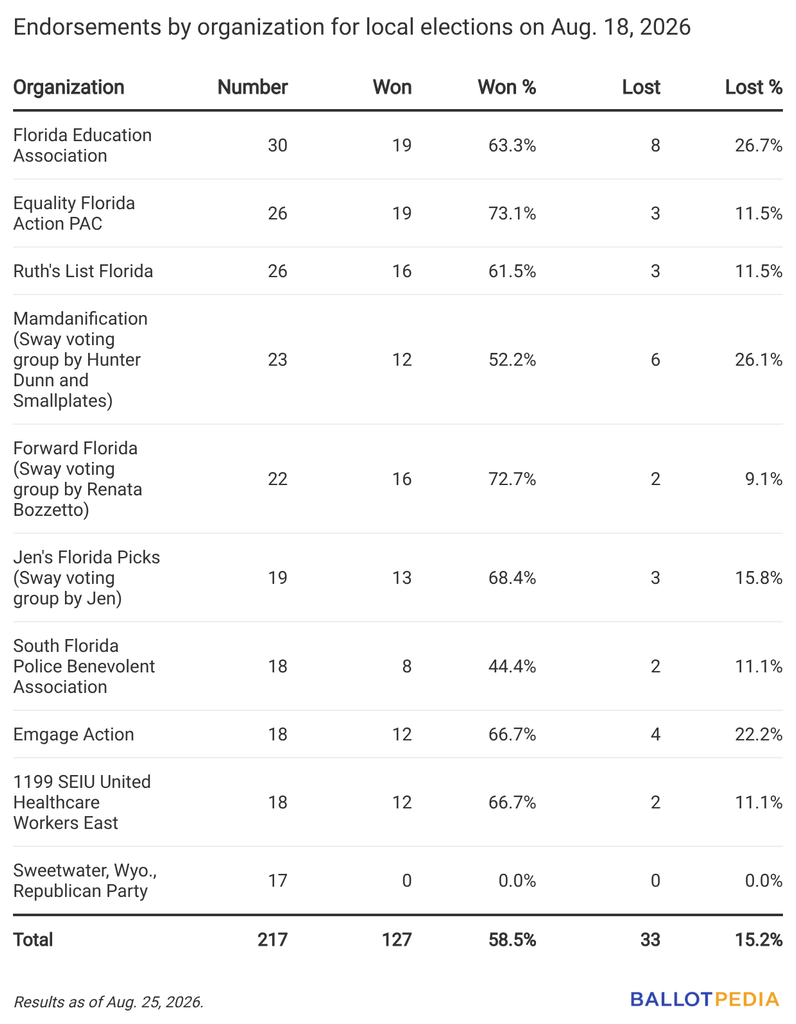
Collectively, the 10 RECs that endorsed the most candidates in local elections on Aug. 18 endorsed 217 candidates. Of those, 127 (59%) won or advanced to the next election stage, while 33 (15%) lost. The table below displays these organizations and their endorsee success rates. (Fifty-seven candidates, or 26% of the candidates that these RECs endorsed, ran in races that were either uncalled or for which Ballotpedia does not cover results.)
Partisan primaries
In partisan primaries, endorsements can help voters identify meaningful differences between candidates who otherwise share the same party affiliation.
One such example from Aug. 18 was the Democratic primary for District 108 in the Florida House. Different RECs supported two of the three candidates in this primary:
- Daphne Campbell won the primary with 46.2% of the vote. Endorsements Ballotpedia tracked for Campbell included the Associated Industries of Florida and Florida Realtors PAC.
- Dinah Escarment finished second with 42% of the vote. Endorsements Ballotpedia tracked for Escarment included the Florida AFL-CIO, Florida Education Association, and Run for Something.
We identified eight RECs that issued more than 50 endorsements each in these primary elections. The table below displays the organizations and their endorsee success rates.
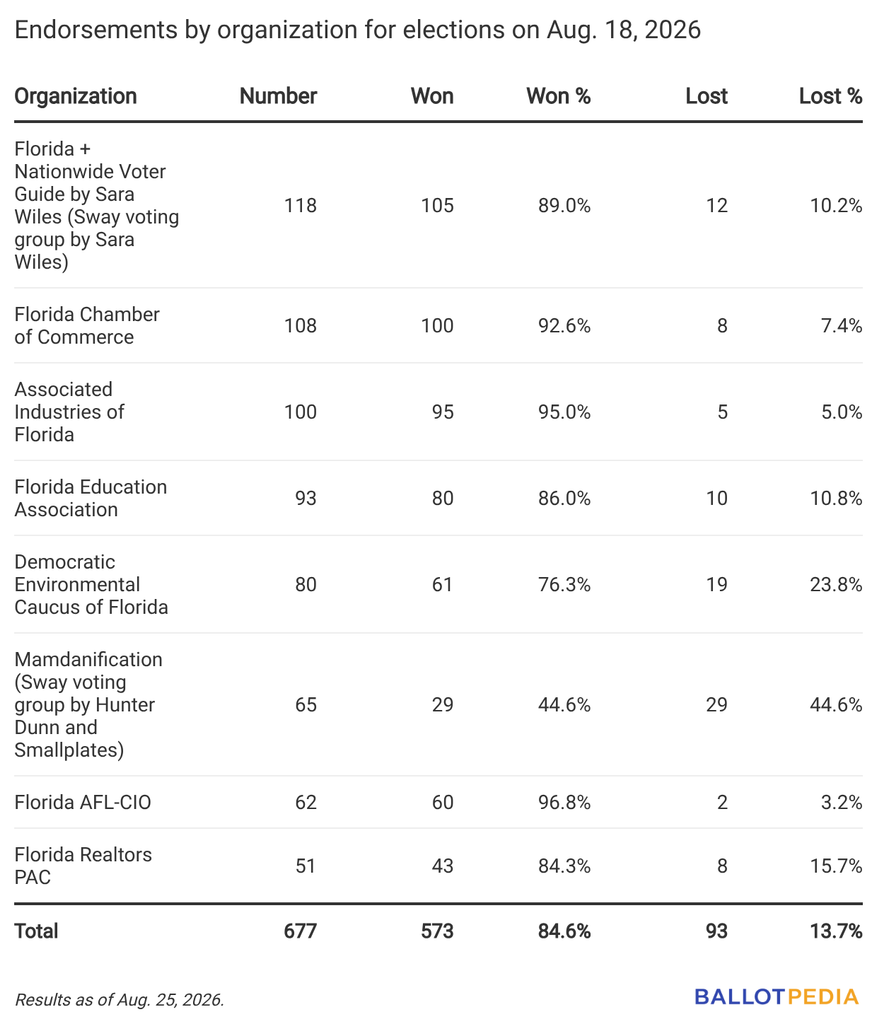
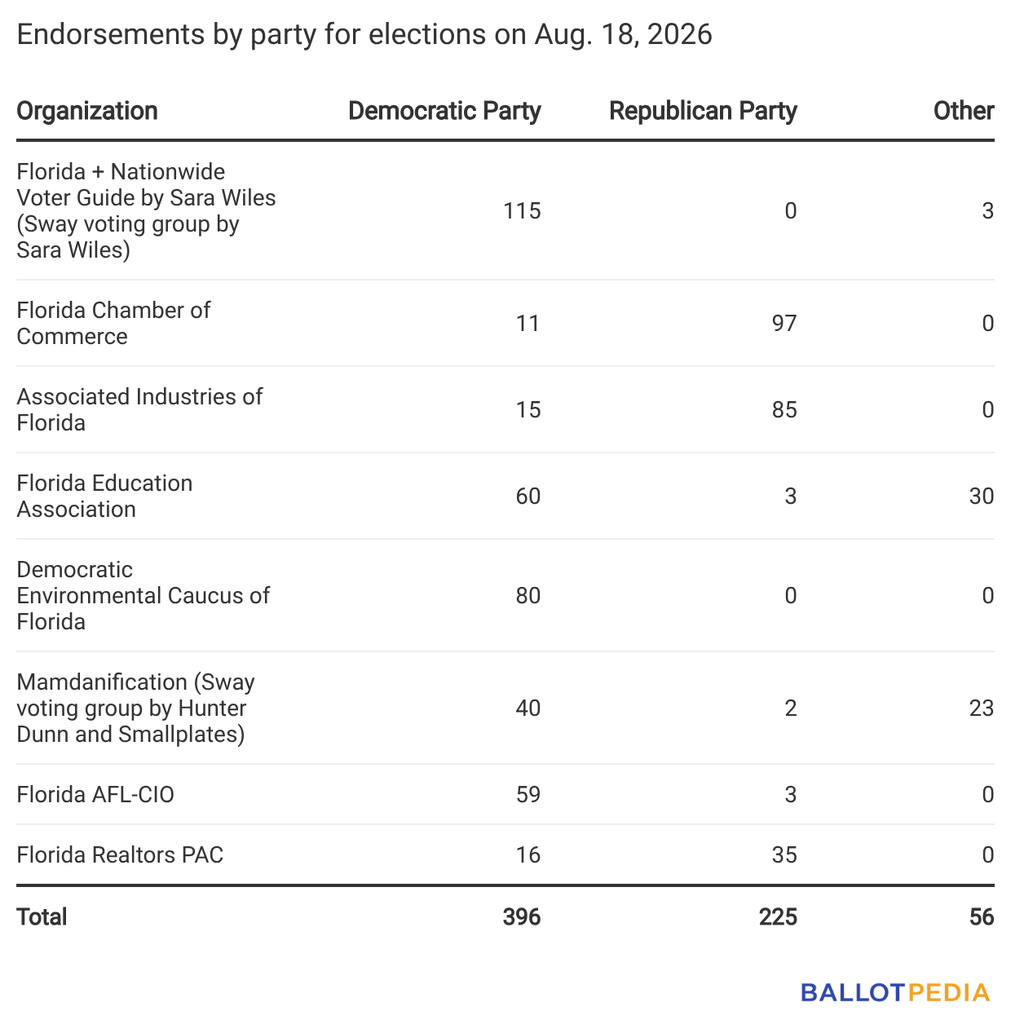
Among these organizations, all but two endorsed candidates from multiple political parties in these partisan primaries:
- Florida + Nationwide Voter Guide: This Sway voting group endorsed 115 Democratic candidates.
- Democratic Environmental Caucus of Florida: Endorsed 80 Democratic candidates.
The remaining organizations endorsed candidates from both major political parties in these partisan primaries. The table below displays the partisan affiliation for all candidates these eight RECs endorsed.
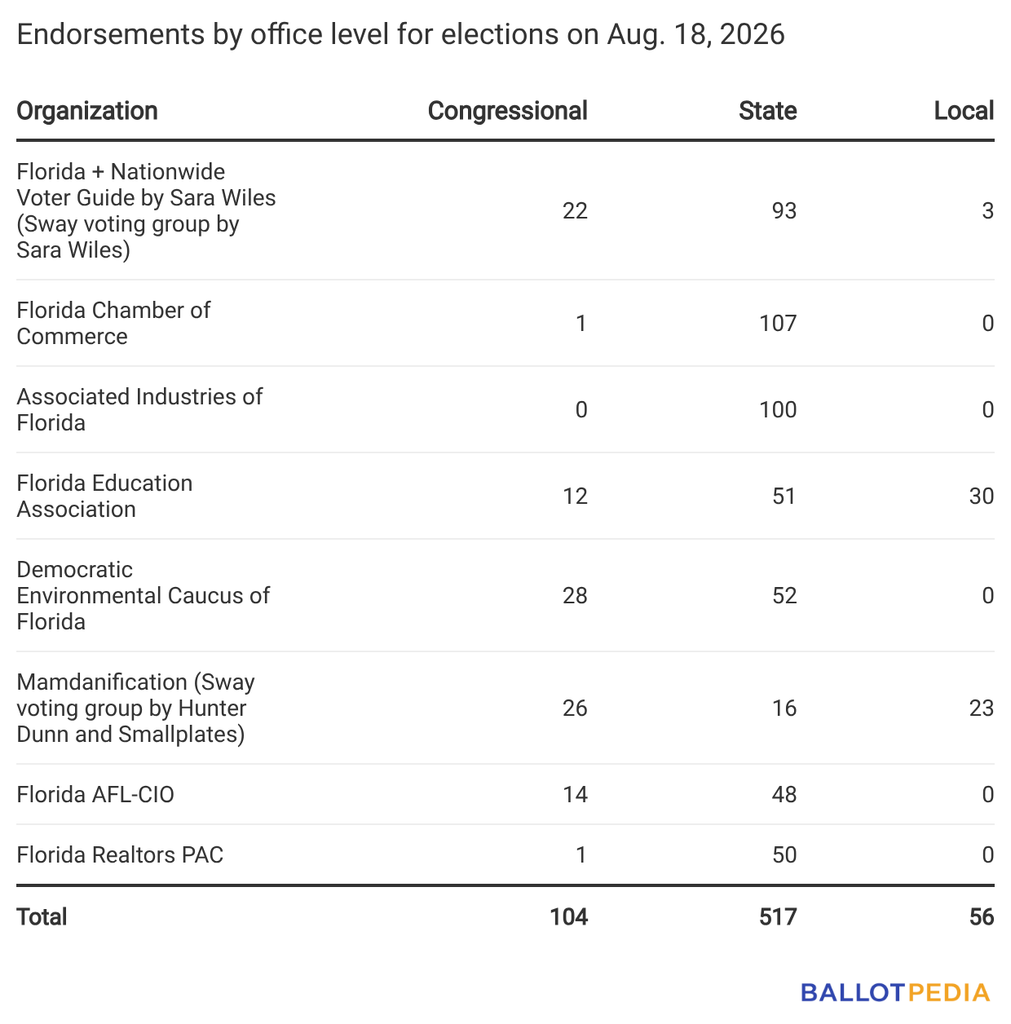
These eight RECs’ endorsements were mostly in state primaries (517), followed by congressional (104) and local primaries (56). Three of the eight RECs endorsed in local races. The table below displays endorsements these RECs issued by level of government.
Ballotpedia is tracking endorsements made by organizations in races at all levels of government, with a particular focus on groups that endorse candidates at the local level. Endorsements are one component of Ballotpedia's goal to provide robust information — data that helps voters understand who a candidate is and what their political philosophy is — for every office on the ballot.
Click here to read more about Recognized Endorsement Contributors.