


Welcome to Ballot Bulletin: Ballotpedia's Weekly Election Policy Digest. Every Tuesday, we deliver the latest updates on election policy around the country, including nationwide trends and recent legislative activity.
In this week’s edition, we cover 26 bills state legislatures acted on last week and summarize the State of Election Policy Legislation 2026 Mid-Year Report.
The state of election legislation in the U.S.
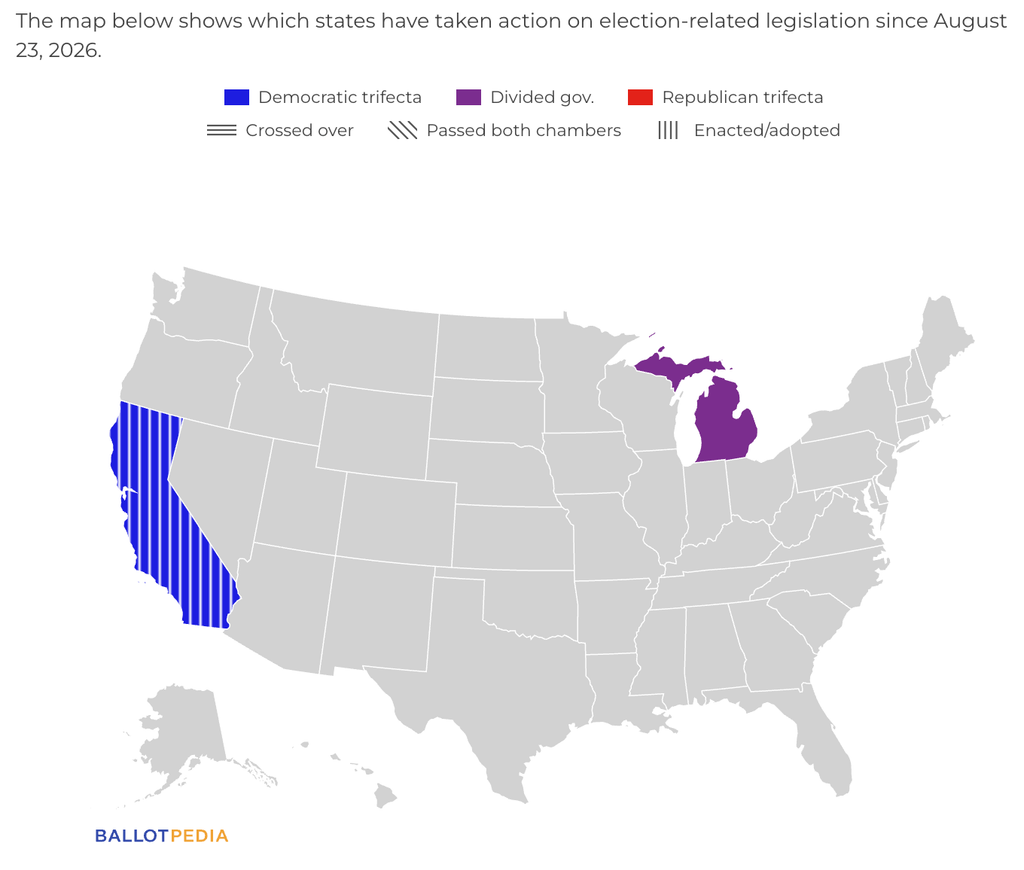
Lawmakers in two states acted on 26 election-related bills last week. Six state legislatures are in regular or special sessions. Last week, three bills were enacted, six bills passed both chambers of a state legislature, and no bills were vetoed.
Of the bills acted on last week, 21 (80.8%) are in states with Democratic trifectas, none are in states with Republican trifectas, and five (19.2%) are in states with divided government. The most active bill categories last week were campaign finance (7), ballot access (5), election types and stages (5), ballot measures (4), offices (4), and election officials and workers (4).
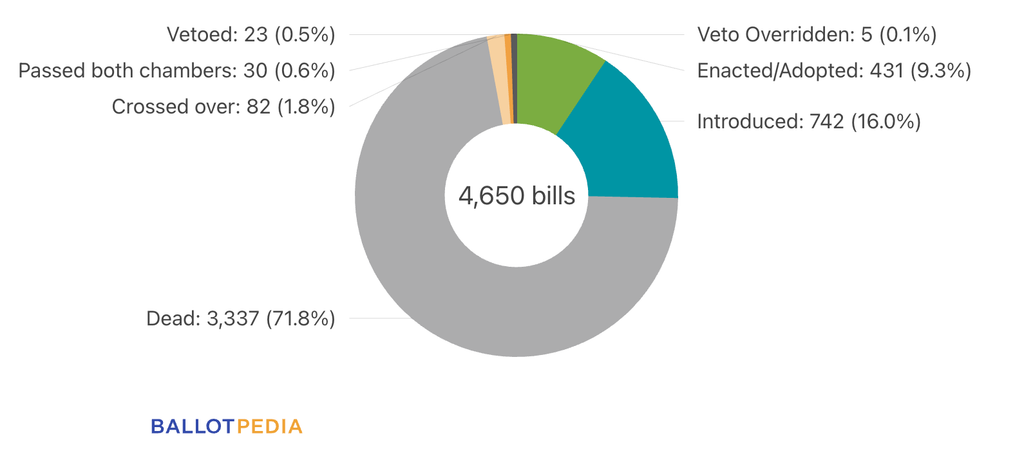
We are currently tracking 4,650 election-related bills across the country. The chart below breaks down the status of those bills based on where they stand in the legislative process:
Enacted bills
Three bills were enacted or adopted last week:
Bills passing both chambers
Six bills passed both chambers of a state legislature last week:
To see a full list of bills awaiting gubernatorial action, click here.
Vetoed bills
No bills were vetoed last week.
To see a list of all bills vetoed this session, click here.
All bills
The chart below shows all bills Ballotpedia is currently tracking, broken down by partisan sponsor.
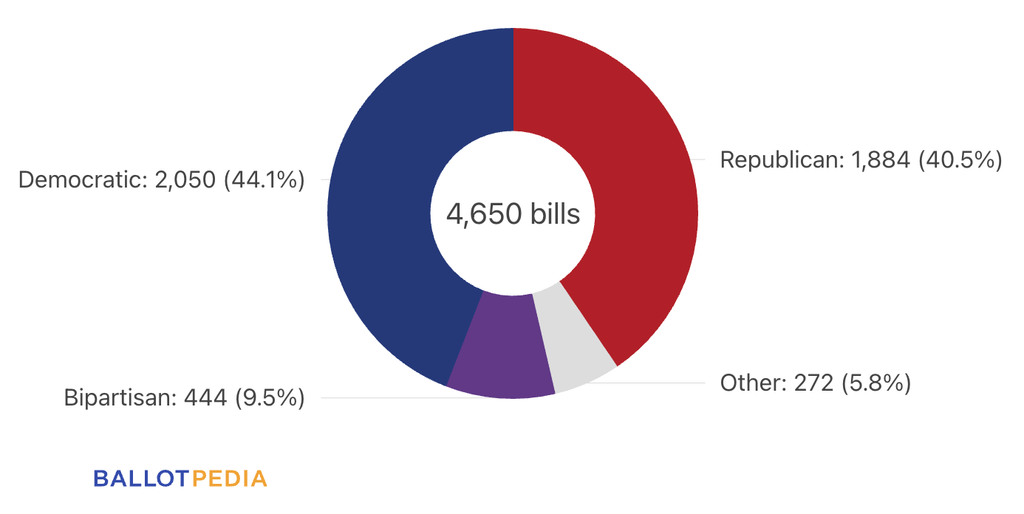
We are currently following 4,650 election-related bills, including bills carried over from the previous year.
- Trifecta status
- Democratic: 1,999 (43%)
- Republican: 1,651 (35.5%)
- Divided: 1,000 (21.5%)
- Partisan sponsorship
- Democratic: 2,050 (44.1%)
- Republican: 1,884 (40.5%)
- Bipartisan: 444 (9.5%)
- Other: 272 (5.8%)
In the news
On Aug. 27, the U.S. District Court for the District of Massachusetts blocked the implementation of federal rules that would carry out an executive order President Donald Trump (R) issued earlier this year prohibiting the delivery of absentee/mail-in ballots to anyone who is not enrolled by state election officials with the U.S. Postal Service. Judge Indira Talwani's ruling came after USPS filed the final rules implementing the executive order on Aug. 21. The rules require state officials to enroll voters in a USPS portal in order for them to receive a mail ballot. The physical ballot mail must also meet set standards and contain certain information, such as a unique ID number for each ballot envelope.
Talwani previously issued two injunctions blocking the implementation of portions of the order, as covered in the Aug. 18 edition of Ballot Bulletin. The U.S. Supreme Court stayed one of those two rulings, which had blocked two parts of the executive order in 23 states and the District of Columbia. Following the Supreme Court's decision, Talwani dissolved a separate injunction issued earlier in August that blocked parts of the order from taking effect nationally.
After the Supreme Court ruling, attorneys general from 24 states and the District of Columbia filed a new lawsuit, alleging the final rules are unconstitutional. Other plaintiffs filed amended versions of their previous lawsuits to challenge the rules. The Department of Justice argued in their reply that the final rules were within USPS's authority.
Talwani issued a temporary restraining order, requiring USPS to pause the implementation or enforcement of parts of the rules for 14 days. Talwani wrote that “the court finds Plaintiffs likely to succeed on the merits of their claims that (1) the USPS lacked authority to issue the Final Rule; (2) the Final Rule is unconstitutional in imposing these requirements on the States; and (3) the Final Rule is unconstitutional in prohibiting non-compliant State and local officials from using the United States Postal Service to mail ballots.”
A hearing on a temporary injunction, which would block the rules' implementation for longer than 14 days, will take place on Sept. 3.
Here are other news stories from across the country:
- On Aug. 26, an Anne Arundel County Circuit Court judge blocked Maryland’s Question 3 on redistricting from appearing on the November 2026 ballot. Judge Robert Thompson said that the legislatively-referred constitutional amendment the Maryland General Assembly authorized during its Aug. 3-5, 2026, special session was deficient because it did not follow the correct legal process and has a misleading ballot measure description. On Aug. 28, another judge in Dorchester County issued a ruling blocking the ballot measure. The state filed a notice of appeal with the Maryland Supreme Court, and Thompson’s order is paused until the results of that appeal are determined.
- On Aug. 25, the U.S. Court of Appeals for the Eleventh Circuit vacated and remanded a 2023 decision from the U.S. District Court for the Northern District of Georgia which found that Georgia’s congressional maps illegally weakened Black voting power. The appeals court said that the U.S. Supreme Court’s decision in Louisiana v. Callais merits a reconsideration of the case, given the change in the legal basis for determining illegal vote dilution. In the per curiam decision, the court specified that the lower court will have to reconsider “whether Georgia’s redistricting plans violate Section 2 of the Voting Rights Act under the updated Callais framework.”
- On Aug. 24, the League of Women Voters and a South Dakota voter sued South Dakota Secretary of State Monae Johnson and members of the State Elections Board. The lawsuit concerns SB 175, enacted in March 2026, which requires documentary proof of citizenship during voter registration. In the complaint, the plaintiffs said that the law violates the procedural due process clause of the Fourteenth Amendment by providing insufficient notice or ballot curing procedures for individuals assigned “federal-only voter” status when registering to vote. On June 2, the League of Women Voters submitted a petition to the elections board with suggestions to standardize the administration of SB 175’s provisions. On July 8, the elections board rejected the petition on a 5-2 vote and said the nonprofit lacked legal standing to challenge the rules.
Policy spotlight: States enact more than 400 election-related bills in first seven months of 2026
The story below is adapted from a recent Ballotpedia News story by Andrew Bahl.
States have enacted 419 election-related bills so far this year — the most of any even-numbered session year since Ballotpedia launched its Election Policy Legislation Tracker in 2022. These figures come from Ballotpedia's State of Election Policy Legislation 2026 Mid-Year Report, which covers election-related legislative activity captured in our legislation tracker through Aug. 14 of this year.
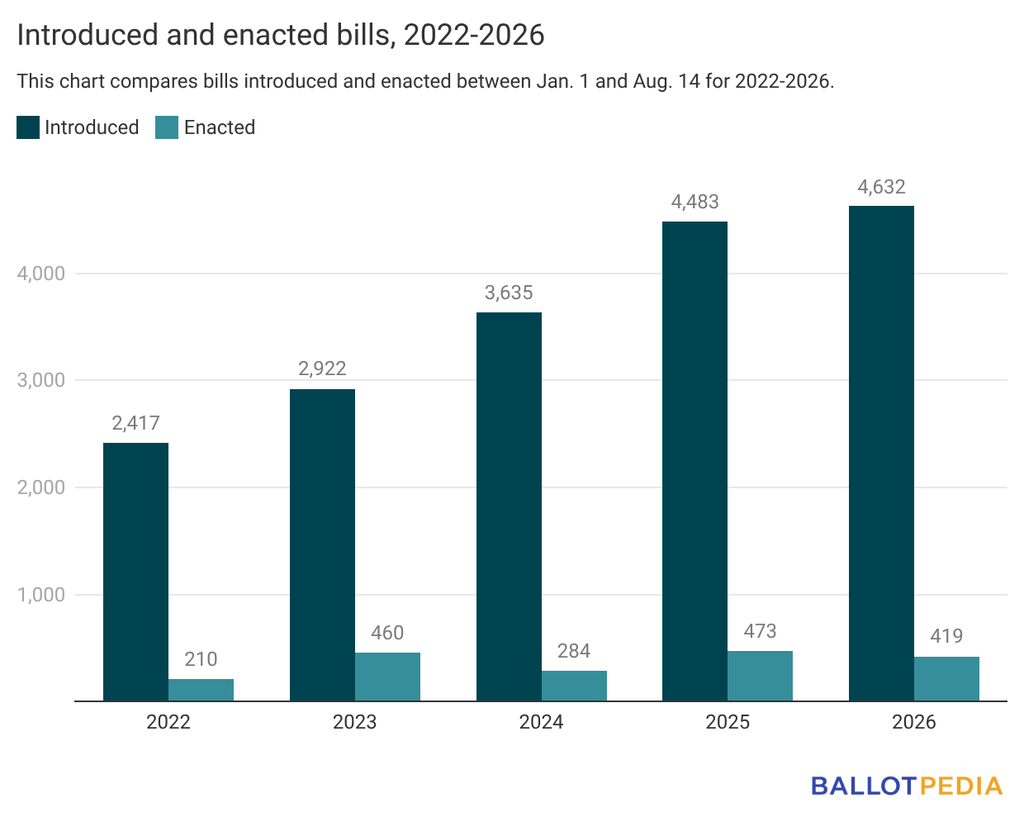
The 419 bills enacted in 44 states represent an 11% decline compared with this point in 2025. Compared with past even-numbered session years, the 2026 total is 47% more than at this point in 2024, and roughly twice as many bills as were enacted in 2022. Montana, Nevada, North Dakota, and Texas do not hold regular legislative sessions in even-numbered years.
Ballotpedia had tracked 4,632 election-related bills and resolutions as of mid-August — nearly as many as were introduced in all of 2025. At this point in the 2024 session, states had introduced 3,635 election-related bills. In 2022, legislators had introduced 2,417 election bills at this point.
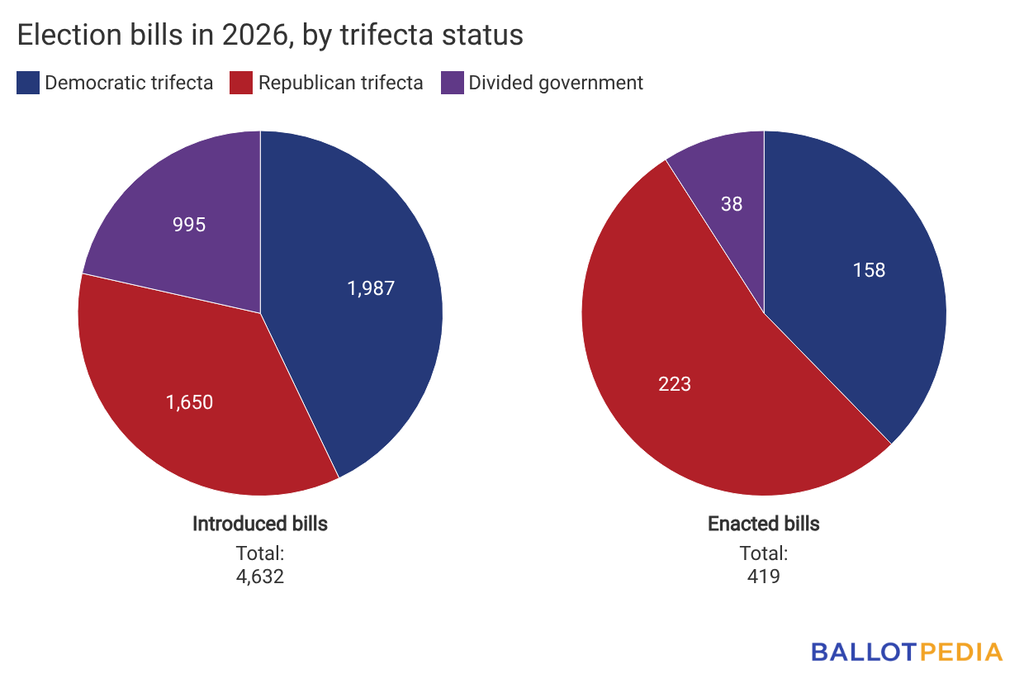
More than half of the bills enacted so far this year (53.2%) were enacted in states with Republican trifectas. Meanwhile, 37.7% were enacted in states with Democratic trifectas, roughly double the 2025 rate, and 9.1% of bills were enacted in states with divided governments.
Virginia, which gained a Democratic trifecta in January, had the most election bills enacted of any state and accounted for 29% of all bills enacted in Democratic states. For more information on Virginia’s 2026 session, click here.
Of the bills introduced in 2026, 42.9% were introduced in states with Democratic trifectas, 35.6% were introduced in states with Republican trifectas, and 21.5% were introduced in states with divided governments.
Lawmakers across the country have considered bills related to each of the 127 election legislation categories Ballotpedia covers, including the following noteworthy policy topics:
Absentee/mail-in voting
All states allow for some form of absentee/mail-in voting. Connecticut became the 29th state to allow any eligible voter to cast an absentee/mail-in ballot after Gov. Ned Lamont (D) signed HB 5001 into law on May 15.
Thirteen states require voters to provide a valid excuse to vote absentee/by mail. Eight states have automatic mail-in ballot systems, also known as all-mail voting systems.
Delaware is now the only state with a Democratic trifecta that requires voters to provide an excuse to request an absentee/mail-in ballot. Legislators passed SB 3, a constitutional amendment that would require no-excuse absentee voting. It passed both legislative chambers this spring but will only take effect if approved again next session. Delaware is the only state where the legislature can amend the constitution without voter approval.
Eleven of the other 12 states that require voters to provide an excuse to vote absentee/by-mail are Republican trifecta states, while one, Kentucky, has a divided government. None of those states advanced bills to allow for no-excuse absentee/mail-in voting.
Lawmakers in 40 states introduced 320 bills and resolutions related to absentee/mail-in voting. These bills address different elements of the absentee/mail-in voting process, including how and when voters can request and return an absentee/mail-in ballot, when election officials must mail ballots, and deadlines and procedures for curing problems with an absentee/mail-in ballot.
Regulations on law enforcement presence near polling places
Seven Democratic trifecta states enacted 12 bills or resolutions on the presence of law enforcement, National Guard members, or immigration authorities at or near election sites.
The majority of the bills would prohibit law enforcement personnel from being within a set distance of polling places, tabulation sites, or election offices.
Lawmakers in California, Connecticut, Illinois, New Mexico, Oregon, Rhode Island, and Virginia enacted bills or resolutions related to this topic.
Changes to how primary elections are run
Currently, 14 states require open primaries, 13 require closed primaries, 10 require semi-closed primaries, and five require top-two style primaries for at least some federal or state-level offices. Eleven states give parties discretion to choose participation rules for their primaries.
Legislators introduced 193 bills related to primary elections in 2026. No states have enacted changes to these broader categories this year. Eleven states enacted bills to move a primary election date or change how primaries are administered.
Policies prohibiting or authorizing the use of ranked-choice voting
In 2026, two states with Republican trifectas, Indiana and Ohio, prohibited the use of ranked-choice voting (RCV), bringing the total number of states with an RCV ban to 19.
Virginia became the first state since 2023 to approve legislation, SB 176, that allows or requires the statewide use of RCV for state or local elections.
Lawmakers have introduced 78 RCV-related bills. Forty-seven would authorize or require the use of RCV in at least some elections, while 20 bills would prohibit or repeal RCV.
Mid-decade redistricting
Florida, Louisiana, and Tennessee voluntarily enacted new congressional maps ahead of the 2026 midterm elections. In Virginia, voters approved a legislatively referred constitutional amendment 51%-48% on April 21 that would enact the maps contained in HB 29. The Virginia Supreme Court, however, ruled that the General Assembly violated procedural requirements when placing the measure on the ballot, overturning the result.
Indiana, Maryland, and South Carolina had bills to enact new congressional maps pass one legislative chamber.
State-level voting rights acts
Three states — Delaware, Maryland, and New Jersey — enacted new state-level voting rights acts, or laws that mirror or expand upon the provisions of the Voting Rights Act of 1965. Two other states, Washington and Virginia, amended or expanded their existing state-level voting rights acts in 2026.
This is the first year that multiple states enacted new state-level voting rights acts in the same year. Nationally, 15 states introduced 24 bills to enact or amend state-level voting rights acts.
Changes to voter ID requirements
Thirty-six states require voters to present identification to vote at the polls on election day. Of these states, 24 require voters to present identification containing a photograph, with certain exceptions, and 12 states do not require photo identification. The remaining 14 states do not generally require voters to present identification in order to vote at the polls on election day.
None of the 14 states without voter ID requirements have advanced bills in 2026 to require it. And no state that allows non-photo identification has enacted legislation to require photo identification.
Legislators in three states — Arizona, Ohio, and Oklahoma — put constitutional amendments on the ballot related to voter ID in 2026. Three other states — California, Nevada, and North Carolina — will also have ballot measures in November on new voter ID laws or placing existing requirements in the state constitution.
Eleven states enacted bills modifying their existing voter ID requirements. Notable bills include Louisiana SB 319 and Iowa HF 2501. Legislators have introduced 204 bills related to voter ID so far in 2026.
Policies related to voter registration
Legislators in 44 states introduced 627 bills related to voter registration, which accounts for 13% of all bills introduced in 2026.
These bills change various aspects of the voter registration process, including creating documentary proof of citizenship requirements, changing the data sources election officials are required to use when carrying out voter list maintenance, and expanding automatic voter registration systems.
A common legislative focus in 2026 has been on expanding the data sources that election officials are required to use for voter list maintenance. That includes requiring or authorizing officials to use federal or state datasets, such as the Systematic Alien Verification for Entitlements system (SAVE), to check the citizenship status of individuals who are currently registered to vote.
Six states have enacted legislation on that topic in 2026. Notable enacted bills include Kansas HB 2437 and Louisiana HB 691.