


Welcome to Hall Pass, a newsletter written to keep you plugged into the conversations driving school board governance, the politics surrounding it, and education policy.
In today’s edition, you’ll find:
- On the issues: The debate over HHS’ proposed changes to Head Start
- School board filing deadlines, election results, and recall certifications
- No party affiliation, GOP are top choices in Indiana’s first partisan school board elections
- Extracurricular: education news from around the web
- Candidate Connection survey
On the issues: The debate over HHS’ proposed changes to Head Start
In this section, we curate reporting, analysis, and commentary on the issues school board members deliberate when they set out to offer the best education possible in their district. Missed an issue? Click here to see the previous education debates we’ve covered.
On Aug. 6, the U.S. Department of Health and Human Services (HHS) released a proposal to modify regulations governing Head Start, a federal program created in 1965 and operating in all 50 states. Head Start provides children from low-income families and pregnant women with access to free preschool services and some neonatal and post-natal healthcare.
Head Start operates through federal grants awarded to local nonprofits and government organizations, such as school districts. In Fiscal Year 2026, Congress allocated $12 billion to Head Start. In 2024, roughly 800,000 children and pregnant women were enrolled in the program.
HHS says its proposal would overhaul Head Start’s Performance Standards, eliminating duplicative regulations and giving states more latitude over their own programs while maintaining accountability and alignment with federal law. According to the proposal, the changes “would ultimately empower states to actively lead the advancement of early childhood education, ensuring meaningful impact for children and families.”
Among other things, HHS calls for replacing many of the regulations governing eligibility, recruitment, and enrollment with a new framework that would lessen reporting requirements not otherwise required by the law. The proposal also calls for giving local organizations authority over transportation practices, background checks, and staff-child ratios, and placing greater emphasis on family engagement. The proposal would also require all instruction to occur in English and providers to offer “nutrient-dense, whole foods.”
HHS’ announcement came in the form of a notice of proposed rulemaking, a preliminary version of a prospective federal agency regulation. Individuals have until Oct. 6 to leave comments on the proposed changes at Regulations.gov.
Today, we look at two differing perspectives on HHS’ announcement.
Bloomberg Opinion columnist Mary Ellen Klas says studies find that Head Start has a salutary record of preparing low-income children for success in school, college, and the workforce. Klas says HHS’ proposal would effectively dismantle the program, harming low-income children and the working parents who depend on it for childcare services. Klas says the changes would allow local providers to reduce the number of staff caring for children, operate their programs for fewer hours during the day, and hire less qualified teachers — changes she says would most affect rural and underserved communities.
The Wall Street Journal’s Editorial Board says Head Start has been saddled with an ever-increasing amount of regulations, reducing the program’s effectiveness. The Editorial Board says many of the regulations seem designed to benefit grant recipients, not children. The Editorial Board says studies do not find that Head Start boosts graduation rates or benefits children academically in the long run. The Editorial Board says HHS’ proposed rules will save the federal government money and allow states to experiment and find what works best for kids.
This Federal Program Is So Effective, the White House Can’t Stand It | Mary Ellen Klas, Bloomberg Opinion
“Head Start was designed to be flexible but maintain quality, but the new rule does the opposite. For example, it requires local Head Start programs to operate only in English, eliminating support for bilingual students (with a carve-out for Native American tribes). It allows centers to replace trained teachers with those without qualifications. It reduces the staff-to-child ratio that has been a hallmark of the program’s success, erects barriers to parental involvement and ends the mandate that Head Start programs operate for a full day.”
…
“Rural and Southern families will be hit especially hard. If state ratios become the default standard, the number of toddlers per staffer will more than double in nine states — all of them in the South and Southwest. Moreover, Head Start programs are often the only source of childcare for families in rural and underserved areas, so if those programs operate for a minimum of three hours, as the new rule allows, rural parents will have few alternatives.”
A Welcome Trump Restart for Head Start | Editorial Board, Wall Street Journal
“The researchers posited that the program’s quality may have deteriorated in recent decades. Could a growth in federal mandates bear some of the blame? Federal funds are conditioned on preschool providers following 133 pages of rules, which prescribe everything from how often children brush their teeth to classroom disciplinary procedures.
“Grant recipients must ensure mental-health consultations are available at least once a month and ensure ‘collaborative relationships and partnerships with community organizations’ that administer welfare programs. That’s more about full employment for those ‘community’ outfits than helping children. Other mandates seem intended to boost union employment—for instance, a requirement that one ‘monitor’ be present on all school buses carrying Head Start participants.”
School board update: filing deadlines, election results, and recall certifications
In 2026, Ballotpedia will cover elections for more than 30,000 school board seats. We’re expanding our coverage each year with our eye on covering the country’s more than 80,000 school board seats.
Election results from the past week
Idaho
The Boise School District, in Idaho, held a special general election for an at-large seat on the Board of Trustees on Sept. 1. Andy Hawes, who previously served as a trustee, defeated Kirt Naylor 50.93% to 49.07%.
No party affiliation, GOP are top choices in Indiana’s first partisan school board elections
A new Indiana law requiring partisan school board elections is in effect for the first time this year, and nearly half of the 1,033 candidates running in 277 districts for office on Nov. 3 opted against selecting a party label. The next most common choice was the Republican Party, which 36% of candidates selected.
No other designation — including the independent and Democratic Party designations — was selected by more than 8% of candidates.
Indiana is one of 23 states where Ballotpedia is providing information on every school board race in 2026, giving us a detailed look at how the Hoosier State’s transition into partisan school board elections is playing out. Click here to see districts holding elections and the candidates running in them.
How Indiana’s partisan school board elections work
More than 85% of school board candidates in the U.S. run in nonpartisan races, without a party label appearing next to their names on the ballot. That was true for candidates in Indiana until last year, when Gov. Mike Braun (R) signed legislation making Indiana the fifth state in the country to require partisan school board elections.
Click here to read Hall Pass’ deep dive into the law from 2025.
In their filing paperwork, candidates running for school board in one of Indiana’s 290 districts must declare a party affiliation, identify as an independent, or say that they are not affiliated with a political party and do not identify as an independent.
Whether a school board candidate can run as a Republican or Democrat depends on how that candidate has voted in the two most recent primary elections. Candidates wishing to run as Republicans who haven't voted in the two most recent GOP primaries must seek a certification from the county chair of the local Republican Party.
More than one candidate in a race can be affiliated with the same political party.
The law allows individuals to challenge a candidate’s party affiliation, as happened recently to two candidates running for Indianapolis Public Schools school board. Incumbent Chris Bultman and challenger Lindsey Cornett both filed as Democrats in the special general election to represent District 4, but challengers alleged that neither had voted in the two most recent Democratic primaries. Ultimately, the Marion County Election Board ruled on Aug. 10 that Cornett did not satisfy the law’s requirements and removed her from the ballot, while keeping Bultman in the race as a Democrat. In response, Cornett filed as a write-in candidate and has asked a court to review the Marion County Election Board’s decision.
Candidates split on declaring a partisan affiliation
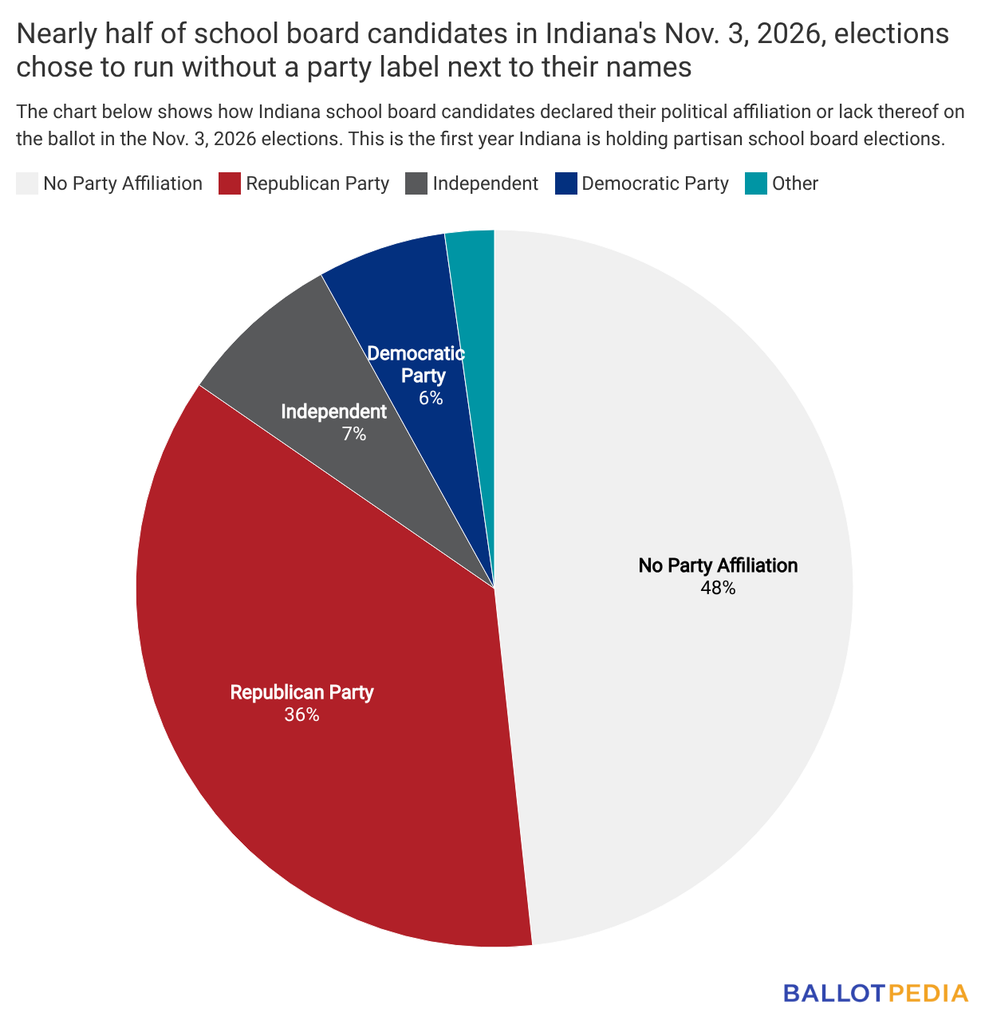
Roughly half of Indiana school board candidates chose to run without a party affiliation. The other half declared a combination of major- and minor-party affiliations, as well as both “independent” and “nonpartisan.”
Here’s the breakdown:
- No Party Affiliation (499)
- Republican Party (375)
- Independent (76)
- Democratic Party (60)
- Nonpartisan (15)
- American Solidarity Party (4)
- Libertarian Party (4)
Indiana has a Republican trifecta.
The state does not capture party affiliation information when voters register, meaning that it isn’t possible to tell precisely how many voters in the state are registered Republicans, Democrats, or something else. However, according to the Independent Voter Project, a nonpartisan organization “dedicated to re-engaging voters and promoting election reform,” primary election and voter file data suggest that roughly 30% of voters are affiliated with the Republican Party, 25% are affiliated with the Democratic Party, and 45% identify as independents.
A plurality of races feature only candidates running without a party label
Across the state, 276 school districts are holding 629 races. In nearly three-quarters, candidates either exclusively opted against a party affiliation or affiliated with the Republican Party.
Here’s how the race composition breaks down:
- All No Party Affiliation: 267 races (42%)
- All Republican: 185 races (29%)
- Mixed designations: 134 (21%)
- All independent: 19 (3%)
- All Democratic: 15 (2%)
- All nonpartisan: 9 (1%).
There are no races with only Libertarian or American Solidarity candidates.
Roughly 62% of Indiana’s school board races this year are uncontested, meaning only one candidate filed to run.
How Indiana compares to other states with partisan school board elections
Indiana is one of five states that require partisan school board elections, alongside Alabama, Connecticut, Louisiana, and Pennsylvania. Additionally, five states — Georgia, North Carolina, Rhode Island, South Carolina, and Tennessee—allow for both partisan and nonpartisan elections, depending on the district.
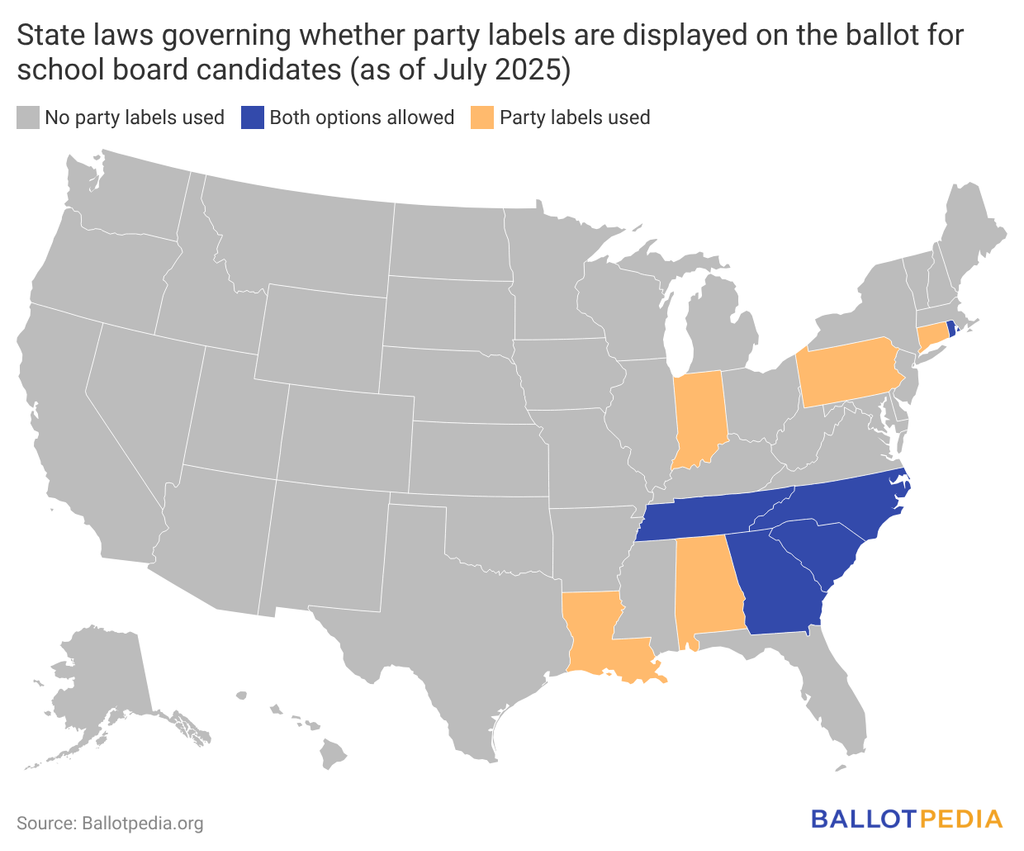
The 10 states where some or all school board elections are partisan use different rules for how candidates can identify themselves. In Louisiana, where candidates run in partisan elections, all candidates, regardless of party affiliation, compete in the same primary. If no candidate receives more than 50% of the vote, the top-two vote-getting candidates advance to a general election, regardless of party affiliation.
In North Carolina, however, where only some districts hold partisan elections, candidates with the same party label run in primaries, seeking the nomination, before advancing to a general election. Unaffiliated candidates run only in general elections.
Ballotpedia is covering all school board elections in North Carolina in 2026. Of the 108 North Carolina school districts holding elections this year, 61 (56%) have partisan elections and 47 (44%) have nonpartisan elections. Among the candidates who ran for school board in the 61 districts with partisan elections, 63% were Republicans, 35% were Democrats, and 2% were unaffiliated.
You can learn more about the rules governing party labels in school board elections here.
Extracurricular: education news from around the web
This section contains links to recent education-related articles from around the internet.
- Reading won’t save liberalism | The Argument
- Districts buckle on LGBTQ+ policies under Trump administration pressure | K-12 Dive
- More Schools Are Imposing Phone Bans. Do They Really Work? | The Wall Street Journal
- School Choice Wouldn’t Just Reform Education. It Would Reform Society | New Oxford Review
- Central Ohio schools supporting immigrant students who lost TPS status | The Columbus Dispatch
- The Best Way to Help Kids Settle in at College? Back Away and Let Them Grow Up | The 74
- Poll: Americans want stronger rules for AI in schools | Scripps News
- Schools Caught Flat-Footed After Google Makes Gemini Chatbot Available to All Students | Education Week
- Educators Say Immigration Enforcement Is Emptying Their Classrooms | The Century Foundation
Take our Candidate Connection survey to reach voters in your district
Today, we’re looking at survey responses from the two candidates running in the Nov. 3 general election for Pasco County Schools school board District 3, in Florida.
Pasco County Schools, located north of Tampa, is the 10th largest district in the state, with roughly 86,000 students.
Matt Geiger and Mollyana Ward advanced from the Aug. 18 primary with 29% and 21% of the vote, respectively. They were the top vote-getting candidates, and neither won outright with a majority of the vote. Three other candidates lost in the primary.
Geiger’s career experience includes working as a teacher at a juvenile justice school, the director of a YMCA camp, an administrator at a psychiatric hospital, and a supervisor for special needs and disabilities. Here’s how Geiger answered the question, “What areas of public policy are you personally passionate about?”
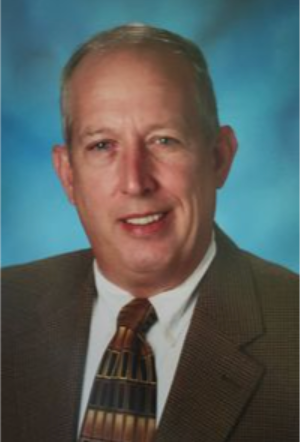
“The public policy areas I am most passionate about are student achievement, school safety, teacher retention, workforce development, and parental engagement. With nearly 30 years in education, I believe every student deserves a safe, orderly classroom led by an effective teacher. I support policies that strengthen discipline, empower educators, and improve accountability. I am also committed to expanding Career and Technical Education programs that provide industry certifications, apprenticeships, and pathways to high-demand careers. Parents are essential partners in education, and my goal is simple: put students first, support teachers, engage families, and prepare every graduate for a successful future.”
Click here to read the rest of Geiger’s responses.
Ward’s career experience includes working in business. Here’s how Ward answered the question, “What are the main points you want voters to remember about your goals for your time in office?

- “Support and retain great teachers and staff. We cannot build great schools without great people. That means competitive compensation, affordable benefits, better working conditions, and reducing unnecessary burdens that take teachers away from teaching.
- Less screens, more paper. Especially in the early grades, technology should support education, not replace books, handwriting, face to face instruction, critical thinking, and interaction with teachers.
- Give every student a path to success. Strong core academics must remain the foundation, while expanding CTE, certifications, apprenticeships, dual enrollment, and other pathways that prepare students for college, careers, or the workforce.”
Click here to read the rest of Ward’s responses.
As a reminder, if you're a school board candidate or incumbent running this year, click here to take the survey. If you complete the survey, your answers will appear in your Ballotpedia profile. Your responses will also appear in our sample ballot. If there is an election in your community, share the link with your candidates and urge them to take the survey!