


Welcome to the Friday, Sept. 4, 2026, Brew.
By: Briana Ryan
Here’s what’s in store for you as you start your day:
- Voters in seven states are deciding on 13 property tax measures this year
- New Mexico’s trifecta status will be decided in the Nov. 3 elections
- 161 statewide ballot measures have been certified this year — above the average in even-numbered years
Voters in seven states are deciding on 13 property tax measures this year
This year, voters in seven states will decide or have already decided on 13 statewide ballot measures regarding property taxes.
On May 16, Louisiana voters defeated Amendment 4, which would have allowed parishes to exempt business inventory from property taxes, 66.1% to 33.9%. The remaining 12 property tax measures will appear on the Nov. 3 ballot in Florida, Georgia, Louisiana, North Carolina, Oklahoma, Tennessee, and Wyoming. The 12 remaining measures cover the following policy areas:
- Four measures concern property tax exemptions for homeowners.
- Three measures concern property tax exemptions related to agriculture, business, and other nonresidential uses.
- Three measures concern property tax assessments.
- One measure concerns the authority or procedures local governments use to set or increase property tax rates.
- One measure concerns restrictions on imposing property taxes.
Between 2020 and 2025, voters decided on 58 property tax measures, approving 45 and defeating 13. Twenty-four of those measures dealt with property tax exemptions for homeowners.
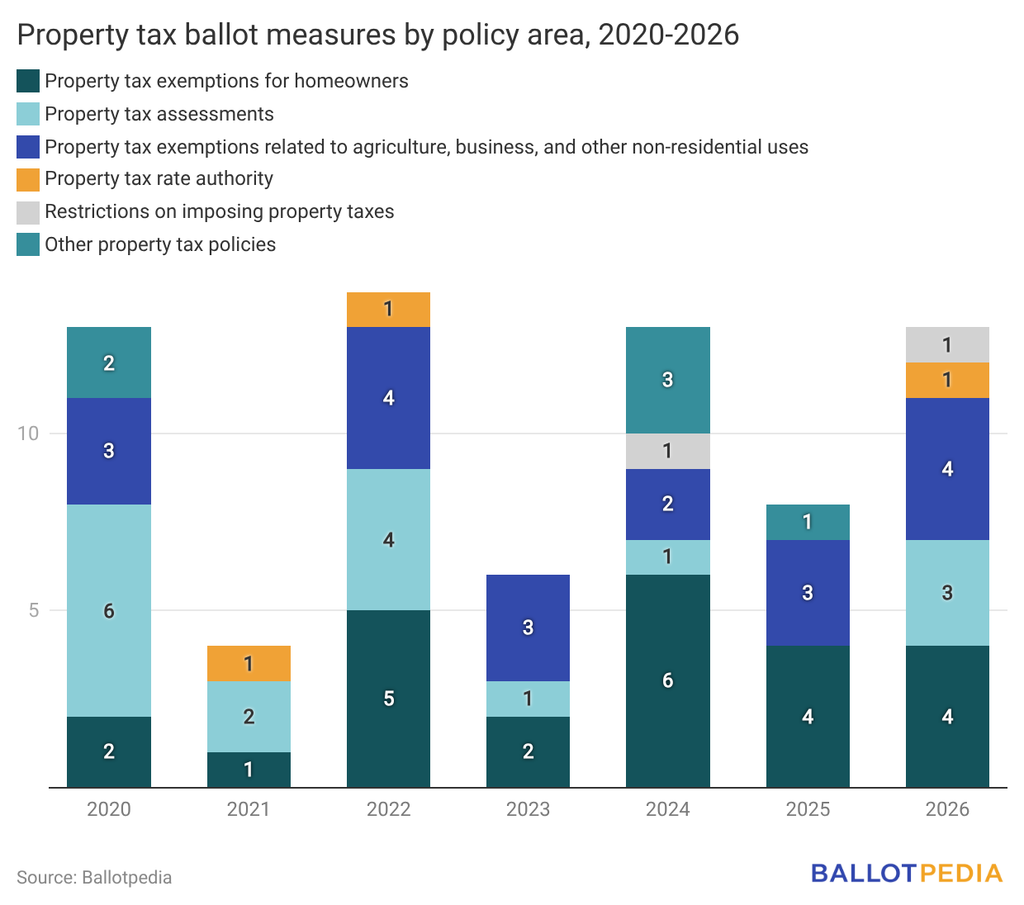
Voters in Florida and Louisiana will decide on multiple property tax measures this year.
Florida Amendment 3 would expand the non-school property tax exemption from $25,000 to $150,000 in 2027 and $250,000 in 2028, with the amount indexed to inflation starting in 2029. Another measure would exempt certain agricultural property from property taxes.
In addition to the already decided Amendment 4, Louisiana voters will decide five other property tax measures in November.
State legislatures put 12 of the 13 property tax measures on the ballot this year. The remaining measure in Wyoming, Initiative 1, qualified through the citizen initiative process. Initiative 1 would exempt 50% of the assessed value of a homeowner’s primary residence from property taxation.
The campaign supporting Amendment 2 in Tennessee has raised the most money among the 13 property tax measures this year. The measure would amend the state constitution to prohibit the Tennessee General Assembly from imposing a state property tax. Yes on 2, the campaign backing the amendment, had raised $109,500 through June 30.
Click here to read more about property tax statewide measures on the ballot this year.
New Mexico’s trifecta status will be decided in the Nov. 3 elections
Welcome to our next installment of our 50 States in 50 Days series, covering New Mexico. To view our archive of past editions, click here.
New Mexico’s trifecta status will be decided in the Nov. 3 elections. The state has an open governor’s race, and all 70 seats in the New Mexico House of Representatives are up for election. No seats in the New Mexico Senate are up for election.
Democrats have a 26-16 majority in the state Senate and a 42-26 majority with two vacancies in the state House. Because the governor is a Democrat, New Mexico is one of 16 states with a Democratic trifecta.
We identified New Mexico’s trifecta as somewhat exposed to breaking. Republicans would need to win at least 10 seats to gain control of the state House, and Democrats would not be able to lose more than six seats.
Want to see what's on your ballot this November? Click here to use our Sample Ballot Lookup Tool. Now let's take a closer look at what's happening in New Mexico.
Voters must register online or via mail by Oct. 6. Voters can also register in person through Nov. 3.
Early voting opens Oct. 6 and ends Oct. 31.
Polls open on Election Day at 7:00 a.m. and close at 7:00 p.m.
Voter ID is not required to vote in New Mexico in most cases. The federal Help America Vote Act requires that individuals in all 50 states who register to vote by mail and have not previously voted in a federal election in their state must provide either their driver's license or a paycheck, bank statement, current utility bill, or government document showing their name and address.
Absentee/mail-in ballots must be requested by Oct. 20 and returned by Nov. 3.
Current party control
Democrats represent all three congressional districts. Both of New Mexico's U.S. Senators are Democrats.
In addition to having a Democratic trifecta, New Mexico is one of 21 states with a Democratic triplex. That’s because the state’s governor, attorney general, and secretary of state are all Democrats. One judge on the New Mexico Supreme Court was elected in a partisan election as a Democrat, and Democratic governors appointed four judges.
Offices on the ballot
Elections are also taking place for the U.S. Senate and the U.S. House of Representatives.
There will also be elections for lieutenant governor, attorney general, secretary of state, auditor, commissioner of public lands, treasurer, and five seats on the public education commission. All 70 seats in the state House are up for election.
New Mexico is also one of 32 states this year where we are providing comprehensive election coverage down to the local level. This year’s ballot includes elections for judicial and county offices.
Notable elections
Public Lands Commissioner: Juan Sanchez III (D) and Michael Perry (R) are running in the open election. Since 2003, the party affiliations of the last four commissioners have alternated from Republican to Democrat to Republican to Democrat. In their Candidate Connection surveys, Sanchez and Perry both said that ensuring access to state trust lands for outdoor recreation was a priority.
2nd Congressional District: Incumbent Rep. Gabriel Vasquez (D) and Greg Cunningham (R) are running. This district is one of 23 that Democrats are defending this year that President Donald Trump (R) won in 2024. In 2024, Vasquez defeated Yvette Herrell 52.1% to 47.9%. In the 2024 presidential election, Trump defeated Kamala Harris (D) in the district 49.9% to 48.1%.
Statewide ballot measures
There are seven statewide measures on the ballot this year. From 2000 through 2024, New Mexico voters decided on 99 ballot measures, or eight per even-numbered year. During that period, voters approved 88 measures and defeated 11.
Here’s a closer look at four of the measures on the ballot:
The Eliminate Governor’s Pocket Veto and Require Veto Explanations Amendment would require bills to become law if the governor does not sign or veto them within the required timeframe, eliminating the governor's pocket veto. It would also require the governor to provide a substantive explanation for vetoes. Currently, New Mexico is one of 13 states that allow pocket vetoes, in which the governor's inaction on a bill within a specific timeline effectively vetoes it.
From 2006 through 2024, New Mexico voters decided on 35 bond issues totaling approximately $1.95 billion. Voters approved all but a $155.57 million bond for higher education in 2010. New Mexico voters will decide three bond measures:
- The Higher Education Improvements Bond Issue would authorize $230 million for capital improvements to higher education institutions.
- The Library Acquisition Bond Issue would authorize $20 million for public library acquisitions.
- The Senior Citizen Facilities Bond Issue would authorize $30 million for senior citizen facilities.
Tuesday, we'll preview elections in Ohio, the Buckeye State.
Click here to see every edition of 50 States in 50 Days as we publish them, and here to use our Sample Ballot Lookup Tool.
161 statewide ballot measures have been certified this year — above the average in even-numbered years
As of Sept. 1, 161 measures have been certified for statewide ballots — more than the historical average of 149 at this point in even-numbered years from 2014 through 2024. From 2014 through 2024, an average of 153 measures were certified in even-numbered years.
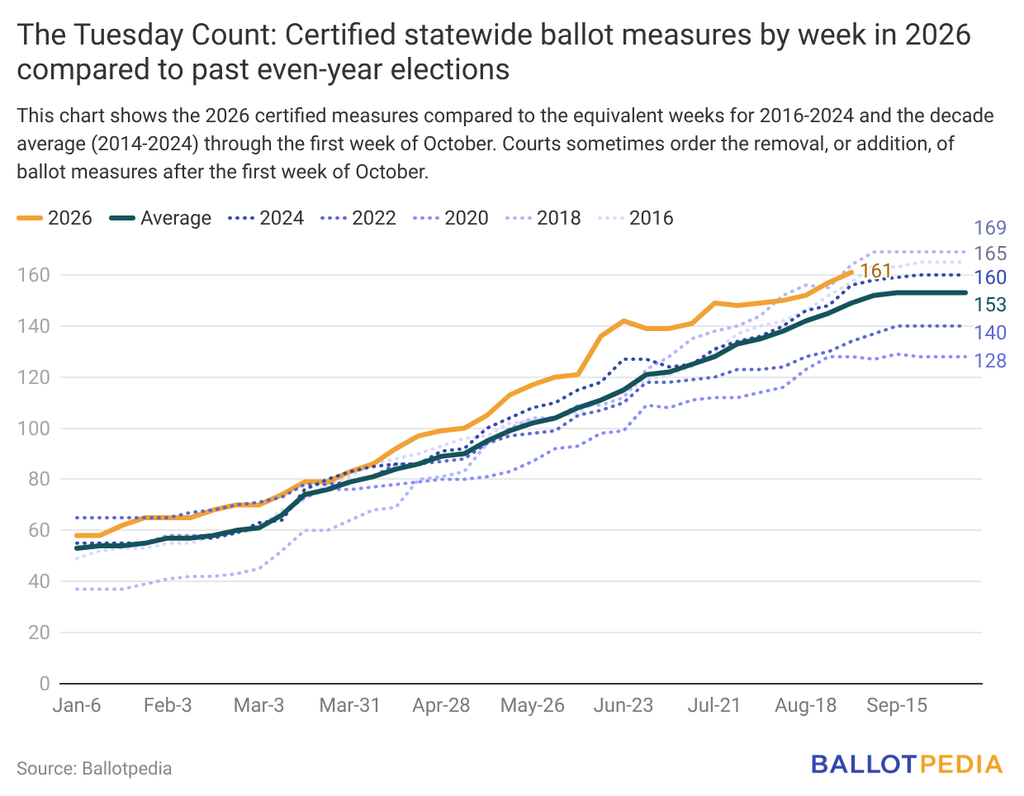
Over the past two weeks, 10 new measures were certified for the ballot:
- Colorado Establish 4.4% Cap on Individual and Corporate Income Tax Rates Initiative
- Colorado Establish a Graduated Income Tax Amendment
- Colorado Require Plain Language and Eighth-Grade Reading Level for Ballot Measures Initiative
- Colorado Require Commission and Supreme Court Approval for Mid-Decade Congressional Redistricting Initiative
- Colorado Require Voter Identification Number for Mail-In Ballots Initiative
- Colorado Retain Sporting Goods Sales Tax Revenue for Conservation and Wildfire Prevention Fund Initiative
- Colorado Right to Hunt and Fish Initiative
- Nebraska Allow Laws Authorizing Online Sports Wagering Constitutional Amendment
- Nebraska Allow and Regulate Online Sports Wagering Initiative
- Nebraska Sex Requirement for School and College Sports Initiative
One measure — the Colorado Require Vehicle-Related and Fuel Tax Revenue to Be Used for Road Transportation Initiative — was removed from the ballot after proponents withdrew it in exchange for a state commitment to provide up to $120 million in additional funding for road repairs.
The Michigan Legislature has until Sept. 4 to enact one indirect initiative — the Michigan Utility and Government Contractor Campaign Finance Regulations Initiative. The Michigan House of Representatives approved the initiative on Aug. 25, but the Michigan Senate did not. If both chambers do not approve it before the deadline, it will appear on the Nov. 3 ballot.
State officials rejected four initiatives after determining they did not meet the signature requirement or for other reasons. Proponents are challenging those decisions in court.
- Michigan Citizenship Verification and Voter Identification Initiative
- Missouri Congressional Map Referendum
- Missouri Initiative and Referendum Powers and Legislative Change Requirements Amendment
- Nebraska Require a Four-Fifths Vote for Legislative Ballot Initiative Changes Amendment
No citizen initiatives are pending signature verification, and no additional initiatives are eligible to submit signatures for this year’s ballot.
Click here for more information about the measures on statewide ballots this year.